Growing old-er...aren't we all?

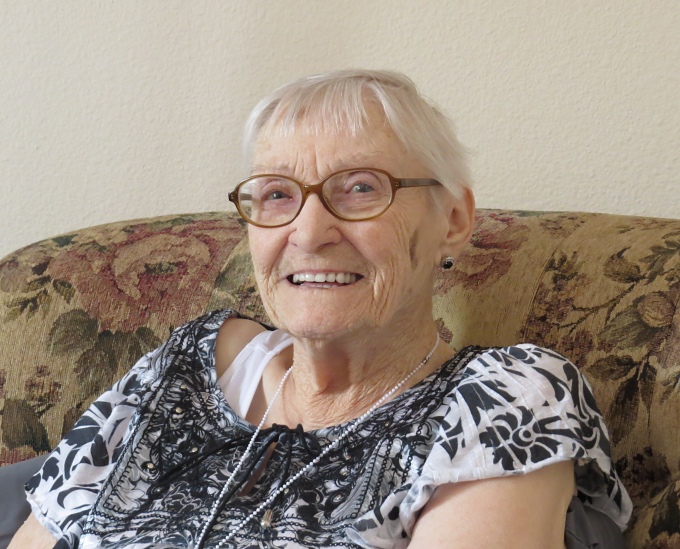
One of the first things we did when we arrived in Las Vegas last January was to visit David's mum. She's 98 years old, lives in a pleasant, assisted living complex and remains very, very independent. She's got it all together and has a wonderful sense of humor. I wonder how I'll be doing at age 98 … if I'm still around. Though her age amazes me, it's really her attitude that astounds. She's feisty, persistent and strong, but in the nicest possible way. Everyone loves her. She recently began teaching an art class to other folks where she lives. She was elected Vice President of the Residents' Committee and has all sorts of ideas that she's hoping to implement that will allow residents more control of their lives … everything from menus to meal hours to entertainment.
new home smile

What brought up this topic is that we've recently noticed that some people tend to treat us differently than in the past. I look in the mirror and, yeah, there are always a few more lines and wrinkles. If it weren't for Miss Clairol, I'd be gray. Gravity has taken its toll on my body … some parts sag instead of being perky. David looks the same to me as he did 30+ years ago, although I guess his hair is white now and a bit sparse on top. But still I wonder exactly when we started looking like we were feeble and stupid? How come some folks insist on calling us “hon” and “sweetie”? I really hate that familiarity from strangers. It should be reserved for family and children. Did we treat older people this way when we were younger? Did we automatically assume that anyone over age 60 was senile and incapable of intelligent thought or decisions or providing sound advice from years of experience?

Living full-time with my mum a couple of years ago was a real eye opener. She struggled to maintain her independence in subtle ways and I failed to recognize it. I thought it was sheer stubbornness (that seems to run in the family). She knew she couldn't drive, but refused to sell her car. She preferred to do things herself although it took her forever. She'd chastise me when I automatically helped her without being asked. “I can do this myself!”, she'd shout. She insisted that she manage her own finances although she frequently made errors or forgot to pay bills. She decided which clothes she'd wear even if I thought they were unsuitable for the occasion (and trust me, sometime they were). No matter, she was scrappy and spunky to the very end.

As David and I grow older, I hope we are able to maintain our independence and personal dignity as Rebecca has. We don't want someone else making all our decisions for us. We certainly don't want to be dependent on others. If we live long enough, our bodies will fail us to a certain extent and that we must accept. Yes, we'll need help with day-to-day stuff perhaps, but I hope we can maintain our sense of humor and adventure and our desire to learn.

We were listening to the local cruisers' radio net the other morning. It's quite an active community here and the local cruisers all listen at 0800. Cruisers take turns being the controller (aka host). The net provides weather forecasts, news of interest, local happenings and activities, "treasures of the bilge", etc. Anyhow, one fellow got on the radio and asked if anyone could help him move his dinghy. David offered to help and we walked down to his boat, Jolly Friends, after the net to see what he needed.
older_Vern coming own stairs

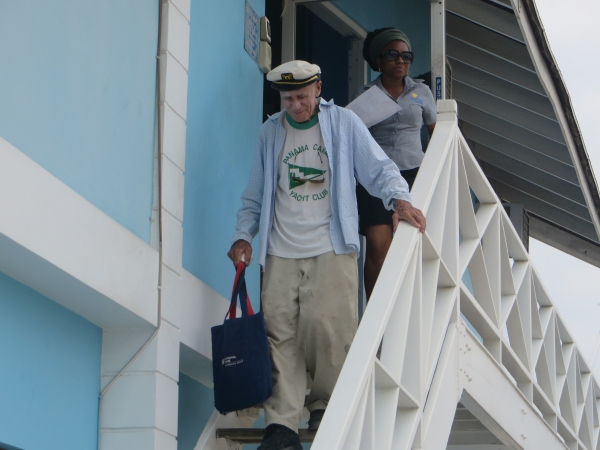
Down the ladder came a fellow who was obviously a few years older than we are. He looked a bit frail and weathered, but maneuvered the ladder quite well. Vern, we found out, is 91! He lives on his boat and still sails. He has a younger fellow aboard, Ken (in his 40s), who helps him out sometime. He thinks it's the sailing and staying active that accounts for his longevity. “If I sat at home and watched television like some of my friends, I'd be dead in a month!”

vern and ken

Not sure what it is, but Vern is an inspiration to us all. He proves that there's hope for us sexagenerians. We've got at least another 25 years left to sail. Whoopee!

Watch out you young whippersnappers, we're sticking around. And don't call me hon!

Anti-fouling Our Big-bottomed Girl

I never appreciate how big Nine of Cups is until I start painting her bottom. With a modified full keel, our 45' (14m) girl has a big, big bottom … a lot of area to cover with anti-fouling paint. Painting the bottom has become my job … mostly because it seems I do little else aboard plus I can't screw it up very much. It's pretty mindless work … right up my alley. We typically haul-out every 12-18 months. Our last haul-out was in Mandurah, Australia in May 2014, so we're overdue. Before that, it was Kettering, Tasmania in November 2012 … only proving the point that cruising is doing boat work in exotic places. That said, we were surprised and pleased by the condition of Cups' hull when we hauled out this time. After a pressure-washing, the hull was pretty clean and still looked blue which means our last bottom job lasted quite a long time.

haul out in trinidad


There are several reasons to anti-foul Cups on a regular basis. The paint retards the growth of organisms on the hull. Growth on the hull and prop reduces speed and also may transport harmful marine life from one area to another, infecting new areas with marine pests such as mud snails and fanworms. We've seen first hand how quickly these pests can propagate and take over.

fanworms

We tend to use whatever anti-fouling paint is locally available. Even inexpensive antifouling paint is expensive. We expect to pay ~US$1000 for 15-20 liters … enough for 2-3 coats. Estimating the amount of antifouling paint you need is relatively easy. There are all sorts of formulae on line. Sometimes the 20-liter (5 gallon) bucket is cheaper and we opt for it. This time we chose Jotun, a Spanish product. Jotun describes it as “a one component acrylic, hydrolysing antifouling coating based on ion exchange technology .” There you have it … all you need to know. In English, basically, it's very toxic stuff, using copper-based additives as a biocide.

5 gallon bucket of jotun

The prepping is not difficult. David usually wet sands the waterline areas and I lightly sand other areas that require it and which can be reached without using the scaffolding (it's a height thing!). The hull is rinsed with fresh water and allowed to dry thoroughly overnight. The waterline is masked so we don't slop over onto the topsides.

masking

We alternate bottom paint colors between blue and black, sometimes red. We tried green once … it was a mistake. I'm applying dark red this time around, mostly because that's what was available. The purpose of alternating colors is to 1) be able to see where you've painted and more importantly 2) once she's in the water, to see where the paint is wearing off. If we can see lots of blue under red, we know it's definitely time for another anti-fouling job. We use ablative or self-polishing paint which means the paint sloughs off over time due to interaction with the water. When it sloughs, the algae, barnacles and sea critters hopefully slough off with it or do not adhere to it in the first place because of the biocides in the paint. A tie-coat was recommended which helps the new paint adhere to the old and I applied that first.

grey over blue

I wear a protective suit, gloves and a respirator to apply it. It is not a becoming look … think Pillsbury Dough Boy in baby blue. Painting the large, open areas of the hull is quick and easy. I use a roller and it goes pretty quickly. It's the tight areas around the prop and the very bottom of the keel that are more challenging only because you have to scrunch down and use a brush to get at them. I learned the hard way that without a respirator, the fumes can just about knock you out.

painting attire

The whole job is usually accomplished in two days. This time, however, it stretched to three days. The heat is fatiguing and I took breaks every hour or so to cool down and drink water. The tie coat was applied in the morning. After a 2-hour dry time wait, I applied the first coat of red anti-fouling.

first coat almost done

David joined me in order to get as much done as possible, but the two coats was all we could manage. On Day 2, we applied the second coat of red early in the morning. It requires a 6-hour dry time and then the afternoon showers began. On Day 3, the boat stands were moved so we could paint the unpainted areas under the stand pads and applied a third and final coat. Typically whatever paint is left over is applied to the leading edges until all the paint is used up. We called it a good job done, said hallelujah and disposed of all the used supplies. Cups was ready to go back into the water.

removing boat stands

Since the bottom paint is always one of the very last jobs to do on the boat, I love looking at Nine of Cups when the job is finished. She looks all clean and shiny and ready to go … until next year!

cups looking fine

Annual Ditch Bag/ Safety Inspection

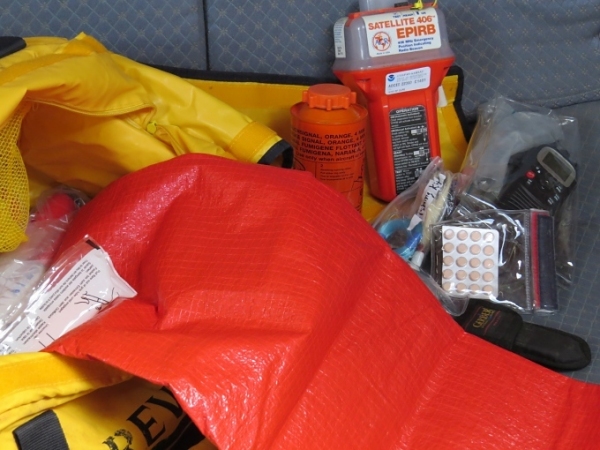
I've heard them referred to as ditch bags, overboard bags, abandon-ship bags and grab bags. Whatever you call them, it's that time of year again. Annually, it's my job to complete the ditch bag/safety equipment inspections aboard Nine of Cups. I've blogged about this in the past, but I thought it might be a good reminder if you haven't done it in awhile that this might be a good time to consider doing it. It's one of those things that tends to slip your mind unless you have it on your calendar or pre-passage checklist. ditch bag contents

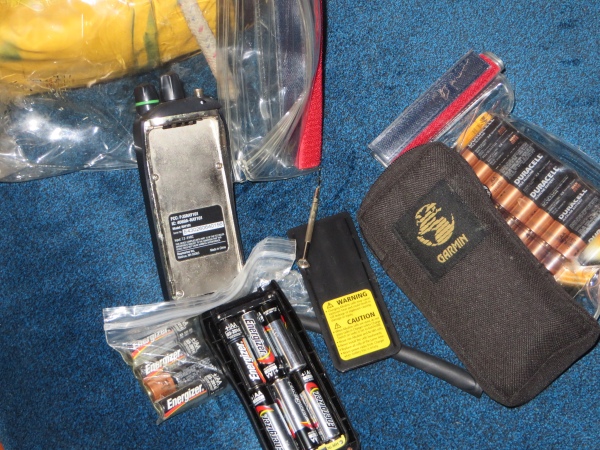
I have a checklist I use and just work methodically down the list. I update it from time to time as we add or delete items from the list. Some checks are easy and take less than a minute … test the EPIRB and check that the decal is current, for instance. Some items, like making sure the spare GPS and VHF are operative, take a little longer since they're stored without batteries. Then there are others that are time-consuming like making sure the manual watermaker works and then re-pickling it. Nonetheless, since our lives might depend upon each and every one of these invaluable items, we inspect them yearly, hoping we'll never have to use them.

This year there were a number of things that needed updating. David got a new passport and our boat docs were renewed. I replaced the old docs with the new and also replaced the US$100 cash we borrowed when heading home to Las Vegas last time. There were several out of date AA batteries and I replaced those with some we'd brought back with us from the States. We must have borrowed and not returned the little screwdriver we pack with the VHF and GPS because it was nowhere to be found. I replaced it with a spare one from the tool drawer (probably the same one that was originally in the ditch bag).

gps and vhf

Once the ditch bag inspection was complete and the contents repacked and stowed, I made notes for myself for next year's inspection. More batteries will need changing out next year as will some of the flares. Several of the meds are near their expiration dates, too. I moved on to the safety inspection.

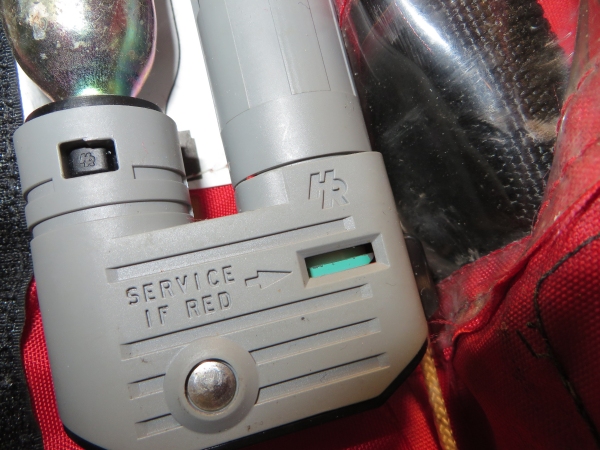
Our inflatable PFDs are in good shape … both canisters showed green and the strobe lights and whistles work.

green light on pfd

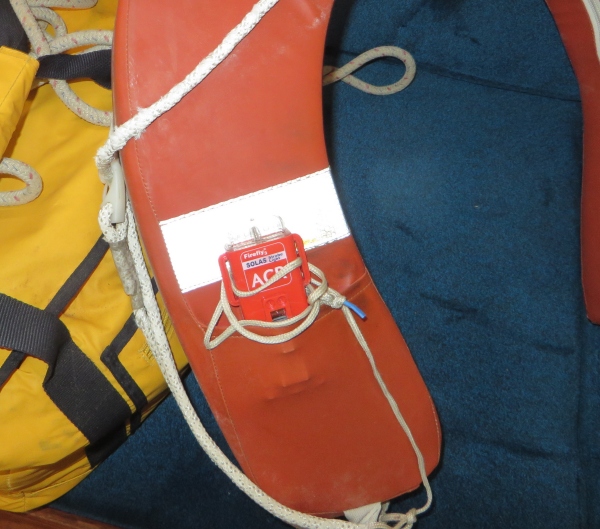
We added a new strobe light to the horseshoe just recently.

horseshoe strobe

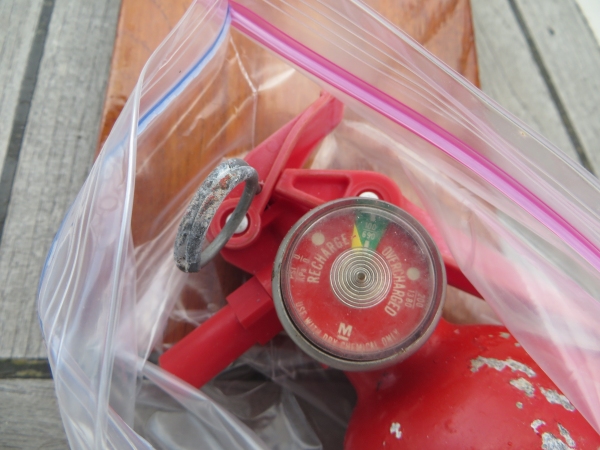
The fire extinguishers (all five of them) were fine except for the one in the cockpit which needed replacing. The others just needed their annual dusting off.

replace cockpit fire extinguisher

We have two EPIRBs aboard, one in the ditch bag (an older one) and one in a holder by the cockpit ladder, ready to grab in an emergency. I tested it, confirmed we'd put the new decal on it and rechecked the date for battery expiration.

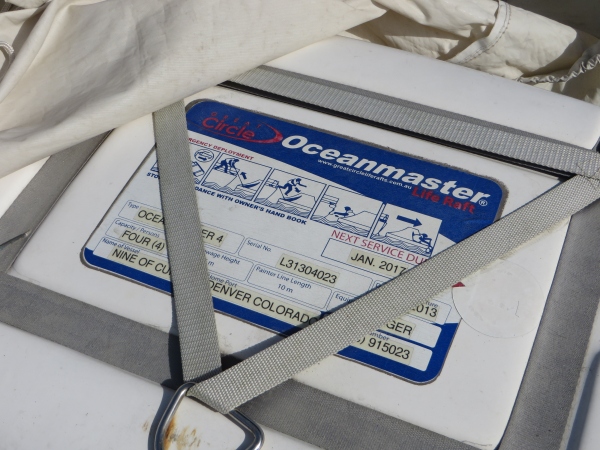
Last, but certainly not least, I took a good look at our Great Circle life raft. It's mounted on the coach roof in a sealed canister, so there's not much to see. I noted, however, that it's due for its 3-year inspection in January 2017, so I put that on my calendar as a reminder.

liferaft reminder date

The entire check took about an hour … well-spent time for safety and peace of mind.

We have an updated checklist available. If you'd like a copy, just drop an email to Gentry and she'll e-mail it to you.