Culebra to St. Augustine - Days 4-6

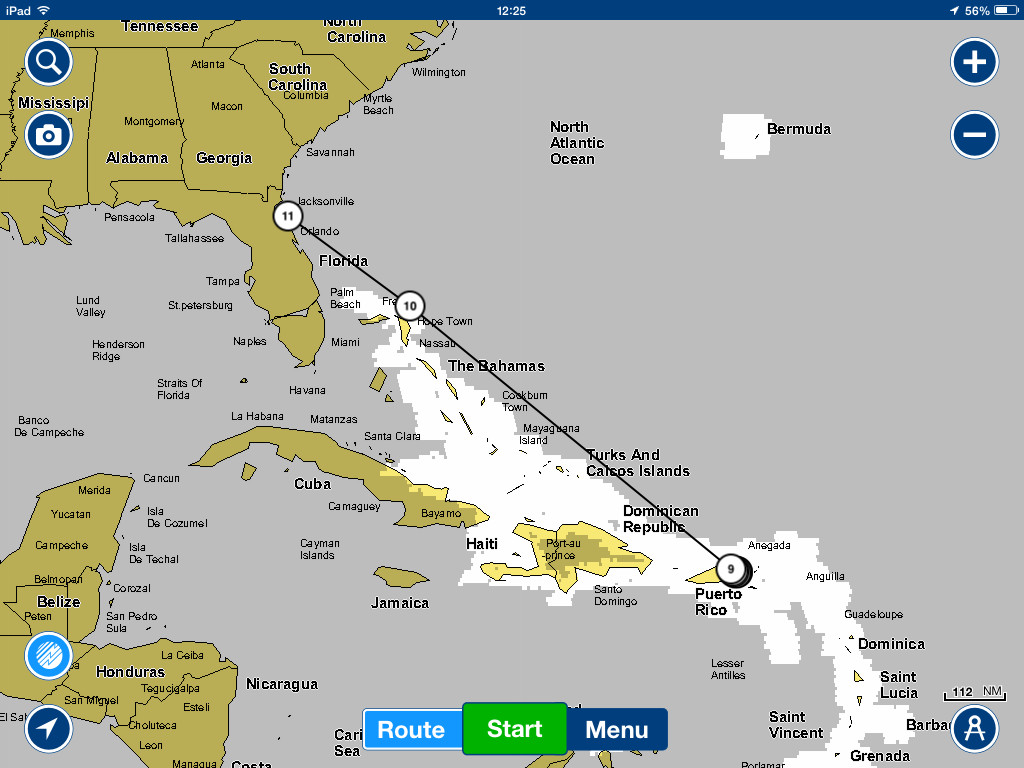
san juan to st. augustine route map Day 4 -  675 nm to go

Another gorgeous day in paradise. The change in winds has been delayed, it seems, and the E/SE winds along with that half knot current, continue to move us along smartly.  The current is a faint vestige of the North Equatorial Current that snakes its way along the northeast side of the island chain and eventually joins forces with the mighty Gulf Stream. We've seen nary a nasty cloud nor a raindrop since we left Culebra and we wonder when our wonderful weather bubble will burst. Maybe tomorrow.

It was a rather momentous day. Around dinner time, we marked 1000 miles sailed since leaving Trinidad. With no oceans to cross, it's harder to get higher mileage. We keep bumping into land and stopping. Around 2200, we crossed the Tropic of Cancer (~23.5N) and officially exited the tropics. I slept through it (my off-watch) and woke to find I needed a fleece and blanket. Actually, the early morning hours between midnight and 0600 seem to be quite cool and we enjoy needing a long-sleeved shirt or light blanket for a change after the recent sweaty, humid temps of the tropics.

Typically, there's a ring of thick clouds on the horizon that encircles us each morning with a clear blue sky above, like the tonsure of good friar's head. The waves have increased in size to 6-10' (2-3m) and we can feel their push as they pass under us. I sometimes contemplate the amount of water volume and force necessary to sweep 20-ton Cups along like a twig in a fast-flowing river. It's the same feel as body-surfing a big wave at the beach when it surrounds you, picks you  up and carries to shore with a gush.

Being in the Bermuda Triangle has conjured up all sorts of images in my mind. I half expect to see a huge, long, suckered tentacle reach out of the sea on my night watch and wrap itself around Cups and drag us down to the depths. I've obviously been reading too much BT lore which I realize has “mostly” been proven to be exaggerated and downright wrong. Still … we've seen very few birds and no dolphins or whales. Maybe they know something we don't?

Day 5 – 534 nm to go

The winds diminished and changed direction to <10 knots from the south between 0300-0600 and we slowed down considerably. It was still a pleasant ride, but we were noticeably off our course line. The wind god finally ran out of wind altogether late in the afternoon as predicted. When we fell below 2 kts/hr, we reluctantly cranked on the engine, knowing if the forecast was right, it would be on for the next 24 hours.

By the change of the 2100 watch, the south wind was unexpectedly, but thankfully, back. It wasn't much, but enough to sail along at 4 knots on a broad reach. It prevailed all through the night, long enough for David to pick up the revised weather forecast which showed exactly what we'd been seeing. Thank you, Neptune.

We've been making plans for the rest of 2016, as well as contemplating short-term projects on Cups. The trim around the portlights in the saloon and aft cabin all need re-varnishing. In preparation, I removed all the window coverings, rods and hardware and have decided all the “drapes”need to be replaced. If the good weather continues, we might get the portlights sanded and prepped before our arrival in St. Augustine, allowing us a headstart on getting the project completed before heading further north. The usual number of things are breaking, i.e. the manual foot pump for the fresh water isn't working and needs either repair or replacement. David also thinks it's time to replace all the water hoses for the watermaker. He's still pondering the refrigeration issue and tinkers with it daily. Always, always, always a list!

Day 6 – 418nm to go

It was a slow, slow day, but we were still sailing. We saluted Gentry, our web mistress, as we sailed by Gentry Bank off the Turks and Caicos.  As we passed by the Bahamian islands, we reminisced about the time spent there more than a decade ago … Mayaguana, Rum Cay, San Salvador, Eleuthera, the Abacos ... so many little islands, so many memories. Imagine how Columbus and crew must have felt when they arrived in this paradise.

The days are noticeably longer. Dawn's first light is around 0530 and the residue of sunset is still on the horizon at 2000. There's much to be said for heading north as summer approaches. The wind left us again just after noon and in a huff. A bit of a gust was followed by a drenching shower, the first rain we've seen since leaving Culebra. The downpour cleaned the dust and dirt off the decks and the cockpit looked refreshed. The rain seemed to wash all the color from the day. The blue, sunny sky we've grown accustomed to was sapped of its brilliance, replaced by a washed-out blue-grey, overcast sky that merged with the horizon and the now drab waters of the Atlantic. We expected more showers, but they never came.

Once our speed dropped below 2 knots, we cranked on the engine again. The seas were flat and calm with nary a wind ripple to disturb them. The wind indicator showed 0 wind speed … we were smack dab in the middle of a high pressure.

We've been reading Mark Twain's “Innocents Abroad” … it's a free download on Gutenberg.

If you've read  Paul Theroux's curmudgeon-y travel books and enjoy his caustic humor, you might enjoy this Twain classic. Talk about an “ugly American”, Twain's flowery prose mixes with acerbic wit as he travels with fellow Americans in the late 19th century through Europe, northern Africa and the Holy Land.  David finished it before I did. I refer to it as “Innocents Asleep” and trudge through  a chapter just before it's time for me to go off-watch. Robert B. Parker's Spenser series has kept me awake during the midnight-0300 watch.

Affiliate links added for your convenience.

11 Interesting Facts About the Bermuda Triangle

We'll be entering the Bermuda Triangle soon, on our way north to the USA. Just Google “Bermuda Triangle” and you get over 3 million hits. I had to research carefully, because if we believed all the fantastic stories written about occurrences in this area, we'd never sail there. Here are some interesting facts to ponder: bermuda triangle

1. The exact size of the Bermuda Triangle depends on your source. The smallest area ever defined is at least 500,000 square miles. Some sources day it is as large as 1.5 million square miles.

route through the bermuda triangle

2. The Bermuda Triangle is roughly defined by an imaginary triangle that connects Miami, Florida to Bermuda and San Juan, Puerto Rico. This area is also known as “The Devil's Triangle” or “The Hoodoo Sea."

3. Christopher Columbus is thought to be the first European to sail through the area known as the Bermuda Triangle on his first voyage to the New World. He reported that a great flame of fire (probably a meteor) crashed into the sea one night and that a strange light appeared in the distance a few weeks later. He also wrote about erratic compass readings.

4. The first mention of unusual incidents within the area was in 1894. A US Navy officer, S. D. Sigsbee, concluded a 7-year study in which he noted that 1,628 derelict vessels had been found within the area that is now called the Bermuda Triangle.

5. Vincent Gaddis, an American author, coined the phrase “Bermuda Triangle” in a February 1964 Argosy magazine cover piece. The Argosy was the first American pulp magazine published 1882-1978.

argosy 1064 cover

6. Some scholars claim that William Shakespeare’s play, The Tempest, was based on a real-life Bermuda Triangle shipwreck.

7. The Bermuda Triangle was a best-selling 1974 book by Charles Berlitz which popularized the belief of the Bermuda Triangle as an area of ocean prone to disappearing ships and airplanes. The book sold nearly 20 million copies in 30 languages, but is now out of print.

8. Unexplained events within the Bermuda Triangle have been attributed to: UFOs, leftover technology from the mythical city of Atlantis, underwater pyramids, sea monsters, methane bubbles and mud volcanoes, giant whirlpools and blue holes, electronic fog, compass deviation, violent weather (including sudden squalls, downdrafts, hurricanes and waterspouts), the Gulf Stream, giant rogue waves and human error … and probably a few more that I've missed.

bermuda triangle monster squid

9. Steven Spielberg played upon the UFO theory in Close Encounters of the Third Kind when the planes of the missing WWII Flight 19 were discovered in the desert and the missing crew was returned on the alien spacecraft.

10. Lloyds of London, a major insurer of ships and boats, does not charge any extra premium for vessels plying the waters of the Bermuda Triangle. If the insurers don't charge more, they obviously don't think it's a risk. In actuality, considering the amount of ocean-going traffic in the area, the incidence of losses in the waters of the Bermuda Triangle are no worse than any other place.

11. The Bermuda Triangle was one of the places on Earth where true north and magnetic north line up and this was sometimes considered a cause for miscalculation on the part of sailors when sailing through the BT. This is no longer true, however, because as the Earth's electromagnetic field has changed, magnetic north has shifted. The agonic line, the point at which true north and magnetic north are the same, is now somewhere in the Gulf of Mexico.

agonic line changes

Want to test your knowledge of the infamous Bermuda Triangle. Take this quiz.

Culebra to St. Augustine - Days 1-3

Day 1 -  1130 nm to go Once again, it was a flurry of activity as we prepared to up-anchor and head out from Culebra to St Augustine. We woke with the dawn, checked the weather again, and after a cuppa and a few more checks, we were off across Ensenada Honda on an overcast morning and heading back into the Caribbean Sea. We'd rigged the pole and removed the sail cover last night to save ourselves from too much morning activity. 1130 nm to go … the first day out, it always seems that the distance is so long, but experience tells us, it goes by quickly. The days at sea seem to blend as we adjust to the passage and before you know it, we'll be sailing into the St. Augustine Inlet and under the Bridge of Lions. In the meantime …

The overcast skies soon burned off, replaced by warm sunshine and big, puffy, linen-white clouds lazing their way through a baby-blue sky. The weather forecast was calling for more of the same for five days out.

If you want to appreciate how wonderful sailing can be, you should have joined us today. Long period, 3-4'(1m) seas, a constant 12-18 knot wind and we were broad-reaching and downwind sailing. There's not much heel. The sails are full out – wing on wing. It's deliciously warm with enough breeze through the cockpit to be totally comfortable. It was an “oh-my – aren't-we-the-luckiest people on earth!” kind of day. The stuff sailing dreams are made of. Fish jumped; noddies, gulls and frigates soared overhead. We cruised along in the low to mid-6s, like the lazy clouds above.

A thought about Puerto Rico. It has all the amenities of the USA … US phones, ATMs, it's reasonably safe and secure, access to all American goods and supplies … but it's distinctly and delightfully a true Spanish culture in a warm, tropical environment. Looking for a place to escape (but not really, totally escape)? Puerto Rico's the place to visit.

san juan to st. augustine route map


Day 2  -  968 nm to go

Once past the islands, islets and outlying reefs, we set a NW course (315M) which would take us all the way to St. Augustine Inlet, skirting to the north of the Dominican Republic, the Turks and Caicos and the Bahamas.

Our first night out was a restless one as usual, trying to get into a sleep pattern of  3 on/3 off. We're tired, but unable to sleep on our off-watch, then sleepy during on-watch.  It all passes quickly and we'll be in the swing of things in another day. On a very positive note, no one aboard has been the least bit seasick thanks to benign weather and seas.

Several ships passed during the night, our trusty AIS alerting us to their presence, but none passed closer than 3-4 miles away. The night offered the same constant trade winds from the S/SE and we made good mileage .We're already less than a 1,000 miles to go. At this rate, we should arrive in about a week.

We're traveling with a buttery yellow, waxing moon as our companion. She lights up the sky till about 0200, dousing the brilliance of the stars surrounding her. No matter, I prefer moon glow.

The day was lovely and primarily spent reading and writing. There's limited chatting since one of us always seems to be napping. By tomorrow, it'll be all good and we'll be on a sched again.

Day 3-  826 nm to go

Another good mileage day under ideal sailing conditions. Neptune is looking out for us, for sure. A favorable half knot current and a gentle following sea have definitely helped our cause. The moon continues to wax and outshine the stars ... except for Venus, her constant companion, who seems to maintain her star-glow in spite of her sidekick's brilliance.

Though there are not many ships (3-4 a night), we see lots of jet contrails during the day. As I watch them, I wonder where the people aboard are heading and why. On vacation to the islands maybe? I wonder if the passengers can look down and see the tiny dot of a boat floating in the endless, surrounding seas and are wondering the same about us. Come to think of it, from 40,000' (12,000+m) up, I doubt we are even noticeable.

According to the charts, the depths here are deep, deep, deep – over 26,000' (8,500+m) and we wonder about the terrain below us and the mountain tops that form the Turks & Caicos and the Bahamas, only 60-70 nm south of us. What critters lurk down there?

A big high pressure system prevails, providing us with the fine weather. The GRIBS and Buoy Weather, however, agree that we'll be windless soon. Sigh! We'll be here adrift in the midst of the great, mysterious Bermuda Triangle.

Ah, yes, we are well into the infamous Bermuda Triangle now and are constantly on the lookout for sudden squalls, not to mention Kraken and other great sea monsters, methane bubbles, waterspouts and especially aliens. So far, so good.