Intracoastal Waterway - Day 10

Still  206 nm to go- that's what happens when you don't move! I never thought I'd say this after the heat of the last few months but … BRRRR! With the strong northerlies came a significant drop in temperature and it's been downright chilly. This morning we rose to 64F/18C, 93% humidity. The winds had calmed during the night, but there was still a brisk 15+ knot winds blowing. Despite the sun, in the cockpit as the wind whistled through, it was cold and raw. I dug out long-sleeved shirts to keep us warm, but we just couldn't face long pants or shoes. Even though it was cool, the high humidity kept everything dewy and sticky. We had to squeegee the windscreen so we could see through it. No defrosters or windshield wipers on the boat!

As we departed Swansboro, we passed local shrimp boats tied up at the dock and weathered houses along the shore … very scenic and maritime-esque.

IMG_0019

We had planned this as a very short day ... for two reasons. First, planning evening anchorages for the next couples of legs was difficult. There weren't many anchorages that would accommodate our 7'2” draft (2.1m), so we chose a closer anchorage for tonight and two anchorages further up the ICW that were about 60 nm apart. The second reason for the short day?  As you know, we are lazy sailors and we can easily rationalize short days. Enough said. Unfortunately, though it was a short day, we still left before 0600 in order to time the rising tide for passing shoal areas.

We headed up the ICW, under the Emerald Isle Bridge and across the wide, flat expanse of the Bogue Sound. The wind whipped up the waves and there were whitecaps until we reached the relative shelter of Morehead City. We smelled wood and sawdust as the huge bulk container vessels unloaded their wood pulp into the waiting barges.

intracoastal waterway

As we turned the corner at the end of the commercial docks, we were exposed to the Morehead City Inlet. The current was in direct conflict with the wind and the waters roiled. We passed through the open, bascule Carolina Coastal Railroad Bridge and then immediately under the fixed Morehead City-Newport River Bridge. Eddies and whirlpools pulled and pushed the boat as it glided through.

intracoastal waterway

Just up the way, we spotted Chimney Island, which by the way, is for sale. Though I'm not sure of its history, its name is obvious.

intracoastal waterway

By mid-morning, it was warming up and comfortable again and we were ready to anchor. Newport Marshes is a tiny little spot just off the ICW that can accommodate about one boat the size of Nine of Cups. We found a fine little 15' pocket, dropped the hook and settled in for the rest of the day and night.

By the light of the full moon, everything looks beautiful.

full moon on the intracoastal waterway

Some new ICW info … We picked up a new navigation app by Navimatics called Charts and Tides, as recommended by Bob423 (aka Bob Sherer), a frequent and trusted contributor to Active Captain. This app overlays the Active Captain info on NOAA charts and it's pretty slick. It has lots of nifty features that we haven't even discovered yet. Though we're still learning about it, so far it's terrific. It's not just for the ICW, however, it also includes charts for the entire USA including Alaska, Hawaii and the US Caribbean islands. We're impressed!
Intracoastal Waterway - Day 9

Stuck in Swansboro

Day 9 – 206 nm to go

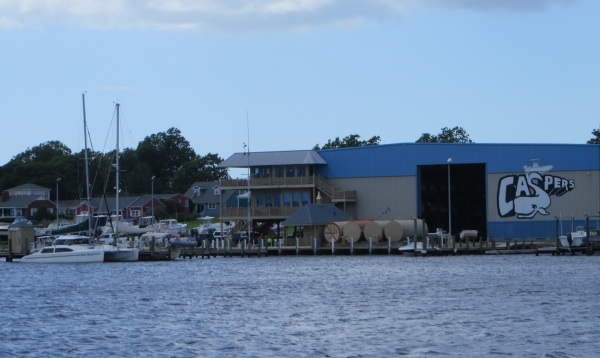
With a forecast of gale force winds offshore and high winds and rainy weather inland, we decided we'd take a day off and stay put in our pleasant little anchorage just off Swansboro Village. Launching the dinghy would have been akin to flying a kite, so we happily stayed aboard for the day. Thanks to nearby Caspers Marina, we enjoyed free wifi all day. Though we didn't get into the village at all, we think it's probably a hopping place as the music went on both nights we were anchored here till well into the wee hours of the morning.

caspers marina on the intracoastal waterway

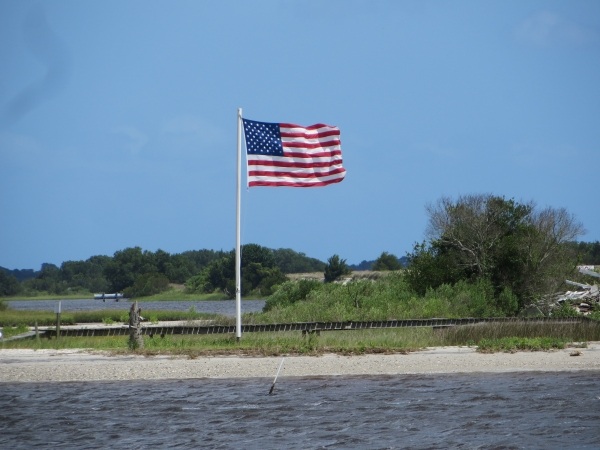
As it turned out, the day was sunny, but blustery. Not a drop of rain fell, but the wind howled. With good internet, we spent the day writing, catching up on articles and blogs, photo editing, doing some minor chores and just hanging out. It's quite pleasant to just “be” in a place some days with no agenda.

wind blown flag on the intracoastal waterway

This is probably a good day to talk about what we've learned … and re-learned/remembered … while traveling on the  ICW. Granted, our previous experience on the ICW has been extremely limited, but usual navigation skills and rules of the road apply, as well as boating etiquette. It's just that when we're at sea, we don't have the opportunity to use some of these skills much, so this has been a welcome refresher course for us.

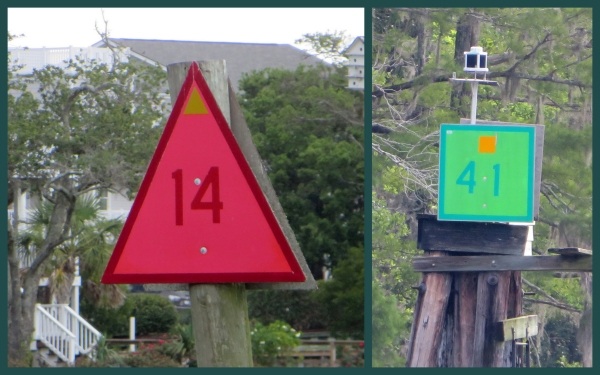
Something new we learned … all ICW navigation markers are marked with a either a yellow rectangle (for green markers) or a yellow triangle (for red markers), so at a waterway intersection, sailors always know which direction the ICW is going. Clever, huh?

markers along the intracoastal waterway

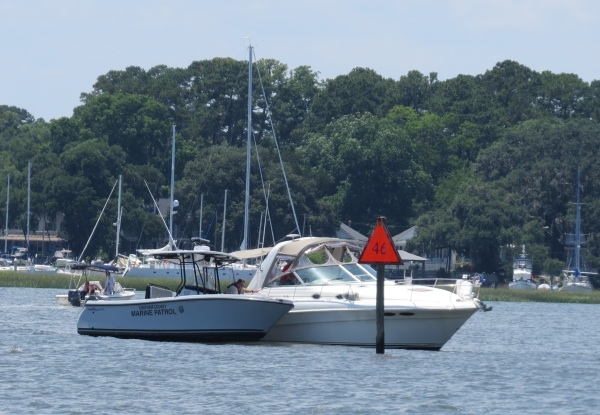
Something we remembered … there are still lots of courteous cruisers out there. Larger motor vessels will hail their intentions to pass us and give us a “slow pass” to minimize their wake as they're going by. If motor vessels are going too fast, especially in no-wake zones in towns, the local marine police stop and ticket them.

marine police on the intracoastal waterway

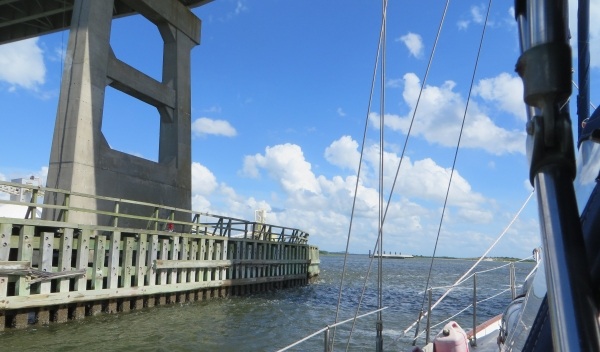
Something we're remembering/relearning … the timing for negotiating transit through opening bridges. We don't pass under or through bridges very frequently on ocean passages. How long does it take the bridge keeper to stop traffic, ring his bell and siren and activate the bridge opening. And then, just how long does it take the bascule leaves to raise or the swing bridge to swing? How does passing under a fixed bridge affect the control of the boat? There is usually a loss of wind, then a gust on the other side and then there's the current and numerous little eddies to contend with. We were a bit rusty, but with  ~70 bridges to transit during this passage, we got it figured out once again. Bridge tenders, by the way, have been courteous, friendly and efficient which has been most appreciated.

a bridge on the intracoastal waterway

Something we forgot … when out of the USA, we rarely have help with lines or docking and tipping is not the usual protocol, nor expected ... even in restaurants. So to the young man at Osprey Marina who was so helpful and accommodating … we didn't mean to stiff you on your tip, we really did forget.

Something I noted … taking pictures from a moving boat is pretty tricky. Taking pictures of moving things from a moving boat … pretty marginal results. That's my story and I'm sticking to it.

Intracoastal Waterway - Day 8

Day 8 – 274 nm to go Today was one of the more challenging days on the ICW. The lengthening days have been working to our advantage. We're up at 0515 and anchor up by 0545. We witness spectacular sunrise after sunrise. The rising tide gave us a good push this morning up the Cape Fear River. All was calm and we were on our way. Despite the shining sun, a long, compact, cigar-shaped roll cloud came into view in front of us, reminiscent of the roll cloud we experienced for the first time in the Great Australian Bight. Within seconds, nearly 30 knots of wind barreled through the rigging and pommeled us for 3-4 minutes, then departed as quickly as it had arrived, apparently planning to harass some other unsuspecting sailor down the river. A good morning, adrenaline rush of a wake-up call to start our day.

roll cloud on the intracoastal waterway

From the Cape Fear River, we transited Snow's Cut to the New River. One of the main bugaboos of today's passage was the number of opening bridges we had to deal with, all with differing schedules. Two bridges opened only on the hour and two opened on the hour and half hour. There wasn't time to coordinate openings from bridge to bridge, so there was a lot of waiting involved. We wasted a significant amount of time treading water waiting at one bridge, then we'd speed up to get to the next, only to be disappointed by missing the opening by a few minutes and waiting until the next opening. Boats don't stop. They float and drift around with the wind, current, wakes and waves and constant maneuvering is required to keep them in place. Staying put for a boat is akin to keeping an impatient toddler in place.

bridge on the intracoastal waterway

There was also constant shoaling along our route today, especially at inlets from the sea. Despite having foreknowledge from the Active Captain comments, we went aground at Masonboro Inlet. We were in the middle of the channel, but obviously got too close to the green side. (For non-sailors, red is the port (left) side and green is the starboard (right) side … at least when we're heading north up the ICW. Red and green markers indicate the position of the channel.) The sand was soft and David worked us free in a matter of minutes and we were on our way.

The second grounding came about an hour later and again at an inlet. This time the Mason Inlet was the culprit and getting off this sand was not as easy, especially since we were on a falling tide. It took us over 30 minutes of working back and forth and side to side before we found enough water to get off the grounding, out of the shallow area and back on track. Again, we were in the channel, but obviously just not in the right spot. Though challenging, time-wasting and frustrating, going aground in sand and mud is not that big a deal. The sand tends to scrape the barnacles off the keel, but not much more than that. If worse came to worse, we could have called Towboat US to which we subscribe. Many folks do, but the captain preferred to hone his “going aground extrication” techniques and this was a good opportunity. Again, no kedging off, no launching of the dinghy, but those ideas were ready if we needed them. We watched a young fellow poling his john boat through the shallows a little while later and we didn't feel so bad. They say “ it's not IF you go aground, it's just WHEN you go aground.”

poling a john boat on the intracoastal waterway

The last of the bridges for the day was the Onslow Beach Swing Bridge. We timed it well for a change and passed through at 5:30pm. The US Marine training facility, Camp LeJeune, is in this area and from time to time live firing exercises are under way. At those times, the bridge is closed until the exercises are completed, usually several hours.

live firing on the intracoastal waterway

Lucky for us, all was calm at Camp LeJeune, though we did see some marines and military equipment on the shore.

military on the intracoastal waterway

The winds increased throughout the day. We saw a steady 20 knots by late afternoon. The forecast is calling for strong north/northeast winds along the coast and inland coastal waters, so we were looking for a protected anchorage in which to hunker down for a day or two, if necessary. At sea, 20-25 knot winds aren't a problem, but inland on narrow waterways with significant shoaling, the wind makes maneuvering a bit trickier.

Swansboro Village was our anchorage of choice. Literally just a few hundred feet off the ICW, we found a 15' spot with good holding just opposite the town dock. By the time we were settled in, the rigging was rattling and the wind was howling in the high 20s from the north. The temperature plummeted nearly 20 degrees to a wonderfully comfortable level. We were in need of a day off to catch up on writing and just relax a bit. We'll take advantage of this opportunity and blame it on the weather.

swansboro village