
The Durban Food Shopping Experience

Beyond boat chores or passage and travel planning, there are the practical aspects of living aboard like eating, for instance, which necessitate regular grocery shopping. Without a car, food shopping is always a challenge. Sometimes we call it foraging. We've talked about it before, but having just returned this morning from a Durban food shopping experience, I thought it was worth sharing with you. First of all, we've learned from experience here that shopping early is better for three reasons: 1) there's the possibility that there will actually be product on the shelves and even meat in the cold cases; 2) the lines won't be as long; and 3) it won't be as hot and humid. Early usually means before 0800 … the grocery stores all open at 0700. There are three stores within our comfortable walking range: Shoprite, Woolworths (Woolys) and Game.

woolys

Shoprite is the largest of the three and has slightly lower prices, but it's always chock-a-block crowded beyond belief and the quality of its meat and produce is sometimes not the best. Woolys is small, but the quality is usually good and they most always have fresh chicken (except when they don't). Game is a two-story store with electronics on the top floor and a large supply of limited shelf products, produce, meats and plastic housewares-type articles. Of course, it was necessary to shop and explore all three to come to this conclusion.

We left this morning just after 0800, a little later than planned, and it was already 83F/28C with enough humidity to have us sweating immediately as we began walking down the dock. All three grocery stores are within a  two-block radius of each other, about ½ mile. Since we prefer Wooly's, we headed there. Wooly's is interesting in that the first time we stopped there, we passed by thinking it was only a  clothing store. You have to know it has a grocery section to wend your way through all the clothing to get to the back of the store. Just beyond the men's undershorts, you can spot the grocery check-out.

beyond the underwear is the food

We had our to-buy list with us. In addition to the necessities like fresh chicken, wine, water and biscuits (crackers), we had a few exotics on the list, too ... sesame seeds, sunflower seeds, dried coconut, (all for making homemade granola), canned/tinned mushrooms, artichoke hearts and cream cheese. Had I wanted any variety of curry powder or Mrs. Balls chutney or even lamb rub, it would have been an easy task. I found one small cup of low-fat cream cheese, but none of the other items were available, nor was there any shelf space for them.

what they did have

Sometimes, part of the problem is that I know what I want, but I don't know what it's called. It's one thing when I don't know the Spanish word for something, but when I'm in an English-speaking country and I can't figure it out, it's a bit odd, don't you think? For instance, zucchini squash in the USA is called courgettes in Australia and I found out today, it's called marrow here in South Africa. Eggplant, known as aubergine in Australia (and France), is called brinjal. Go figure. Even though I now knew what they were called, I didn't need them. We headed to the check-out line which was long, but moved fairly quickly.
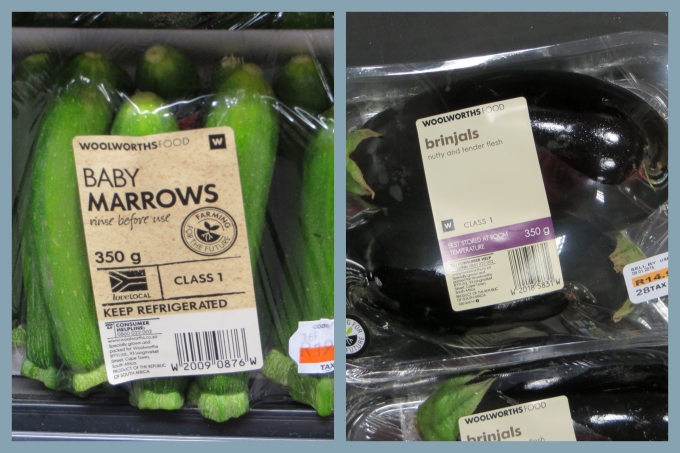
marrows and brinjals

With less than half the items on my list purchased, we headed across the street and down a block to Shoprite. You take your life in your hands crossing the streets here. Pedestrians don't seem to have any right of way at all. Even when the “green man” flashes and tells you it's okay to cross, there's a pretty good chance a mini-bus or turning traffic will cut you off. Since we already had three bags and a full backpack from Wooly's (yes, we did find some things to buy), David waited at the entrance while I popped into Shoprite to find some of the missing items. Though this store has lots more products on offer, none of them came close to what was on the list. You wouldn't think canned mushrooms would be so hard to find, would you? I did find a ream of printer paper on an end-cap of the canned veggie aisle though, so the trip wasn't a total waste.

durban traffic

Off we trudged back to the boat, arms aching by the time we reached the dock. A dive bag full of clean laundry was waiting for us to add to the burden. David shouldered it along with his backpack and two bags. I grabbed the other two bags and we headed back to the boat. All told … 2-1/2 hours lost from our day, but we'll eat tonight.
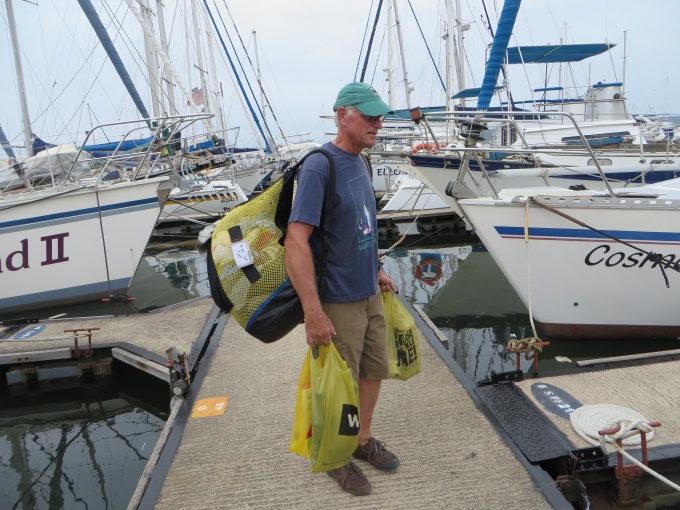
beast of burden

Some important points about grocery shopping we've learned:

  • If you don't have transportation, never buy more than you can comfortably carry. We use shopping baskets instead of a cart. When the baskets get heavy, we know we've bought enough.
  • When you're toting groceries, the route back to the boat is always longer.
  • If you see something you want, buy it now and in quantity - you may never see it again.
Planning Our South African Land Travel

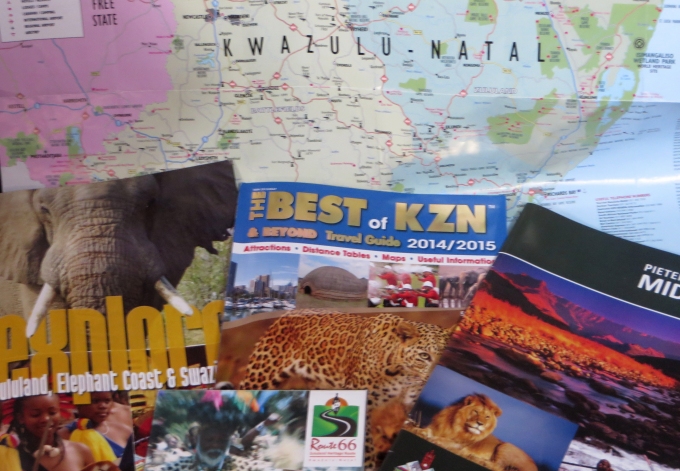
One of my most treasured “jobs” as the first mate of Nine of Cups is travel planning. I collect the literature, read the guide books, do research on line and then come up with a plan. In South Africa, especially where we are in KwaZulu-Natal (KNZ) province, there's so much to see and do, it boggles the mind. There are game parks, game reserves, marine reserves, Zulu culture and historical sites, and of course, the world-famous Kruger National Park. First things first, I headed to the tourist info office in downtown Durban and collected as many tourist brochures about the region as possible. all the tourist brochures

Now, the hard part … perusing all the brochures, reading the guide books and deciding what to see and what to give a miss. It's a challenge to be sure.  I usually set up criteria based on the amount of time we have available, what there is to see and how much $$ we want to spend. Whetted by our recent visit to the Hluhluwe-iMfolozi Park, we agreed that we'd take 7-10 days for land touring in this area and still have 7-10 days for boat chores/repairs. Sounded pretty fair to me and I went to work planning the details. We plan to leave South Africa by the end of February, so that would still give us 5-6 weeks to get to Cape Town and head out.

For our upcoming trip, we'd need to rent a car; plan the route; reserve accommodations in advance if we wanted to stay in the game parks or national parks, since it's high season; determine the ancillary things to see and do beyond the game parks such as craft markets, cultural exhibits, museums, etc.  Several cruisers had already done some land travel plus the locals are happy to share information, so I checked with them first. They each had a nugget or two of wisdom to offer, but none offered the perfect Nine of Cups itinerary. My job was cut out for me.

map of kwz

Renting a car is easy enough; getting a good deal is another matter. After much research, I found an economy car with unlimited mileage, A/C, in-town pickup,  and a small enough excess (deductible in case of accident or theft) that we could swallow, just in case. I got it down to ~$22/day including insurance. Now to set the itinerary.

Since animal encounters were tops on our list, I narrowed down the game parks and reserves that seemed to offer the most animal viewing options, but tried to choose those that were a bit off the beaten track. It's summer season here and there are scads of tourists (like us) that we are hoping to avoid. I checked what other attractions were nearby the parks that would be of interest, as well as in-park accommodations, nearby hotels, restaurants, etc. For hotels, wifi and A/C are two amenities high on the wish-list along with free parking and free breakfast. We usually like to wing it as far as hotels go, but since it's the tourist season, I wanted to at least book a couple of nights in advance.

After devoting an entire, frustrating day to internet and travel research interrupted frequently by everyday life aboard, I managed to figure out a rather ambitious and adventurous itinerary. It's a big territory to explore, but I think we'll make the most of our time and money. We're booked in a combination of hotels and backpacker hostels, inside game parks and out. Our route will include at least three major game reserves/wildlife sanctuaries plus multiple nature reserves; a few days in Swaziland, a tiny kingdom to the north; opportunities to visit several craft and local markets, museums and cultural centers plus exposure to Zulu, Swati and Ndebele people.

We're quite excited about this trip, but, of course, we have to get our chores done first, so it'll be a few more days before we can leave. We hope you'll come along. We always enjoy your company.

A Taste of South Africa - Hluhluwe-iMfolozi Park

As if our appetite for travel wasn't already at its peak, our South African berth neighbors, Alan and Margie, aboard the tiny day-sailer, Honey Bird, asked us if we'd like to take a daytrip with them to Hluhluwe-iMfolozi Park (That's roughly pronounced Shloo-shloo-wee Umfo-low-zee). Our reply was a resounding “Absolutely yes!” imfolozi map

The park is located about 3-1/2 hours from Durban and Alan suggested leaving at 1:00AM in order to be at the gates by the 5AM opening time to ensure best animal viewing. We packed breakfast and lunch in a cooler, grabbed a thermos of hot tea and, all psyched for a day of adventure, we met them promptly at the marina gate in the early, early morning. The ride went smoothly with lots of chat as we headed north on the N2 highway and then turned onto Route 66 (yup, Route 66!) toward the Cengeni west entrance to the park. Though it was dark, the full moon shone brightly and illuminated the hillsides. A huge owl stood by the road and fluttered up as we passed. Alan slowed for numerous goats along the way that insisted on crossing the road just in front of us. Our arrival timing was excellent, and in fact we thought we were a bit early until we crossed the little bridge over the Hlinza River and the car got gobbled up by a huge pothole. An adventure of an unexpected nature developed.

pothole

As the car lurched out of the pothole, we heard a sickening whoosh and it was evident we'd damaged a tire. Alan and David got out immediately and surveyed the damage. By torchlight, they could see a huge hole in the sidewall of the right rear tire, but luckily no apparent damage to the undercarriage. They hauled out the spare, made the exchange and we were on our way … for about 10 meters. The right front tire was flat, too. Now what? We were no more than 500 meters from the park entrance, but Alan knew there were no services available in the park. A long story short ... Alan managed to drive on the flat front tire some 40 km until he determined the rim was in jeopardy. The men changed to the other flat tire and we continued into the town of Ulundi where a local Dunlop tire dealer, alerted by Alan's Audi-Assist representative, showed up on a Sunday morning to sell and install two new tires.

changing the second tire

Not to be deterred by our little setback, we returned to the park and were at the entrance by 9:00AM … four hours later than anticipated, but still looking forward to a full day of animal viewing. Alan and Margie had visited  many times in the past and were familiar with the gravel roads that criss-crossed the park.

park entry sign

We had barely paid our entrance fees when we spotted some impala grazing near the side of the road and nearby a yellow-billed kite sat high in a tree inspecting the landscape for possible snacks.

impala and kite

Spotting animals in the bush is not always easy. Their protective coloring allows them to blend easily with the foliage and landscape. When you're really tall, however, it's kind of hard to escape notice. We were thrilled when a giraffe poked his head up to give us a nod.

giraffe takes a peek

Around each turn, there seemed to be something of interest. We sat for quite some time being thoroughly entertained by the antics and interactions of a troop of Chacma baboons.

baboon with baby

Hluhluwe-iMfolozi Park is the oldest park in South Africa and actually a combination of two reserves originally established in 1895 and covering 96,000 hectares (290,000 acres). It is home to the proverbial Big Five: lion, rhino, elephant, buffalo and leopard. It is dissected by the White and Black Umfolozi Rivers and as we neared the White Umfolozi, we spotted our first rhinos cooling themselves  the water.

rhinos

We stopped at the Mphafa Hide to check out a waterhole which in actuality didn't have much water. We were rewarded with great views of a blue wildebeest, vervet monkeys, several impala including a handsome male, mocking chats and yellow-eyed canaries.

Imfolozi_mfafa hide collage labels

We stopped for a picnic lunch overlooking the White Umfolozi River. We were on the look-out for large carnivorous animals on the prowl looking for humans, but none showed up.  An orange skimmer dragonfly lit nearby and caught my attention. A pin-tailed whydah, its long tail feathers dragging behind, searched for insects. Raptors soared gracefully overhead and a Cape vulture stood sentry in a tree near the river.

picnic collage

The afternoon was hot and humid as we continued through the park. We were pleasantly surprised by the limited number of cars and tourists we saw and the diversity of animal life we viewed.  A giraffe crossed the road in front of us, followed by several more. They joined up amiably with warthogs, zebra, wildebeest, and impala, all finding their own space and not infringing on others. We watched them walk off together, perhaps heading to a secret animal rendezvous in the hills.

animals together

Leaving the park provided just a few more surprises. We'd seen elephants in the distance, but an old bull was close-up near the exit and seemed fine with onlookers admiring him.

elephant

As we exited the reserve and headed back to the highway towards Durban, a beautiful kudu buck bid us farewell. A fitting ending to a great day.

kudu bids farewell