Mkhuse Game Reserve - South Africa Pt. 2

We left the Nsumo Pan exhilarated by the hippo sightings. If we saw nothing else, we would have been satisfied with our time in Mkhuse. We chose a route to the Enxwala Vista Point for a picnic lunch. The park has great views of the Lebombo Mountains in the distance. The area in which we traveled was a grassy veld with enough trees to provide shade for weary animals. Unfortunately, the road was so rough, we had to turn back about half way there. We were high-centering on rocks and worried about damaging the rental car beyond insurance limits … or repair within the park. We slowly made our way back and tried another loop road with the same results. We retraced our track back to the main park road and tried yet another gravel track heading towards the kuMasinga Hide. landscape at mkhuse game reserve

We had a very late picnic lunch of bread, cheese and smoked chicken before heading into the hide. There were several cars there and no one seemed to be leaving. That was a good sign. If we were excited about seeing hippos, we were ecstatic with the number and variety of animals at the waterhole here.
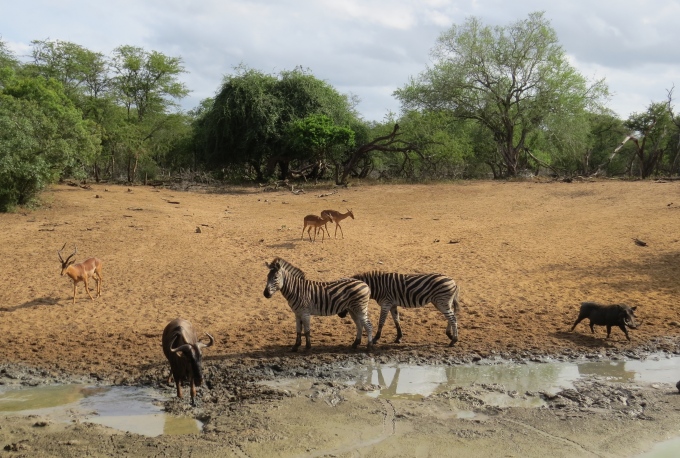
waterhole at mkhuse game reserve

We watched as a giraffe family … mom, dad and baby … made their way tentatively to the muddy water's edge for a drink. Despite their size, the giraffes were very skittish.  They sensed we were watching and looked directly at us from time to time.

giraffes looking right at us at mkhuse game reserve

When they felt safe enough, they'd splay their legs precariously and stick out their long tongues to sip a quick drink, then abruptly turn away.

giraffe drinking at mkhuse game reserve

Rhinos walked the edge, too, looking for a good place to wallow. We watched a zebra approach tentatively and then jump back when a rhino snuffed at him impatiently.
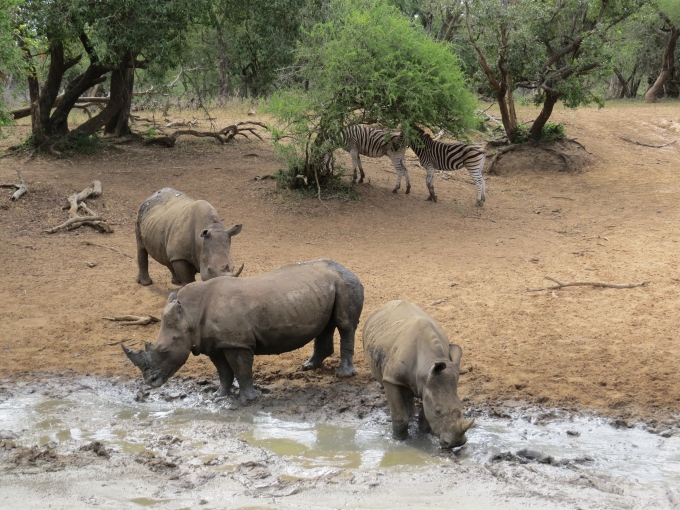
rhinos and zebras at mkhuse game reserve

Then a wildebeest made his way from the forest's edge and tromped into the thick, viscous mud right up to his knees. He had no reservations whatsoever. He was hot and needed a drink and cool-down.

wildebeest at mkhuse game reserve

A fat old warthog, obviously ill-tempered based on the wide berth he was given, approached as well. He found a good wallowing spot immediately and luxuriated in the cool mud with grunts of appreciation.
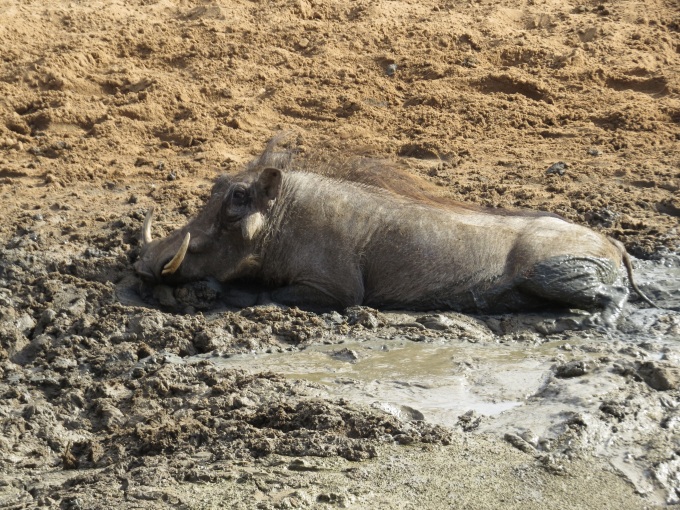
warthog wallowing in mkhuse game reserve

Every once in awhile, something would spook the animals and they'd all gallop off to a safe distance, returning, slowly cautious, when they deemed the coast was clear again.

spooked animals at mkhuse game reserve

We could have stayed watching and observing forever, but we needed to be out of the park before dark and negotiating the rough roads back to the highway loomed in our minds. We reluctantly drove back to the gate, checked out of the park and headed back to the highway. The Shayamoya Lodge was less than an hour's drive to the north, just shy of the Swaziland border.
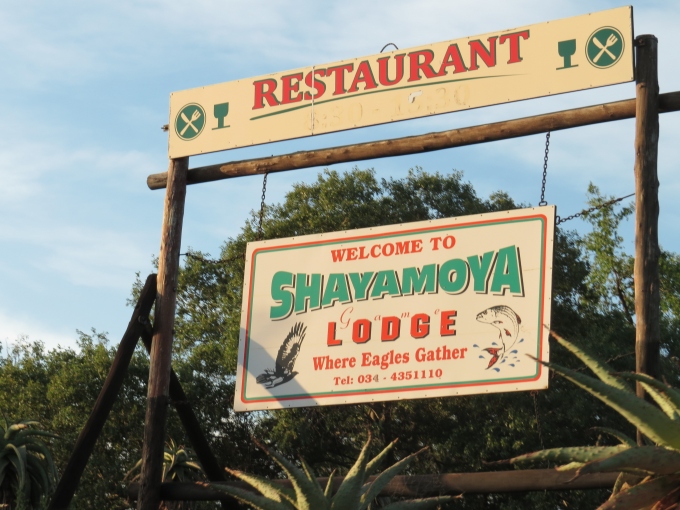
shayamoya lodge south africa

The drive in was comparable to some of the rough gravel roads in the park, so we weren't sure what to expect. Oh, my … were we ever surprised. Talk about good luck. Our “chalet” was a beautiful thatch-roofed, secluded hut.

the hut at shayamoya lodge

The interior was rustic, but elegantly charming as befits an African lodge. Wooden furniture, mosquito-netted beds (twins, unfortunately), a large bathroom with tub and an outside, hot-water shower. It was positively splendid.
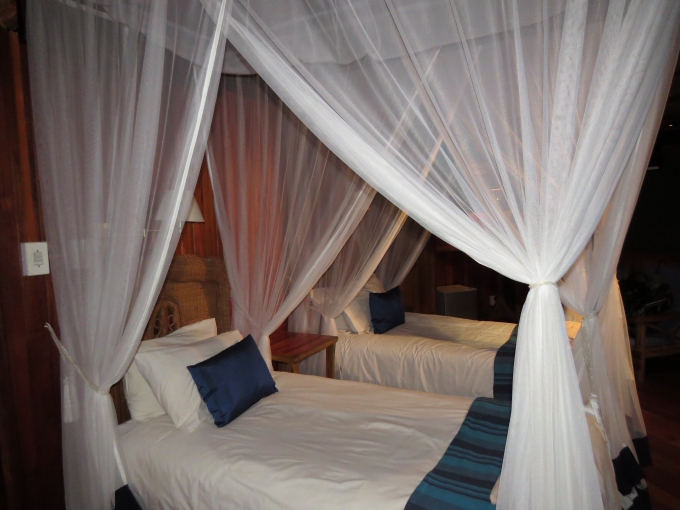
mosquito net beds at shayamoya lodge

We were invited to a braai (BBQ) in the lapa, an outside patio area and enjoyed our dinner under the stars. We returned along a dimly lighted, stone path to our chalet. We could hear frogs and insects and the night sounds of small animals nearby. All in all, a lovely, unexpectedly fine evening. As we concluded Day 2 of our inland travel, we sighed in satisfaction and anticipated what lay ahead.

Mkhuse Game Reserve - South Africa Pt. 1

After a restful night and a full breakfast at the Hlulala Guest House, we were on the road to Mkhuse (Mick-hoo-see) Wildlife Sanctuary. It was a short distance on the N2 North Coast Highway to the cut-off, but once off the highway, it seemed to take forever to get to the park. The gravel road was rutted and rough, but stopping for the cows was the primary reason for such slow-going. Cows were everywhere. They are not fenced in, but rather roam aimlessly, perhaps looking for the perfect grass … or not. They spend a good portion of their day walking on the roads, stopping what little traffic there is. They do not respond to horn-honking. They move at their own pace. Once we got closer to villages, the cow traffic not only increased, but goats, donkeys and kids were added to the mix. traffic collage mkhuse

Driving through Zulu villages was interesting. Friendly, smiling people waved as we passed. The round, thatch-roofed huts were a traditional rondavel style. Sometimes there were small rectangular houses as well, always tiny and we wondered how many people could possibly live in them.

stone zulu hut mkhuse

There was obviously no running water in some areas, as we watched women washing clothes in a large waterhole that was shared by animals and bathing kids.

waterhole

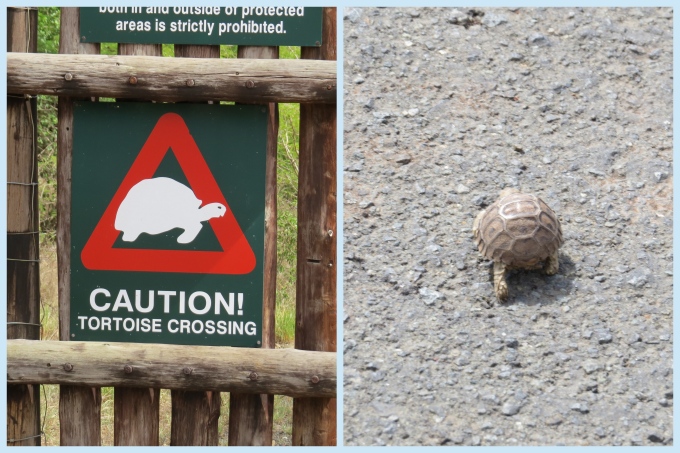
After much bone-jostling, we arrived at the Mkhuse gate, paid our entry fees (R131) and began our careful watch for animals. A sign on a fencepost at the gate warned us to be on the look-out for tortoises. David stopped suddenly about 300' (100m) inside the gate… a tiny tortoise was crossing the road … just as advertised.

watch out for tortoise mkhuze game reserve

We were a bit disappointed as the first hide we wanted to visit was temporarily closed for repairs. Ah, well. We moved on to the Mantuma reception center. Pre-booked accommodation was available here, but none had been available for the time of our visit. We visited the info center and small gift shop and got our bearings in the park. We'd purchased a guidebook  of Zululand reserves at iMfolozi and it included Mkhuze.

mkhuze park map

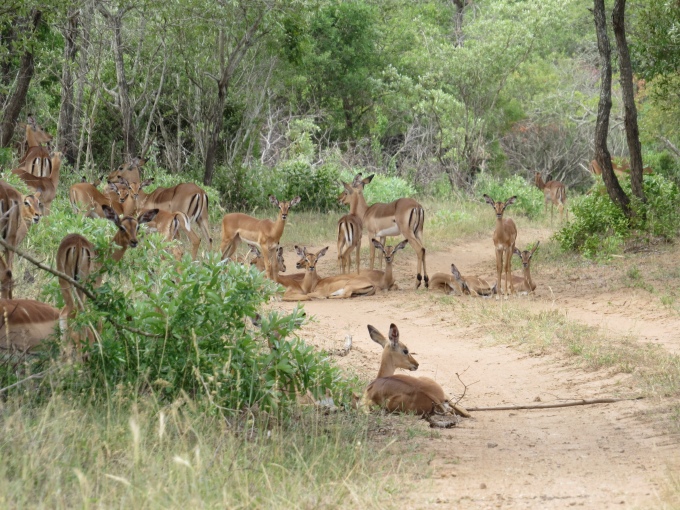
Unfortunately, we found out that the Zulu Cultural Center was closed, too, as well as several roads and other hides. We were feeling a bit gypped as we headed back onto the park roads, but not for long. There were so many impala laying in the road and all around us, it was hard to be miffed for very long.

impalas at imkhuse game reserve

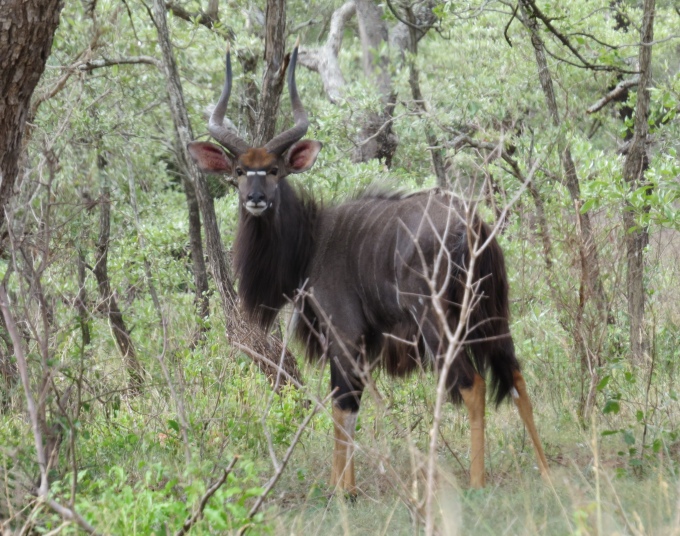
And then we spotted zebra … and wildebeest … and a baboon in a tree ... and a handsome nyala.

a handsome nyala at mkhuse game reserve

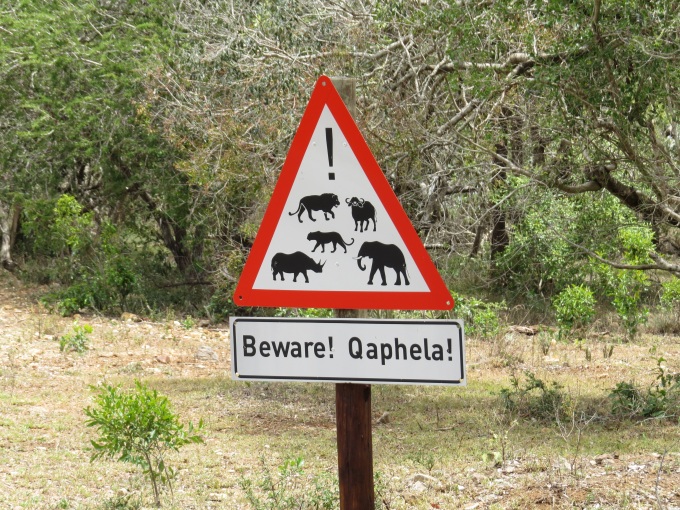
A highlight of the park was the Nsumo Pan, a large, shallow lake and part of the larger iSimangaliso wetland system. We were surprised that there were no cars at all in the car park. We noted the sign as we left the car and headed down the path to the hide.

beware of wild animals at mkhuse game reserve

The pan was large and beautiful. We could see egrets and ibis in the trees on the opposite side and with the help of the telephoto lens, we could barely pick out warthogs and ducks.

pan view mkhuse game reserve

As we settled quietly onto the benches in the darkened hide, we could hear loud, grunting, pig-like sounds. They sounded close, but we weren't sure what they were. Big bumps appeared in the water on the opposite side of the pan. The sounds continued and then a head emerged. Hippos!

hippos at mkhuse game reserve

This was our first sighting of hippos in the wild and we were thrilled. Hippos are not one of the Big Five, but are reputedly responsible for more fatalities than any other African animal. They're temperamental and tip over or swamp boats, drowning the occupants or providing fodder for the crocs that live in the same habitat. We kept our distance from the hippos and from the shore, where numerous signs warned about crocs. Patience is a virtue when photographing animals. David waited for nearly an hour to catch this picture of a hippo yawning.

hippo yawning at mkhuse game reserve

In the middle of our pan experience, we received a cell phone call from Timboti Ridge, our lodging for the evening. Considering we were in the middle of nowhere, we were pretty surprised when the phone rang. We had been “upgraded” to a sister location at Shayamoya Lodge. They provided no explanation as to why, just a confirmation and directions to the lodge. We had no idea what to expect. The small disappointments at the beginning of the day faded away and were far outnumbered by the surprises that occur later. Stay tuned for the rest of the adventure tomorrow.

And We're Off

We worked and worked and finally … we're off on holiday for some inland travel in South Africa. I'd spent odd moments throughout the week making lists and assembling what we needed to take for 10 days of travel … without overwhelming the captain. We picked up the rental car late in the afternoon before departure and parked it in the secure Point Yacht Club car park. I slept little during the night. I was excited to be up and on the road. The captain was as excited as he ever gets … all things in moderation. We were up at the crack of dawn and leaving the car park by 0530. Not a minute of our holiday was to be missed. We'd really enjoyed our first visit to Hluhluwe-Imfolozi, and decided we'd return there to see the northern part of the park that we'd missed on our first visit. We drove to Mtubatuba (love that name) and entered through the Nyalzi Gate, the gate we'd exited on our previous visit. We saw elephants as soon as we arrived. The old bull we'd seen previously had a young female fawning over him and as we watched two, three, then four others joined them.

elephants

This part of the park climbs higher into the hills and then dips back down to the Hluhluwe River. The self-drive gravel auto roads are in rough condition, and David's experience in driving Colorado mountain roads came in handy. We bumped along through the pot holes and mini-ravines in our little Volkswagen Polo without incident. We were delighted to stop for zebra crossing the road. David shut off the engine and I poured us some tea from a thermos. They weren't in any hurry and neither were we. They came closer and closer. I was surprised to see two colts that were well camouflaged while standing next to their mothers.

zebra

Around a corner, we spotted a couple of white rhinos in a mudhole.  As we drove closer, we discovered there were actually four rhinos sharing the thick, brown muddy wallow. One grunted loudly, stood up with much effort, then settled himself down again between the others, causing further grunts of dissatisfaction from his cronies.

rhinos

We saw a huge herd of buffalo grazing on the hillsides in far distance and I whinged that I couldn't get any photos. No problem … awhile later, we waited patiently while another herd took its time crossing the road in front of us. Buffalo are considered one of the big five though they don't seem to fit the bill for ferocity. Evidently, like American bison, they are cantankerous and can charge on a moment's notice, doing a considerable amount of damage.

buffalo crossing

We walked into the Thiyeni Hide enclosure and lunched on fruit and crackers and a bit of left-over chicken I'd brought from the boat. It was hot and sultry as we made our way through a long, enclosed bamboo walkway to the animal viewing area. There was barely any water and no animals were interested in this exposed area on a hot day.

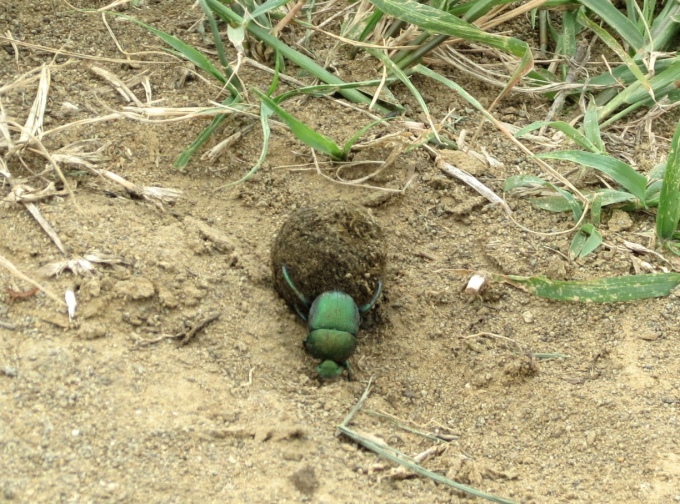
Back on the road, we chuckled when we saw big balls of dung rolling across in front of us. We remembered dung beetles from our last visit to South Africa. These little guys work their hind legs hard, forming dung into a ball in which to lay their eggs. They provide a service to the environment and short term amusement for us. We'd only seen black beetles in the past, but evidently they come in colors … iridescent blue and green as well as black.

dung beetle

Throughout the day, as we meandered slowly on the pot-holed, gravel roads, we spotted lots of other animals and marveled at this environment which supported them all. Raptors circling lazily overhead. Birds chirping and singing whenever we stopped for a few moments to listen. Endemic animals were at every turn and our ability to get so close to observe them. As we turned the last corner of a forested path to head out of the park, an elephant crashed out of the forest, a lasting reminder of Hluhluwe Reserve.

elephant crashing out of the forest

We headed to the little town of Hluhluwe about 20 km away and where a comfortable room at the Hlulala Guest House waited for us. First day … already over, but so much more to come and so many memories to take with us.