New River, New Country, Same Old Chores

One of the inescapable parts of the liveaboard cruising/travel life is chores. I guess it's not much different than living in a house … except we float (usually in salt water), things vibrate and shake a lot (and we're not talking earthquakes) and we're solely responsible for fixing/maintaining it all ourselves. No local handyman to call; no quick trip to the local Home Depot. Yes, we could wait till we were in a marina and hire all the jobs out … sometimes we do, but rarely. Our budget doesn't support it, plus it's always better to do things yourself. The to-do list in Suriname includes varnishing. David had started it in French Guiana, but he was far from finished. Varnishing, in and of itself, isn't all that bad. It's the prep work involved that takes up the time. First, we must remove everything obstructing the work area. In this case, David is working on the eyebrow, the port cap rail and the teak boxes on the aft deck. (He tells everyone that's where we hide our doubloons.) All the fuel cans and the fender boards on the port side need to be removed and stowed somewhere else on deck. Hardware needs to be removed and hopefully put in a place where we'll find again. (No worries, we have a system … that usually works.) Sheets and lines need to be coiled up out of the way. Then comes the sanding … a mindless, hand-wrenching, skin-abrading task that takes forever and, if not done properly, screws up the whole varnishing job.

david sanding

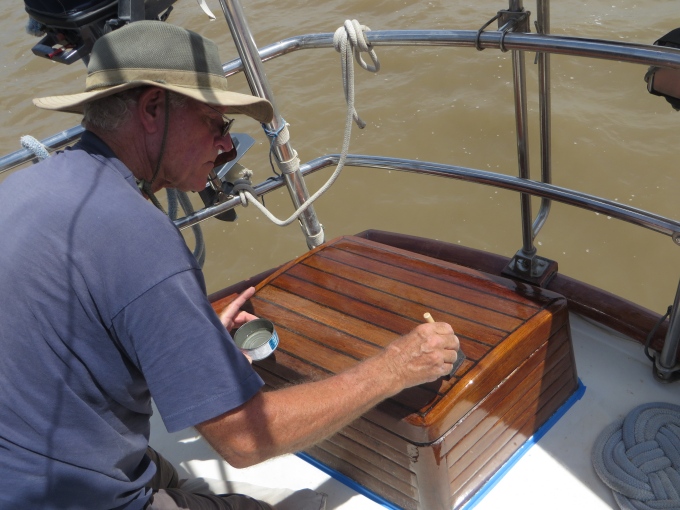
There's the careful masking of all areas to be varnished, then a wipe-down of the teak with acetone and finally … the first coat of varnish or in this case, Uroxsys, can be applied. Depending on the product and directions, a second coat may be applied without more sanding … or not. By the third or fourth coat, light sanding is always required once again … and then at least one more sanding before the final coat. Then, of course, when the varnishing is done, the masking tape and any sticky residue must be carefully removed and all the hardware, fender boards, fuel cans, etc., must be re-stowed and lashed. This whole process takes days, not hours and it's particularly tedious. (Note to selves … next boat should have less teak...and stainless)
david varnishing

Okay, so you've listened to me whinge about varnishing for a few paragraphs. What else? The decks are filthy and I've been scrubbing them in sections, careful to avoid the newly varnished areas. There's still laundry to be done everyday. The marina has one washer ashore, but the cost is high (US$6/wash-no dryer), so I've been doing it by hand which means lugging fresh water to the boat. There's a fresh water tap on the dinghy dock though which is a bit easier than toting those full water jugs for two blocks in Saint-Laurent.

filling water jugs

There's the usual sweeping, cleaning, dusting, washing, meal prep, cooking and clean-up required midst the rest of the chores we need to tackle. There's free wifi here at Marina Suriname, but alas, the signal is not strong enough to reach the boat even with our super duper antenna, which means we have to tote the laptop to shore each day. All in all, we're keeping busy. Please note that though all the photos show the Captain working, the First Mate, does, on rare occasion, pitch in and do her share.

Forgive me if I sound like a broken record when it comes to doing chores. The only reason I provide the chore routine regularly and in detail is because that's the way it really is. We'd hate you to think that we sail along, get into a port, plan our inland touring, have fun, and then move on. It's never that way … never. Living on a boat is about compromise and hard work. It's about keeping up with repairs and maintenance. It's about working in the hot sun or with your head in the engine room or the bilge when you don't really feel like it, so that the boat is always shipshape… so you can find time to go exploring another day. That's the reward.

We've worked hard since we arrived and you guessed it … time for a road trip to see some of Suriname. Maybe this weekend?

About Suriname

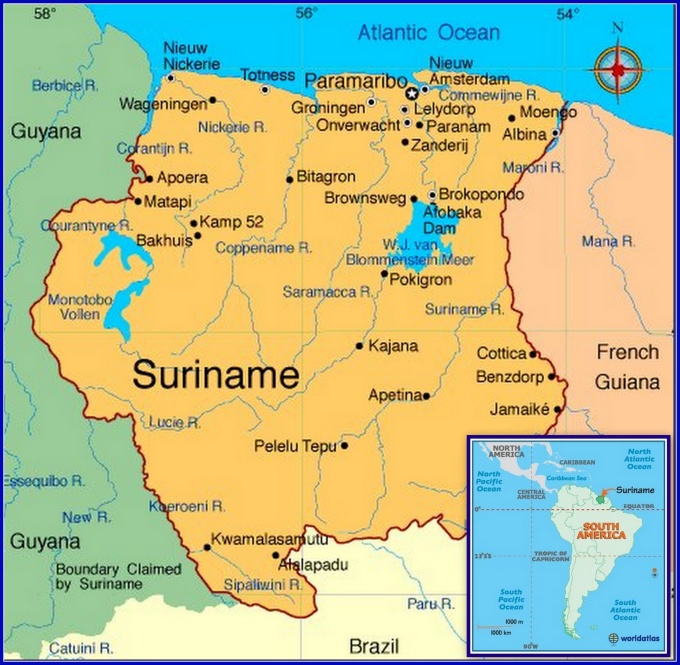
about suriname Known as Dutch Guiana before its independence from the Netherlands in 1975, Suriname is about the size of the US state of Georgia and considered by some, to be the best of the Guianas for tourism. We're about to find out. Wedged in between Guayana, French Guiana and Brazil with the Atlantic coast to the north, there continues to be border disputes with the neighbors.

map of suriname

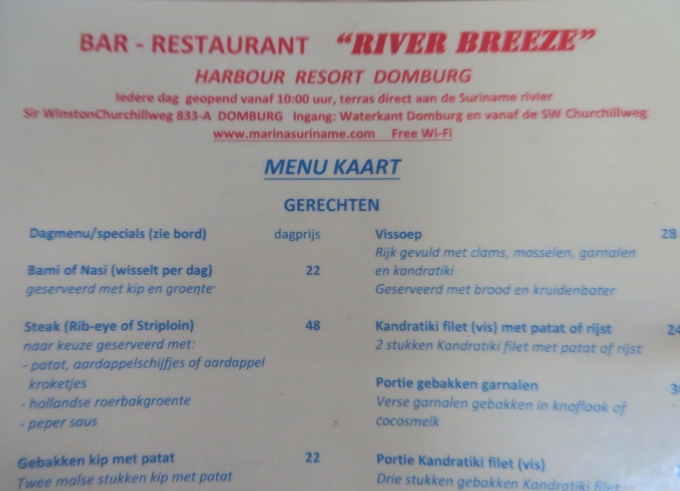
The official language here is Dutch, but English is widely spoken as is the local language known as Sranan Tongo (Surinam tongue) or Takitaki. Our Dutch is a bit rusty … okay, it's non-existent, but we're picking up a few words as we go. We certainly know yes/ja (yah), no/nee and beer/bier. A local woman, Pamela, who works at the yacht club is helping with translations. Today's word was “kip” - chicken. She's also described some of the local Javanese dishes served here … for instance, bami and nasi (fried noodles and fried rice). We'll figure it out as we go. That's half the fun.

suriname menu

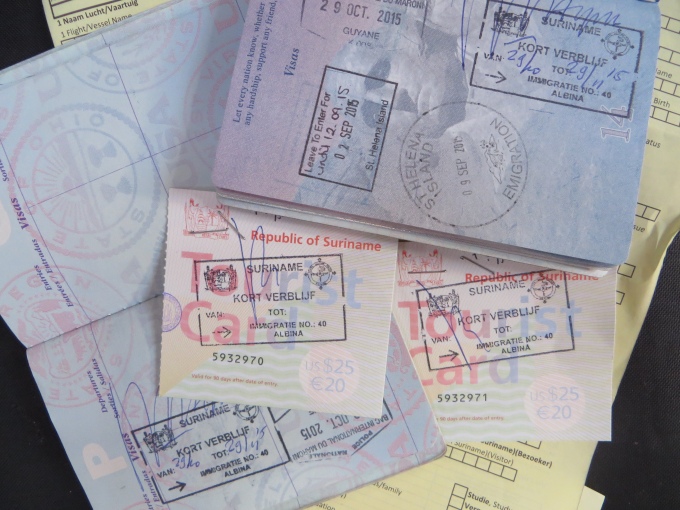
We'd actually cleared into the country when we visited Albina just before we left, so we were saved the hassle of taking a bus or taxi into Paramaribo to handle all the formalities. We had to purchase a Tourist Card (€20/pp) at the Surinamese consulate in Saint-Laurent before entering Surinam, payable only with a credit card. They added a €2 handling and VAT fee. We completed a rather long form in duplicate for the Immigration fellow in Albina. Then stamp, stamp, stamp. The process was easy and painless, however. We have 30 days to visit Suriname before having to renew.

passports and visitor cards for suriname

The currency is the Surinamese dollar (SRD) with a current exchange rate of 3:1 to the US$. However, most hotels and even the marina here, charge in Euros (€) or US$ because of the significant fluctuation in the local currency. Credit cards are not accepted as widely here as they were in French Guiana. Cash is king, a tough transition for credit card kids like us. In general, things are considerably cheaper here than in French Guiana, a welcome change. But, of course, we're missing our 70¢ fresh baguettes and croissants.

suriname dollars

The Dutch were the first to settle land in the Guianas. They formed the Dutch West India Company in 1621 and traded with the local AmerIndian people. Cocoa and sugar plantations were established along the rivers with the locals supplying much of the labor. When the locals were nearly wiped out by diseases introduced by the Dutch, slaves were imported from western Africa. Escaped slaves known as Maroons formed their own settlements in the interior, maintaining much of their African culture and language. These Maroon villages still exist today in central Suriname. Maroon wood carving is considered some of the best in South America.

It was the British, however, who founded Paramaribo, Suriname's capital city, on the banks of the Suriname River in 1650. In the Treaty of Breda (1667), the Dutch chose to retain Suriname and their colonies on the Guyanese coast, but ceded French Guiana to France. The Brits also got New Amsterdam in the trade ... better known today as Manhattan, New York. Ouch!

suriname flag

When the British banned slavery in 1834, they also discouraged all slave trade in the Caribbean forcing plantation owners to seek other cheap labor. Enter a huge influx of Asians especially from India, Indonesia and China. Today's Suriname reflects this very diverse, quite harmonious, ethnic mix. Politics in today's Suriname, however, is a different story ... about which we'll make no comment.

A little Suriname trivia for you …

  • Suriname is the smallest country on the South American continent. And, by the way, it's the 12th of 13 South American countries that we've visited. One more to go … Guyana.

  • The country is sparsely populated, ~500,000 people, half of which live in the Paramaribo area.

  • This is a beer-drinking country, although they produce excellent, inexpensive rum as well. The local beer is Parbo. The local rum is Borgoe and it runs about US$9/liter.

    parbo beer in suriname

  • In 2002, the country's capital city, Paramaribo, was listed as a UNESCO World Heritage site.

  • The country’s name is believed to be derived from a Taino group called Surinen, who first inhabited the region.

  • The bauxite (aluminum ore) industry dominates the country's economy. It comprises more than 15% of the GDP and 70% of export earnings.

So, what's on the agenda while we're here? Chores, of course. Varnishing is key... followed by the usual stuff … deck washing, laundry, cleaning and a few repairs and routine maintenance. Then, there's all that sightseeing that must be done. We're hoping to spend a weekend in Paramaribo to see the sights,and perhaps a trip into the jungle if we can find one that fits our budget. We'll definitely be busy, so why not clear your schedule and come along? We could also use a little help with the deck chores, in case you'd care to volunteer.

The Blue View - Fender Boards

fuel jetty Some of the most interesting places we've visited also had some of the roughest piers and wharves to tie up to. Hobart, Tasmania is a good example. The downtown wharf is a wonderful place to visit, with great old buildings, a plethora of pubs and chandleries, and a wonderful seafaring ambiance, all within walking distance of the waterfront. Unfortunately, we were required to tie up to a commercial wharf with pilings that probably dated back to Flinders' visit in 1798. Lying against the rough pilings, especially with the large tidal swings there, would have been a problem for our topsides and varnish had it not been for a couple of fender boards.

fenderboard with tire

Fenders are the inflatable bumpers that are hung from the sides of boats to protect the topsides from getting scratched or damaged at a dock or jetty. They work well when lying against the typical marina jetty or pleasure boat dock. They are, however, pretty much useless when used to fend the boat off from a commercial wharf or jetty. They aren't wide enough to stay between the boat and a piling, and may be chafed and ruined by a concrete wharf. Some wharves have huge tires attached to them which provide protection for ships and large fishing vessels, but which are much too large, coarse and dirty to lie against a sailboat. Attempting to use fenders when tied alongside these huge tires is not a good idea either. With harbor surge and tidal changes, the tires will likely snag the typical sailboat fender, and may break the line holding, it or even rip the stanchion out of the deck. In addition, the usual tar, muck and oil deposits on a commercial wharf will quickly coat those pretty yacht fenders with a sticky black residue, which will, in no time, get ground into the boat's topsides.

fender board illustration

Fender boards are large planks of wood that are suspended between the boat's fenders and those nasty commercial wharves. We have two dedicated fender boards that have kept Cups' topsides reasonably intact at dozens of some of the nastiest wharves and docks you can imagine. We also have three more planks that are primarily used as supports for our fuel cans, but could be drafted into action as fender boards should the need arise.

To make our fender boards, I started with two 2x10x7 (50mm x 250mm x 2.1m) planks. I drilled a couple of 3/4” (18mm) holes in the planks about four inches (~100mm) from the ends. Then I cut four 8 foot (2.4m) lengths of ½” (12mm) line and attached them to the fender boards using bowlines.

better fender boards

One of our friends has a much better method. He started with the same type planks and drilled a 1-1/2” (37mm) hole about three inches (75mm) in and three inches down from the upper corners of each plank. Then he drilled a vertical 3/4” (18mm) hole from the upper edge of the plank and down to the 1-1/2” hole. The line was fed down the vertical hole and pulled out the the 1-1/2” hole. He tied a stopper knot in the end of the line and pulled it back until the knot was taut in the hole. It was more work, but there was no possibility of the line chafing against the piling, whereas in my version, the bowline might rub against the piling.

Before deploying the fender boards, we make a reconnaissance of the wharf to determine where, how many and how high we need them. Marcie attaches the fenders, then secures the fender boards in place. We use either two or three fenders behind each fender board, depending on the wind and surge.

fenderboard in use

The next part of the plan is for me to maneuver Cups to within a foot or so of the wharf and come to a stop while Marcie lassos a cleat or two. Rarely do I manage this. More often, I come to a nice stop 8 feet off the wharf or I come in too close and snag one of the fender boards on a tire or piling while still moving forward with interesting results. We've provided entertainment in a variety of exotic places around the world, but eventually we get tied up.