Down the Maroni...Up the Suriname

down the maroni up the suriname Suriname is either 1.5nm directly across the Maroni River from us (Albina) or ~150nm to a safe anchorage at Domburg, about 35 miles up the Suriname River, and 8 miles north of Paramaribo, the country's capital city. After three weeks in French Guiana (my, how time flies), we're heading back down the Maroni River.

coastal route

The tides dictate boat movement on the river. We needed to wait for an ebbing tide in daylight to carry us down the Maroni back to the Atlantic, and then wait for a flood tide on the Suriname River, to get us upriver to Domburg. Luckily, the total distance is only about 150 nm and there are a few spots to anchor in the rivers while waiting for the proper tides if need be. The tide tables provided on our Navionics charting software are reliable and good indicators for planning departures and arrivals.

tide tables

The tide wasn't changing till near 1100, so we had plenty of time to do morning chores. We wrote and did final internet. David cleaned the dinghy on the shore while I walked into town for our last French baguettes and croissants. We paid our last week's bill at the marina (13 beers, really?), hauled the dinghy, got everything stowed. The tide was just turning as we slipped our lines off the mooring. As we passed through the mooring field, we waved goodbye to new and old friends, wondering which of them we might see again in some other anchorage.

We followed our inbound track 27 nm down the circuitous Maroni, making the outbound trip a bit less stressful than the upriver trip had been. The wind picked up to 20-25 knots on the nose about half way down, causing short, square muddy brown waves to smash against the bow… wind against current and a bumpy ride. With the ebbing tide to carry us, however, we were spit back into the Atlantic just 3.5 hours later.
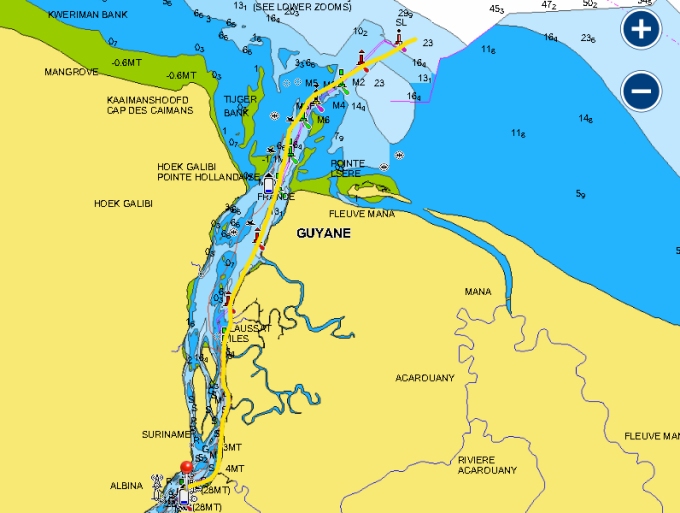
maroni track

A toast to Neptune and we were headed west towards Suriname on a beam reach. David lowered the French courtesy flag and raised the Suriname flag.

raising the suriname courtesty flag

The winds petered out before midnight and we made the decision to motor when our speed dropped to less than 4 knots. Though we were 8-10 miles offshore, the water is still quite shallow at 25-35' (10m). Fishermen were out in great numbers. Some boats were lit, some not. They laid out great nets with a strobe to mark the end of the net, then waited downwind a mile or more stretching out the net. Knowing which side of the net to pass was the challenge. If we could spot their boat, just a tiny point of light in the vast darkness, it wasn't difficult. If their boat was unlit or too far away, it was a crap shoot. Neptune was looking out for us and we managed the 80nm avoiding all the fishing boats and nets.

We were at the mouth of the Suriname by 0530. It was still dark, but the flashing channel markers and the light of the gibbous moon guided us up the channel entrance. The fishing fleet was just returning to port as well, and we followed along in good company, waving at the homecoming crews. The sun rose at 0615 and we began to see river sights.

fishing boat in suriname waters

The Suriname River was just as muddy and brown as the Maroni, but it was wider and deeper. The channel markers were more frequent; the coastline less wild and forbidding. There were lots of small settlements and we saw fishing stakes laid out close to shore.
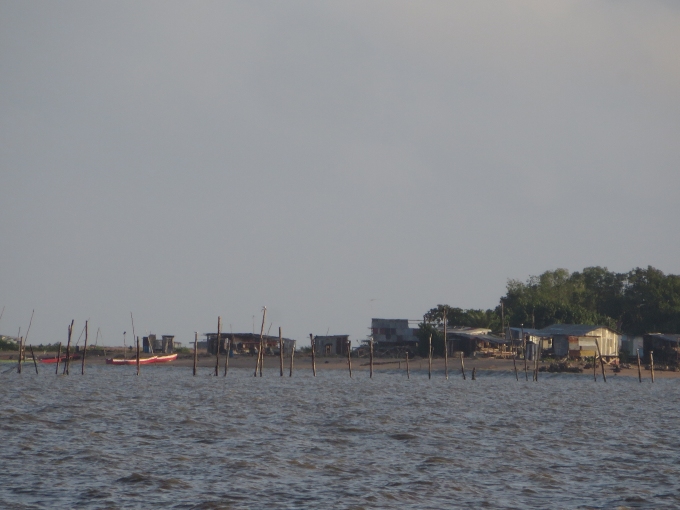
settlements along the shore suriname


We reached the confluence of the Suriname and Commewijne Rivers when the current was at its peak and felt the conflicting pull of the current... eddies and whirlpools... as we veered to starboard up the Suriname. Yellow butterflies flew over the the aft deck. We heard the high-pitched chirp of welcome swallows as they fluttered around the boat. One fellow landed on our anchor and bummed a ride upriver.

welcome swallow riding along with us to suriname

As we motored further and further up the river, more industry and towns appear on the riverside. Fishing boats were lined up on wharves and piers.
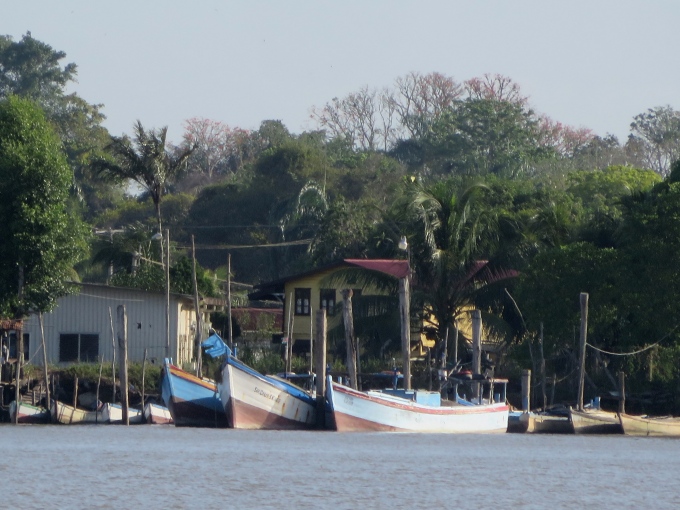
fishing boats lined up in suriname

Beautiful riverfront homes sprawled along the banks.
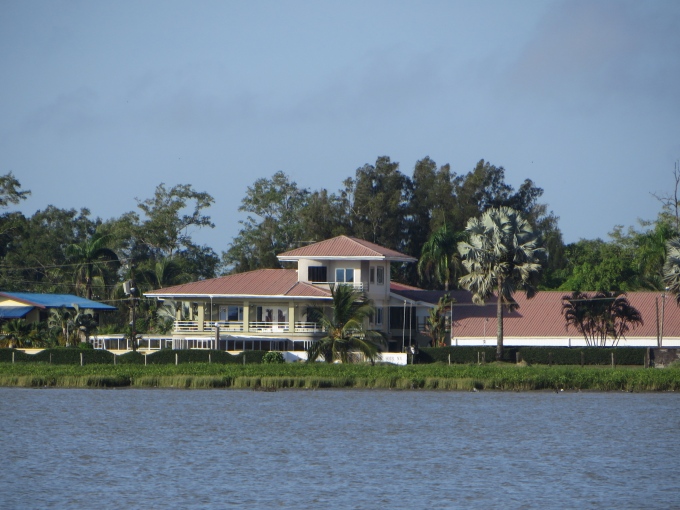
beautiful homes along suriname shore

We approached Paramaribo, Suriname's capital city. It stretched scenically along the foreshore, the spires of its cathedral and a stately clock tower dominating the skyline.
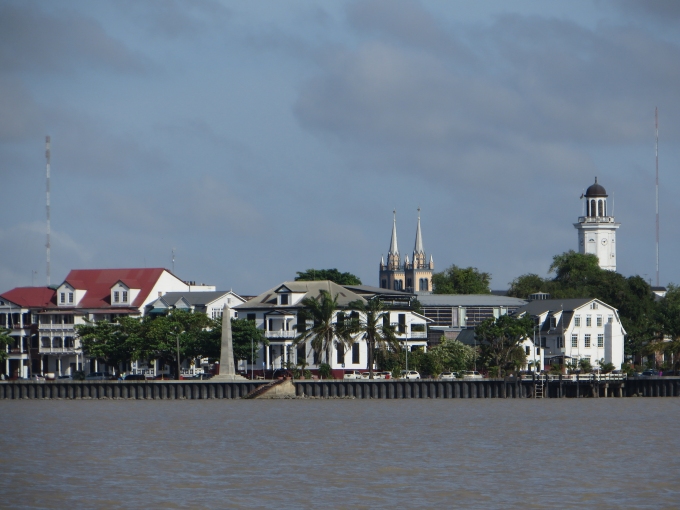
paramaribo suriname shoreline

An old wreck marked NDP and noted as “Goslar” on the charts lay just outside the channel. It reminded us of the Edith Cavell off Saint-Laurent,

old wreck off suriname shore

The Brug Surinamerivier (Suriname River Bridge) lay before us, spanning the river, connecting Paramaribo with the town of Meerzorg and points east. It was plenty high enough, but as we slid under, there's always a bit of a catch in our throats as wait to clear.

under the suriname bridge

The shores became less busy as we progressed up the river; the channel markers disappeared. About eight miles up from the bridge, we spotted some masts and knew we'd arrived at Domburg and the Marina Suriname. We headed for a mooring, lassoed it on our first try (no one was watching, of course), tied up and sighed. It was 24 hours from anchorage to anchorage and about 142 nm. Life is good … a new river and a new country.

A Taste of France in French Guiana

a taste of france in french guiana Beyond the fresh baguettes, croissants, pains au chocolat, and palmiers, there was definitely a lot of France in French Guiana when it came to cuisine, mixed with the local flavor of spice and tropical fruits. We don't frequent restaurants all that often, but eating out is part of the experience, so we felt obligated.

le mombari restaurant

Moules frites is the the national dish of Belgium, but very popular here. We tried it at Le Mombari, a local, popular restaurant in Saint-Laurent and then again while we were in Cayenne. They serve a kilo of mussels in a marmite (black kettle) with a large plate of frites (French fries) on the side. We found a kilo was plenty enough for two to share.

kettle of mussels

The traditional way to enjoy mussels is to use the empty mussel shell from the first one you eat as pincers to extract the subsequent mussels. Served with cold white wine, and French bread to soak up the delicious, creamy broth, it was really a feast for the palate.

using mussel shells as pincers

I checked out several recipes on-line for preparing the mussels. Here's the one I thought most closely resembled what we had.

A Taste of France in French Guiana
Author: Marcie Connelly Lynn
Moules frites is the the national dish of Belgium, but very popular here. We tried it at Le Mombari, a local, popular restaurant in Saint-Laurent and then again while we were in Cayenne.
Ingredients
  • 2 tablespoons (30g) butter
  • 1 shallot, peeled and finely chopped
  • 3 garlic cloves, peeled and finely chopped
  • pinch of salt
  • 1.5 cups (375ml) dry white wine
  • 2 tbsp (8g) fresh parsley
  • 2 pounds (1kg) mussels
  • 1/4c heavy cream
  • Plus 750ml (1 bottle) of chilled, dry white wine … for the cook as she's preparing the meal
Instructions
  1. Cook shallots and garlic in butter till translucent.
  2. Add wine and bring to a boil.
  3. Add cream, salt and parsley and stir gently, then slowly add mussels, stirring gently once again.
  4. Cover and simmer for 5-7 minutes till all mussel shells open.
  5. Serve with bread.
Notes
Fries can be deep-fried or oven-fried and served with mayo.

A couple of other French culinary finds …

Pain perdu – We call it French toast. It's made here with leftover baguettes. Literally, “lost bread” because a day-old baguette is … well, a day-old baguette. It's stale and dry until you dip it in an egg and milk mixture, with a little sugar and nutmeg and fry it up. Oooh, la, la.

Jamais gouté - a fish caught specifically in the Maroni by Amerindian people which translates literally to “never tasted” and unfortunately, we never did get a chance to taste it. Next time maybe?

A Pirogue Trip to Albina

The local mode of transportation here on the muddy brown River Maroni is the pirogue. From the Spanish word piragua (by water), we've seen several different types of pirogues in our tavels. They're basically dugout canoes, but they come in many different varieties. Here they're particularly long and narrow and have humongous outboard engines on them to ply them back and forth across the river. Some of the tourist pirogues for taking daytrips up the river are brightly colored, but the regular ones for heading back and forth are workhorses.

tourist pirogue

We've been looking across the river at Albina, Suriname since we arrived in Saint-Laurent. It's only about 1.5nm across the river, but none of our friends has ventured over there. We were told it wasn't much, although locals go there to shop because the prices are considerably cheaper. There seems to be little issue with Immigration or Customs going back and forth from Suriname to French Guiana as long as you stay within the river towns. So, why not go? A ride in a pirogue plus a peek at Albina.

our pirogue awaits

We walked to the busy pirogue dock and negotiated a price for a one way ride. One was just getting ready to leave and he agreed that €3/pp was fair. I'd say that we “hopped” aboard, but it wasn't quite that easy. The pirogues are long and narrow and thus, quite tippy and unstable. Watching the locals get aboard made it look easy, but we “tourists” were a bit more cautious.

boarding a pirogue

Because it's narrow and low to the water, the inside is quite cramped and close.

inside the pirogue

Soon the colorful foreshore of Albina came clearly into view. The ride across lasted only 10-15 minutes.

colorful albina

Other pirogues zipped behind us, in front of us, beside us. The drivers are quite adept at maneuvering these long, awkward crafts and we managed to get to the other side unscathed. Unloading was less tricky now that we had the hang of it.

offloading the pirogue

Well, the folks who said Albina wasn't much were absolutely right. The town is pretty much only the riverfront wide. There are some houses scattered behind and along the riverfront. There are taxis and a once-a-day bus to Paramaribo, Suriname's capital city, but that's about it. Fuel is considerably cheaper here, so the fuel dock does a brisk business.

pirogues at fuel dock

We found no open restaurants other than a few street food vendors. We wandered along the narrow foreshore walk and found a couple of shops in which to poke around.

albina supermarket

The shops offered grocery items and a myriad of Chinese-imported goods … like Black & Docker (yes, Docker) tools and Galvin Klain jeans and underwear. We did find a local beer, Parbo … cold and refreshing, despite the fact it was only 10:30 AM!

black and docker tools

Finding a ride back was a little trickier, since we wanted to be dropped off at the beach near the dinghy dock. After some negotiation, we agreed upon €15 for all of us. We boarded the pirogue, Pasensi Lobi (Translation: Hot Love), and took off in a flash with the driver's brother at the bow providing slight hand movements to the helmsman to negotiate our path. He evidently needed to make a quick stop at another dock. We sped at full throttle under a low bridge which we thought might have knocked his brother's block off, but our bowman gracefully ducked just in time and was no shorter on the other side of the bridge.

approaching the bridge in a pirogue

While we waited at the other dock, we got the chance to view life on the foreshore from a slightly different perspective. People came and went with their purchases … just another day in Albina.

local folk of albina

We finally got under way again and sped across the river. As we landed at the beach, new fare negotiations began. It seems that the driver had mistakenly quoted us the wrong price. It should have been €20. In all fairness, we had been told the fare was €5/pp to our beach. We smiled, gave him his €20, shook hands and said adieu. After all, the best parts of the trip were the pirogue rides!

Check out a short video on our pirogue trip across the muddy Maroni to Albina.