Moored in the Suriname River

Once again, we're up a muddy, brown river hanging on a mooring, watching the tide do its thing with great enthusiasm as we tackle our chore list. Each river seems to have its own unique feel. Though the river here is narrower than our anchorage on the Maroni, it seems calmer and a bit less turbulent even at the height of the flood tide. The breeze is certainly better here. It's cooler… no Edith Cavell wreck to block the wind. The wind gen and solar panels are always churning out power. We've had no need to start the engine since we arrived. sunrise on the suriname river

Not far from us on shore is a busy water taxi stand. From dawn till dusk, folks are ferried up and down the river regularly to little AmerIndian villages along the riverside. They look similar to the dugout canoes called pirogues in French Guiana. The prows are different. I asked if they were called pirogues here as well, and they're not. “So what then?”, I queried. “They call them boats”, was the response. I found out later that the AmerIndians call them corials or korjaal.

suriname river taxi stand

It's not nearly as busy here as St. Laurent though and the mornings are typically calm and quiet. Sometimes on the weekends, there are fancier, two-decker corials that bring tourists up the river for a tour.

suriname river tourist boat

The boats typically stop at the little Domburg dock for a quick look-around and snack at the Javanese warungs (food stalls) in the little square next to the marina restaurant. Quiet during the week, the place is jumping with tourists and local families on the weekends.

domburg square on the suriname river

We usually head into the little marina restaurant, the River Breeze, twice a day. In the morning, it's a quick check on the Internet for e-mails and posting the blog. In the early evenings, after the workday is finished, we return for showers, more Internet, a shared djogo of cold Parbo beer and a get-together with other cruisers. Currently, there are Canadians, Brazilians, Argentinians, Austrians, Italians and Germans here plus an American family from Seattle that just arrived from Brazil this morning.

river breeze restaurant on the suriname river

In the early mornings, it's been very foggy … the pea soup variety. We can sometimes hear the leonine roars of the howler monkeys in the jungle in competition with dogs barking on shore. Kiskadees still provide the key melody to morning bird song. Tiny welcome swallows flit around and frequently land on our solar panels or lifelines. At night, when the birds sleep, we hear the flutter and whoosh of bat's wings. A bat flew in through the forward hatch the other night, giving us an adrenaline rush. We could feel him and hear him more than actually see him. He was like a wraith as he whizzed back and forth and finally, thank goodness, found his way out through the aft hatch. We thought this was very unusual, but talking with other yachties, it happens quite frequently here.

Thanks to the bats, there are amazingly few bugs or mosquitoes around. We see butterflies and bees during the day that check out the boat before continuing on their way up the river, but that's about it. The only nuisance is the disturbingly loud drone of jet-skis that come out in swarms on the weekends, churning up the river water as they race around the moored boats.

jetskis on the suriname river

Logs and debris float by regularly with the turn of the tide. We're told that folks clearing land up river, dump all the tree trunks and cleared shrubs into the river, so they don't have to cart it away. One sailboat anchored near us was unable to raise his anchor when it came time to move. Closer inspection indicated about 50 meters of anchor chain wrapped around a huge, water-sodden log. It took the crew the better part of two days to unravel the mess and break free.

anchor chain around a log

We watched a good-sized powerboat sink near shore over several days with apparently no intervention by locals or the owner. We noted that his stern seemed to be particularly low in the water one evening … perhaps his stern line was too tight? The next morning only his bow remained above water. We reported it at the marina, but after two days, still no action was taken. Some fellows took a look at it, but we think they're perplexed as to what to do. They have limited funds and limited equipment with which to work.

sinking boat on the suriname river

We're trying to finish up chores in order to get on with our passage through the Guianas and then on to Trinidad for a haul-out. David sands or varnishes whenever possible. It's so dewy in the mornings, it's hard to get an early start and it appears the rainy season has begun. After a couple of days of dry weather when we first arrived, we now have showers and heavy downpours nearly every afternoon making varnishing a challenge. It might have to wait. There's plenty more to do, however. He's replaced the cockpit GPS with a spare. The whisker pole track and a new solenoid switch for the stove are still on the “to-do” list. And, of course, there's more to see in Suriname before we depart. Never enough time!

Today's Dutch word – ankerplaats - anchorage
The Blue View - Replacing a Halyard

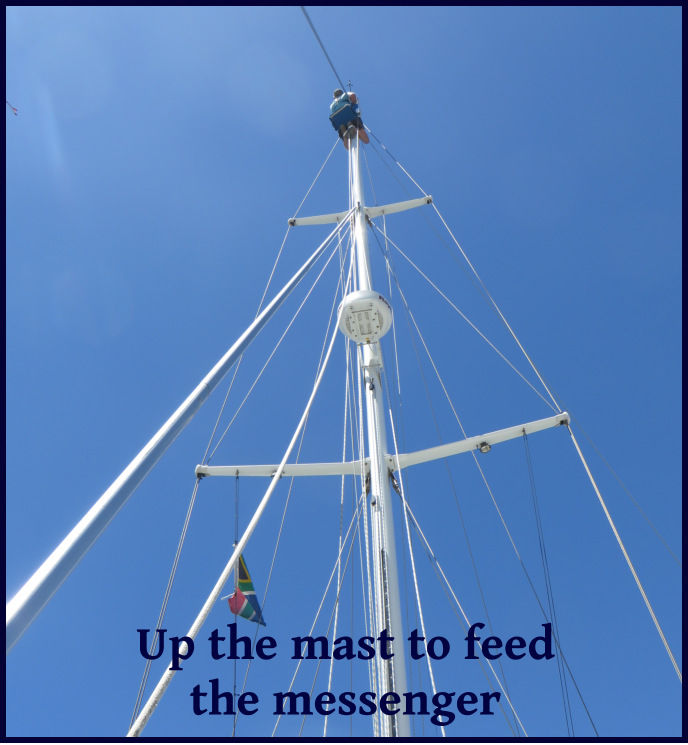
up the mast One of the problems we had while crossing the Indian Ocean last year was a head sail halyard that parted. It starts at the deck, enters the mast about six feet up (2m) on the port side, exits the top of the mast and is attached to the head sail. We had last replaced it several years ago in New Zealand, and apparently it had been chafing against the main halyard all these years. Unfortunately, the spot that chafed was inside the mast at a location that never sees the light of day except on the rare occasion the head sail is removed, so we didn't see it coming and it eventually chafed through and parted. Fortunately, we were near the end of our passage and were able to furl the head sail and complete the passage with the staysail and reefed main.

Usually when we replace a halyard, we can use the old halyard as a messenger. We attach the end of the new halyard to the end of the old one, and as the old halyard is pulled out, the new one follows (See the Blue View – Reeving a New Halyard). In this case, however, the old one had parted and pulled out of the top of the mast. We wouldn't have wanted to use the old halyard as a messenger anyway, because if we routed the new halyard along the same path as the old, it too would chafe through in a few years. Better to route a new messenger.

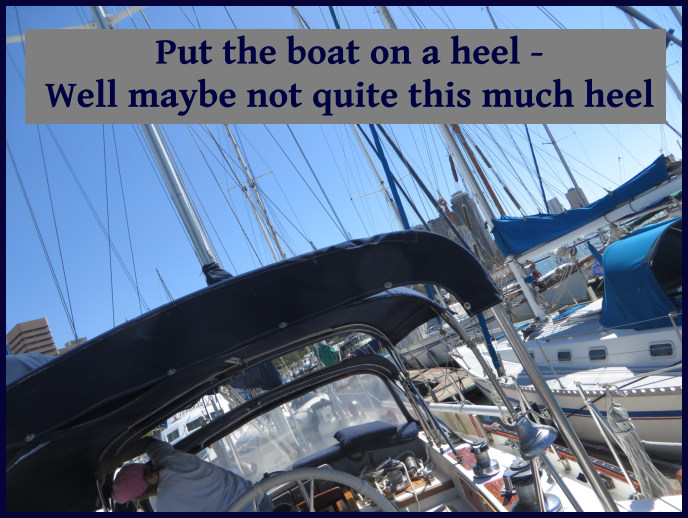
Both the entry and exit points for the halyard were close to the port side, so we wanted the new halyard to lie close to the mast on the port side. If we simply dropped the new messenger down into the mast, it quite likely would foul one of the other halyards inside the mast. To avoid this, we put Nine of Cups on a heel to port. We attached a long line from the spinnaker halyard to a stout cleat on the end of a slip a few boat lengths away and using a cockpit winch, we tensioned the spinnaker halyard until Cups had a definite list to port. Had we been at anchor, we would have swung the boom out to the port side and hoisted the dinghy and engine from the end of it. Together, they weigh about 200 lbs – if this wasn't enough weight, we would have partially filled it with water.

nine of cups at heel

We removed the stainless trim piece from the entry hole for the halyard in the side of the mast, then I rigged up a messenger using 1/8” (3mm) line and a few fishing weights. I attached the opposite end of the messenger to the new halyard, then went up the mast. I lowered the messenger over the masthead block and down into the mast.

reeve messenger wire hook

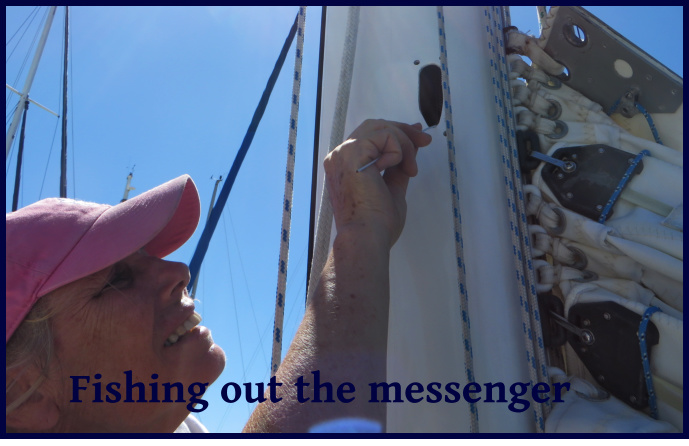
Marcie positioned herself at the halyard exit point and watched for the end of the messenger to appear. Using a bent wire, she fished the weights on the end of the messenger out of the mast. Then it was a simple matter to pull the remaining messenger and the attached halyard out of the bottom exit point on the mast as I fed the line from the top.

fishing

All that was left to do was reattach the trim piece and whip the halyard ends.

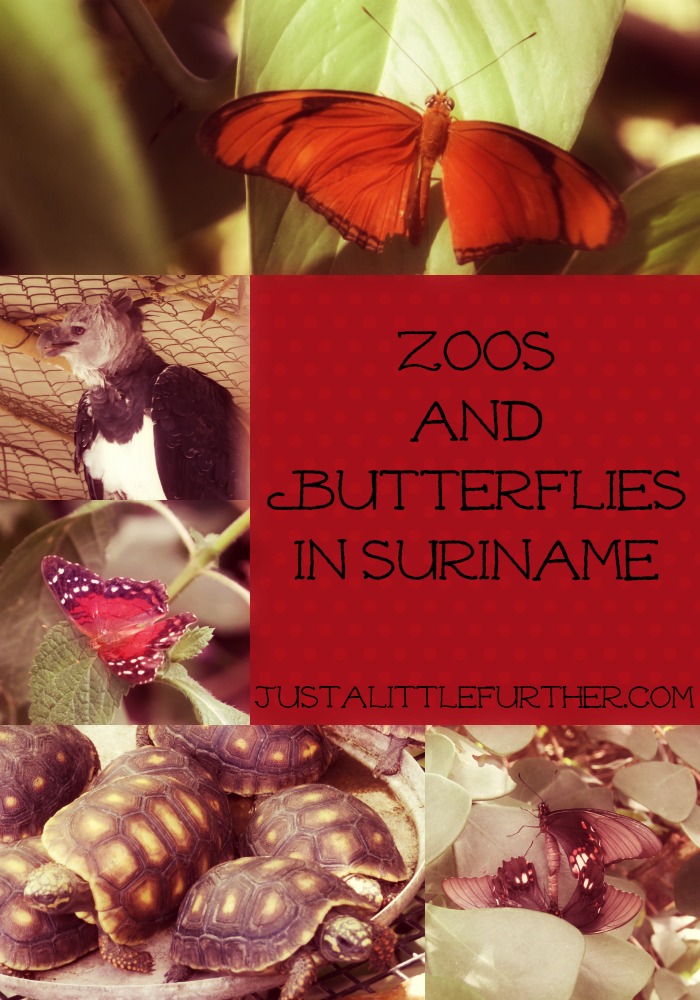
Zoos and Butterflies in Suriname

zoos and butterflies We have mixed emotions about zoos. We've been to some spectacular ones like the Denver Zoo, for instance, and we've visited some smaller zoos in the Amazonia that were revolting. In all cases, the animals are spectacles, on view for all to see, and in enclosures. The type and size of the enclosures and the care given to the animals is paramount in how we rate the zoo. We passed up the zoo in Cayenne, but we were close to the Paramaribo Zoo and had the time. It's a small zoo, hidden away in a wooded area north of the city, accessible by a narrow, bumpy road with limited signage. Not many people visit though the admission is fairly cheap (SRD10/pp). It's an uninspiring place.

paramaribo zoo

It was a hot day and the animals were naturally lethargic … as were we. We were interested in the zoo because it specialized in South American species. No polar bears or kangaroos or buffalos, but instead tapirs and anacondas and colorful, exotic birds. For instance, we'd never seen a Harpie eagle in the flesh, but of course, his small enclosure made us sad for him instead of excited about seeing one for the first time.

harpie eagle paramaribo zoo

The anteater was out and about, snuffling for ants. The single anaconda was all coiled up in the grass trying to stay cool in his cage and the spectacled caiman was eyes-only above the murky, trash-filled waterhole in which he lived.

anteater paramaribo zoo

A lone tapir roamed his enclosure, as did a couple peccaries and coatis. Two river otters seemed to be enjoying their small pool of water, but they were hard to see. A few monkeys were playing in the trees behind the cages and they were much more fascinating than the caged animals.

tapir paramaribo zoo

Many of the signs had both Dutch and English descriptions. Some of the signs were missing. In other cases, there were signs, but the cages were empty. Most of the cages were surrounded in a fine mesh with a single bar in front to keep people away. Bad for photos and totally useless to keep people out. Unsupervised kids ran in front of the bars, threw rocks and trash at the animals and banged on cages. No one on the supervisory staff seemed to be aware or care. When I scolded one little boy for throwing rocks at the jaguar, he gave me a dirty look, threw another rock and moved on. No parents in sight. The jaguar looked unconcerned.

The birds were gorgeous, but there were several of them crowded in each cage. Photographing them behind bars is not very satisfying. The zoo was depressing, and we left.

birds paramaribo zoo

We'd heard about the Neotropical Butterfly Park and decided it was probably worth a visit. For some reason, we never feel quite as sorry for butterflies bred in captivity for display. We made our way south out of the Parbo to Lelydorp. The parking lot for the butterfly park was nearly empty and we weren't sure whether it was even open. It was. The admission price was steep (SRD35/pp) for Suriname. I doubt many locals get to visit.

butterfly park paramaribo

There were a couple of buildings to explore on our own before heading on a guided tour. The Insect Museum came first. Primarily concentrating on butterflies and moths, it gave the arachnids and roaches and beetles and other 6-legged critters their fair share of display place. I noted that all specimens were actually from Suriname which made my skin crawl.

insect museum paramaribo

Here's some butterfly trivia for you … “Worldwide there are an estimated 20,000 species of butterflies with roughly ten times more moths.” In Suriname, 1,460 butterfly species have been identified.

A small gallery next door had mediocre quality bird and animal paintings on display. Upstairs in the same building was the panorama with associated audio, touted as “”a hand painted 360⁰ panoramic view of typical Surinamese landscapes”. We were unimpressed, but then maybe we're getting jaded in our old age.

The “vlindertuin” was my favorite part … the butterfly garden. We were able to photograph several beauties before the guide corralled us for a tour.

heliconius paramaribo buttlerfly park


anartia in butterfly park paramaribo


blue black in butterfly park paramaribo

We didn't realize that the park also bred boa constrictors and turtles for export. We passed by cage after cage of constrictors and then a large area of caged white rats (boa cafeteria) before heading to the turtle hatchery. Honestly, we were less interested in the snakes and turtles and more interested in the butterflies, but we plodded along.

boa in butterfly park paramaribo


baby turtles butterfly park paramaribo

In another small building, we watched slow-working, bored ladies chatting behind glass while picking and packaging butterfly pupas for export to butterfly parks around the world. With so few visitors, you'd think they'd at least make an effort to look interested in their work when guests walked by, but instead they chose to ignore us.

bored butterfly park worker paramaribo

We were led into another room full of lovely blue morphos that had hatched a week or so before. The males are large and black with a contrasting metallic blue on their wings. Absolutely lovely. The females … drab brown and yellow.

blue morpho butterfly park paramaribo

New hatchlings gathered together in clusters, a form of protection … safety in numbers.

cluster of butterflies butterfly park paramaribo

We followed the guide on a wooded path where she pointed out trees and shrubs, but unfortunately the names were all in Dutch and she didn't know them in English. She led us back to the entrance building, thinking we were ready to leave. Au contraire...we wanted our money's worth and headed back to wander through the butterfly garden again.

julia in butterfly park paramaribo


butterfly bliss

All in all, a less than satisfactory day in the animal/insect department. Still, had we not gone to the zoo and butterfly park, we'd have probably regretted it. As Mark Twain so aptly put it … “Twenty years from now, you will be more disappointed by the things you didn’t do than by the ones you did do.” With that in mind, we're glad we went.

Want to see more butterflies? Check out our butterfly page on the Nine of Cups website.

Back to the boat for a couple of chore days, but more exploring to come. Stay tuned.

Today's Dutch words – dagvlinder en nachtvlinder – day butterfly and night butterfly (moth)