In Search of Internet in Guyana

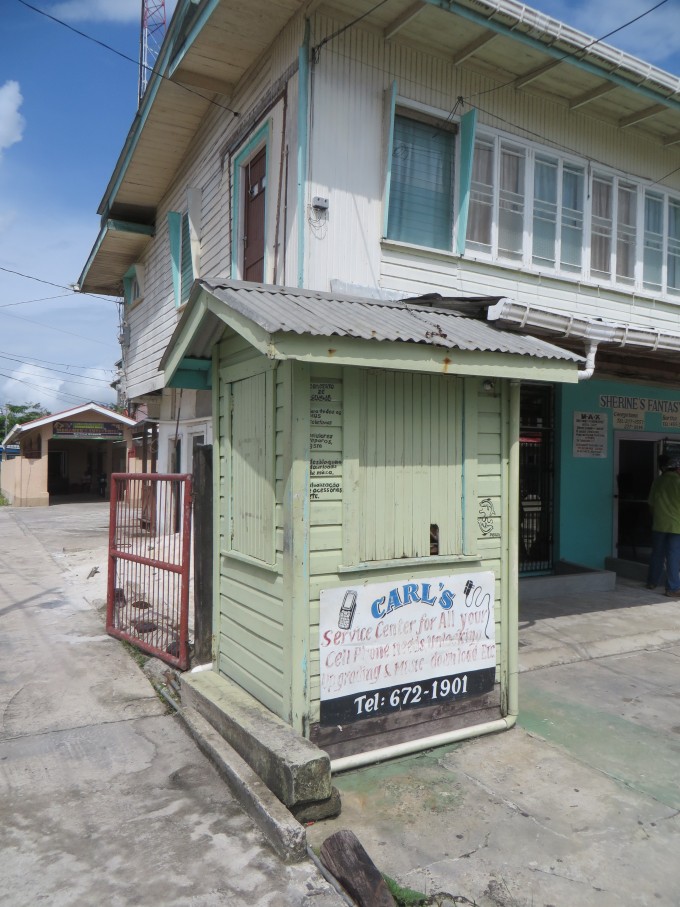
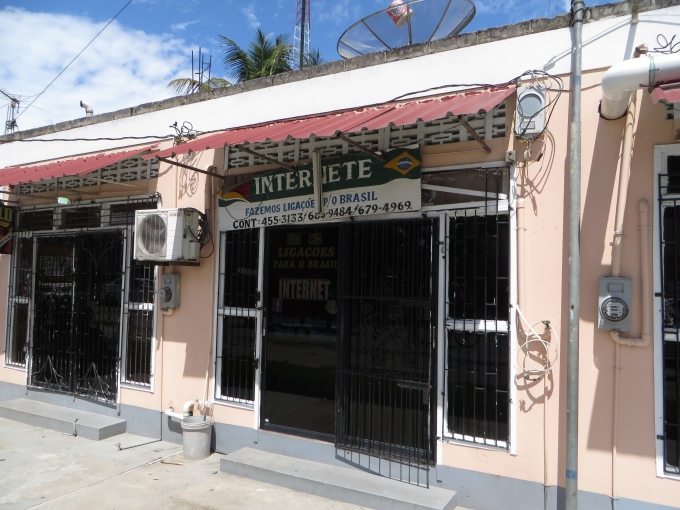
Once again, we are Internet-challenged. Sad to say, we used to survive admirably well without Internet in our early days of cruising. But now that we do a daily blog, it seems a hardship to do without it. Internet access aboard, via digital modem, has been on our agenda since we arrived here in Bartica. Typically, in other countries, we've purchased a dongle/digital modem, a SIM card and a prepaid data package and though there were hiccups, we (read that David) usually succeeded in getting Internet aboard. It's been a struggle here, however, to access the Internet at all. As you'll recall, we visited the Digicel office on our first day ashore. We couldn't purchase a digital modem here in Bartica (maybe in Georgetown...hours away downriver), but if we unlocked our iPad, we could purchase a SIM and a prepaid data package. Not the best solution, but better than nothing. But Carl, the “unlock” guy, wasn't in his office that day or the next, so we needed to find another alternative … an Internet kiosk. Really? We haven't done that in nearly a decade.
internet in guyana

We found two places offering Internet … one was locked up tight; the other was just opening at 10:15. Internet was G$500/hour … fair enough. David had his iPad and, with a little help from our kiosk friend, was able to get on line immediately. I had a USB memory stick with me loaded with pics and blog posts for Gentry and I planned to use the kiosk's computer. I had problems getting on-line. First, the keyboard letters were missing entirely. Second, all the screen commands were in Portuguese … I forgot to mention, it was a Brazilian Internet place.

I finally accessed Yahoo only to be blocked from the account. “It appears you have not accessed your account from this computer before. For security reasons, we'll send you a code to verify your identity.” They offered to send it to my Yahoo mail (which I couldn't access) or our SailMail email address. Well, we weren't on the boat and I didn't have my computer, so SailMail was out of the question. Luckily, David was already on line, so we opted to have the code sent to the Yahoo address.

We waited and waited. Internet was painfully slow, but not this slow. I asked for the code to be resent. It popped up on the iPad screen a few minutes later. Unfortunately, the message “Downloading this message is taking longer than usual” also appeared. We waited and waited some more. Finally, the Yahoo code appeared … just about the same time that the electricity went out. “Black-out”, murmured our Internet guy. “How long?” we queried. A shrug of the shoulders indicated anywhere between 10 minutes and 10 hours. He told us to return in 30 minutes.

We checked out the flea market alley and a few other shops … Christmas decorations were on sale … and dutifully returned to the Internet shop in 30 minutes. Still no power. We had lunch and returned in another hour … still no power. We picked up some Demarara sugar from the grocery store and returned an hour after that to find the shop closed. A neighboring vendor indicated 6pm was the ETA for power resumption. We gave up and headed back to the boat.

En route, David noted that the generators for the power station, right on the main street, were housed in a semi-trailer in front of the Bartica Power & Light Company. A service truck was parked in front of the trailer.

guyana power and light

Looking up at the bird's nest of wires surrounding each utility pole along the street, we could begin to understand the power issues in Bartica.

birds nest of power wires in guyana

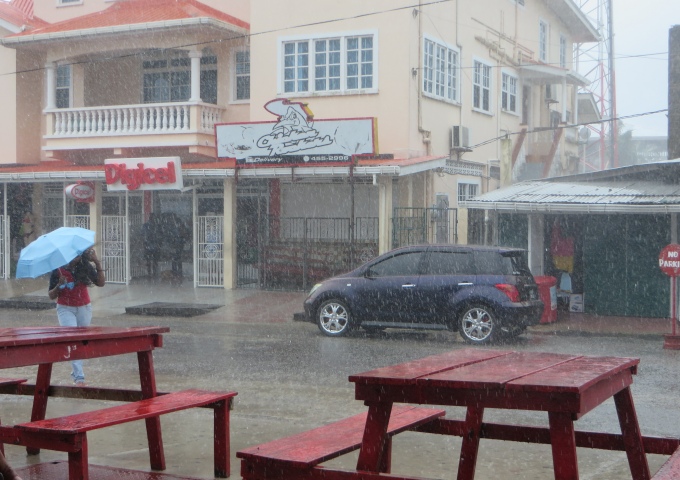
And then it was Sunday … everything was closed. On Monday morning, bright and early, we headed back into town. We found Keevan who handled our iPad unlocking problem. We waited out a torrential downpour then headed to Digicel to purchase a SIM card and 1GB of prepaid data for a whopping G$5000. Ouch!
waiting out the rain in guyana

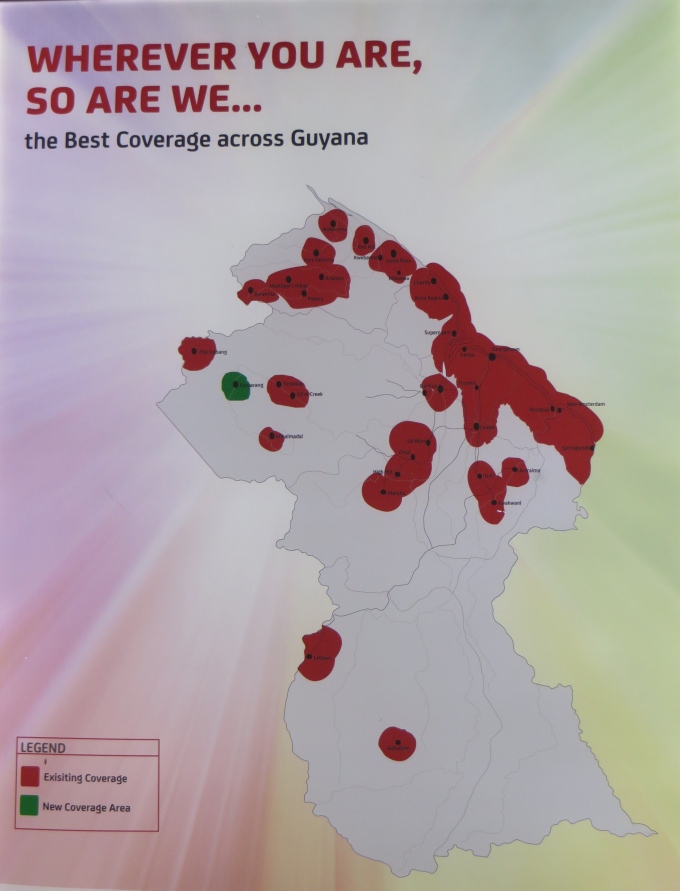
Looking at the Digicel coverage map in Guyana tells the story of where the population centers are … and aren't.
digicel coverage map

While David waited for the Digicel service to be activated (anywhere between 10 minutes and 2 hours, we were told), I headed back over to the Internet kiosk. We had never paid the fellow for our previous visit (though we'd accomplished nothing) and I was anxious to send blogs and photos to Gentry. This time we lugged my laptop ashore and I could get into Yahoo without delay. The Internet was slow, but at least I got through. Hallelujah! Just as I was finishing up, David arrived with a smile on his face and working Internet on his iPad.

at the internet kiosk in guyana

Do we sound disgruntled and frustrated? Well, we were a bit frustrated, but honestly, the rustic, vibrant feel of Bartica has been enough to overcome the Internet malaise. Life is good, especially now that we're in touch with the world once again.
Welcome to Bartica

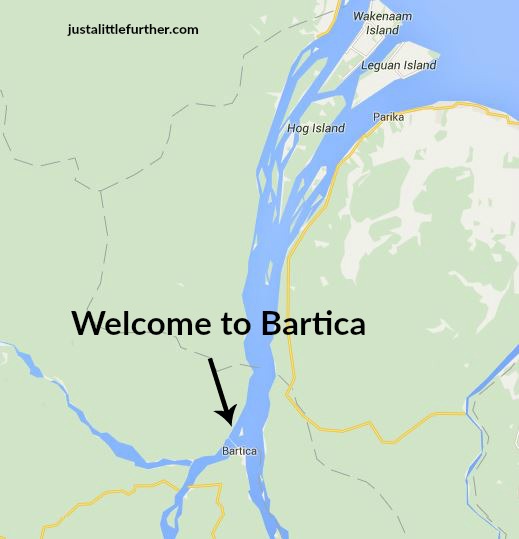
Bartica, (pronounced BAHR-ti-kah), a small port town of ~15,000+ people, is located on the Essequibo River, at the confluence of the Cuyuni and Marzaruni Rivers, about 50 miles upriver from the Atlantic. It's called the “Gateway to the Interior” as it's the key jumping off spot for freelance miners, known as pork knockers, that scour the alluvial fields of Guyana's interior for gold and diamonds. More about pork knockers later. welcome to bartica

We arrived just before Noon, launched the dinghy, and after feeling comfortable with our anchorage and holding, headed into town to check-in. We dinghied up and down the wharf to determine a place to tie up. No place was immediately evident. At the fast ferry dock, we asked and were pointed upriver to a raft of boats tied aft and stern not far away.

view of wharf from the dinghy

We nudged our way between the nestled boats up to a ramshackle hut with a wooden loading ramp that was missing about every other plank. A young black fellow grabbed our painter as we gingerly climbed out of the dinghy and made our way up the steep, rickety ramp, over a cement embankment and onto land. He would tie up the boat and we'd pay him later. Good, since we didn't have any Guyanese currency yet. The narrow muddy trail along the shore led to an alley which finally dumped us out on the main street, First Avenue. We made a mental note for our return that the little alley was next to a Digicel Top-Up sign.

parking the dinghy

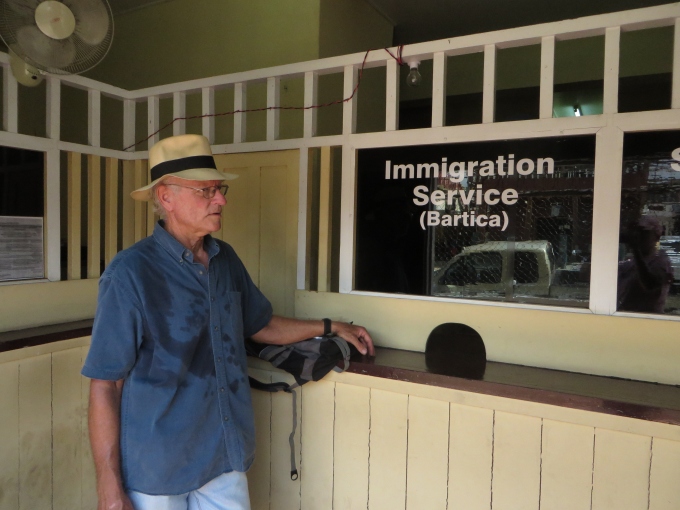
Our first stop was Immigration on First Avenue. It may be a small town, but it seemed everyone was out and about either walking or driving. We arrived just after lunchtime (Noon-1pm) at the Immigration office, but no one was around. We waited a half hour and finally checked in with the police next door. They promised to give the guy a call. He showed up about 10 minutes later, apologetic, and after completing our entry forms and showing him our paperwork, he stamped our passports and directed us to an ATM in order to be able to pay our Customs' fees

immigration check in bartica

We found the Scotia Bank on Second Avenue without much trouble and withdrew G$30,000 from the 24/7 ATM . It's an affiliate bank of Bank of America … no withdrawal fees involved. (Hooray!) Seemed like a lot of money (~US$150) and it was dispensed in all crisp G$5,000 notes. There's always a sigh of relief when our ATM card works in a new country. We headed immediately to Customs back on First Avenue across from Immigration. The office was located down an alley with no signs, next to Church's Chicken and up a steep cement staircase. We completed more forms and paid our G$2,500 incoming fees. We were legal in Guyana. The whole process took about 90 minutes … most of it spent waiting.

5c notes in guyana currency

It was mid-afternoon now, hot and steamy. David had read that Digicel offered prepaid data packages here in Guyana and throughout the Caribbean and they had an office in Bartica. We found it at the other end of First Avenue and waited our turn in line. No complaints … the shop was air-conditioned. After much discussion, it was determined that Digicel did not sell dongles/digital modems for the computer … at least not in Bartica. If we could get our iPad unlocked, they could sell us a SIM card and we could then buy a prepaid data package. Though this wouldn't be optimal for transferring blogs and pics, it was doable and better than nothing. We went in search of the “unlock” guy, but his “office” was closed on a Friday afternoon.

unlock guys office in bartica

We decided to check out the Central Market, a couple supermarkets and generally get the lay of the land. The Central Market was pretty much done for the day...early morning is best, so we'd return another day. There were several small supermarkets with basic supplies. We noticed lots of American products … Bush's beans, Heinz ketchup, Kellogg's Frosted Flakes. Brazilian products were plentiful as well. The prices were horrendous, but considering where we were, probably reasonable just for the effort of getting the products here. Demerara sugar, produced locally, was a bargain, however, at G$240. Rice and beans seemed plentiful and were sold in quantities from huge 25kg (55#) sacks down to individually packaged small plastic bags.

demerara sugar in bartica

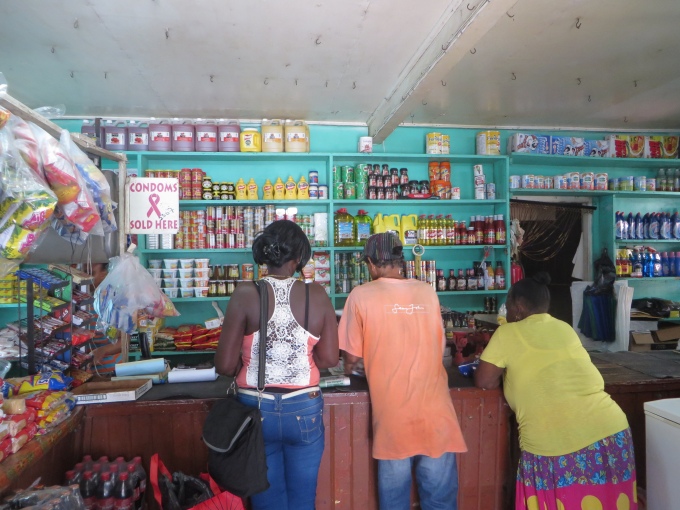
Mike and Tessa's General Store on First Avenue has been around quite awhile. We poked our heads in … five cans of this and four cans of that on the shelves. They sold lots of bulk products like flour, rice and beans. They still weighed everything on an old-fashioned balance scale. Rubber boots hung from the ceiling and we imagined during the rainy season, they'd be in high demand.

mike and tessa general store bartica


mike and tessa general store bartica

There were bars and drinking establishments on every corner and several in between. We saw cases of the local Banks Beer being unloaded. Some men staggered along the streets and we figured they'd begun their drinking early.

banks beer bartica

The Morocco offered three beers for G$1000. Three beers for a thousand dollars … even for Guinness that seemed high until we did the math … ~US$1.50 each.

3 beers for 1k in bartica

It was late afternoon when we tried to find our way back to the dinghy dock. It seems that our landmark, a Digicel Top-Up Sign, was one of many along First Avenue. We finally managed to find the right alley and retrace our steps to retrieve the dink. Heading over the cement embankment and down the steep, now slippery, every-other-plank-missing ramp was a bit awkward, but we managed. Our dinghy parking valet brought the dinghy back to the edge of the ramp. We paid our G$500 fee and nudged our way back out of the parking lot and back to Cups. Enough exploring for one day. Time for dinner, a cold beer and a movie. Tomorrow's another day and we're looking forward to it.

retrieving the dinghy


The Blue View - Handheld Windlass Controller

anchored off bartica In the last Blue View, Nine of Cups was in Suriname and I talked about installing foot switches for controlling a windlass, and using a windlass motor control module to reduce the current that passes through the switch contacts. Now we are 50 miles up the Essequibo River in Guyana, anchored off the small town of Bartica. In this BV, I want to address the usefulness of a handheld windlass controller and how to make one.

up the essequibo

Navigating the river was a challenge at times. The river has a strong tidal current, and it is necessary to wait until the current is flowing in the right direction before heading upriver. I know this is nothing new to you sailors who grew up sailing in waters with a large tidal swing, but for a guy who grew up in Colorado, it never ceases to amaze me when a river not only flows backwards six out of every twelve hours, but does so with great enthusiasm. The river is quite muddy, making it impossible to pick out shoals and rocks visually. In addition, the electronic charts are off by several hundred feet, and most of the channel markers have long since disappeared. Finally, the local fishermen use long nets, either stretched between poles stuck in the river or between an anchored float and their small dugout fishing boats. Our trip up the river had to correspond to the tidal swings, but had to be in daylight as well. We anchored offshore the first night, a few miles up the river on the second night, and made it to Bartica during the flood tide on the following day.

hosing off the chain

The river is quite muddy, and every time we haul the anchor, it and the chain come up coated with thick grey mud and clay. Our Boss anchor pulls up great gooey globs of the stuff. Rather than getting the mud all over the deck and down into the chain locker, Marcie uses the deck wash and hose to wash the mud off as the chain comes up. She leans over the bow pulpit, raises the anchor a few feet, and sprays the exposed chain until the mud is washed off, then repeats the process. Unfortunately, in this position, she can't reach the windlass foot switch with her toe.

hand held controller

Our handheld windlass controller makes her job easier and faster. She can lean over the bow pulpit with the hose sprayer in one hand, while controlling the windlass with the other. When we have a lot of chain out and the mud is thick, raising the anchor might take a half hour using the foot switches, while the handheld controller might knock ten minutes off the process. Notice that we still have the foot switches mounted in the deck. If either the foot switch or the handheld controller stops working, the other remains as a backup.

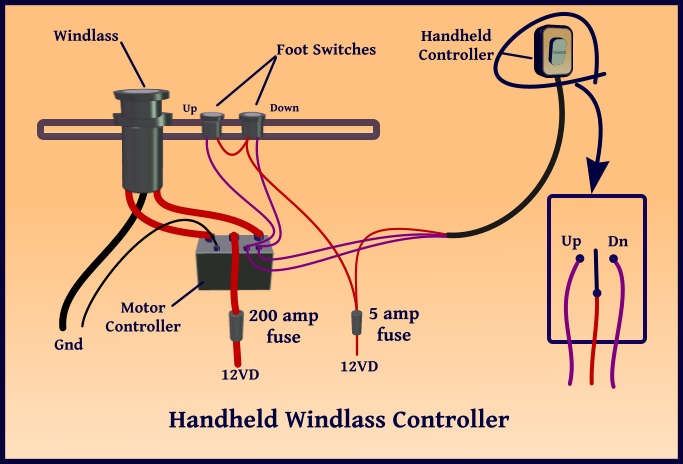
hand held controller sketch

The handheld controller is nothing more than a SPDT rocker switch mounted in a small palm-sized enclosure and connected to the windlass motor control module with a long, three conductor cable. The cable is long enough to reach from the motor controller to the bow. One switch contact connects 12vdc to the 'Up' connection on the motor control module and the other contact connects 12vdc to the 'Down' connection. Since the current required for these connections is less than 5 amps,(typically 3 amps) for our Lofrans windlass motor control module, the switches and wiring can both be small. I used a waterproof Cole Hersee “Contura” rocker switch from West Marine (C-H Pt. No. 58332-22-BP). I store the handheld controller in a small bin mounted in the forepeak locker when not in use to keep it out of the elements for most of its life.

In the next Blue View, I'll talk about our chain counter. It's not difficult to add a small display and some circuitry to the handheld controller so that Marcie can see how much chain is in the water as we drop or raise anchor. Marcie may disagree, but for you fellow sailor-geeks out there, it just doesn't get much more entertaining than that.