About Guyana

about guyana As usual, we've done our homework in advance and have some feel for what to expect when we arrive in Guyana. We're kind of excited about the trip; it's the only country in South America we haven't visited and it'll be a good tick on our bucket list. Guyana is a small country, a bit larger than the state of New York. Formerly British Guiana, it became independent from Great Britain in 1966. It's proper name is the Co-operative Republic of Guyana. Nestled between Venezuela to the west and Suriname to the east, it borders Brazil to the south and the Atlantic sweeps its shore on the north.

map of guyana

Guyana is an Amerindian word translating to "land of many waters." It has a huge network of rivers, the three largest of which are the Demerara, the Berbice and the Essequibo. It's the Essequibo, Guyana's longest river, that we'll tackle. From what we've read, the climate is pretty much identical to that of French Guiana and Suriname … hot and steamy this time of year with frequent showers. Like the other Guianas, Guyana is more Caribbean in culture than South American. We aim to find out.

Lonely Planet provided a list of Guyana's key attractions. Kaieteur Falls tops the list. LP describes it this way … “Watching 30,000 gallons of water per second be shot out over a 250m (820ft) cliff in the middle of a misty, ancient jungle without another tourist in sight is a once-in-a-lifetime experience.” Something we'd love to do. We'll see how it works out.
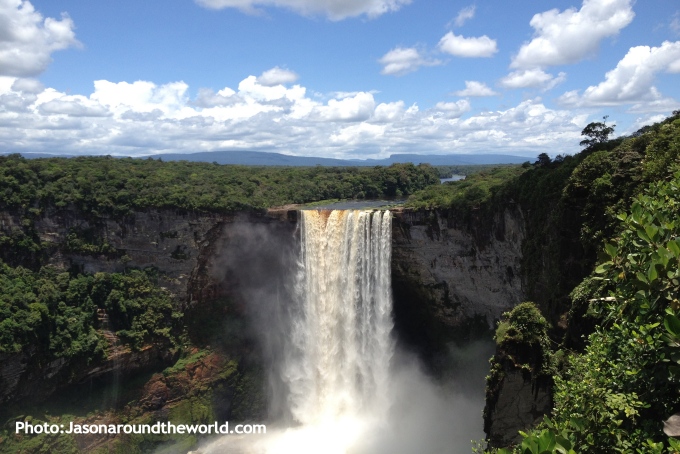
kaieteir falls in guyana Lonely Planet

The Guyanese currency is the Guyanese dollar (GYD – G$). The exchange rate today is about US$1=G$200 which means we'll be doing higher math to figure out our true cost of things.

currency in guyana

A little Guyana trivia for you …

Guyana is the only country in South America with English as its official language although Creole, Hindi, Urdu and several AmerIndian dialects are frequently spoken.

Guyana is probably best remembered as the site of the mass suicide at Jonestown in 1978. Jim Jones, the leader of the People's Temple Movement, convinced 900 of his followers that it was “time ... to meet in another place”. They all drank cyanide-laced red Kool-aid and were dead within an hour.

Georgetown, Guayana's capital and only large city, lies 13 feet below sea level at high tide. A sea wall and an early Dutch canal system keeps the town from flooding and provides drainage.

Demerara sugar, a brown, raw cane sugar, gets its name from the Demerara River in Guyana. The Guyanese sugar industry, with a 300-year old history, is nationally controlled (Guysuco) and huge. Logging and mining (gold and bauxite) are also important contributors to Guyana's economy.

The Guyanese national flag is called “the Golden Arrowhead”. Whitney Smith, an American, is credited with the design. Our friend Doris in Namibia made ours for us and we'll have the chance to use it now.

courtesy flag of guyana

Guyana's first Olympic medal was won by Michael Parris who got a bronze for boxing in 1980. Cricket is a national sport, introduced by the British and played religiously.

We're looking forward to our time here. We hope you plan to come along.

Up Guyana's Essequibo River

It poured cats and dogs during the night. We were up at quarter to dawn to catch the early morning flood tide 40 nm up Guyana's longest river, the Essequibo. The rain had mostly stopped and it was cool, misty and grey at first light. The decks were wet, but clean. We hauled the anchor, heavy and thick with clay and mud. Smoke, sawdust and rich earth smells filled the air. IMG_0084

From the get-go, the passage up the Essequibo was interesting, but required lots of concentration. We had what we assumed were good waypoints (23 of them!), but even the few navigational aids shown on the chart were missing. In the entire, circuitous 50nm trip, we saw only three markers. To add to the challenge, our Navionics charts were off by about 700' N/S and 300' E/W, making it appear at times, as if we were sailing over land.


IMG_0085

Sights along the river were colorful and diverse. We saw an array of Hindu prayer flags on a beach and

hindu prayer flags essequibo river

lots of abandoned, rusting hulks. Several large motor vessels were high and dry on the sand, hopefully using the low tide for repairs and maintenance.

high and dry on the essequibo river

For a good portion of the trip, we had one foot on land and one in the water, i.e. we were very close to the river shore. This afforded the opportunity to observe shore life and take lots of pictures.

kids on the shore of the essequibo river

The largest port on the river is Parika, low-lying Georgetown's primary port. We watched the ferry from Bartica pass us as it headed to the stelling (a new word for us), the commercial wharf/terminal for ships.

bartica ferry on the essequibo

The wharves of Parika were busy with trucks and boats loading and unloading market produce. Bananas seemed to be a bumper crop.

parika market essequibo river

Fishermen, in tiny open boats, worked hard pulling up their nets. We watched men wrestle fuel barrels off riverboats onto small boats. Fast river taxis whizzed past and slow heavily-laden barges, nudged forward by tugs, shared the river with us.

fisherman on essequibo river


guys with fuel essequibo river

Logging is big industry in Guyana as evidenced by the number of sawmills, mountains of sawdust and volume of cut logs piled along the shores. The distinct, pleasant smell of freshly cut wood permeated the air.

sawmill on the essequibo

Houses dotted the shore with boats moored nearby, some barely visible through the dense foliage. There are few roads in Guyana, but lots of waterways. Boats are essential transportation here as they were in the other Guianas.

red boat docked on the essequibo

Numerous private piers extended into the river from the shore for ease of loading and unloading. Some were very elaborate and some basic, but all seemed to do the trick. The tidal range here is about 8' (2.5m).

private pier on the essequibo river

By mid-morning, the grey overcast cleared and white puffy clouds appeared in a blue sky. We motored on a milk chocolate river.

a little sunshine

We passed Fort Island, location of the British Guiana's first capital city, and could make out the ruins of the 18th century Fort Zeelandia, built while the Dutch ruled the colony. We noted that this might make a great stop for exploring on our way back downriver. The Dutch were not very imaginative with their fort names evidently. Wasn't the fort in Paramaribo named Fort Zeelandia, too?

fort zeelandia on the essequibo

The foliage ashore was thick and verdant. There seemed to be a thousand shades of green, accentuated by random streaks of yellow, red and purple blossoms and brightly colored parrots and macaws squawking and flitting between trees. I spotted a toucan, perched high on a dead tree. Our first toucan in the wild ... far away, but easy to identify in profile.

first toucan on the essequibo

Moths, butterflies, bees, dragonflies and welcome swallows darted by, traveling significantly faster than our 7.5-8 knots. They all eyed us briefly, but obviously discovering nothing of interest, continued on their way. Several of Eddy Egret's kin crowded on the riverside mangroves.

egrets on mangroves on essequibo river

As we neared Bartica, we passed close to Two Brothers Island where musician, Eddie Grant, has built himself quite a palace.

eddie grants place on essequibo river

The current provided about a 2.5 knot push for us. The further up the river we progressed, the later the high tide, and the 40 nm quickly passed. A few sharp turns, an adrenaline moment as we transited Rattlesnake Pass and saw the depth meter dip quickly to 9' (2.8m) and there was Bartica. We motored past the Bartica Stelling and were anchored comfortably off the town by Noon. A new country and a new adventure lie ahead.

there's bartica

We're thankful for...

happy thanksgiving It's Thanksgiving Day in the USA and here we are in Guyana, quite removed from the family, festivities and feasting … and turkey. We'll make do with chicken and whatever else we can rustle up to go with it … maybe mashed potatoes and, if we're in luck, a little cranberry sauce? We always find a way to celebrate.

We decided to spend a little time en route on our last little passage, making a list of all those things for which we're thankful. We know we're blessed to be living the life we do and it's the perfect time to reflect on just how fortunate we are … especially when you hear us griping about doing boat chores, Here we go … 8 things for which we're most thankful.

  1. Our health

    Man, are we ever lucky in that department. We've had our share of health issues along the way, but nothing catastrophic or continuing. Considering our ages, creeping ever upward, we're in pretty good shape. Neither of us requires any daily medication, except for maybe some Ibuprofen once in awhile. Knock on wood, we hope our good health continues.

  2. Our lifestyle

    We know we lead a charmed life and there's barely a day that passes that we don't think about it. Sailing around the world … our hotel room and restaurant with us. Dawdling indefinitely when we want to; leaving when we decide it's time. Cultural immersion, inland travel, flights home so our family won't forget our faces … it's all part of this wonderful life we lead. No, it's not for everyone, but it's definitely for us.

  3. Our friends and family

    Our family has been supportive of our lifestyle from the start (though they get a bit testy about our absence every once in awhile). We've met so many good cruising friends and wonderful folks in the countries we've visited that have enriched our lives. Then there's you, our readers, who take the time to read and share our experiences with us.

    Special thanks to our niece, Gentry, who's responsible for publishing and maintaining Just A Little Further every single day. And, of course, Lin, Marcie's sister, who pays the bills and handles most every other emergency that pops up and gives us a place to live when we visit Boston. And David's sister, Mary, who feeds us gourmet style and gives up her bed when we visit Las Vegas. Oh, we could just go on and on … we're thankful, you guys, we really are.

  4. Good fortune

    Luck has a lot to do with our continued ability to sail, travel and live aboard. All the planning in the world can't trump plain old good fortune. We've certainly had situations that could have been catastrophes, but have instead been important learning experiences and life lessons. Others we know have not fared as well. Good fortune has been with us and we pray it sticks with us.

  5. How much water there is on Earth

    70% of the Earth's surface is covered in water. We thank God for giving us such a fantastic planet ... so much water and so much world to sail around.

  6. Nine of Cups

    Who could have known back in 2000 when we bought this 1986 Liberty 458 that she'd be our home for the next 15 years and carry us nearly 90,000 miles around the world to exotic places that we'd only dreamed about … and a few we'd never even heard of before. She's seaworthy and sea-kindly.

  7. Our financial situation

    We're not rich by any stretch of the imagination, but we saved enough before retiring and now have sufficient income to live comfortably and travel aboard Nine of Cups. It's a combination of hard work, planning and luck, but we're thankful we have the funds to continue living this life.

  8. Each other

    This lifestyle wouldn't work if we weren't both in love with this life of travel and adventure and each other … and all aboard a sailboat.. For 30+ years, we've been soul mates. For the past 15+ years, it's been living this life aboard Nine of Cups. Really …. how could we not be grateful for all we have?

Happy Thanksgiving everyone!