Grass Islands and Roosting Parrots

grass islands graphic While reading Doyle's Cruising Guide to Guyana, I noted a Noonsite comment about things to do near Bartica … “Some nights must also be spent at Grass Islands, where hundreds of parrots go every night to roost, a sight you will be unlikely to see anywhere else in the world, not to mention the sounds.” We decided to get away from the big city for a night or two and check out the Grass Islands, just a mile or two on the other side of the Essequibo.
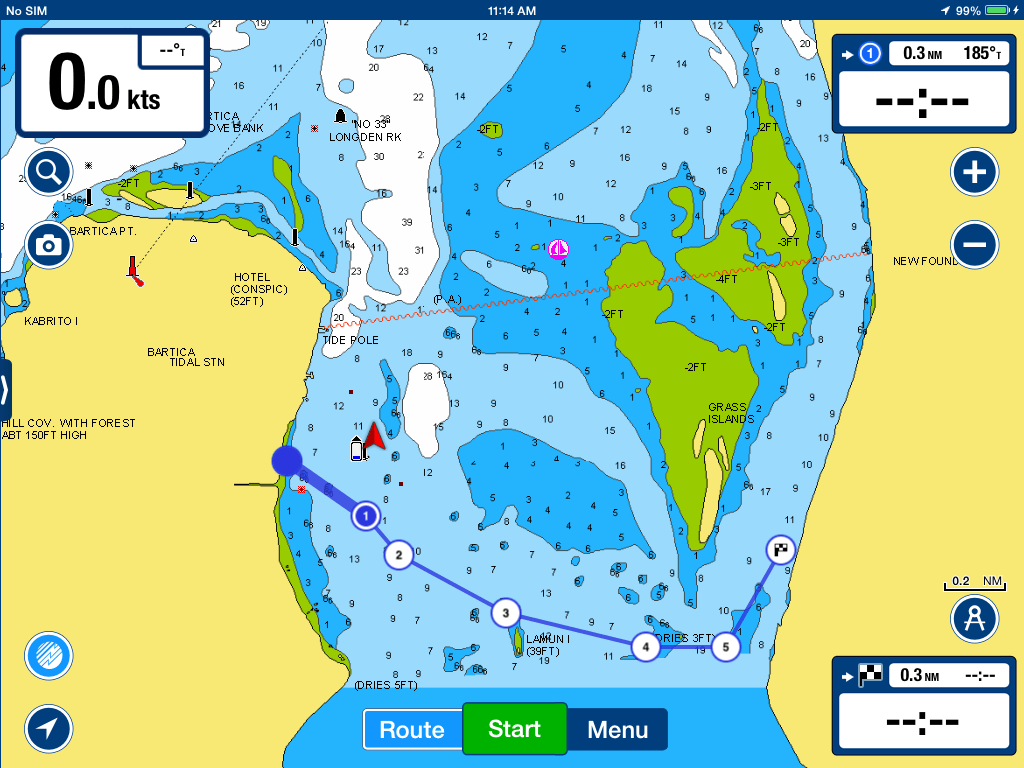
chart for the grasslands

We had more than one motive for moving the boat. It gets pretty loud near the Bartica shore at night with music, traffic noise and the comings and goings of small riverboats, fast ferries, and ships on the wharf. We were hoping for a more tranquil setting. We left Bartica in late afternoon and picked our way carefully across the river. The distance isn't far, but with uncharted shoals and rocks, we played it safe and headed there slowly on a rising tide. We saw a least depth of 9.8' (2.8m) during the transit and anchored in the lee of the largest island in about 20' (6m). The setting was quiet and calm, out of the ship channel between the Grass Islands to the west and a few houses and a little river ferry stop on the mainland shore to the east.
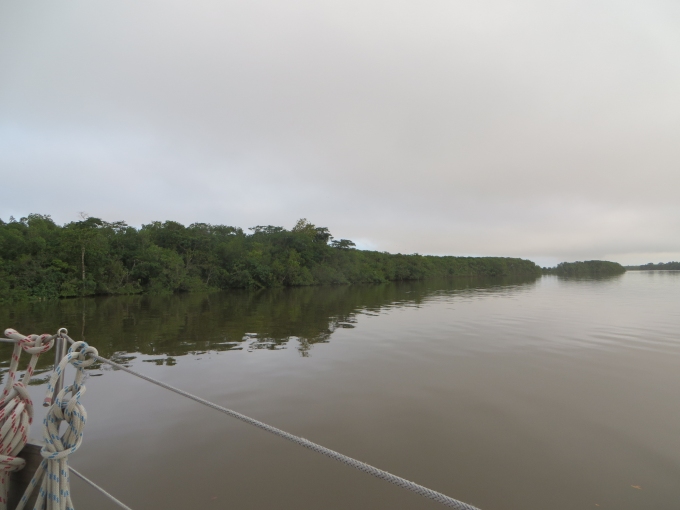
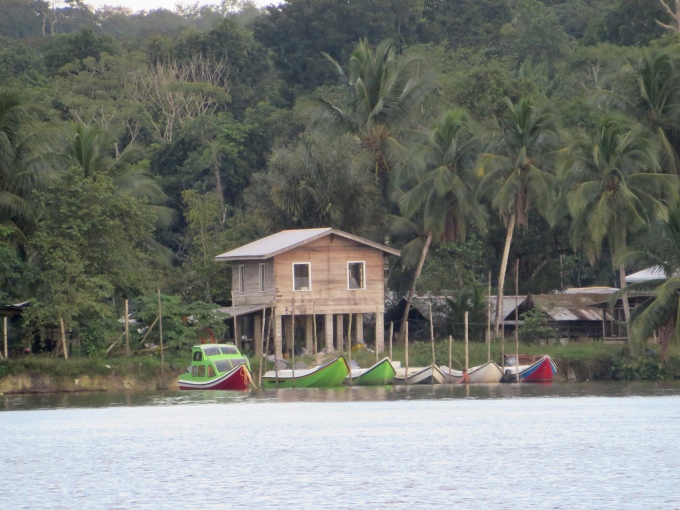
grass islands in guyana


ferry station guyana

As we waited for dusk and the parrot migration, we busied ourselves with little chores … polishing stainless, wiping down the cockpit, general tidying up. As a side note, we've been quite disappointed in the new stainless rigging which seems to show rust much more than any previous rigging we've had. This, in spite of the fact that the highly recommended South African rigger made a point of telling us and emphasizing that he only used top quality European wire and nothing imported from China. I gave David a much needed haircut on the aft deck. At slack tide, we took a refreshing dip in the river.

wiping down the stainless in guyana

It was dusky by 5:15 and still no parrots. We thought we'd been misled when we suddenly heard a faraway squawk, then another, then another. Flapping their wings in the awkward, comical way that parrots do, and squawking loudly all the while, they came in pairs, then five pairs, then flocks of 20 and 30 pairs. They came from the south mostly, from upriver where it's less inhabited and more densely forested. The sound volume was incredible … chaotic, frenzied “Honey, I'm home” squawks … a 45 minute concert of disharmony.

parrots returning in guyana

They landed in the treetops, then seemed to delve deep into the foliage. They must have occupied every tree and branch on the island. We wondered if they return to the same reserved roosting branch every night or if it's first come-first served. The sound had intensified and then at 6pm, when the last vestiges of day had disappeared, it was as if the 'lights out' signal was given. We heard a couple of “Good night, John Boys”, and then all went silent. Unfortunately, the light was so dim and we were so far away, the photos taken from Nine of Cups' deck were pretty poor quality. Despite that, can you pick out all four parrots in this picture?

parrots in guyana

We had our dinner, enjoyed the evening calm and resolved to be up at dawn to see the parrots return to their day jobs. At first light, just about 12 hours after their previous night's return, we heard the first squawks of the early birds heading out. Then the sky was full of squawking parrots and by 5:45am, all was quiet again. Again, too dim for photos, but we certainly enjoyed the entertainment. It was reminiscent of the corellas on Bribie Island on Australia's east coast. The squawking was so loud there that a fellow finally stomped out of his house and began thwacking the trees with his cricket bat in a maniacal way, yelling “Shut up … shut up!”. It worked ...kind of. The corellas, startled by the thwacks, flew off to other trees just down the road.

We stayed another night, snuggling in closer to the nesting island, in hopes of getting better photos, but overcast skies dampened our chances. In the morning, it was pouring which didn't deter our parrot friends in the least. They headed off to work just like mailmen. The rain cleared and we ventured in the dinghy to the far side of the roosting island to see what we could see. Spider lilies bloomed profusely and trees boasted large orange blossoms.

spider lillies

During low water, we could see why these were called the grass islands. We drifted in the dinghy with the tide for awhile, then David paddled through shallow channels lined with tall grass.
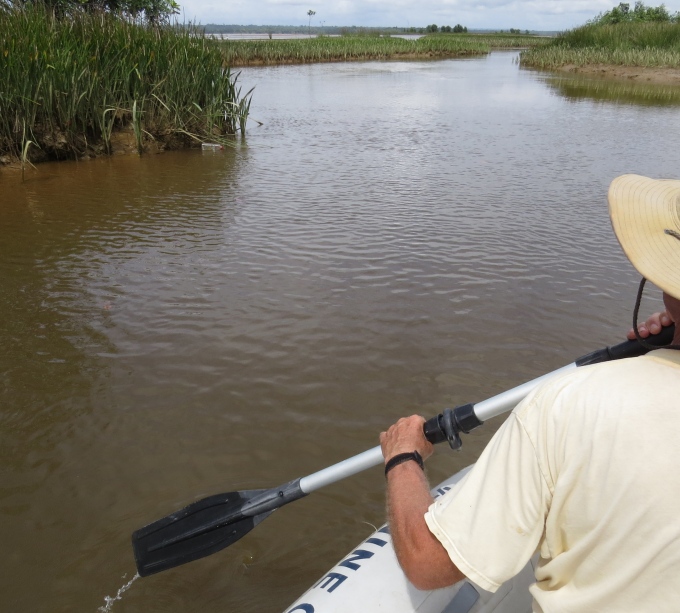
shallow canals on grass island guyana

The parrots were gone, but a pair of egrets surveyed the muddy low-tide shore for snacks.
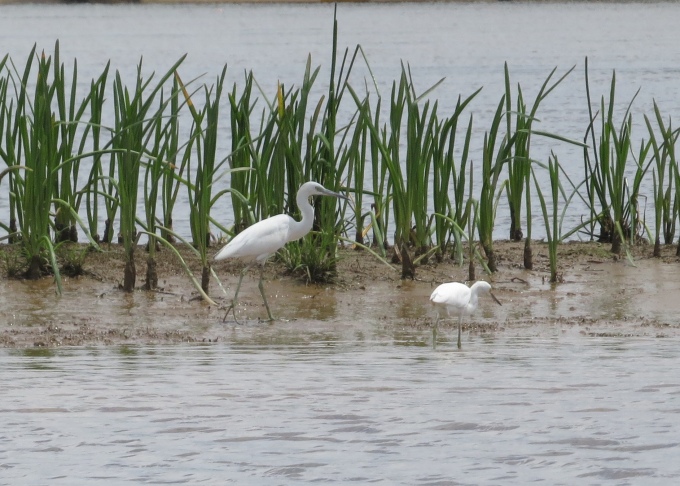
egrets in guyana

At dusk, it was raining again, so no chance of a closer encounter or photos. We did, however, enjoy a repeat of the parrots' discordant sonata.

We have marginal internet capabilities here and haven't purchased a bird book for the Caribbean. Any chance someone can help us to identify this medium-sized, lime green parrot with yellow cheeks and a blue head?

Cowboys and Pork Knockers

porkknocker collage

Visiting Bartica has become an experience in itself. It reminds us of Dawson City in the Yukon Territory or Leadville, Colorado, high in the Rocky Mountains or even Iquitos, Peru on the banks of the Amazon. A kind of 1950s-ish, scoff-law cowboy town … isolated and agrestic. The folks who live here are mostly miners or purveyors of supplies and services for miners.

we buy gold signs in guyana

Miners here are uniquely referred to as “pork knockers”, a term specific to freelance Guyanese gold and diamond miners. According to Wiki, the term “refers to the miners' regular diet of pickled … wild pig that is often eaten at the end of the day. Caribbean author, A. R. F. Webber, suggested that the term may have originated as pork-barrel knocker.” Odd name though it probably aptly describes the rough and tumble folks that live in this colorful, mining town. “Pork-knockers have been responsible for discovering large deposits of gold and diamonds. Many Guyanese stories describe pork-knockers who have made fortunes only to lose them in a tragic or comic fashion. Guyana-born author Jan Carew's 1958 novel, Black Midas, involves a boy leaving his coastal village to become a pork-knocker.”

There is a lawless kind of feel to the place though the police station is right on First Avenue … behind a sturdy fence topped with razor wire. The roads are unmaintained. There's trash everywhere ... on the streets, in the gutters, vacant lots, and along the shore. We brought in a bag of trash to shore for disposal and asked our dinghy valet where to dispose of it. He shrugged and pointed to the shore which was heaped high with rubbish. We asked at the Police Station and it took awhile to determine that the only public trash bin they knew of was on the ferry stelling.

trash on the shore of bartica

Cars and trucks park haphazardly anywhere there's room and sometimes where there's not. Big olive green mining trucks full of fuel barrels, equipment and supplies take up all of the width of the roads sometimes, forcing other cars to back up out of the way.

mining truck in bartica guyana

The narrow, pot-holed streets are jammed with pedestrians and traffic, but it seems to work. Traffic noise is trumped by loud music blaring from the booths of vendors selling pirated CDs and DVDs. Orderly chaos, maybe?

busy first avenue in bartica guyana

The bars, most without signs, do a land-office business and seem to be open all the time, dispensing cold beer and spirits in volume. People ... men and women … walk, or sometimes stagger, along the streets swigging beer day and night (not unlike Vegas or New Orleans, I suppose), talking loudly or maybe singing We hear music ashore late into the night. Like hard-working miners everywhere, when there's a bit of a jingle in their pocket and there's time away from the harsh, backbreaking mining routine, it's time to relax and throw a few beers back (and then a few more).

bar with no sign in bartica guyana

Housing must be at a premium because there's a plethora of weathered old, dilapidated houses throughout the town that should probably be condemned, but appear to be occupied ... laundry hanging on the lines and rain barrels in position to catch fresh water. Speaking of fresh water, there is no potable water available from the town taps and effluent drains into the river. We cannot use the watermaker because we're anchored in fresh water. We've been advised to catch rainwater for drinking or buy bottled water. Our water tanks are still pretty full, but we're in conservation mode.

dilapidated houses in bartica guyana

Despite the trash and the potholes and the inconveniences, there is a definite third world, Old Wild West charm to Bartica that we appreciate. People are friendly on the streets, look you in the eye, smile, and say hello. We stopped by one shop to ask a question and were invited to a Hindu pre-wedding party later that evening. People are rugged and self-sufficient here, living in wild isolation, but their friendliness shows through a rather hard exterior.

In Search of Internet in Guyana

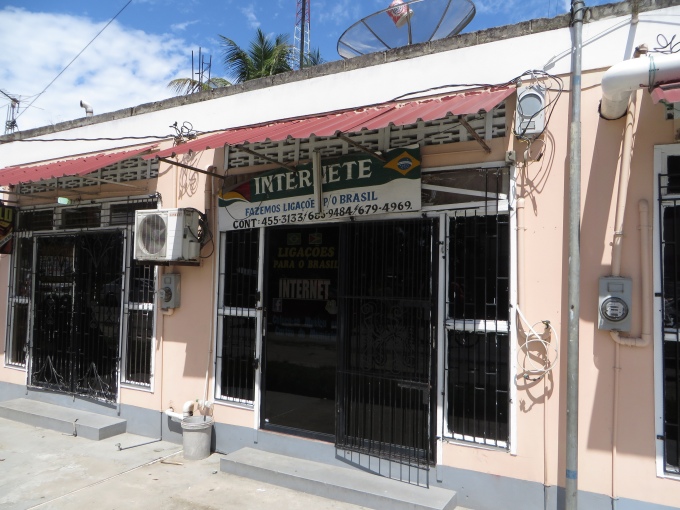
Once again, we are Internet-challenged. Sad to say, we used to survive admirably well without Internet in our early days of cruising. But now that we do a daily blog, it seems a hardship to do without it. Internet access aboard, via digital modem, has been on our agenda since we arrived here in Bartica. Typically, in other countries, we've purchased a dongle/digital modem, a SIM card and a prepaid data package and though there were hiccups, we (read that David) usually succeeded in getting Internet aboard. It's been a struggle here, however, to access the Internet at all. As you'll recall, we visited the Digicel office on our first day ashore. We couldn't purchase a digital modem here in Bartica (maybe in Georgetown...hours away downriver), but if we unlocked our iPad, we could purchase a SIM and a prepaid data package. Not the best solution, but better than nothing. But Carl, the “unlock” guy, wasn't in his office that day or the next, so we needed to find another alternative … an Internet kiosk. Really? We haven't done that in nearly a decade.

internet in guyana

We found two places offering Internet … one was locked up tight; the other was just opening at 10:15. Internet was G$500/hour … fair enough. David had his iPad and, with a little help from our kiosk friend, was able to get on line immediately. I had a USB memory stick with me loaded with pics and blog posts for Gentry and I planned to use the kiosk's computer. I had problems getting on-line. First, the keyboard letters were missing entirely. Second, all the screen commands were in Portuguese … I forgot to mention, it was a Brazilian Internet place.

I finally accessed Yahoo only to be blocked from the account. “It appears you have not accessed your account from this computer before. For security reasons, we'll send you a code to verify your identity.” They offered to send it to my Yahoo mail (which I couldn't access) or our SailMail email address. Well, we weren't on the boat and I didn't have my computer, so SailMail was out of the question. Luckily, David was already on line, so we opted to have the code sent to the Yahoo address.

We waited and waited. Internet was painfully slow, but not this slow. I asked for the code to be resent. It popped up on the iPad screen a few minutes later. Unfortunately, the message “Downloading this message is taking longer than usual” also appeared. We waited and waited some more. Finally, the Yahoo code appeared … just about the same time that the electricity went out. “Black-out”, murmured our Internet guy. “How long?” we queried. A shrug of the shoulders indicated anywhere between 10 minutes and 10 hours. He told us to return in 30 minutes.

We checked out the flea market alley and a few other shops … Christmas decorations were on sale … and dutifully returned to the Internet shop in 30 minutes. Still no power. We had lunch and returned in another hour … still no power. We picked up some Demarara sugar from the grocery store and returned an hour after that to find the shop closed. A neighboring vendor indicated 6pm was the ETA for power resumption. We gave up and headed back to the boat.

En route, David noted that the generators for the power station, right on the main street, were housed in a semi-trailer in front of the Bartica Power & Light Company. A service truck was parked in front of the trailer.

guyana power and light

Looking up at the bird's nest of wires surrounding each utility pole along the street, we could begin to understand the power issues in Bartica.

birds nest of power wires in guyana

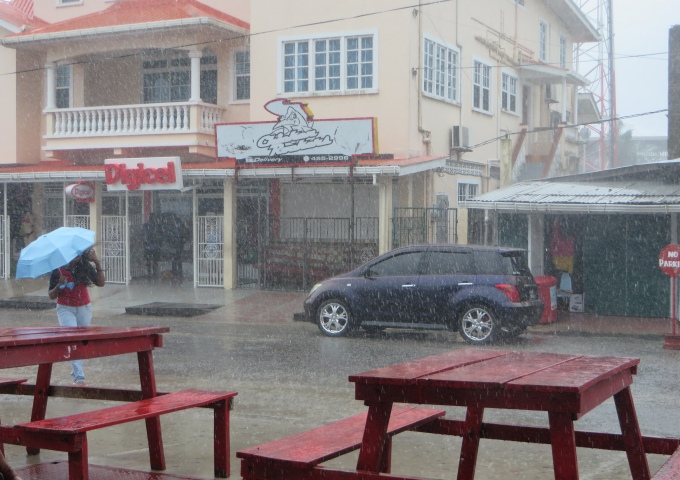
And then it was Sunday … everything was closed. On Monday morning, bright and early, we headed back into town. We found Keevan who handled our iPad unlocking problem. We waited out a torrential downpour then headed to Digicel to purchase a SIM card and 1GB of prepaid data for a whopping G$5000. Ouch!

waiting out the rain in guyana

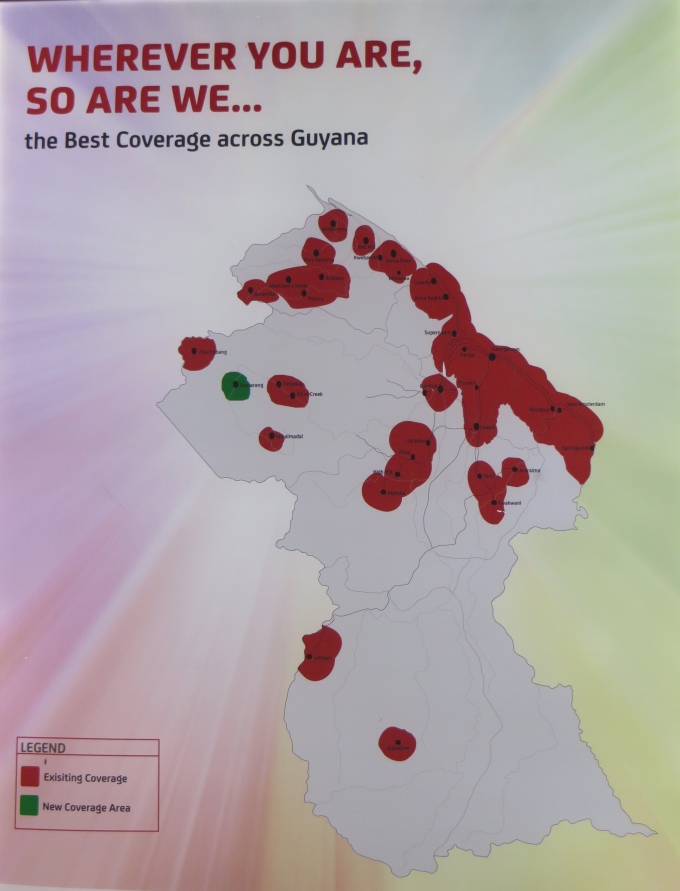
Looking at the Digicel coverage map in Guyana tells the story of where the population centers are … and aren't.

digicel coverage map

While David waited for the Digicel service to be activated (anywhere between 10 minutes and 2 hours, we were told), I headed back over to the Internet kiosk. We had never paid the fellow for our previous visit (though we'd accomplished nothing) and I was anxious to send blogs and photos to Gentry. This time we lugged my laptop ashore and I could get into Yahoo without delay. The Internet was slow, but at least I got through. Hallelujah! Just as I was finishing up, David arrived with a smile on his face and working Internet on his iPad.

at the internet kiosk in guyana

Do we sound disgruntled and frustrated? Well, we were a bit frustrated, but honestly, the rustic, vibrant feel of Bartica has been enough to overcome the Internet malaise. Life is good, especially now that we're in touch with the world once again.