A Morning Jungle Walk at Hurakabra

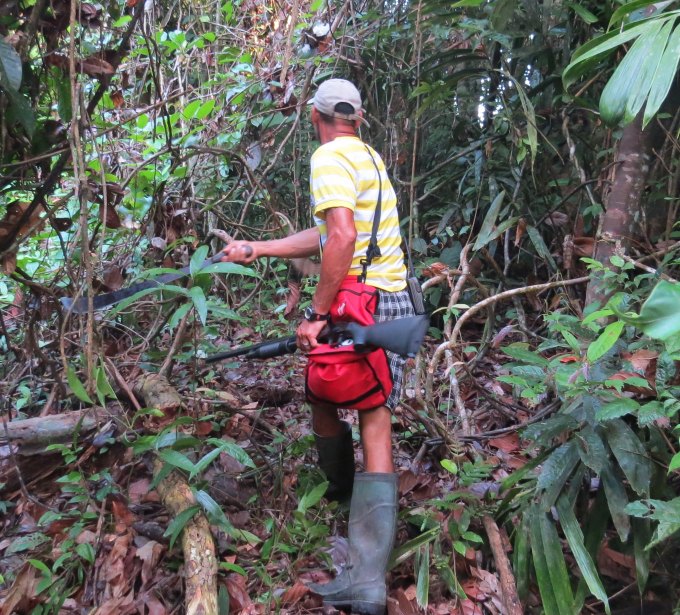
From our anchorage, we can hear the morning chatter of birds and monkeys ashore at Hurakabra. Mike offered to take us on a morning jungle walk and we were only too happy to take advantage of his offer. Along with the Crazy Diamond crew, we clamored ashore at 0630 where Mike, armed with a machete and a shotgun was waiting for us. There might be jaguars!  

mike of hurakabra

We walked through a grove of bamboo, then thick, jungle foliage took over. Mike was very knowledgeable about flora, but had little opportunity to show off his fauna expertise. He pointed out monkey vines and monkey ladders, but we saw nary a monkey (spider monkeys and capuchins inhabit the area).

monkey ladder

Some of the vines looked very much like snakes and I worried that the opposite was also true.

vines look like snakes in guyana

Though Hurakabra touts 178 known species of birds on its 22 acres, we saw few. We heard lots of them, but the only ones we saw flitted high above in the canopy, unrecognizable. The high humidity and heavy morning dew made the thick layer of leaves on the path a bit slippery. The trail is well marked and Mike hacked at new growth as he lead the way. Mike assured us not to worry ... just sitting on the veranda, we'd spot lots of birds.
hacking through the jungle in guyana

We trekked along and trekked along at a leisurely, enjoyable pace. Despite the lack of fauna, it was pleasant to be out and about so early in the day walking in the rain forest. Brightly colored butterflies fluttered past including several gorgeous, iridescent blue morphos. Barry stopped for moment to look at at a plant and a butterfly (or is it a moth?) landed on his boot. We made him keep perfectly still, so we could photograph it.

orange butterfly in guyana jungle

Then Ryan, another accompanying guide, spotted a bright red spider. Despite the fact I hate spiders, this spider was particularly beautiful and quite industrious. It's easier to be brave on the end of a telephoto lens.

spider on his web in guyana

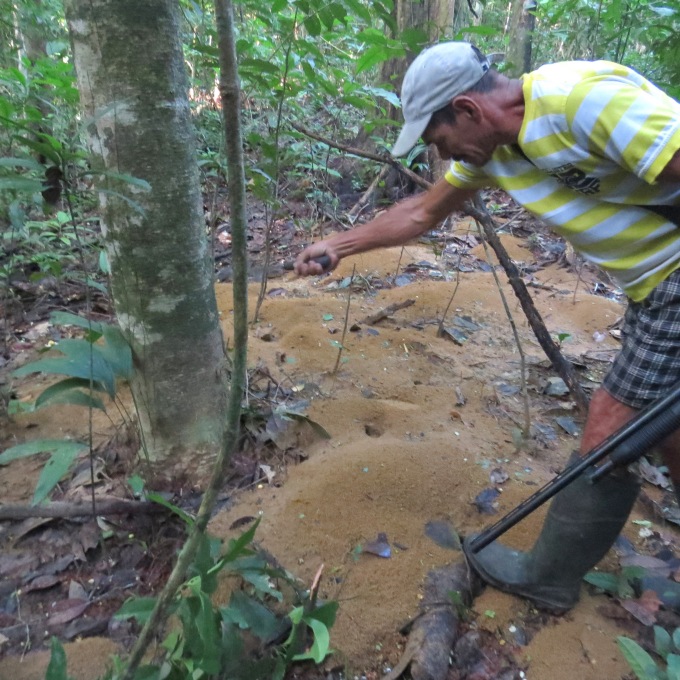
Mike pointed out an acushi ant hill … huge!
acushi ant hill

Brightly colored lizards crossed our path, but thankfully, no snakes.

lizard in guyana jungle

Mountain roses provided bright contrast to the green of the forest.

mountain rose in guyana jungle

Mushrooms and fungi, lots of different varieties we didn't recognize, grew profusely in the rich soil and humid conditions.

mushrooms in guyana jungle

We walked for two hours, then retraced our steps in an hour, covering about 10km (6 miles) total … not a bad morning walk. On our return to Cups, it appeared there's also a bit of jungle going on aboard … beyond the errant frog that David found in the saloon and the bat that whizzed through a couple of weeks ago. The welcome swallows (aka white-winged swallows) have overstayed their welcome and become a nuisance. They flit and dart around over the aft deck regularly now and sometimes through the cockpit. They're always on the bow or the lifelines or sunning themselves on the solar panels leaving a tiny trail of bird poop in their wake.

swallow on nine of cups

They're cute, delightful little creatures, but they've become a bit too cheeky. I watched one land on the solar panels the other day with a twig in its mouth. Oh-oh …

swallow with twig on nine of cups

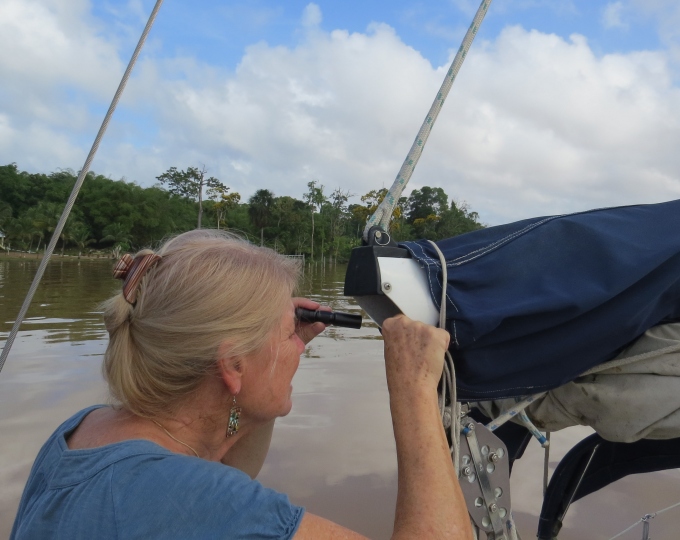
David suggested checking the end of the boom and sure enough, there was the start of a nest. I removed the detritus … twigs and leave parts ... and we stuffed a rag into the end of the boom. After having egrets, bats, and frogs aboard, we've determined that visiting is one thing...moving in is quite another.

We'll keep that in mind when we visit with our relatives in the States!
checking the boom

The Blue View - Windlass Chain Counter

  windlass chain counter

In the last two Blue Views, I talked about our experience with windlass controllers – what worked for us and what didn't and our own version of a handheld controller. In this Blue View, I want to show you how to make a digital chain counter.

The chain counter keeps track of the revolutions of the windlass gypsy, calculates exactly how much chain or rope is deployed, and displays the result in feet or meters on a small LED display. It uses very little power, drawing a few hundred milliamps when operating and only a few milliamps when it's not being used.

I know, I know – if you've never sailed, you probably couldn't care less. If you're an old salt, you're probably thinking “why don't you just mark the chain, ya idgit?”. Well, we do mark the chain, and use the marks as our backup system. We've actually used three different methods to accomplish the job - I talk about the different methods we've used in my book Nine of Cups Guide to Anchors and Anchoring.

I could argue that there are times when the marks are difficult to see, like when the chain is coated in mud or it's a dark and gloomy night - both of which are true. I could also argue that after we are hooked and I go forward to attach the snubber, it's nice to be able to double check, at a glance, that how much chain I think Marcie deployed is actually what's in the water. Probably the biggest reason I built my chain counter, if truth be told however, is that I'm a geek and just really enjoy these projects. Marcie is quite patient as I explain how much easier her job will be and that I'm doing this just for her – or that I can't imagine how we've managed to cruise all these years without whatever I'm planning to build.

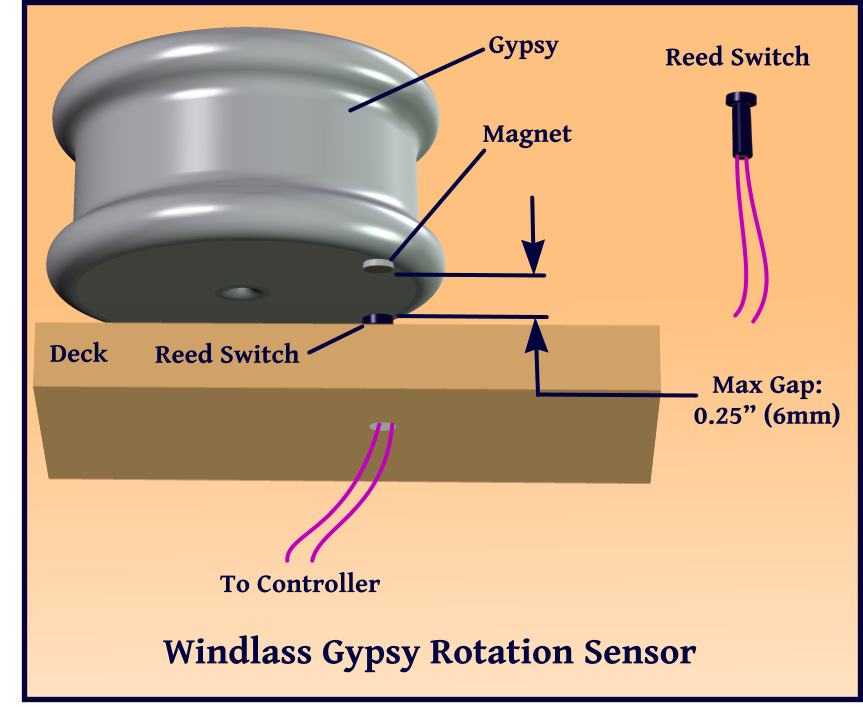
The first issue to resolve is how to keep track of the windlass revolutions. If a magnet is passed in close proximity to a magnetic reed switch, the magnetic pull causes the switch contacts to close. By attaching the magnet to the bottom of the windlass gypsy, and attaching the reed switch to the deck or the base of the windlass just below the gypsy, each rotation of the gypsy will pass the magnet over the reed switch, closing its contacts for a few milliseconds.

chain counter rotation sensor

On our old Maxwell windlass, I had to drill a small indentation in the gypsy bottom in which to mount the magnet. I used Sika bedding compound to hold it in place and seal it from the elements. On our newer Lofrans windlass, a magnet sized dimple just the right size for a magnet was already part of the design. When we replaced the windlass last year, the gypsy came with a magnet already bonded in place.

The reed switch is mounted either in the deck or in the base of the windlass. The maximum gap between the magnet and the reed switch should be about 0.25” (6mm). The Lofrans windlass has a pre-drilled hole in the base that is intended for a reed switch, so all that is necessary is to drill a hole in the deck to pass the wiring through. As with any hole in the deck, the core should be sealed with epoxy to prevent damage. Once the switch and wiring are in place, the entire hole can be sealed with silicone.

chain counter block diagram

The block diagram shows the general design. The handheld enclosure has two pushbutton switches which, when pushed, connect 12 vdc to the 'Up' or the 'Down' terminals of the windlass motor controller. The reed switch contacts are connected to one of the microcontroller input pins. The microcontroller knows that each time the reed switch contacts close, the gypsy has made one revolution, and from this, can calculate how many feet or meters of rode have been deployed. Since the microcontroller cannot tell which way the gypsy is rotating, it also checks whether the 'Up' button is being pushed. If the gypsy is rotating and the 'Up' button is depressed, the chain is being retrieved. If the gypsy is rotating and the 'Up' button is not depressed, the chain must be going out.

The display is a three digit, 8 segment LED display. Since the LEDs draw a measurable amount of current, the display is turned off when the windlass has not been operated for about five minutes.

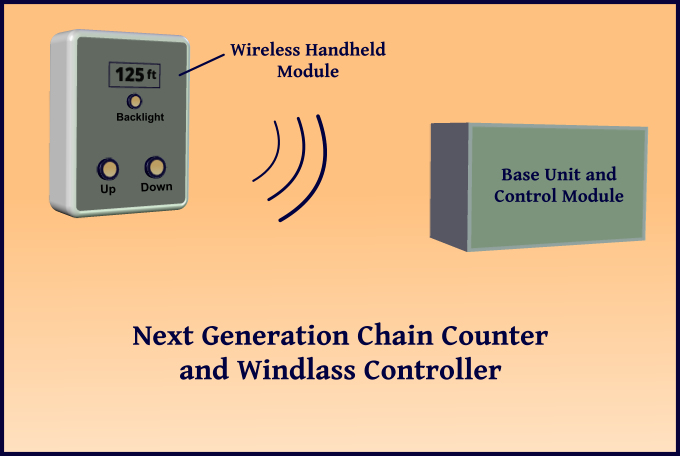
All in all, this was a pretty simple design, and we have been using it for about four years now. Generally, I am happy with it, but I plan to do a couple of things differently in the next version. First, the LED display in the current version is quite bright in low ambient light, but hard to read in bright sunlight. I will replace it with a backlit, daylight readable LCD display which should make it more visible in either the bright sun or at night. Also, with all the new technology now available, I plan to make the handheld module wireless and battery-powered, eliminating the cable. It should be pretty straightforward to incorporate matching 90mhz – 2.4 ghz radio transceivers in the handheld module and in the control module mounted in the forepeak locker.

next generation chain counter

For those of you who are interested in building your own windlass controller and chain counter, I am happy to provide the design details for the current version – just send us an email requesting them. Alternatively, if you aren't in a hurry, I plan to build the next version during the first few months of 2016, and should have all the design details available soon after. (I'd start working on it now, but I can't seem to find the right LCD display and RF Transceivers at the hardware store here in Bartica, Guyana – go figure.)

Heading to Hurakabra on the Essequibo

Via an introduction from an old cruising friend (thanks, Jack!), Kit and Gem Nascimento had e-mailed us and invited us to anchor off their Hurakabra (Her-rah-KAH-bra) River Resort and avail ourselves of the amenities … showers, internet, a place to hang out on land and more. We planned to take advantage of their generous offer. We departed the Grass Islands at first light near the end of the rising tide affording us lots of water for the transit back to Bartica and then downriver a few miles. Mist rose off the river and mingled with the smoke of morning cook fires ashore. misty morning on essequibo river

By the time we'd wended our way across the river, the sun was up and Bartica was coming alive. We'd met some of the Close family on the American yacht, Daystar, and wished we could spend more time with them, but they were heading out. They're a family of four in their third year of sailing on a 43' Mason ketch with a website cleverly entitled Close Quarters. We hailed on the VHF to say goodbye, chatted for a moment, then signed off.

daystar anchored off bartica

Another boat was anchored off Bartica as well, but we hadn't seen the name. The radio crackled again, hailing us. One of the miracles of cruising, it was Barry and Sue on Crazy Diamond, cruising friends whom we hadn't seen since New Zealand. They'd just arrived from Brazil and needed to clear in. We made plans to get together at Hurakabra in the coming days. Big world … small world.

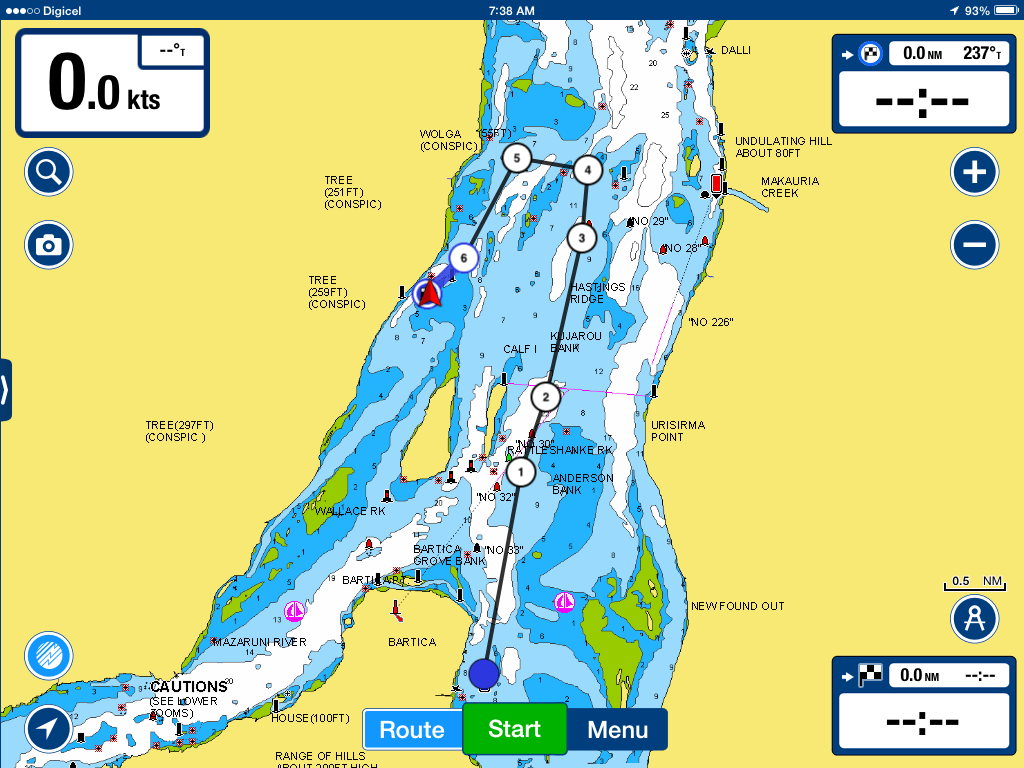
There were two routes to Hurakabra shown in the cruising guide. One was about 13 nm and required us to go downriver a few miles, cross the river via a channel, then come back upriver again. The second route was a bit more sketchy. It was only 3 miles from Bartica, but mentioned that the route passed over a shoal area that provided about 7' at mean high. Since we draw 7'2”, we were a bit leery about this route. David mulled it over a bit and using the known offset on the chartplotter, plotted us a different route past Calf Island, then connecting with the deeper, more northern route a bit further downstream. A total distance of 6 nm with much more water under the keel. Though it worked like a charm, the many unknowns and unplotted hazards of this river along with missing navigational aids had us motoring slowly and carefully.

route to hurakabra

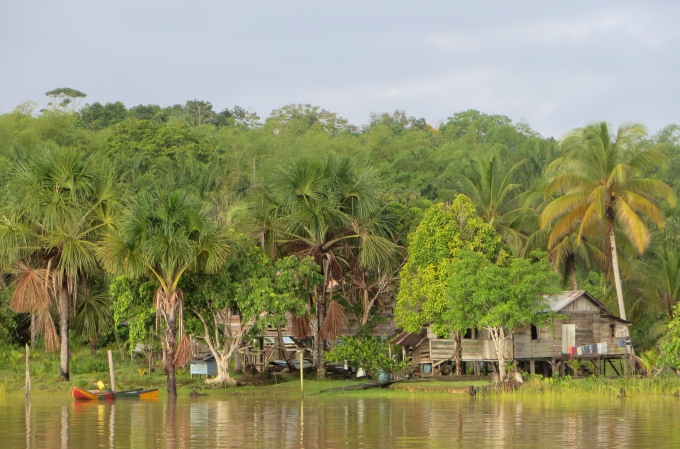
Motoring along the west side of the Essequibo now, we passed houses on stilts ashore with colorful boats moored in front.

rover houses on the essequibo river

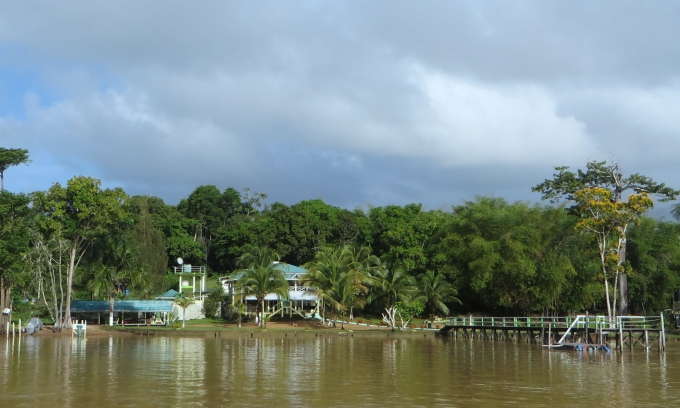
The distinctive green roof of Hurakabra came into view and the place looked positively inviting. A long pier extends out into the river with a floating dinghy dock. Tall palms and bamboo are interspersed with tall deciduous trees. We could hear birds singing and someone waved from the shore.

approaching hurakabra on the essequibo river

The river really rages during peak tides here. The anchor dug in well and we let out extra scope. After a couple of hours, feeling confident that we were holding, we headed into shore. Mike, the caretaker, greeted us warmly and provided information about Hurakabra as we walked. He took us to the main house for a cool glass of lemonade and a warm welcome from the rest of the staff. The “plantation house” is spacious with shuttered, screened windows and a large overhang covering the veranda which kept us dry from the intermittent rainy season downpours while we did internet.

internet on the veranda at hurakabra

We plan to spend a few days here. There's a jungle walk to take in the early mornings with Mike as our guide. Kit and Gem, our hosts, live and work in Georgetown, but will arrive for the weekend and we're looking forward to meeting them. Crazy Diamond arrived during the afternoon and we're keen to connect and catch up with them...and we still have some inland touring to plan. Stay tuned. We only have a week more here, but it'll be action-packed.

anchored of hurakabra

Find out what others had to say about this beautiful river resort.