Clark County Wetlands Revisited

Whenever we're in Las Vegas, one of my favorite local spots to visit is the Clark County Wetlands Park. A little over a mile from Mary's house, we discovered it on a previous sojourn in Las Vegas a few years ago and have enjoyed it each time we return. It was a bit nippy when we headed out, but warmed up as we were walking. There's a calm, quiet, structured wilderness feel to the 2900-acres of water, trails, and trees encompassed within the park along the Las Vegas Wash. It makes us forget we're in a metro area in the middle of the Mojave Desert, just 7 or 8 miles from the insanity of the Las Vegas Strip. clark county wetlands

A Gambel's quail met us at the entrance … scurrying around with a crazy top-knot feather bobbing over his head, impressing all girl quails no doubt. A roadrunner (Beep! Beep!) crossed our path, but was too fast for a photo.

gambels quail

The park is touted to be home to 300 species, but it's not all birds. They claim more than 70 species of mammals and reptiles have been spotted. We saw several, odd-looking spiny soft-shelled turtles sunning themselves, their long, serpent-like necks extended to catch some warm rays.

spiny soft shelled turtle

Desert cottontails dashed in front of us, then hid in the thick bush and bramble, confident that if they couldn't see us, we couldn't see them.

desert cottontail

There were coots, and pied-billed grebes and gallinules (We used to call them moorhen, but now it's gallinule … the name was changed. Who knew there was an ornithologist's union with such power?)

common gallinule

Raptors stood sentry high in the high bare-leaved trees, scanning their surroundings for errant, incautious bunnies.

hawk

We walked along the multiple paths and trails that criss-cross the park, over bridges and streams, stopping at the edge of ponds and marshes to admire the riparian scenery. A great blue heron stood stock-still, frozen in place, waiting for a fish to swim past. A noisy, busy duck happened to come ashore just next to him and the heron let out a very loud, aggravated, “frawnk”. The duck was oblivious. The scene brought back memories of my grandpa in a little row boat intently trying to fish while his noisy granddaughter chatted and squirmed incessantly beside him.

heron and duck

Speaking of chatting, as the morning warmed up, we were surprised by the number of people we met on the trails. Some running, some strolling in groups, chatting and laughing (scaring the wildlife away). The secret is out. It's obviously become a popular place. With a huge, classy new nature center and lots of scheduled community activities, it's a magnet for families. Glad folks are enjoying it, but (sigh) we might have to find another place for peaceful morning walks.

Football and Freshies

We've written many times about things we miss while we're at sea or just things we can't find in foreign countries. Crunchy green things for salads, fresh blueberries, green chiles, ground turkey … cars … washing machines … blenders. We manage just fine without, but it's always a treat when we get to have these things again. We certainly appreciate them more. For sure, one of things I miss most when we're at sea is fresh produce and I try to get my fix whenever we're ashore. Sometimes, even when we're in port, finding a good variety of freshies nearby is a challenge. When we're in Boston with Lin, we head to Trader Joe's. When in Las Vegas, Mary and I usually head to Sprouts Farmer's Market, first thing. It allows me to OD on the beautiful displays of freshies … unbelievable variety ... apples, oranges, pears, pomegranates and pineapples ... salad makings galore and everything from parsnips to peaches and kale to kiwi.

sprouts market

Instead of planning meals based on what's left in the larder, (pickled beets, lentils and tuna?) we plan more appealing meals and buy to suit our tastes on a given day. “Let's have roasted root vegetables tonight”, Mary suggested. And so we bought golden beets and parsnips, carrots, red potatoes and onions. We threw in some butternut squash and Brussel sprouts for color and good measure. We prepped the veggies, then Mary tossed them lightly in olive oil, salt and pepper and popped them into the oven to roast. She didn't even worry that it would use up too much propane. Oh, my … delightfully tasty, yet nutritious … a winning combination served with basil chicken sausage from the grill.

chicken wings

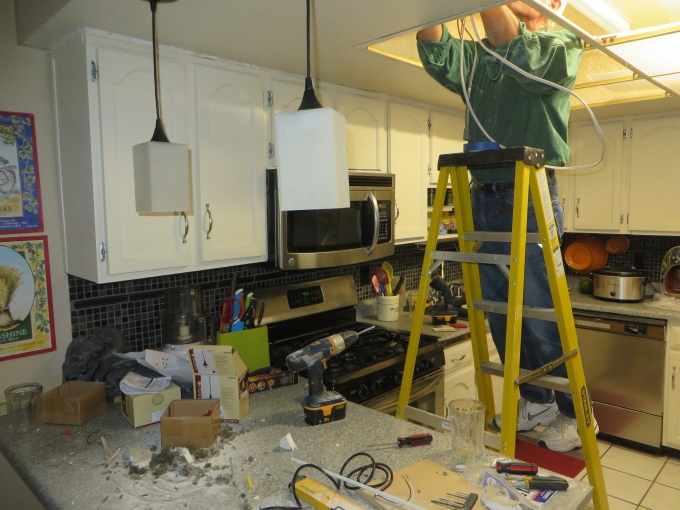
Though David might miss the food aspect of things, he rarely complains. He does miss the space to work on his projects, access to more tools (if that's possible) and watching football. Here in Las Vegas he has space, several projects he's volunteered to do for Mary and a whole cache of tools. He's installed new LED overhead lights in the kitchen and added more lights over the breakfast counter. He's replaced a temperature sensor in her all-electronic Samsung fridge-freezer. He doesn't like moss growing on his boat shoes.

new kitchen lights

Especially at this time of the year, however, his passion for watching football comes to a crescendo. On the boat, we never watch games and rarely even get to listen to them. It's one of America's autumn pastimes and he usually misses out. Not this year. It's play-off season and Sunday afternoons are usually spent watching a game … or two. Of course, that requires a TV, as well as access to the sports channels, and luckily Mary has both.

david watching the game

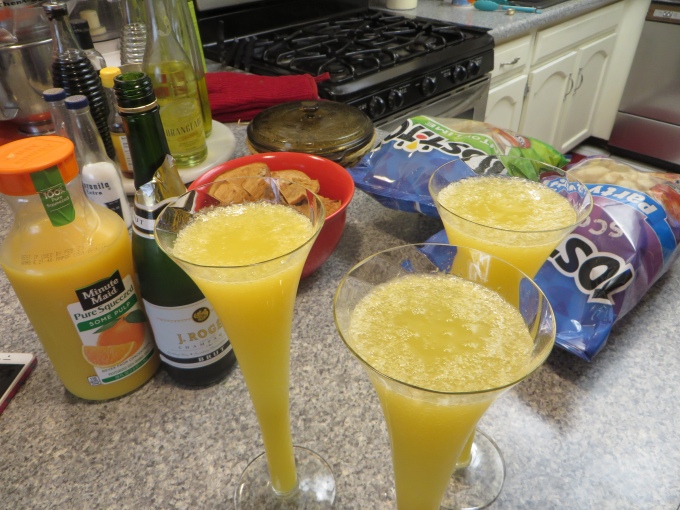
Now, how do freshies and football connect, you ask? Beyond the fact we miss both things while we're at sea is the fact that not only do we eat healthier here and get to watch the football games now, but we eat (not always healthier) WHILE watching football games. We plan our football feast and shop expressly for it … chips and salsa, guacamole, beer, mimosas (champagne and OJ for Mary and me), spicy chicken wings with bleu cheese dip, crudite (that's the healthy part) and whatever else strikes our fancy. Me? Oh, I like football okay - I can take it or leave it, but I enjoy watching with everyone and then there's the mimosas. Did I mention the mimosas?

mimosas and snacks

The Blue View - Clam Shell Patch for Inflatables

We were on our way to the local Lowes to pick up parts for a house project a few days ago, when the subject of repairing things in remote parts of the world came up. What a difference it makes having a car and just about any conceivable part available only minutes away. Marcie reminded me of a few years ago, when we were exploring the hundreds of tiny anchorages in Tierra del Fuego and Patagonia. We were anchored in a snug little cove for the evening with the anchor in deep water and two lines ashore, and after we were all settled in, we put the dinghy up on the davits. It wasn't unusual to experience large katabatic winds there, usually late at night. Right on schedule, at about 3am, a “racha”, or katabatic wind (also known as a “williwaw”), came blasting down the mountain behind us, and the 135 lb. (60kg) dinghy became more of a kite than a boat. The wind lifted the dinghy up against the solar panels with such force that a corner of one of the panels tore a 3-inch hole in the starboard pontoon of the inflatable. rowing the inflatable

Most of the anchorages in this area require lines ashore, so having a dinghy is quite important. Knowing we would be hundreds of miles between chandleries and being aware of how important the dinghy was, we came prepared. I had a couple of square feet of hypalon patch material, and a fairly fresh kit of two part adhesive. The next morning I pulled out our patching materials and adhesive, only to discover that the accelerator, one part of the two part adhesive, in our unopened, six month old kit had totally evaporated.

Not to worry – it was only the 'accelerator', which would imply that given enough time, the adhesive itself should still cure. I tried a small amount on a scrap piece of material, but even after 24 hours, the adhesive still remained tacky and wouldn't hold. I tried heating the adhesive – no luck. When I was a boy, patching a bicycle inner tube involved lighting the adhesive with a match and letting it burn a few seconds. This didn't work on the hypalon adhesive, however.

Maybe we could get by with one pontoon deflated... it had three chambers after all, and two were still inflated. I put the dinghy in the water, and the bow and port side pontoons kept the dinghy afloat, even with my weight. Rowing it was rather comical, however. It quickly swamped, so I couldn't sit down and row. I stood up and paddled it, but it was slow going and only wanted to go in circles. Trying to tow 300 foot (90m) lines ashore in a half submerged dinghy that only went in circles would have made a great Mr. Bean video.

I pondered our dilemma for awhile, then remembered I had once seen a product called a 'clam shell patch', a mechanical patch that could be used for patching an inflatable. I rounded up a few scrap pieces of aluminum, plastic panels and rubber gasket material and set to work.

anatomy of a patch


patch in place

The illustrations above show my first version of the concept. It still leaked air rather copiously, so I added a rubber gasket on both sides of the tear.

patch parts

The second attempt worked quite well. The patch held well enough to keep the pontoon inflated for about 24 hours. As long as I pumped it up each day before it was needed, it would stay inflated long enough to get our lines ashore in the evening and retrieved in the mornings. The patch served us quite well until we reached Ushuaia and could get a new kit of adhesive shipped in. It now resides with our patch supplies as an emergency repair kit.