

Exploring Dewey, Culebra - Puerto Rico
/This is our third day here and we haven't managed to get ashore yet. What's up with that? We were tired and we wanted to make sure the anchor was set well … and oh yeah, the dink needed repair. So, those were our excuses on Day 1. Yesterday, it rained all day long. No sense in getting wet, right? And today? Well, we got as far as launching the dink in the early morning calm and puttered away most of the rest of the morning. We decided it was getting a bit ridiculous and headed into shore.

It's always a thrill heading into a new port, but there's much to be said for getting some chores done on the boat right away and/or lazing around a bit before heading to shore. Some folks are off their boats as soon as the anchor drops. Not us … we like taking our time … but three days? Come on now! In our defense, we have gotten several #1 chores completed and we've been taking afternoon dips in the warm, clear waters of Ensenada Honda.
The new dinghy patch was doing its job and the ride to shore was pretty dry. As we approached the shore, certain sights jogged our memories, especially the big, bright orange lift bridge . We'd been here in the Spanish Virgin Islands once before … back in 2002 when we first visited the Caribbean. At that time, the nearby island of Vieques was off-limits to cruisers because of live shelling exercises by the US military. We'd anchored here, but just for an overnight before heading on to St. Thomas, so we'd not explored any of the island. In the beginning, we used to be in a hurry to get to the next place.

We tied up at the town dock, deposited our trash in the bins provided and and walked across the bridge to the Dinghy Dock, a local restaurant and cruiser hang-out. Well, the lift bridge has been newly painted and looks pretty spiffy, but it doesn't lift any more … not sure it did on our last visit either. The cruising guide didn't provide much information about the little town of Dewey, but we figured a cruiser hang-out was the best place to find what we needed. It was. We found an island map, access to fresh water, free wi-fi, directions to two grocery stores and lunch.

After scoping out the two grocery stores which were chock-a-block full with everything you can imagine (yippee), we decided to dinghy under the lift bridge and up the canal that connects the “inside” of Ensenada Honda to the “outside”, i.e. the ferry dock at Bahia Sardinas and the Caribbean Sea. A big rope hangs down from the bridge structure and though it would be hard to access, we wondered if it's used as a rope swing on occasion.

The canal is only about a ½ mile long and it's dotted with little restaurants closer to town and lined with mangroves as it empties into the Caribbean. The ferry terminal for transit to Fajardo on the Puerto Rican mainland is located here and the ferry was getting ready to go.

Hector el Protector was a surprise and a very interesting sculpture that stands sentry at the end of the canal opposite the ferry dock in Bahia Sardinas. Made solely from recycled old pallets, Hector was created by Thomas Dambo, an artist/designer based in Copenhagen, Denmark, as an entry in the 2014 Culebra Es Ley Art Festival. Hector appears to take his job seriously.

There didn't seem to be a reasonable place for a dinghy tie up, so we retraced our course along the canal. I spotted two beautiful green iguanas hanging out on the canal wall. They were wary of our approach and one ran off into the bush, but the other, though keeping a cautious eye on me, allowed a photo. They're actually an invasive species and considered pests. The locals called them “gallina de palo” … tree chickens ... and they're evidently quite tasty.

We tied up the dinghy at the Dinghy Dock and walked back over to the ferry terminal, giving us a different view of Dewey town. The streets are narrow and everything is delightfully Spanish. Signs are in Spanish and the colorful houses add to the Spanish Caribbean feel. People smile as they pass you on the street and say hi or hola. Lovely! There were several little restaurants, shops, outdoor cafes, guest houses and souvenir shops along the route. We popped our heads in and looked around, enjoying the discovery process.

The ferry terminal area is colorful and pleasantly touristy. We read that the ferry fare to Fajardo was “inexpensive”, but that, of course, is a relative term. Is inexpensive $40/pp or $5 or ?? Well, turns out, it's $2.25/pp each way unless you're old farts like us and then it's $1.00! (If you're older than dirt, i.e. 75 or older, then it's free!) We had the urge to board immediately for the 1-1/2 hour ride to Fajardo, just because it was such a bargain. We fought the impulse, but it's on the list of budget entertainment possibilities in the next few days.

We stopped at one of the supermarkets on our return trip. The outside of the Colmado Milka was quite deceiving. Inside was a warren of narrow aisles, well-stocked shelves and little alcoves and annexes that offered about anything we could want in the way of groceries, booze, fresh meats and chicken, etc. We bought dinner ingredients and headed back to the Dinghy Dock to retrieve the dink. Thai peanut chicken with rice and Asian cole slaw are on the dinner menu, if anyone's hungry.

Enough exploring for one day. If it's nice, we're hoping to hike over to Flamenco Beach tomorrow, noted as one of the most beautiful beaches “in the Western Hemisphere”. Let's see if we agree.


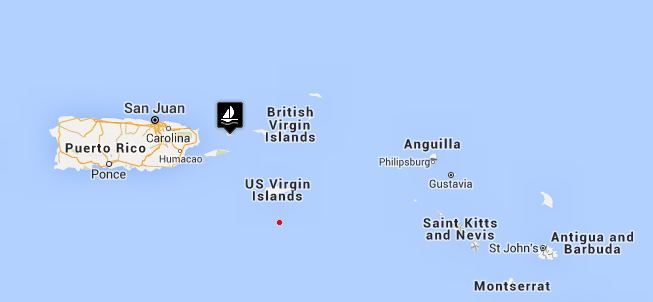 We jibed all through the night, waiting till the change of the watches so it didn't disrupt our sleep scheds. The shore lights and loom of St. Croix dimmed as we skirted around its west end and then we could see the hazy lights of Vieques, Culebra and an all-but-glowing, very well-lit St. Thomas. We made our final jibe about 0330. By 0630, we were heading through the well-marked Canal del Este (Eastern Channel) into Ensenada Honda. Remember … red, right, returning. (For you landlubbers … keep the red markers to the right.)