
Rotten Eggs and Other Smells

One of the things about boats is they smell. Sometimes it's the garlic and onion you're sauteing, but more likely it's something else or a combination of “something elses”. My sister, Lin, always hugs me rather tenuously when we first arrive home after a long stay on the boat and wrinkles her nose. “Boat smell”, she pronounces. We don't smell it until we've been away from the boat for a few days and then it's very evident. It's a mix of diesel and mildew, the last meal you cooked, head (toilet) smells and the bilge among other things. It's certainly not Chanel #5. Yesterday, there was a strong smell on the boat, emanating from the galley, not the head. We've been taking dips and rinsing off daily, so it wasn't us. Except when it rains, we've had all the hatches and ports wide open, airing Cups out. I finally tracked it down. Two adjoining eggs in our stash had hairline cracks on their bottoms (maybe one cracked the other...misery loves company?) and when I lifted them out of the carton, they exploded most dramatically and aromatically in the sink. Whew! Rotten eggs! It took awhile for that sulfur smell to dissipate, believe me!
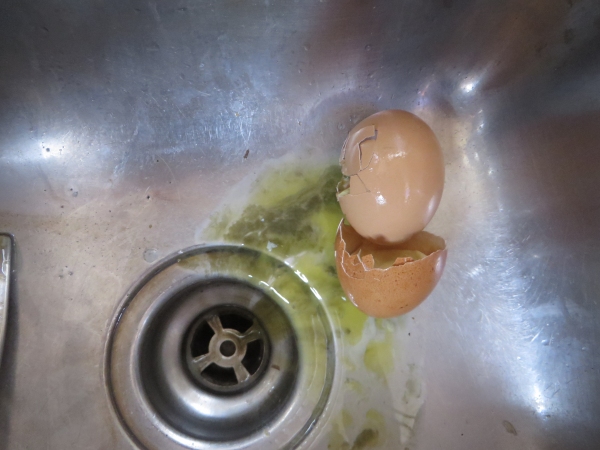
rotten eggs

Rotten eggs are pretty infrequent unless an unnoticed crack sneaks by as it did recently. Other smells on the boat, however, can be a challenge. The head can definitely be a culprit. It gets cleaned frequently and I use one of those stick-on, gel-type deodorizers in the bowl, but it's just not enough. Every month or so, we pump a bucket of bleach water through the system and let it set for awhile and then pump it out. After awhile, even bleach water isn't enough. Calcification builds up in the hoses and that becomes a whole other issue to be taken care of. Once a year, David pumps a hydrochloric acid/water solution through the system which dissolves the lime and, in combination with our other maintenance, it seems to keep head odors at bay.

The bilge collects everything that finds its way to the bottom of the boat. The smells contain fermenting salt water, mold, mildew, diesel … a lovely bouquet that assaults your senses especially when the boat's been closed up for awhile. We usually dump a bucketful of soapy water down there and let it slosh around for awhile before turning on the bilge pump once we're a ways out to sea.

Diesel smells were strong during our recent passage from Trini to Culebra. With particularly rolly seas, David discovered that the starboard fuel tank was leaking around the inspection plate gasket. Not much diesel escaped, but what did was quite pungent. Typically, boats smell of diesel in the same way cars sometime smell of gasoline and certainly your garage smells of auto fuel. The problem is, you don't usually park your car engine in the middle of your kitchen or living room, so it's not a problem. Our engine is smack dab in the middle of the boat … next to the galley and salon. Stopping the leak was a #1 on the fix list and adequate ventilation is taking care of the rest of the problem.

Mold and mildew can be kept to a minimum, but if you're in the tropics, it's hard to remove them entirely. We have such a mix of clothing for the different climates we encounter, some clothes are always stowed away in lockers. When we haul them out, they smell like “boat”, mostly due to mold and mildew. We try to hang them out on sunny days with a light breeze and wash down the lockers with vinegar and water while the clothes are airing. We left a dehumidifier on 24x7 when we left Cups alone in Trinidad and it was well worth the expense. Thankfully, there was no noticeable mildew or mold when we returned. The closed up boat, however, still smelled rather unpleasant until we opened all the ports and hatches and got some air circulating.

Here's where I'm really sorry there are no sensory “smell chips” so that I can share the delightful smells that can emanate from a boat with you. Believe me, it's something you're probably glad to have missed.

A Walk to Flamenco Beach

Flamenco Beach is touted as “one of the world's top beaches”, so we couldn't leave Culebra without visiting it. Getting there wasn't as easy as we had imagined. We were up and off the boat around 0800 on an overcast morning, having packed our snorkel gear, towels, apples, water, etc. We parked the dinghy and were about 10 minutes into the walk when David asked if I'd brought the map. No, I'd forgotten it. Another 10 minutes and we saw a lady putting out her trash can for pick-up and remembered we'd also forgotten to bring our smelly trash in for disposal, too. Darn! The clincher was about 10 minutes later when David discovered he'd also forgotten his wallet. Then it started to rain. These must all be signs … this was obviously not the day to visit the beach (or perhaps our memories aren't what they used to be?). Instead, we returned to Cups, did a few more chores on the list and called it a day. Beach day tomorrow. We read in a guide book that Flamenco Beach was a short walk (about a mile) from town. Often, when people write “short walk … about a mile”, they've never walked it, only driven it. We were right … it's more like 2-1/2 miles one way, but we were game for a good morning walk. Having double-checked that we had everything including the wallet, map and the trash, we were off the boat by 0730 on a gorgeous, sunny morning.

Walking has many advantages over driving. First, it's good exercise. Second, we see more because we're not whizzing by everything. And third, well, since we don't have a car, driving isn't really an option. There are only two main marked routes on this 5x7 mile island and Route 251 is the one that leads to and ends at Flamenco Beach at the northwest end of the island.

There was lots to see along the route … schools and playgrounds, lots of little local restaurants that looked appealing, colorful houses with anoles climbing up their walls, an abundance of hibiscus and other gorgeous flowers in full bloom, and Culebra's Lilliputian-sized airport. We could hear the constant cooing of pigeons and morning doves. Frigate birds soared silently overhead.

culebra airport

There's an abundance of golf carts and small jeeps on the island, used primarily by tourists who visit. They all seemed to be driving to the beach. We saw no other walkers. We had the grassy side of the road to ourselves. The narrow, paved road wends its way to the northwest past the Flamenco Lagoon. We caught sight of the lagoon and beach from the crest of the route's biggest, steepest hill (which I was dreading on the return trip). We hoped to see flamingos in the lagoon (flamenco = flamingo in Spanish), but all we saw was a couple of laughing gulls.

culebra lagoon

We finally spied signs for the beach in the distance.

entrance to flamenco beach culebra

The entrance to the beach was very inviting as we made our way through the parking lot, past several food stands which weren't open yet and onto the beach. There are campsites and lovely picnic tables under the canopy of spreading shade trees.

food stands on flamenco beach

We chose one of the little paths that cut through the beach flora and a long expanse of white sand beach lay before us.

flamenco beach

A palm tree provided enough shade for our towels and gear. We just sat for a few minutes, chatting and taking it all in. The beach is clean and, at this time of day, uncrowded. The water is dazzling … bright turquoise with coral reefs a ways out, just rising above the surface. There was sufficient surf for some beach-goers to ride the waves. We were content just watching, walking along the shore and taking a quick dip to cool off. We retreated to our towels and lay in the shade of our little palm tree, enjoying the day. Seems odd to say since we live on the sea, but I can't remember the last time we lay on a beach.

flamenco beach

According to Wiki, Teddy Roosevelt established the Culebra Naval Reservation in 1903 and in 1939, the US Navy began using the Culebra Archipelago as a gunnery and bombing practice site in preparation for the US involvement in World War II. In 1971 the people of Culebra began protests to remove the Navy from Culebra. Four years later, in 1975, the use of Culebra as a gunnery range ceased. Remnants of the military occupation are still evident including this tank on Flamenco Beach and unexploded ordinance which shows up from time to time.

a tank on culebra beach

By 11am, multiple vans and tourist buses had unloaded herds of vacationers at the beach for the day and blanket space on the beach was at a premium. The once “uncrowded” beach we'd enjoyed just an hour previously had filled up and was now swarming with people. That was our cue to head out. I think we're becoming curmudgeons.

No matter, we trudged back to town, the return always seeming shorter than the trip out (despite the dreaded hill) and we were back in town with nary a whimper from the first mate (really). David found an unusually well-stocked ferreteria (hardware store) along the way, at which he bought caulking to repair the diesel tank gasket leak. We also found a small supermercado that had frozen ground turkey (hallelujah) which supplied the main ingredient for the evening's taco dinner.

ferreterria in culebra

We're not sure Flamenco Beach is one of the top 10 beaches in the world. That's a mighty broad statement without any criteria provided for comparison and we're probably not the best judge of beaches anyway … but it certainly is a beautiful beach. It was well worth the walk.

Exploring Dewey, Culebra - Puerto Rico

This is our third day here and we haven't managed to get ashore yet. What's up with that? We were tired and we wanted to make sure the anchor was set well … and oh yeah, the dink needed repair. So, those were our excuses on Day 1. Yesterday, it rained all day long. No sense in getting wet, right? And today? Well, we got as far as launching the dink in the early morning calm and puttered away most of the rest of the morning. We decided it was getting a bit ridiculous and headed into shore. culebra puerto rico

It's always a thrill heading into a new port, but there's much to be said for getting some chores done on the boat right away and/or lazing around a bit before heading to shore. Some folks are off their boats as soon as the anchor drops. Not us … we like taking our time … but three days? Come on now! In our defense, we have gotten several #1 chores completed and we've been taking afternoon dips in the warm, clear waters of Ensenada Honda.

The new dinghy patch was doing its job and the ride to shore was pretty dry. As we approached the shore, certain sights jogged our memories, especially the big, bright orange lift bridge . We'd been here in the Spanish Virgin Islands once before … back in 2002 when we first visited the Caribbean. At that time, the nearby island of Vieques was off-limits to cruisers because of live shelling exercises by the US military. We'd anchored here, but just for an overnight before heading on to St. Thomas, so we'd not explored any of the island. In the beginning, we used to be in a hurry to get to the next place.

orange lift bridge culebra puerto rico

We tied up at the town dock, deposited our trash in the bins provided and and walked across the bridge to the Dinghy Dock, a local restaurant and cruiser hang-out. Well, the lift bridge has been newly painted and looks pretty spiffy, but it doesn't lift any more … not sure it did on our last visit either. The cruising guide didn't provide much information about the little town of Dewey, but we figured a cruiser hang-out was the best place to find what we needed. It was. We found an island map, access to fresh water, free wi-fi, directions to two grocery stores and lunch.

dinghy dock restaurant, dewey, puerto rico

After scoping out the two grocery stores which were chock-a-block full with everything you can imagine (yippee), we decided to dinghy under the lift bridge and up the canal that connects the “inside” of Ensenada Honda to the “outside”, i.e. the ferry dock at Bahia Sardinas and the Caribbean Sea. A big rope hangs down from the bridge structure and though it would be hard to access, we wondered if it's used as a rope swing on occasion.

dewey, puerto rico

The canal is only about a ½ mile long and it's dotted with little restaurants closer to town and lined with mangroves as it empties into the Caribbean. The ferry terminal for transit to Fajardo on the Puerto Rican mainland is located here and the ferry was getting ready to go.

ferry in puerto rico

Hector el Protector was a surprise and a very interesting sculpture that stands sentry at the end of the canal opposite the ferry dock in Bahia Sardinas. Made solely from recycled old pallets, Hector was created by Thomas Dambo, an artist/designer based in Copenhagen, Denmark, as an entry in the 2014 Culebra Es Ley Art Festival. Hector appears to take his job seriously.

hector the protector in puerto rico

There didn't seem to be a reasonable place for a dinghy tie up, so we retraced our course along the canal. I spotted two beautiful green iguanas hanging out on the canal wall. They were wary of our approach and one ran off into the bush, but the other, though keeping a cautious eye on me, allowed a photo. They're actually an invasive species and considered pests. The locals called them “gallina de palo” … tree chickens ... and they're evidently quite tasty.

iguana in puerto rico

We tied up the dinghy at the Dinghy Dock and walked back over to the ferry terminal, giving us a different view of Dewey town. The streets are narrow and everything is delightfully Spanish. Signs are in Spanish and the colorful houses add to the Spanish Caribbean feel. People smile as they pass you on the street and say hi or hola. Lovely! There were several little restaurants, shops, outdoor cafes, guest houses and souvenir shops along the route. We popped our heads in and looked around, enjoying the discovery process.

street scene

The ferry terminal area is colorful and pleasantly touristy. We read that the ferry fare to Fajardo was “inexpensive”, but that, of course, is a relative term. Is inexpensive $40/pp or $5 or ?? Well, turns out, it's $2.25/pp each way unless you're old farts like us and then it's $1.00! (If you're older than dirt, i.e. 75 or older, then it's free!) We had the urge to board immediately for the 1-1/2 hour ride to Fajardo, just because it was such a bargain. We fought the impulse, but it's on the list of budget entertainment possibilities in the next few days.

ferry terminal area in puerto rico

We stopped at one of the supermarkets on our return trip. The outside of the Colmado Milka was quite deceiving. Inside was a warren of narrow aisles, well-stocked shelves and little alcoves and annexes that offered about anything we could want in the way of groceries, booze, fresh meats and chicken, etc. We bought dinner ingredients and headed back to the Dinghy Dock to retrieve the dink. Thai peanut chicken with rice and Asian cole slaw are on the dinner menu, if anyone's hungry.

colmada milka in puerto rico

Enough exploring for one day. If it's nice, we're hoping to hike over to Flamenco Beach tomorrow, noted as one of the most beautiful beaches “in the Western Hemisphere”. Let's see if we agree.