
To-Do or Not To-Do - Culebra, PR

I only put our location in the title to differentiate it from what seems like hundreds of other anchorage paradises that have to-do lists longer than the time we plan to spend in port and the fact that I probably grouse about this every time. As soon as everything was tidied up from the passage, we sat with our cuppas and our notebooks in the cockpit and figured out our current to-do list. We use our log sheets as the starting point and add to it as we notice or remember things that need doing. log sheets

It's amazing that after all the work we did in Trinidad, there should be anything to do here, but our initial list, garnered from the log sheets, provided us with 16 to-do items. Sixteen??? Really?? The next step, after lacing our cuppas with something stronger than caffeine, was determining what had to be done while we were anchored in Culebra and what could be delayed, if necessary. We assigned each item a 1, 2 or 3 in order of priority … a little change-up from our usual As, Bs and Cs. The 1s had to be done; 2s would be good to get done and 3s … well, 3s sometimes get done, sometimes not … but the thought is there.

Just before leaving Trini, we realized we had a leak in the dinghy, so that repair was a #1, as was the jib furler and tightening bolts on the staysail furler. We noticed while on a heel during the passage that sometimes the smell of diesel was strong and David found that the starboard fuel tank inspection hatch was leaking around the gasket … another #1. We also noted some vibration in the prop shaft as we rolled during the passage which seems to indicate that perhaps an engine mount inspection and alignment was probably in order. Yet another #1. He got to work on the dinghy repair post haste and while the hypalon adhesive was drying, he addressed the furler issues. The engine alignment and diesel tank leak are on the agenda for another day.

the list

The #2 list included about seven items once we went through the list again and moved a few #2s to #3s. They're minor, non-safety, non-mission-critical items like the oil pressure gauge isn't working and the prop brake doesn't always seem to stop the prop. There's troubleshooting involved and if parts are required, then both items will go on another list for attention when we can obtain the parts. David mentioned he'll have to find his blog on troubleshooting engine gauges to refresh his memory on the sleuthing process.

On my to-do list is the stainless which didn't get totally done in Trinidad and now needs doing all over again anyway and a deck check/tightening of all stanchion screws and bolts … long overdue. Daily cleaning, cooking and writing take up my time, along with hand laundry, mending and dozens of other little things that all told, seem to take up as much time as many of David's projects, but that don't show or get put down on paper. Then, of course, there's napping (always a #1 on my list).

All in all, though each port is certainly unique, life aboard really doesn't change much. There is always something to be done on a boat and addressing the issues as you find them is prudent, but not always convenient, nor fun, nor in the budget. So here in Culebra, we'll get the #1s addressed and perhaps a few more before heading on to San Juan … where we'll have the opportunity to start yet another to-do list.
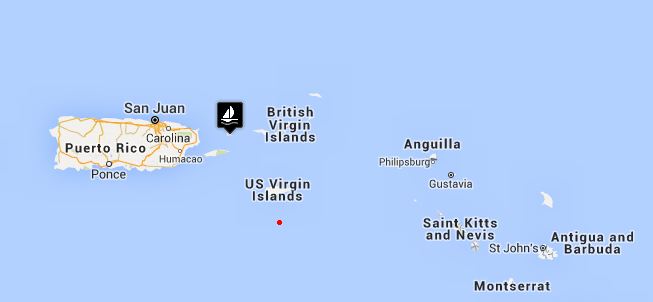
Arrival in Culebra, Puerto Rico

in puerto rico We jibed all through the night, waiting till the change of the watches so it didn't disrupt our sleep scheds. The shore lights and loom of St. Croix dimmed as we skirted around its west end and then we could see the hazy lights of Vieques, Culebra and an all-but-glowing, very well-lit St. Thomas. We made our final jibe about 0330. By 0630, we were heading through the well-marked Canal del Este (Eastern Channel) into Ensenada Honda. Remember … red, right, returning. (For you landlubbers … keep the red markers to the right.)
According to Wiki, Isla Culebra (Koo-lay-brah - "Snake Island") is an island-municipality of Puerto Rico. Located approximately 17 miles (27 km) east of the Puerto Rican mainland, Culebra is Puerto Rico's least populous municipality. The island is hilly, lush and green with what appear to be, high-end houses built on the hillsides. We made our way through the reefs, hugging the marked channel, and anchored off the main town of Dewey, aka Culebra, with about 25+ boats as neighbors. The anchorage is large and we found a fine spot without much effort and dropped the hook. Yahoo!

As we've previously noted, we had registered with the US Customs SVRS (Small Vessels Reporting System) before returning to Trinidad. We had filed a “float plan” according to procedure before leaving Trinidad in hopes that this would streamline the check-in process for U.S. Immigration/Customs. All we can say is “Wow!”. First of all, our iPhone worked within 5-6 miles of Culebra (thank you, ATT & sister, Lin). Once anchored, we called Culebra Customs and Border Protection and provided the necessary information. The officer welcomed us back to the USA and said he'd call back within the hour. Good as his word, we received his call, got our clearance number and sha-bang … we were all cleared in. That was it. Nine of Cups is back in American waters after 9 years abroad and her crew is all legal and checked in.

This called for a cuppa and a sit down in the cockpit to celebrate. The breeze was exquisite and the scenery was candy for the eyes. We'd thought we'd go ashore, but after a bit more discussion, we decided to stay aboard for the day, get our chore list together (yes, there's a list … no surprise there!) and perhaps get a head start on what needs to be done. And then, perhaps, a nap somewhere in the mix.

Total mileage for the trip - 520 nm.

The Blue View - A Couple of Screws Loose

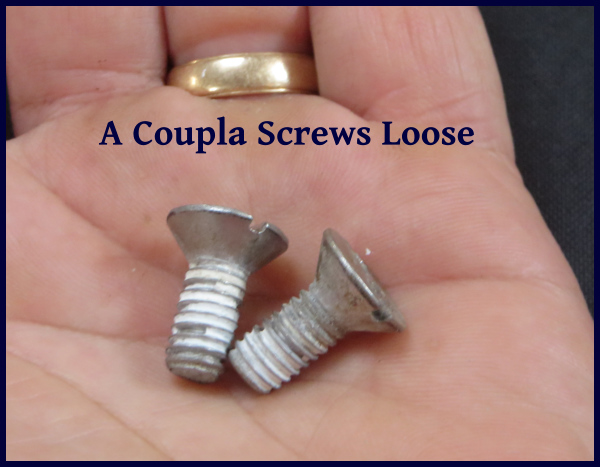
On passages, one of my morning rituals is to do a deck 'walk-around'. My morning watch starts at 0900, and after my morning cuppa, I take a walk around the boat, tossing the night's catch of flying fish overboard and checking for any potential problems. Any lines chafing? Are the dinghy and anchor still lashed and secure? How do the sails look – any issues? The stays and shrouds and other parts of the standing rigging are looking good? … and so on. On one morning's walk-around during our Trini-Puerto Rico passage I found two screws lying in the port side scuppers. Not a good sign and something that required immediate investigation. I had visions of the radar module coming loose from its mounting and self-destructing or the whisker pole coming apart and folding in half – after ripping a large hole in the yankee.

loose screws

I remember talking to an avid racer who said that during a close race, one of his crew mates would sometimes use a slingshot to fire a screw or two into the mainsail of the boat they were trying to beat. The screws would drop to the deck, making enough noise to be noticed. At the very least, the crew would be distracted while trying to figure out where the screw came from and whether they were about to lose the rig. I'm not sure if it was BS or not, and even if it wasn't, I can't imagine the ploy working more than once, but it was a good story. At any rate, there were no boats within sight, so unless the screws I just found came from a drone, they were most certainly from Nine of Cups.

There were a few clues. The screws were just aft of midships in the port scuppers. This eliminated anything further aft, since it was very unlikely they rolled uphill from the place on deck that they landed. They were 5/16” diameter screws, eliminating stanchion screws. They were also coated in Tef-Gel, a substance I use to prevent galling and corrosion when I attach a stainless screw to aluminum – like the mast and boom. So, the most likely places to check were the mast, forward end of the boom, inboard end of the whisker pole, and the furlers. That's still a lot of possibilities.

I had removed the forestay in Trini so that Cups would fit on the Travelift, and this required partially disassembling the jib furler. I thought maybe I had neglected to tighten everything when I reattached the forestay – but everything looked good there. I checked all the screws on the boom and the lower part of the mast – all present and accounted for.

camera

In the old days, the next step would be to lie on the foredeck with the binoculars and try to spot any missing screws further up the mast. Now, with digital cameras and great zoom lenses, it is much easier. I sit on the deck, zoom in and focus on a fitting, then shoot half a dozen photos. Next I review the photos, zooming in as much as possible to try to locate the screw-less hole. I spent a half hour or so carefully checking the possibilities, but still couldn't spot any missing screws.

screws in place

As I was pondering where to check next, I grabbed the staysail furler to re-position myself. There, just below my hand, and not two feet from where I had been sitting for the last half hour, was the furler collar with an empty screw hole. I checked the other side of the collar, and sure enough, the second of three screws was missing. The third screw was partially unscrewed, but still in place. Had it come out, the result wouldn't have been catastrophic, but we wouldn't have been able to bring in the staysail when it was time. It took but a few minutes to put the screws back in place and tighten, and add a note in the log sheets to remove them, re-coat with Tef-Gel and tighten back in place once we arrived in Puerto Rico.

found it

easy fix

Later, as I was pondering how these three screws could have come loose, it occurred to me that last December, when we were getting ready to haul-out in Trini, I had loosened them in the event we had to remove the inner stay in order to fit into the Travelift at Power Boats. This is sometimes necessary, and we once tied up a haul-out facility for an hour or so while I worked on removing a seized screw - because I hadn't prepped the furler ahead of time. Not only had I forgotten I had loosened them, I had neglected to add it to my to-do list at the time. They weren't loose enough to notice during all my pre-passage checks, but were loose enough to work their way free. My bad.

I will make a note to add this to our splash checklist – if I can just remember where I put the damn list.