The Blue View - Replacing Fuel Tanks Pt. 2

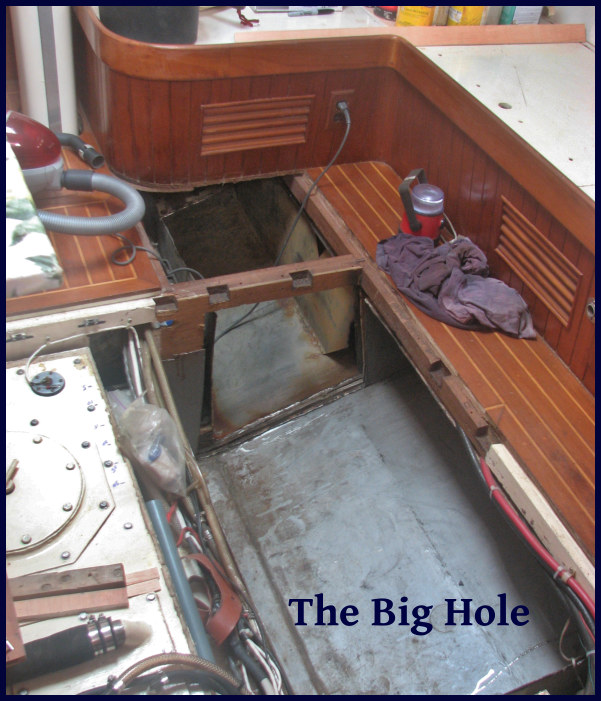
the hole In last week's Blue View, I talked about removing the tops from the old fuel tanks, making the drawings for the new tanks, then building mock-ups out of plywood. Once I was happy with the fit and the drawings, I hired a “flete”, sort of a combination small truck and taxi driver, and made the trip to the metal fabricator. After a lengthy discussion that required Marcie's reasonable Spanish, my crappy Spanish enhanced with a great deal of hand gestures, the drawings and the mock-ups, the fabricator assured us he understood what was needed. He gave us a quote and promised delivery in about a week.

Sure enough, 8 days later I got a message that the new tanks were ready. We rounded up several hundred dollars (Ecuador uses the U.S. dollar as its currency), stuffed them into our pockets and hired a taxi to take us back to the fabricator. The shiny new tanks were lined up alongside the mock-ups, and looked identical. I asked the manager if they had been pressure-checked, and his response was “Si claro, Señor, claro”, which meant “Yes certainly, sir, of course”. I paid him the remaining amount due and arranged to have the tanks transported to Nine of Cups.
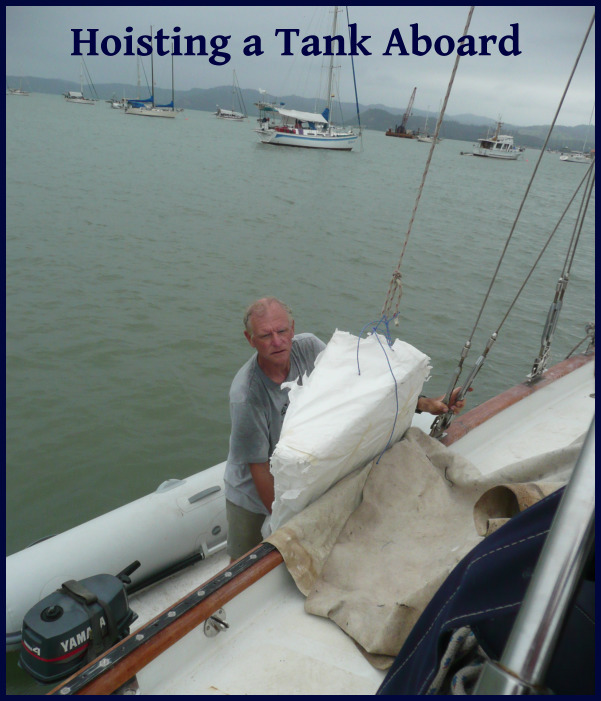
hoisting the tanks aboard

They arrived the next morning, all carefully wrapped to protect them during the trip. We loaded the first one into the dinghy and transported it out to Cups. I made a small harness and attached a spare halyard to the tank, then Marcie cranked away at a cockpit winch while I guided the tank up out of the dinghy, down the hatch and into the saloon, trying very hard not to damage the varnished teak in the process. Once it was below deck, I guided it into the old, cut-away fuel tank, and then slid it into place, securing it temporarily with a couple of bolts.
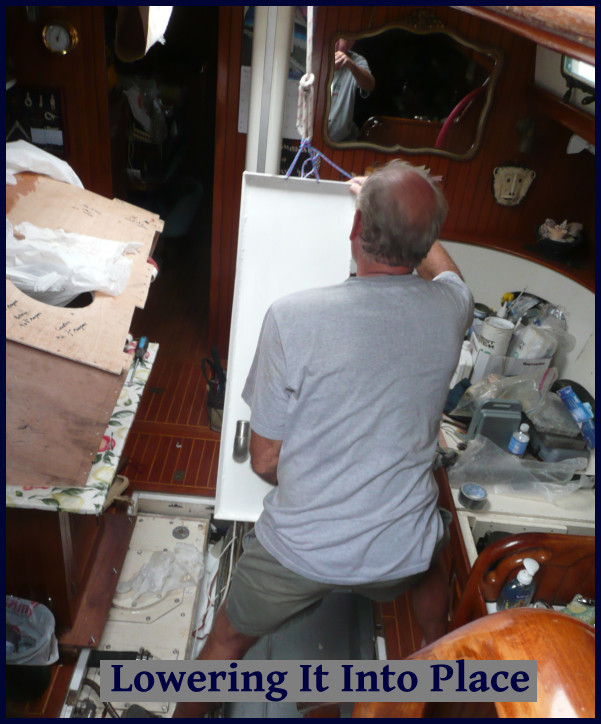
lowering tank

This process was repeated with the second tank, but when we tried to install the third tank, it wouldn't fit into place. We found that the hose fittings were not to specification...something we hadn't noticed when we looked at them at the fabricators...and thus wouldn't fit. Out they came, and we hauled them back one by one to shore in the dinghy, hired a flete once again and took them back to the fabricators. Oh, man!

By the end of the week, they had fixed the problem and the tanks were re-delivered to us. We got them all in, plumbed and ready for the final pressure testing. They had been tested at the fabricators, of course, but this was the final check before filling them with fuel. Leaks...leaks...leaks! It was hard to identify them all in-situ, but there were a lot of pinhole leaks in the welds! So much for the fabricator's assurance that they had been pressure tested. We were sick about it.
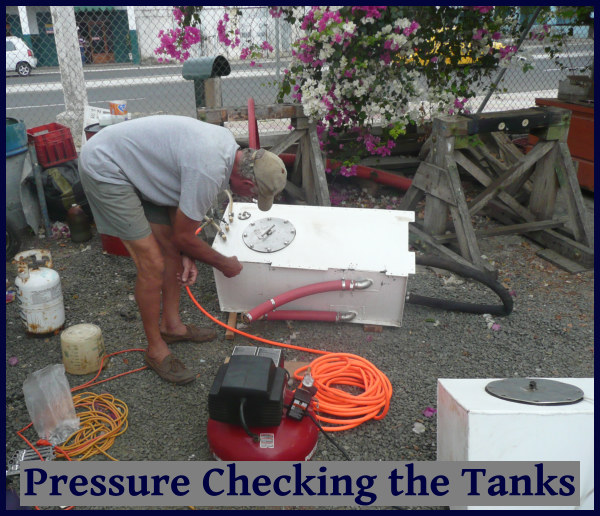
pressure test

Out they all came, and we transported them ashore once again, one at a time. I also hauled my compressor and extension cords as well as several hoses and fittings ashore. We pressure checked all three tanks and found more than 30 leaks in all! We marked each leak and worked with a local welder to make the repairs. It was cheaper and quicker than hiring a flete and returning the tanks to the fabricator. After a new coat of paint, the tanks were ready to go back aboard – for the third iteration.
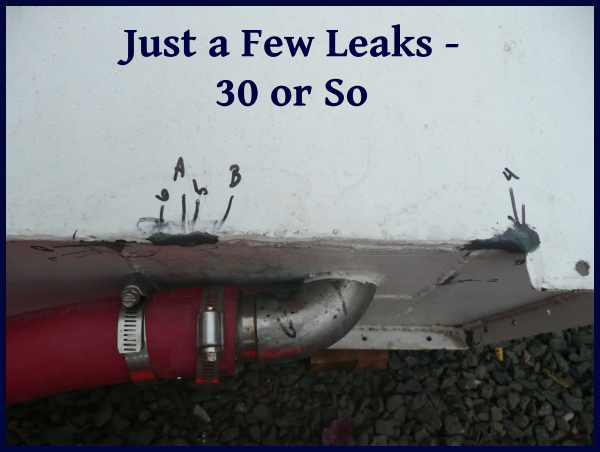
the leaks

This time, after the tanks were installed and plumbed, they passed the final pressure check. I secured each in place with bolts, then reinstalled the floor stringers, floorboards and table. Hoorah!
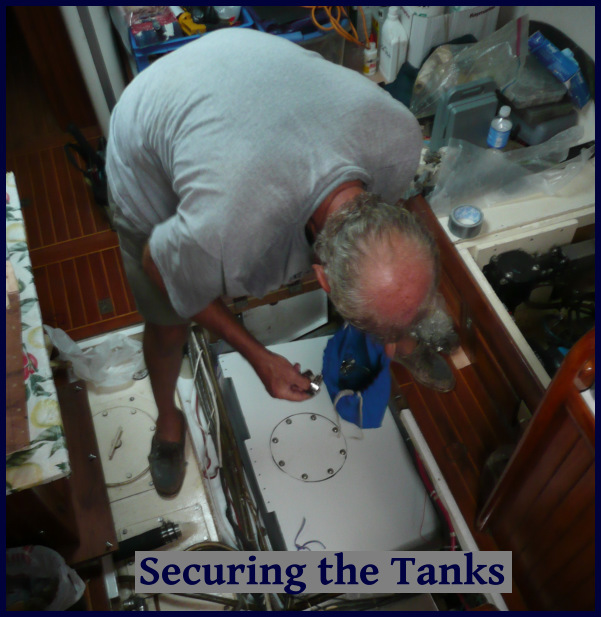
securing the tanks

All-in-all, the fuel tanks turned out well, and I was quite pleased with the results. Like most of my boat projects, however, building the new tanks took about three times as long as I planned. On the other hand, I was quite pleased with the cost – looking at the bright side, it came in at only about 50% over budget as opposed to the usual double or triple.

Building Walls

Something there is that doesn’t love a wall...

Robert Frost, “Mending Walls”

There have been lots of walls built throughout history … usually to keep someone or something in or out. The 5,500 mi (8,850 km) Great Wall of China, was purportedly begun in the 7th century BCE, the majority of the existing wall built during the Ming Dynasty(1368–1644). Visiting the wall is on my bucket list. I'd like to stand on it and ponder the feeling that millions of feet have walked this wall over centuries before me. It was built as an elaborate defense system to protect the “civilized” Chinese folks from the nomadic northern invaders.


great wall of china

Hadrian's Wall, a 73-mile barricade, was built c.122AD under the orders of Emperor Hadrian “to protect Roman Britain from the Picts and the other barbarian tribes that inhabited northern England and Scotland.” We stayed in Chester on one of our trips to England, so we could get up close and personal with this wall.

hadrians wall

According to Wiki, the Wailing Wall, an ancient limestone wall in the Old City of Jerusalem, is a relatively small segment of a far longer ancient retaining wall, known in its entirety as the "Western Wall". The wall was originally erected as part of the expansion of the Second Jewish Temple by Herod (although some would claim differently). The wall resulted in the encasement of the natural, steep hill known to Jews and Christians as the Temple Mount, the holiest place where Jews are permitted to pray.

It has also been called the "Wailing Wall", referring to the practice of Jews weeping at the site over the destruction of the Temples. The wall has been a site for Jewish prayer and pilgrimage for centuries; the earliest source mentioning this specific site as a place of worship is from the 16th century.

wailing wall

When we were in Peru, we had the opportunity to visit some the of walls built by the Incas. In Sacsayhuaman on the northern outskirts of Cuzco, the capital of the Inca empire, a citadel was built using huge boulders, cut to fit so tightly and exactly, no mortar was needed. We marveled at the craftsmenship of these masons.

oncan wall

In more modern times, the Berlin Wall was a barrier constructed by the German Democratic Republic (i.e. East Germany) that completely divided East Berlin and West Berlin (East Germany from West Germany and ostensibly from the rest of the world) from 1961 to 1989. It became symbolic of the “Iron Curtain” that separated the Eastern Bloc countries from Western Europe.

berlin wall

And then, of course, there's Trump's proposed wall along the Mexican border … we won't go there … too politically hot to touch on this blog.

So what has triggered my pondering of walls? David's recent masonry project. He built a 5' high cinder block wall in our new back yard which matches with the wall that encompasses our property. We're walled in or the neighbors are walled out, whichever way you wish to look at it.

david builds a wall

It was no easy project. We loaded 72 – 6x8x16 cement blocks weighing 28 lbs each, along with 10 cement caps and 14 half blocks onto three separate trolleys at Home Depot. We rented a truck from Home Depot, loaded the blocks onto the truck, unloaded them in the driveway, then hauled them through the gate to the backyard and stacked them for the wall-building project. Whew! The easy part was actually building the wall. After painting it the same color as the house, it looks great. The result was not to keep anyone or anything in or out, but to enclose the unsightly A/C system and make an enclosure for storing garden tools and supplies.

finished wall

FAQ: Any weird diseases in your travels?

People are always interested in how we take care of medical problems when we're out of the USA, especially in third world countries and they frequently ask if we've contracted any “weird” diseases on our journey. The answers are … pretty easy and yes. Getting medical care in third world countries is not all that difficult. We've not been in the jungles of Borneo or in remote Antarctica with major illnesses, so we can't comment on those situations. In general, however, we've been able to obtain reasonable medical and dental care wherever we've been. From mammograms in six different countries to an ear infection in the Galapagos, a URI in Ecuador, emergency major surgery in Chile, a sore that wouldn't heal in Vanuatu, and a toothache in Ushuaia, Argentina at the bottom of the world … we've always found adequate care at a fraction of the cost the same treatment would have cost us in the USA.

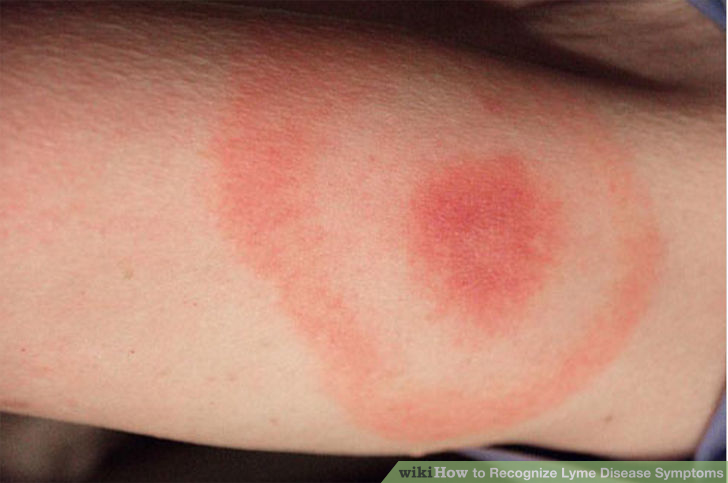
Quite honestly, none of the medical problems we've experience in foreign countries would fall into the “weird” category. All the weird diseases have occurred in the USA! In Boston one year, I contracted Lyme Disease caused by a tick bite. Lyme Disease was easily recognized … a very noticeable bull's-eye rash on my arm. With the help of the internet, I self-diagnosed, but had to go to a local doc-in-the-box to get verification and an Rx.

lyme disease

According to the CDC (Centers for Disease Control), there are “329,000 new cases [reported] each year in the US. Lyme disease is one of the fastest growing infectious diseases in the US and Western Europe. In September 2015, the CDC revised their estimates indicating ... an increase of up to 10 times what was previously believed.” I guess it wasn't that unusual to have Lyme Disease based on its current prevalence in the US, but it certainly seemed weird at the time.

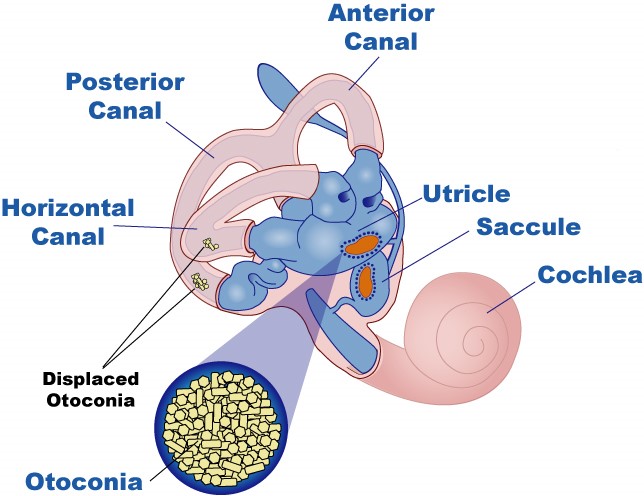
A few years later in Las Vegas, I woke in the middle of the night and my head was spinning (no alcohol involved). I could barely walk and was so dizzy, I began vomiting. Even laying flat in bed and not moving kept my head spinning. Believe it or not, we found a “dizzy clinic” in Las Vegas (go figure!). I was diagnosed as having BPPV (Benign Paroxsymal Positional Vertigo) … who could have known? BPPV is caused by “calcium carbonate crystals (otoconia) that are normally embedded in gel in the utricle becoming dislodged and migrating into one or more of the three fluid-filled semicircular canals.” i.e. crystals floating around in the inner ear. They used the simple Epley maneuver on me and the symptoms disappeared quickly. Interestingly enough, while on a road trip in California a couple years later, David had the same symptoms. We reviewed the steps of the Epley maneuver on line, followed the procedure and David was fine within hours.

bppv

How prevalent is BPPV? Well, according to my internet research, an epidemiological study reports “Eighty percent of people aged 65 years and older have experienced dizziness, and BPPV, the most common vestibular disorder, is the cause of approximately 50% of dizziness in older people.” So I guess, David and I aren't alone, but it certainly was an unusual occurrence for us.

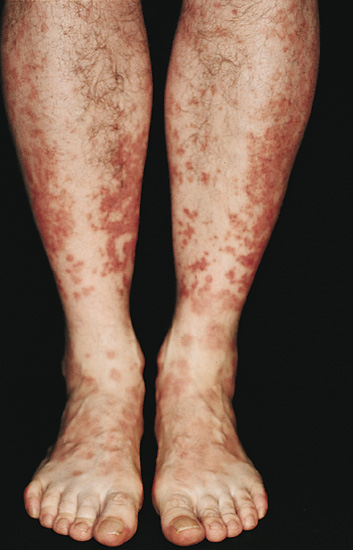
So, what's latest? A month or so ago when we were in Boston, David noticed a rash on his upper legs. It wasn't itchy and didn't really bother him and he thought it would go away. By the time we had been in Vegas for a week, it had worsened and spread further down his legs. We took a trip to Urgent Care where the on-call physician diagnosed “multiple non-venomous insect bites” and assured us that the rash would disappear in a couple of weeks. We disagreed with the diagnosis, but the doc knew best. Predictably, the rash worsened and spread further down his legs to his feet. We returned to Urgent Care where the on-call physician looked at it and said with a straight face “Geez … I have no idea what that is.” Another physician stopped in to take a look. “Wow … that's interesting. See a dermatologist.”

schambergs leg

There are no life-threatening dermatological conditions which require an emergency same-day visit, but after many phone calls, we found a Board Certified Dermatologist on the west side of town that could fit David in immediately. He took one look at David's legs, smiled and said “Schamberg's Disease”, also known as progressive pigmentary dermatosis. The doc brought in a textbook with colored plates and showed David the photos that he could have posed for. There's not much known about Schamberg's. It's rare and the cause is unknown, though there's much speculation. It's benign, non-contagious, eventually goes away and there's not much to be done about it. It looks awful, so David has taken to wearing long pants all the time till the rash disappears – so as to not scare little children.

Just chock it up to another weird disease … in the USA.