
The Blue View - Installing New Batteries
/ A few weeks ago, I did a blog on the latest and greatest in battery technology, and which type of battery would be best for Nine of Cups. After a little analysis, a lot of hemming, hawing, and harrumphing, and a fair amount of pontificating, I finally narrowed the field down to either a replacement set of my old Lifeline AGM batteries or a set of Thin Plate Pure Lead (TPPL) AGM batteries.
My Lifeline AGM batteries had lasted longer than expected - a little over eight years. Buying a new set would make the installation quite easy as they would be identical to the old ones. On the other hand, after a few years of use, I had to equalize them frequently (every 3 months or so) to reduce the build-up of sulfation. They are also more expensive than the TPPLs. In the end, I did some shopping around and bought six new Odyssey 100 amp-hour TPPL batteries.

The new batteries are smaller and lighter than the old batteries, but also only about half the capacity. (The six Odyssey batteries have a total capacity of 600 amp-hours vs. the original 820 amp-hour capacity of the four Lifelines.) Given that our plans for the next few years will more than likely be more coastal and shorter offshore passages rather than the major ocean crossings and high latitude sailing of the past, the smaller battery bank should suit us quite well, however.
Installing the new batteries took about two days. The hardest part was lugging the old 135 pound (61kg) batteries up out of their lockers and hauling them out and onto the dock. Removing the braces that held the old batteries and replacing them to secure the new wasn't difficult, but took most of the time.

Unless the new batteries are identical to the old ones, it is likely that at least a few of the battery cables will have to modified and a few new ones made. I have a lug crimping tool which was quite inexpensive on Amazon.
It is the kind that is smacked with a hammer, so I can make or modify battery cables myself. I strip one end of the cable, insert the wire into the lug, place the lug in the crimper and whack it a couple of times with a small sledge hammer. Then I measure the length needed, cut the cable to the correct length and repeat the process on the other end. Some suggestions:
- I cut the cable with heavy rigging cutters, but it can be cut with a hacksaw, a small angle grinder with a cutting wheel or even a Dremmel tool.
- Before crimping the second lug, I make sure the cable fits. I also rotate the lug if necessary – it's better if the cable doesn't twist in the lug after it is crimped. I use a marker to mark the proper orientation of the lug and wire.
- I finish the lug with a short length of heat shrink tubing.
As the installation is planned, there are a few considerations to be aware of:

Mechanical security. Each battery must be secured so that it cannot move more than 1 inch in any direction – right, left, forward, back or upwards. To accomplish this, I built a frame around the base of each battery out of 1x2 lumber, then bolted it in place. This prevented the battery from moving horizontally. Then I attached pad eyes to opposite sides of the frame and strapped each battery down. I've used either webbing or light line.
Overcurrent protection. A short circuit between the positive battery cable and ground will create some terrific on-board fireworks. The ABYC requires a suitable fuse or circuit breaker on the positive cable within 72” of the battery. An exception is the starter battery. A direct, un-fused connection is permitted between the starter battery and the starter motor.


Terminal isolation. The positive battery terminals should be protected, so that if a metal object is dropped onto the battery, it can't short the terminals. On terminals that have only one wire connected, I use a rubber boot. This doesn't work well if there is more than one wire connected, in which case, I use a small section of clear, heavy plastic to protect the terminal. The last time we replaced the windows in our dodger, I kept the excess plastic window material, and this works quite well. I hold it in place with cable ties. I also protect any other terminals connected to the positive side of the battery – terminal posts, fuse connections, etc. Another alternative is to enclose the entire battery in a battery box.
Ventilation. Most battery types – even the sealed ones – can release explosive hydrogen gas while charging. The battery compartment should be vented to allow this gas to dissipate. Since hydrogen is lighter than air, at least some of the vents should be at the top of the compartment.
Cables. The battery cables must be stranded, and obviously large enough for the current that will be carried. This is a whole subject unto itself and will be the topic of next week's blog.
Fuel fittings, tanks and filters.
- Batteries should not be located directly above or below fuel tanks, filters or fittings.
- Any metallic fuel lines located above or within 12 inches of a battery must be shielded with an insulating material.

In actuality, it took more like three and a half days for the installation – two for the actual installation, half a day to round up all the supplies and another day to look up all the rules and regs and. The good news is that I only have to do this every 5-10 years – the bad news is that I will have forgotten all the regs by then and will have to look them up again.

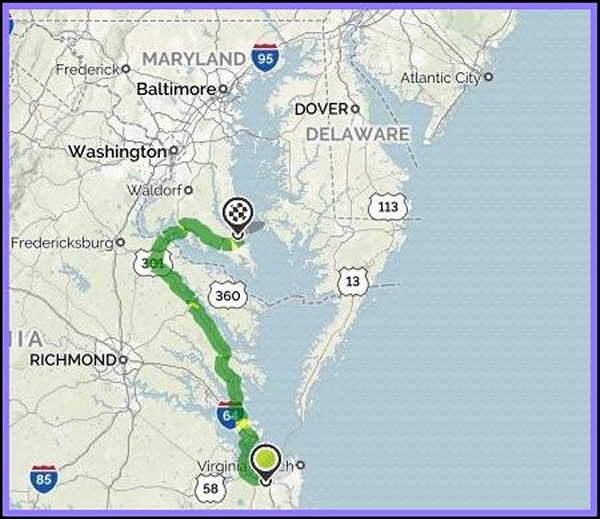
 We have been working non-stop lately (read that David) trying to get as many projects and as much boat work done as possible before we head back to Las Vegas at the end of the month. There's the alternator project and varnishing and installing new batteries and … the list goes on and on. My anti-all-work-and-no-play philosophy kicked in and I convinced the captain that a weekend in Solomons Island, Maryland would be a fine diversion. After nearly 35 years together, my coaxing methods are well honed. With a $9.99/day weekend rental from Enterprise, we set off before the break of day on Saturday. We wanted to make the most of the daylight hours once we got to Solomons and it's about a 3.5 hour ride/200+ miles ride away. Road trip!