
The Long Story of the Camino de Santiago
/If you’ve ever found yourself walking along a quiet country road, wondering how many footsteps came before yours, you’re already halfway to understanding the magic of the Camino.
The Long Story of the Camino de Santiago
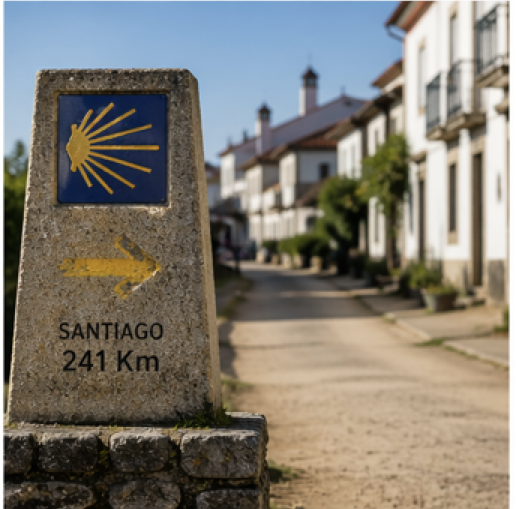
The Camino de Santiago—often simply called “the Camino”—is not just a trail, but a vast network of ancient pilgrimage routes leading to the shrine of Saint James the Greater in Santiago de Compostela Cathedral, in northwestern Spain.
Where It All Began
The story begins in the 9th century, when the remains of Saint James were said to have been discovered in Galicia, a region in the northwest part of Spain. At a time when much of the Iberian Peninsula was under Muslim rule, this discovery became a powerful symbol for Christian Europe. Word spread quickly, and soon pilgrims began making the journey—some from as far away as France, Germany, and even beyond.
By the Middle Ages, the Camino had become one of the three great Christian pilgrimages, alongside trips to Jerusalem and Rome.
The Golden Age (and the Not-So-Golden Parts)
Between the 11th and 13th centuries, the Camino flourished. Infrastructure grew along the routes—bridges, hospitals, monasteries, and inns were built specifically for pilgrims. Towns sprang up where none had existed before, fueled by the steady stream of footsore travelers.
Setting out on the Camino de Santiago in the Middle Ages was less like a mindful walking retreat and more like voluntarily signing up for a very long, very unpredictable survival challenge. Pilgrims often traveled for months—sometimes over a year—on foot, with little more than a cloak, a staff, and a vague sense of the direction to be headed.
The roads themselves were inconsistent at best. Some stretches followed well-worn Roman routes, but many others dissolved into muddy tracks, dense forests, or rocky hills that seemed specifically designed to test both knees and resolve. Weather was another uninvited companion: scorching heat in the summer, bone-chilling cold in the winter, and rain that had a remarkable talent for arriving just when spirits were already low.
Then there were the less charming elements of human nature. Banditry was a real and constant threat, particularly in remote areas where a lone traveler with a few coins—or even just a decent pair of boots—made for an appealing target. While many towns and monasteries offered refuge, reaching them before nightfall was not always guaranteed, and sleeping under the open sky was risky.
Disease, too, loomed large. Without modern medicine, even a small blister could turn into a serious infection. Contaminated water, poor nutrition, and close quarters in pilgrim hostels helped illnesses spread quickly. It wasn’t uncommon for pilgrims to fall sick along the way—some recovered and carried-on, some turned back, and some never made it any further.
Decline and Rediscovery
Like many grand traditions, the Camino’s popularity faded over time. Wars, political instability, and changing religious attitudes led to a steep decline by the 18th and 19th centuries. For a while, the trails were quiet again—more local footpaths than international pilgrimage routes.
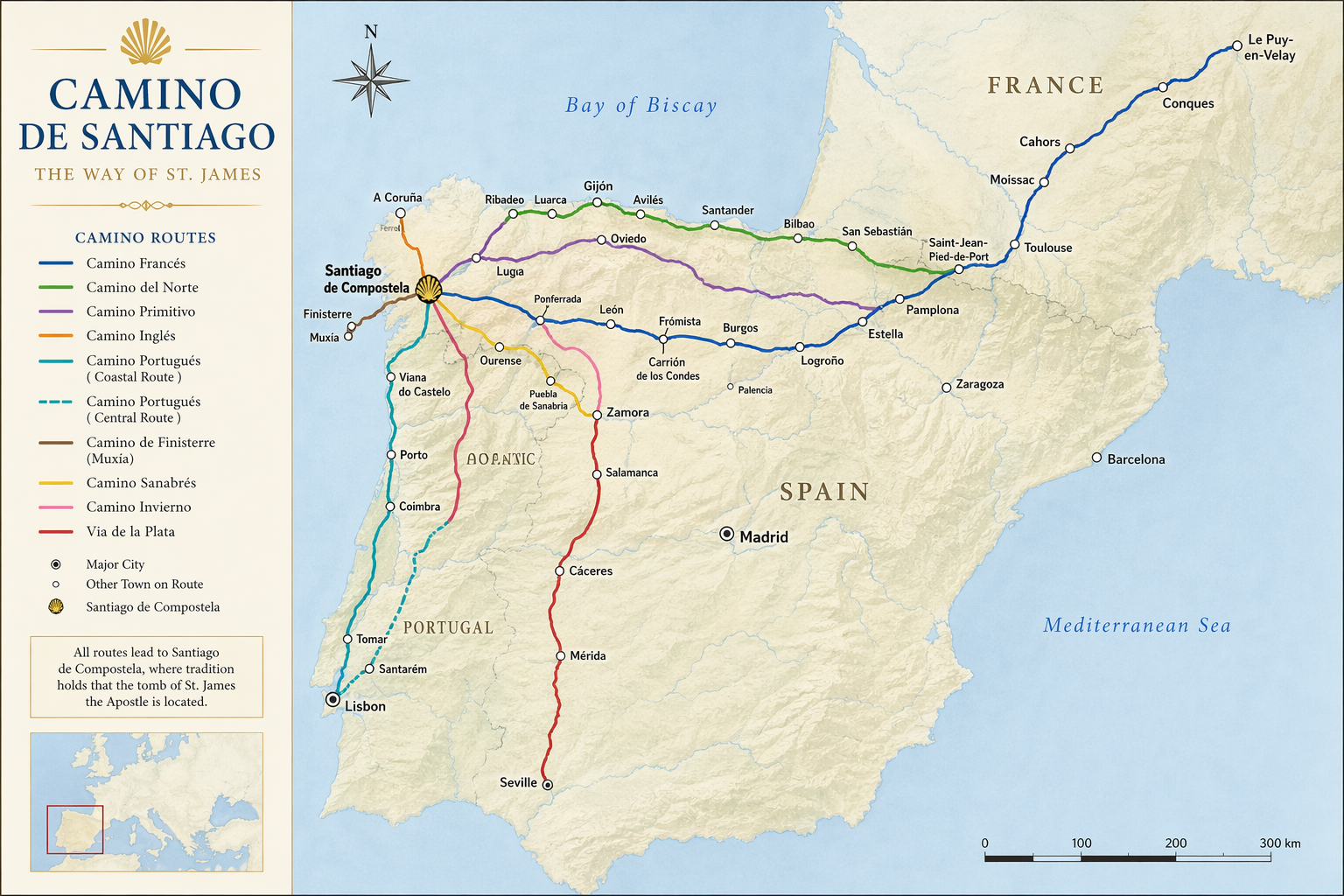
Then came the late 20th century revival. Thanks to renewed interest in cultural heritage, spiritual travel, and the simple appeal of unplugging from modern life, the Camino experienced a remarkable comeback. Guidebooks were written, routes were restored, and the now-famous yellow arrows began appearing to guide modern pilgrims.
Today, hundreds of thousands of people walk the Camino each year—for reasons ranging from deeply spiritual to “I need a break from my inbox.”
The Camino Portugués: A Coastal Twist on an Ancient Tradition
While the Camino Francés, the route that starts in France, gets most of the attention, the Caminho Português has quietly become one of the most beloved alternatives.
A Route Rooted in History
The Caminho Português traces its origins back to medieval pilgrims traveling north from Portugal to Santiago. Like its French counterpart, it developed organically—following Roman roads, trade routes, and ancient pathways connecting towns and religious sites.
Pilgrims often began in Lisbon or Porto, heading north through a landscape of vineyards, forests, and historic villages before crossing into Spain.
Two Main Flavors: Central and Coastal
One of the things that makes the Caminho Português especially appealing is its variety:
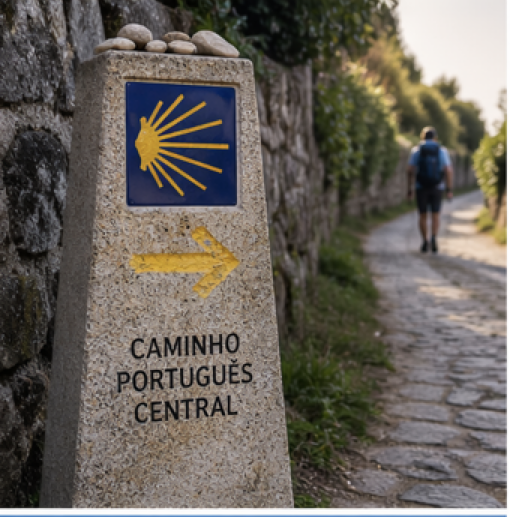
Central Route: The traditional inland path, the route we chose, is rich with history and dotted with charming towns and centuries-old churches.
Coastal Route: A more recent favorite, this path hugs the Atlantic Ocean, offering sea breezes, sandy beaches, and the occasional temptation to trade your hiking boots for a beach chair.
Both routes eventually converge as they approach Santiago, bringing together pilgrims with very different journeys—and very similar blisters.
Why It’s Grown in Popularity
In recent years, the Caminho Português has seen a surge in popularity, and it’s not hard to see why:
Slightly fewer crowds than the Camino Francés
Diverse scenery (urban, rural, coastal)
Excellent food and wine (this is Portugal, after all)
A well-marked and increasingly well-supported route
It offers a balance that many pilgrims find just right: authentic and historic, but less crowded and hectic.
Then and Now: Same Path, New Footsteps
The motivations may have shifted—fewer pilgrims seeking absolution, more searching for clarity—but the heart of the journey endures. It’s still about putting one foot in front of the other, noticing what unfolds along the way, and realizing that the journey matters more than the destination. And yet, there’s an undeniable satisfaction in reaching the end of the day’s walk: footsore, muscles and joints complaining, as we kick off our boots with a sigh and look forward to a shower, a cold beer, dinner, and a bed that feels like heaven itself.
Time to get walking. Join us in Porto for Day 1 on the Camino.