
Walking the Camino Portugués: Then vs. Now
/
There’s something timeless about the Camino Portugués—the quiet rural paths, the steady rhythm of footsteps, the sense of moving toward Santiago. But if a medieval pilgrim somehow appeared beside us today, he’d barely recognize the experience. The route is the same in spirit, yet radically different in practice.
This is a story of two Caminos: one shaped by uncertainty and faith, and another by GPS, café stops, and glowing yellow arrows.
The Old Camino: Faith, Risk, and Uncertainty
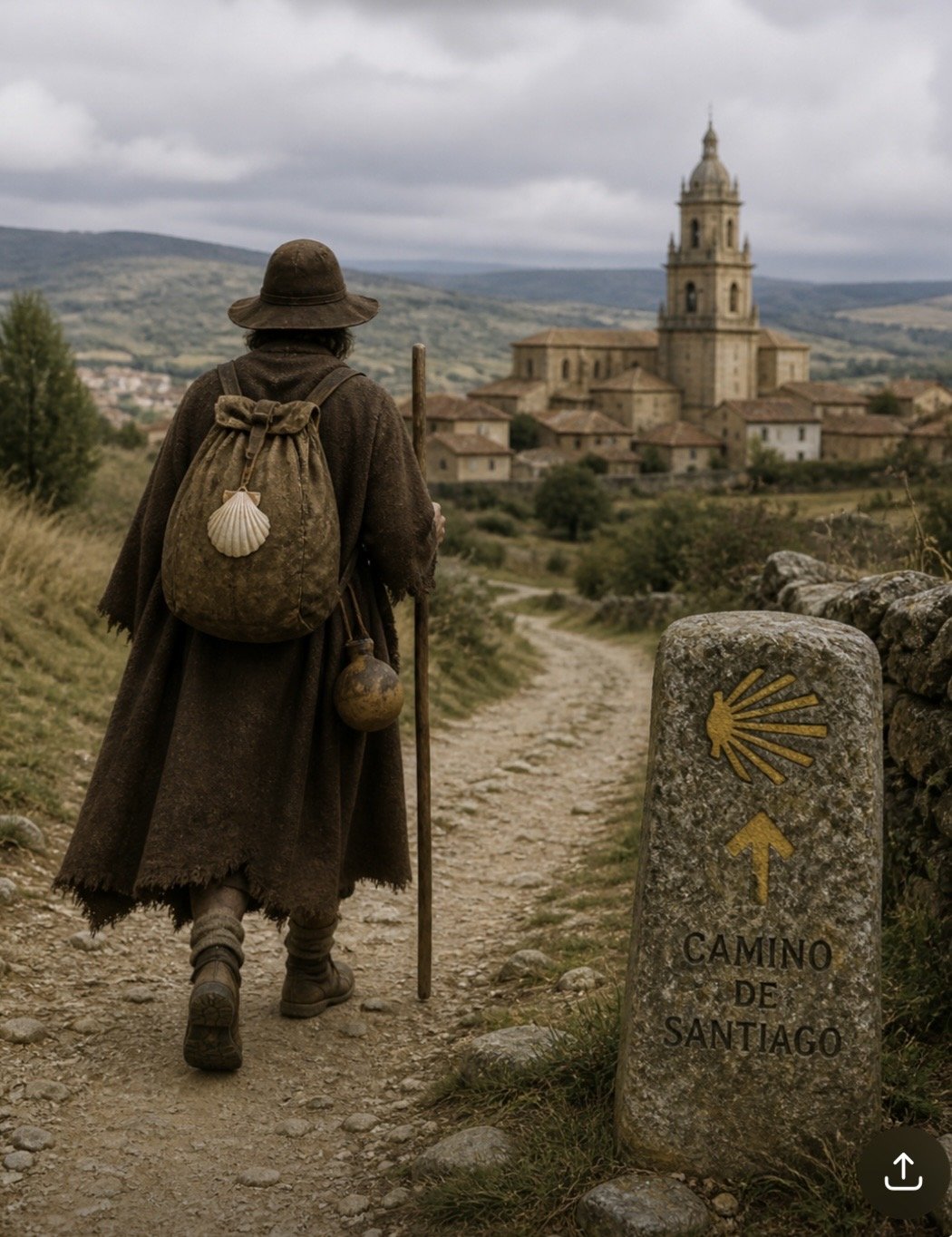
Centuries ago, walking the Camino Portugués was an act of devotion. Pilgrims set out with little more than a staff, a cloak, and trust that the road would reveal itself.
There were no standardized routes. Paths shifted with seasons, politics, and local knowledge. A pilgrim might rely on word of mouth, a rough description, or simply follow other travelers. Getting lost wasn’t a minor inconvenience—it could mean days of delay or real danger.
Waymarking as we know it today didn’t exist. The now-iconic yellow arrows only began appearing in the late 20th century. Medieval pilgrims instead followed rivers, Roman roads, or oral directions and an occasional cairn left by previous pilgrim. Landmarks mattered more than signage.
Services were scarce and unpredictable. Monasteries and churches sometimes offered shelter, but space wasn’t guaranteed. Food depended on charity or what could be carried. Illness or injury could end the journey entirely.
And then there was the threat of bandits. In less populated stretches, especially in forests or along isolated roads, pilgrims could become targets for thieves who knew they were carrying what little money or valuables they had. Traveling in groups offered some protection, but it also made routes more predictable. The risk wasn’t constant everywhere, but it was real enough that fear of robbery—or worse—was part of the mental landscape of the journey.
In short, the Camino was not just a walk—it was a trial.
The Modern Camino: Navigation in Your Pocket
Today, one of the biggest transformations is digital.
Apps like Wise Pilgrim - All Caminos, Maps.me or Buen Camino have turned the Camino into something almost impossible to get lost on. With offline maps, GPS tracking, elevation profiles, and lists of services, we can see exactly where we are—and what’s ahead—at any moment.
We can:
Track our position in real time
See upcoming climbs and descents
Find nearby cafés, pharmacies, and ATMs
Book accommodation on the go.
Compare that to the past, where even knowing the next town’s name might have been uncertain. (Although come to think of it, we rarely know the next town’s name either.)
Marked Paths: From Guesswork to Certainty
The Camino Portugués today is extremely well-marked with yellow arrows, scallop shell symbols, and frequent signage. We could, if we chose to, complete entire stages without ever checking a map—although I’d still glance at my phone for reassurance from time to time.
But it also removes an element of the unknown. The Camino used to demand constant attention and decision-making; now, it often invites us to simply follow.
Services and Comfort: From Survival to Choice
Perhaps the most dramatic shift is in comfort and accessibility.
Modern pilgrims on the Camino Portugués have access to:
Hundreds of albergues, hotels, hostels and guesthouses
Restaurants, supermarkets, and cafés in most towns
Wi-Fi in many accommodations
Luggage transport services
Apps and online platforms list thousands of places to stay, often with booking options and reviews. Today, we can even plan our entire journey in advance—or not plan at all and decide each day as we go.
In contrast, historical pilgrims depended on:
Religious hospitality (if available)
Charity or alms
Limited and uncertain shelter
The Social Camino: Solitude vs. Community
Historically, the Camino could be a lonely road, especially outside peak pilgrimage periods.
Today, the Camino Portugués is a social experience:
Meeting pilgrims from all around the world
Shared meals and conversations
Informal friendships forming along the way
Yet paradoxically, it’s also easier than ever to walk alone. We encountered many pilgrims, women as well as men, walking solo. With navigation handled and logistics simplified, solitude becomes a choice rather than a risk.
Gear: From Cloaks and Sandals to High-Tech Kits
The difference in what pilgrims carry—and wear—might be the most visible contrast of all.
Historically, pilgrims walked in simple, often worn clothing: woolen robes, cloaks for warmth, and basic leather sandals or boots. Their gear was minimal out of necessity. A wooden staff helped with balance and defense, and a small satchel held essentials like bread, a flask, and perhaps a religious token. Everything had to be durable, but comfort was limited and protection from the elements was rudimentary at best.
Today’s pilgrims, by contrast, often look like they’re prepared for a lightweight expedition. Modern gear is designed for efficiency, comfort, and weather resistance:
Breathable, moisture-wicking clothing
High-quality hiking boots or trail runners
Waterproof jackets and rain covers
Ergonomic backpacks with precise weight distribution
Ultra-lightweight trekking poles, blister kits, and hydration systems
Materials have transformed the experience—Gore-Tex, merino wool, and ultralight synthetics allow pilgrims to stay drier, warmer, and far more comfortable across changing conditions.
This shift doesn’t just reduce discomfort; it changes what the body can endure. What once required sheer toughness and resilience can now be managed much more easily with the right preparation and equipment.
At the same time, the modern challenge is the opposite: instead of too little, many pilgrims bring too much. With so many options for comfort—extra clothing, gadgets, backup gear, luxury items—it’s easy to overload a pack “just in case” … and we’re certainly not immune to the temptation. In a journey meant to simplify life, the real discipline now lies in leaving things behind and resisting the urge to carry every possible comfort on your back.
What Hasn’t Changed
Despite all these differences, some things remain remarkably constant:
The physical challenge of walking day after day
The awe-inspiring landscapes of Portugal and Galicia
The pull of Santiago as a destination
Even with GPS and cafe con leche stops, the Camino still has a way of simplifying life.
Final Thoughts
There is no doubt that the modern Camino is “easier”. We’re unlikely to get lost, go hungry, or get robbed, and if we do get sick or injured, medical attention is only a cell phone call away. We know that there is a hot shower, cold beer and soft bed awaiting us at the end of the day.
For us, walking the Camino is an adventure - something we still look for in our lives, and a total departure from our everyday life in Las Vegas. As was true for the ancient pilgrim, each day requires hard work and perseverance. The path may be better marked, but at the end of the day our knees, feet and hips still hurt and our muscles still ache.
We still feel the early morning chill, still dread the long uphill stretches, and still experience the quiet satisfaction of arriving somewhere new under our own power. We talk with strangers who quickly become friends, and create memories that will stay with us long after the walk is done.
In our minds, the Camino may be easier, but it’s no less meaningful.