
The American Salute That History Erased
/In her last blog, Marcie talked about visiting the tiny town of Goffs, California—current population: three. While we were there, we toured the beautifully restored one-room schoolhouse built during Goffs' heyday in 1914.
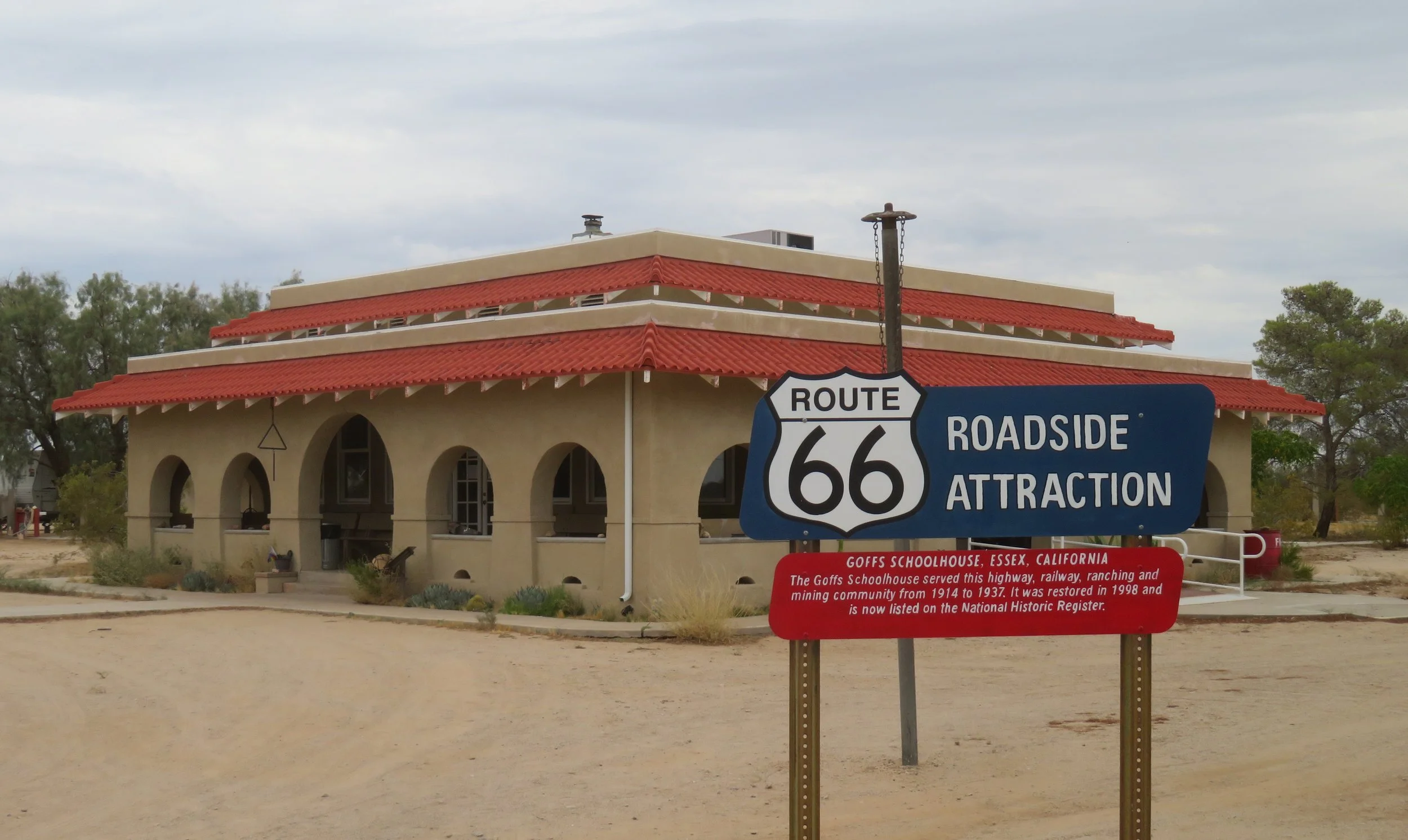
The restored one-room schoolhouse in Goffs, CA
Our docent, Chris Wirth, was a fount of information. As our group grew from two - Marcie and me - to more than ten in the large classroom, Chris helped us to imagine what school was like more than a century ago. He shared stories about Goffs' early years and the families who carved out a living in the Mojave Desert. Then he asked a question that caught everyone off guard.
"If you were a schoolchild in 1914, how would you salute the flag while reciting the Pledge of Allegiance?"
The answers came quickly. A few of us—including me—placed our right hands over our hearts. A couple of people snapped off military salutes. One gave a three-fingered Boy Scout salute.
Marcie had a different idea. After only a slight hesitation, she extended her right arm straight toward the flag.
Chris broke into a grin. "Yes!" he exclaimed, pointing at Marcie. "Only half a dozen people in all my tours have gotten that one right!"
Chris explained that the gesture was called the Bellamy Salute, and for fifty years it was the official way Americans saluted the flag while reciting the Pledge of Allegiance.
History, however, had other plans.
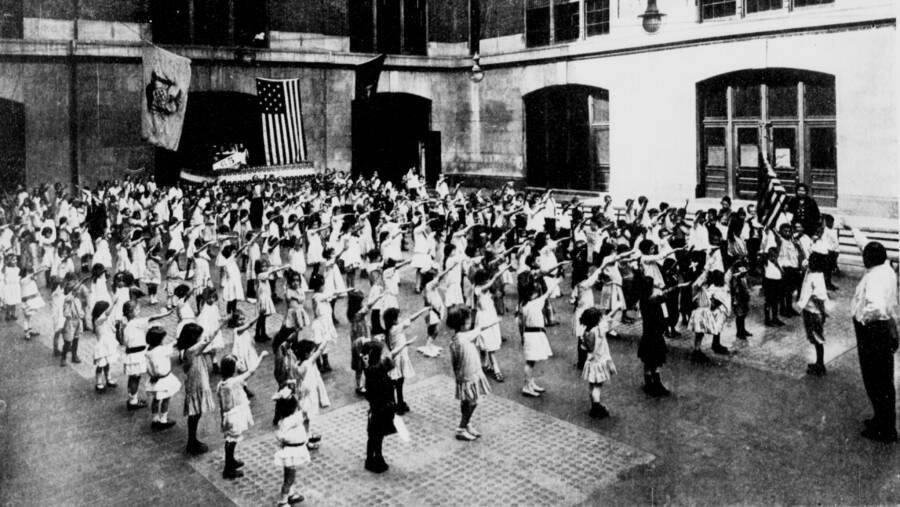
School children and the Bellamy Salute in the early 20th Century
The Birth of the Pledge
The story begins in 1892, when the United States was preparing to celebrate the 400th anniversary of Christopher Columbus's arrival in the New World. To mark the occasion, The Youth's Companion magazine launched a nationwide campaign encouraging every public school in America to display an American flag.
To accompany the celebration, the magazine asked one of its staff writers, Francis Bellamy, to compose a short pledge of loyalty that schoolchildren could easily memorize. His original version read:
"I pledge allegiance to my Flag and the Republic for which it stands, one nation, indivisible, with liberty and justice for all."
Notice anything missing? There was no "under God," and the words "the United States of America" had not yet been added. Those changes came years later.
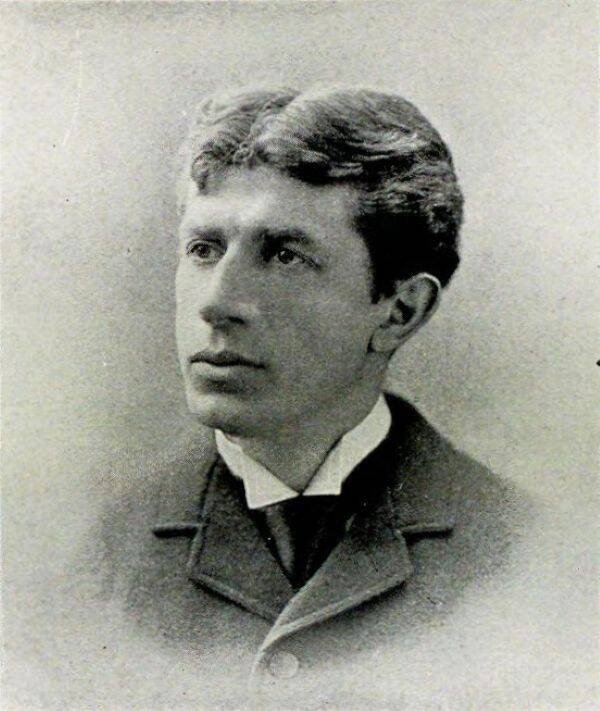
Francis J. Bellamy Circa 1894
Bellamy also devised the salute that accompanied the pledge. Students stood at attention and extended their right arm toward the flag with the palm facing downward. When they reached the words "my Flag," they rotated the hand so the palm faced upward toward the flag, holding that position until the pledge was completed. The execution evolved over the years, and by the 1910s many schools were simply extending the arm with the palm down, which is the version most often seen in photographs.
To Americans in the 1890s—and to the children attending schools like the one in Goffs—it was simply a patriotic gesture.
Then History Intervened
Unfortunately, another movement adopted a strikingly similar salute.
During the 1920s and 1930s, Benito Mussolini's Fascists in Italy and Adolf Hitler's Nazis in Germany began using outstretched-arm salutes of their own. Although historians still debate whether those gestures were inspired by an imagined Roman salute or developed independently, the visual resemblance to the Bellamy Salute was unmistakable.
As Europe descended into war, photographs of American schoolchildren pledging allegiance began looking disturbingly similar to newsreel footage from Berlin. The gesture hadn't changed, but its meaning certainly had.
A New Way to Salute
With America now fighting Nazi Germany, Congress decided the resemblance was simply too great. On December 22, 1942, lawmakers amended the U.S. Flag Code, and the Bellamy Salute was officially retired and replaced with the familiar gesture we still use today—placing the right hand over the heart while reciting the Pledge of Allegiance.
That lesson really hit home as I stood inside the Goffs schoolhouse, looking at the photograph of children from that era honoring the flag with the Bellamy Salute. In 1914, every student who attended that little school would have known exactly how to perform it. It was as routine as sharpening a pencil or hearing the recess bell ring. Yet just over a century later, a gesture once familiar to millions of American schoolchildren has all but vanished from our collective memory. Today, it's remembered mostly by historians, museum docents - and Marcie.