The Blue View - Refrigeration Redo pt.1

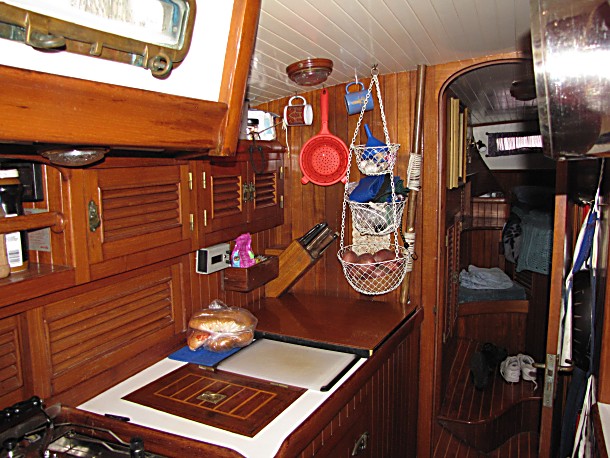
before demolition


In a previous blog, I talked about how inefficient our refrigerator/freezer is. Marcie has been asking about new countertops in the galley as well. It seemed like a good opportunity to tackle both projects while she is away.

On most sailboats, the refrigerator is built in. Much like the Franken-mattress project of a couple of months ago, you can't just go down to the nearest kitchen appliance store, buy a new fridge and slide it into place. On Nine of Cups, we have a 12-volt system. The condenser unit sits under the settee, copper tubing runs behind the galley sink and stove, then through the refrigerator to an evaporator in the freezer and this part of the system is working fine. It's the insulation that is the problem.

Our system has 2” to 3” of foam insulation surrounding it. When new, it was pretty marginal – now after 27 years it is pretty much useless. So all I have to do is remove the old countertop, remove the old fridge/freezer compartments and all the old insulation, re-insulate, build a new fridge/freezer compartment, and fabricate a new countertop.
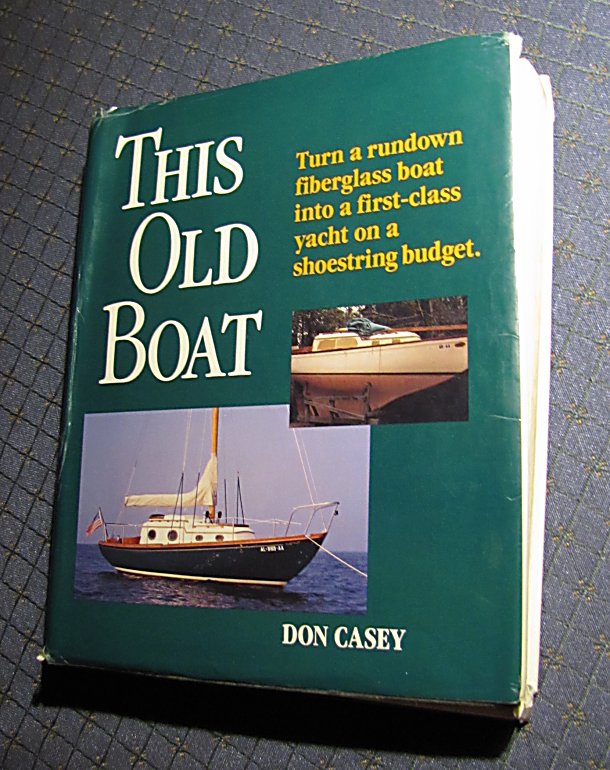
 

this old boat book


I have Don Casey's book "This Old Boat" for guidance. What could possibly go wrong?


stuff everywhere


This is a project that has required demolishing the better part of the galley and covering every remaining horizontal surface on the boat with tools, supplies, refrigerator parts, insulation and everything that used to reside in the galley. I literally have two feet of one settee left to sit on and each night I'm able to clear enough of the bed to sleep on. I've been without a refrigerator for the duration, but I also had to disconnect the stove for a couple of days while I re-routed propane lines. I'll also have to remove the sink for a day or two while I build the new countertop. Did I mention this is a project best done while Marcie is away?


after demolition


The first phase is the demolition part. In his book, Don devotes twelve words to this part of the project - “...extract the old ice chest. Remove all traces of the old insulation...”. It took me three days, but it is now done. A large cavern sits where the old refrigerator box was. The insulation was dripping water, and there were gaps between the foam sections. The insulation in an old Coleman cooler was more effective. There were only a couple of glitches. I wasn't able to extract the copper tubing without kinking it, so I had to cut it. I'll have to repair it with new couplings when I put it back together. And although I tried very hard, I wasn't able to remove all the teak trim pieces without cracking a couple of sections. Hopefully, I'll be able to repair them as well.

For me, this is the worst point in a project. I look at that big cavern and all that self doubt starts creeping in. What the hell was I thinking? I'll never get it all back together and working, and even if I do, it will look like crap. I'm sure I smell the scent of a big dragon lurking outside. Thoughts of burning Cups to the waterline to destroy the evidence start cropping up.

In the old days before Cups, I used to watch those home improvement shows like This Old House, and be amazed at how easy they made every project look. My projects usually turned out more like Tim Allen's in Home Improvement.

Stay tuned...


Days and Ways to Celebrate
A daily list of mostly obscure holidays and fun ways to celebrate them.
Ides of March
The day Marcus Brutus et all assassinated Julius Caesar. "Beware the Ides of March". Unless you're an Imperator, you probably don't need to worry, but it might be good to review your Roman history.
Buzzard Day
Well, Capistrano has its swallows and many cities celebrate the return of sandhill cranes. There are hummingbird festivals and bluebirds fests. Hinckley, Ohio celebrates the return of its buzzards (turkey vultures actually). They come back around this time every year and the folks in Hinckley thought it was worth a celebration. Learn more about buzzards through the Turkey Vulture Society (I kid you not!)


The Blue View - Learning the Lay of the Land

LayoLnd Maps_Snapseed  

When we arrive in a new port, one of the things we enjoy most is getting the “lay of the land”. Where is the grocery, the laundromat; are there hot showers; where's the chandlery, the hardware, the fishing supply place, the guy that does welding? Depending on how long it's been since our last port, we always need to find some of these places, if not all.

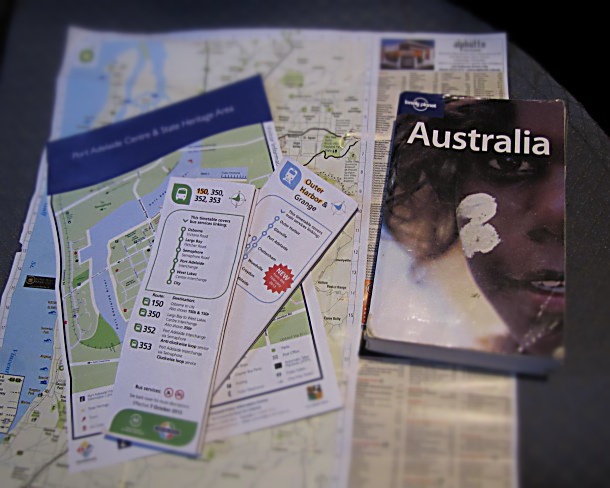
We begin by asking the other yachties, checking Lonely Planet, searching online and finding the local tourist info center. If I can get a map, I can start learning street names and what road goes where. Before long, we have a pretty good handle on where everything of importance is and all the shortcuts.
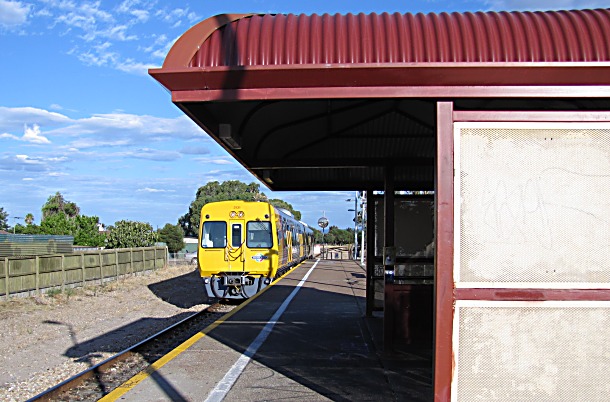
Some ports have everything you need within walking distance. Hobart Town in Tasmania was a great port in this respect. Things were expensive, but you could find anything you needed.


LayoLnd Train


It isn't quite as convenient here in North Haven. North Haven is a suburb of Port Adelaide, which is a suburb of the city of Adelaide. There is a chandlery, a pub and a few restaurants within a few hundred yards. The closest grocery is about a mile away. Anything else requires transportation. Today, I needed a hardware store, a building supply store, a larger chandlery, and an electronics supply place. Finding a tourist info center was also high on the list.

A new friend here in the marina has offered me the use of her car, but I decided to save that opportunity until I get a better feel for the area. I find it quite stressful trying to follow a map, read street signs, locate the store I'm looking for in heavy traffic, all the while trying to remember to stay on the left side of the road. This is a good opportunity to learn the public transit system.


LayoLnd Bus


Adelaide has a good transit system with clean, frequent buses and trains connecting everywhere. They have a good online route planning program, and I can buy an all day “Day Tripper” pass for a few dollars that allows me to ride all the buses and trains I can handle until 4 AM. I spent an hour or so planning all my route segments, and I was ready to go.

Well, as they say here, “it was no drama, mate”. I found everything I needed, didn't get lost, and found my way back home at the end of the day. All told, I rode five buses and one train, and never had to wait more than 15 minutes. The bus drivers were amazingly pleasant and helpful. On several occasions, the driver actually got up to help an elderly person with his or her packages (and no, I wasn't one of them). Once, when a young couple was having a very loud, profanity riddled argument, the driver warned them to lower their voices. When they didn't, he stopped the bus and told them he wasn't having them offend the other passengers with their language and made them get off – which they did without argument.

Once we get to know a port well enough to find everything without a map, it usually means w're starting to get itchy feet, and it's time to move on. I'm not at that point yet. I am liking it here just fine, and looking forward to sharing it with Marcie on her return. I am starting to feel comfortable enough with the lay of the land, however, that I may borrow Dee's car next time.


Days and Ways to Celebrate
A daily list of mostly obscure holidays and fun ways to celebrate them.
Johnny Appleseed Day
American legend John Chapman aka Johnny Appleseed was born in September, but we celebrate his day in March because it's planting season. Read more about Johnny while enjoying a crisp apple.


The Blue View - of Amps and Volts

Solar_blog_Snapseed  

Nine of Cups is happily parked in a marina near Adelaide at the moment. She is connected to shore power, and, for a change, I have no qualms about using a power saw or leaving my laptop plugged in. Having shore power is a luxury we don't often have, however, and when we are sailing or at anchor, energy consumption is always on our minds since we have to generate every watt we consume. So how much power do we consume and how do we make it?

Our biggest power hog is the freezer/refrigerator. When we were in Tasmania, NZ and Tierra del Fuego, trying to keep warm was a priority, and the refrigerator had no problems keeping things cold. Here in Adelaide during the summer, it's working hard to keep things frozen, and consuming a lot of amps. When it's cold outside, it requires about 36 amp hours to keep the beer cold and probably closer to 80 amp hours on a hot day. This translates to 432 watts and 960 watts a day, respectively. For comparison, a large household refrigerator/freezer combination draws around 4000 watts per day. One of the things I hope to accomplish while Marcie is in the States is to trim this hog down a bit.

Next in line in the power hog category are the laptops. We spend a lot of time each day writing, checking weather, communicating and watching the occasional movie. Then there's a bunch of small piglets... interior LED lighting, water pump, charging battery packs, anchor light, etc. And when we're sailing, we need power for the chartplotter, autopilot, radio, and navigation electronics.

So, tallying all this up, our power consumption ranges from about 130 amp hours, or 1.5kw at anchor on a cool day to about 2.4 kw sailing on a hot day. To put this in perspective, the average American household uses 11.5 kw per day.


Windgen_blog_Snapseed


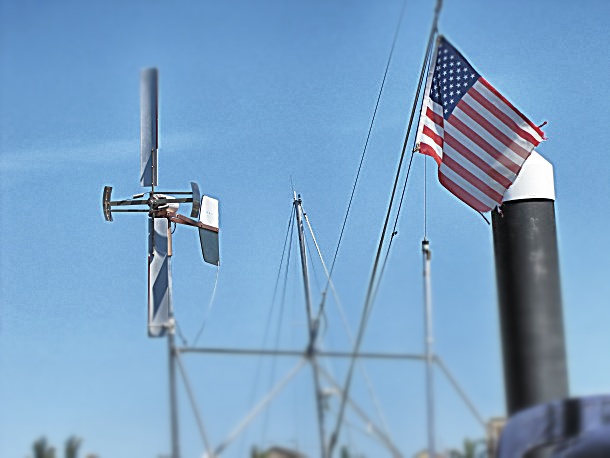
To generate power, we rely primarily on our three solar panels and a wind generator. On a windy, sunny day, we can count on these to produce about 150 amp hours or 1.8 kw each day. So if it's a cool, windy, sunny day, and we're at anchor, we make more power than we need. If it's hot, calm, or cloudy, the solar and wind generator won't make enough power.

One option we have is a small, gas powered generator that I lug up on deck. It can pump about 30 amps back into the batteries, and can also provide power for the sewing machine or a power tool or two. The second option is to start the diesel engine and run it an hour or so. We try to avoid this option. Not only is it noisy, but running the engine with no load on a regular basis is hard on it, and causes a buildup of carbon.

Our goal is to consume only as much as we produce from the wind and sun… kind of like living within budget. We strive for “free” days when there is enough wind and solar to cover all of our power requirements … and then we catch a fish for sushi.


Days and Ways to Celebrate
A daily list of mostly obscure holidays and fun ways to celebrate them.
National Be Heard Day
This is a day to celebrate entrepreneurs and small businesses who employ nearly half the workers in the US (higher percentages in other countries), work long hours, have less dollars to spend, get less attention and still have to compete with large corporations. So support your local Mom & Pop shop. Spend locally.
Alexander Graham Bell Day
It's also the day that Bell was granted the patent for the telephone. Talk about being heard!