The Blue View - Reeving a New Halyard

One of the items on my to-do list was replacing the main halyard. We replaced it last while in New Zealand a few years ago and at the time I thought I would try using a higher quality, lower stretch line than the usual yacht braid.. The cost would be almost the same since I could use a smaller size.

The line was great and I liked it - it ran through the blocks easier and the main came down with less resistance than with the older, larger line. The only problem was that the rope clutch, the clamp that holds the line in place once it is winched to the correct position, chafes the smaller sized line when it is under tension. Once I noticed the four chafe spots corresponding to each of the sail positions, I swapped the line end-for-end a year ago, and now we have 8 chafe spots. It is time to replace it.

We have an internal halyard system. The line starts in the cockpit, goes through the clutch and makes its way to the mast through a couple of blocks. It enters the mast through a small hole, then exits the top of the mast over a block, and is routed back to deck level.

It is easy to reeve a new halyard. Simply attach the cockpit end of the old halyard to the new halyard, then pull the old halyard through the clutch, blocks and mast. As long as the two ends remain attached to each other, it only takes a few minutes to reeve the new halyard. If the lines part, however, the job will take two days instead of a half hour.

The trick is attaching the two ends together without adding any bulk or stiffness. The union must be strong enough to ensure the two lines don't come apart but must not add any bulk or the joint will not pass through the clutch. If it is too stiff, it won't bend around the blocks.

I have a couple of methods for attaching the ends together. The easiest is to simply butt the ends together and use whipping twine to stitch them in place. Then I tape over the union with plastic electrical tape to make the union smooth and add a little strength. This method works well for external halyards and topping lifts that don't pass through a clutch.

method 1

For my internal halyards, especially when the line passes through a clutch, I use a different method. I start by cutting off about 2” (50mm) of the cover of the old halyard. Next, I pull a few inches of core out of the new halyard and cut off 2” (50mm) of it, and tape the ends of the core together. The newly taped core is drawn back into the new halyard until the covers butt together and the union is taped with plastic electrical tape. The I stitch everything together with whipping twine.

method 2

It usually take a little finesse to pull the newly joined ends through the clutch, but once past this obstacle, it is no problem pulling them through the blocks and mast. When the new halyard is in place, I cut the lines apart and either splice an eye in the new halyard or whip the end.
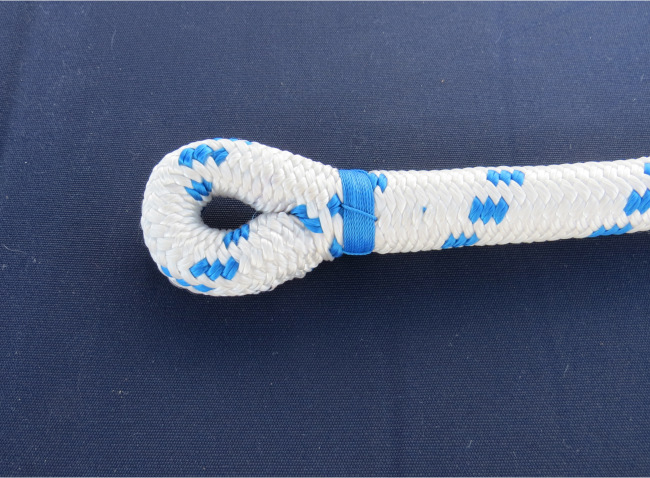
spliced eye

The Blue View - Communicating with Hand Signals

When we first started cruising, one of the things we discovered was that there was a frequent need to communicate with each other at a distance. This happened most frequently when we were dropping or raising the anchor, but also occurred when I went up the mast or when one of us was positioned at the bow trying to direct us through a narrow channel, or around hazards.

In the early days, the typical procedure for raising anchor was for Marcie to go forward to the bow and operate the windlass while I maneuvered Nine of Cups. It takes a little teamwork to get the anchor up, especially when we are in a crowded anchorage and the wind is blowing. The wind causes the chain to be taut, which in turns makes the windlass work harder. I try to motor slowly in the direction of the anchor to take the tension off the chain while Marcie brings in the slack. When all the slack chain has been taken in and we are directly over the anchor, depending on the bottom type, it sometimes takes some finesse to break the anchor free. When it does finally break free, I need to hold position while Marcie brings the anchor up enough to ensure we don't snag it on anything - like someone else's anchor rode or a more shallow spot. Once she has the anchor in view, I can begin maneuvering around the other boats while Marcie secures the anchor. During this process, Marcie may need me to stop while she knocks the pile of chain down or to clean the chain of mud, kelp or seaweed.

Through it all, Marcie and I need to communicate quite a bit of information. She needs to tell me when to motor forward, how fast and in what direction. She needs to tell me when to stop, when the anchor has broken free, and when it is in view. Our initial method of communicating was by shouting at each other. When the wind was blowing, the engine was on, and Marcie was facing away from me, she needed to shout REALLY LOUDLY for me to hear her. Even then, I didn't always hear what she said, so I would have to yell into the wind as LOUDLY as I could, asking her to repeat what she said. There are a whole number of reasons why this wasn't ideal. The number one reason is that when we were yelling at each other, even when we started out with the best of intentions, we both got irritated and then angry. Even when things did go well, we spent the next few hours being snippy with each other. The next biggest reason was that voices really carry over the water. Even if we couldn't understand what the other was saying, everyone else within a half mile could hear us yelling at each other. Sometimes, this would be a source of amusement for the other yachties, but more often I'm sure it was quite irritating, especially when we were trying to leave quietly at the break of dawn.

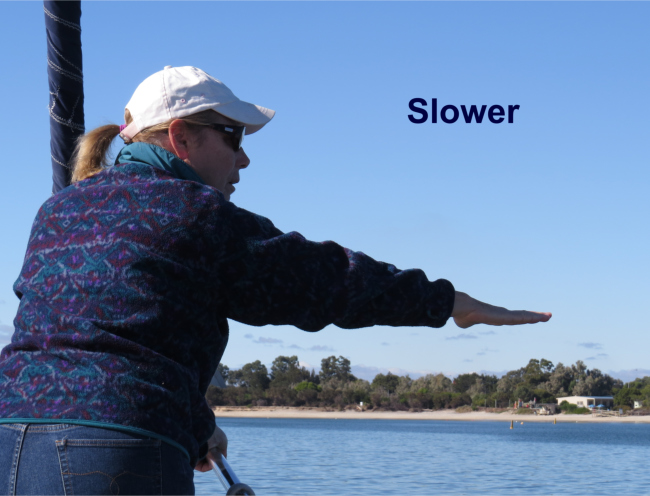
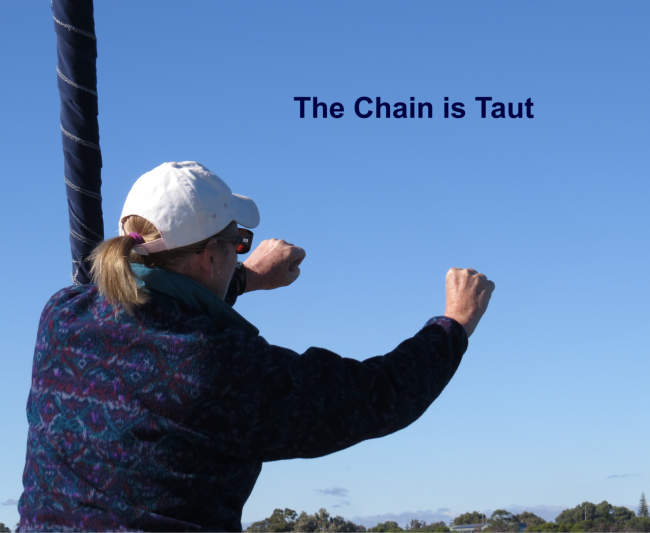
We thought about getting small portable radios or one of the wireless intercom systems. But in the end, we decided to devise our own system of hand signals for communicating with each other. We needed to be able to communicate each command using only one hand, and each signal must be clearly discernible to the other at a fair distance. These are the hand signals we use:

motor forward

faster

slower

stop

anchor free

anchor in sight

chain is taut

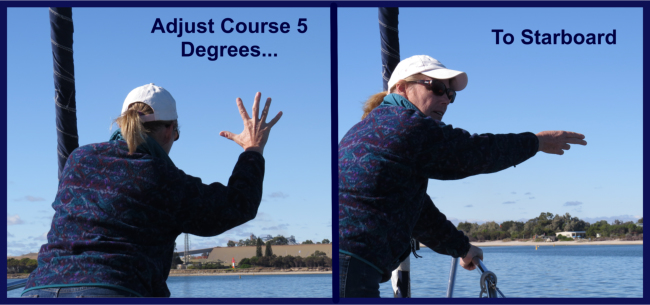
There have been a number of times when one of us was on the bow or part way up the mast to improve visibility while maneuvering around hazards. The atolls in the South Pacific which were often strewn with numerous uncharted coral heads are an example. We use all the same hand signals, but added one more to the list:

adjust course

We have a few other hand signals we use occasionally that aren't actually documented. They translate roughly to the following:

“Uhh – sweetie, I think you may not have recognized my last 6 signals and you will be embarrassed to know that you have just run over the mooring ball...”

or, “Actually honey, I did see your last 6 hand signals, and while I found your last hand gesture quite endearing, you may not have noticed that the wind has piped up just a skosh ...”

and my favorite, “That was quite a humorous response, love. While pondering it, I thought of a new storage location for the boathook I'm holding...”

The Blue View - The Cape Effect

Wind behaves much like a fluid. As it encounters a mass of land, it speeds up as it goes over or around the obstacle, much like the water in a river does as it goes through a narrows or around a boulder. This phenomenon is very apparent on a sailboat as the boat nears the end of an island or a cape. We have often been sailing in very light winds in the lee of an island, only to get blasted by 35 knots or more of wind as we cleared the end of it. Likewise, as Nine of Cups nears a cape or headland from offshore in moderate 20-30 knot winds, we know that the wind will be considerably higher just before we go into the lee of the land.

This phenomenon is often referred to as the cape effect. Most capes mark the end of a landmass, many of which are high promontories or even mountains. When the wind conditions are right, these capes can be dangerous. Usually, giving the cape a wide berth will avoid the worst of the wind. Depending on the cape and the current weather conditions, this might mean staying a mile or even five miles offshore.

Regional weather patterns as well as the local topography can greatly enhance the cape effect. As anyone who has sailed the eastern Caribbean can attest to, the mountainous islands coupled with the strong tradewinds prevalent there often make for boisterous sailing between islands. Likewise, “Windy Wellington” is situated in the Cook Strait, the small gap between the north and south islands of New Zealand. The wind, which is funneled between the two land masses, blew hard every minute of the week or so we spent there.

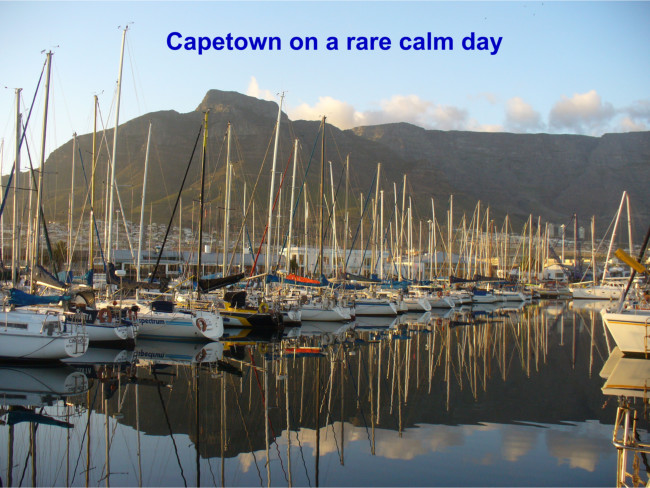
capetown

When we think of Capetown, which is nestled at the foot of Table Mountain, what we remember most about the city, beyond its sheer beauty, is the wind. The combination of the height of the mountain, the frequent inversion layers that prevent the wind from going over the top of the mountain and the local weather patterns result in almost consistently strong winds in Capetown, and at Cape Point a few miles south. It is not unusual to have gale force winds in Capetown and Cape Point, while totally calm conditions exist in Clifton, halfway in between.

deal anchorage

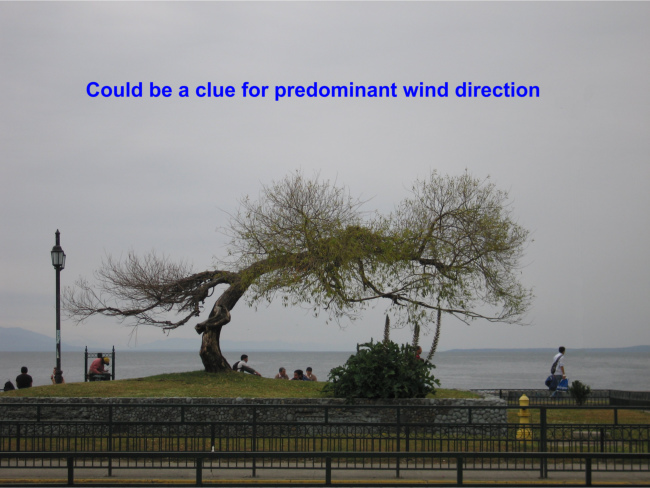
There are other topographies that have this effect as well. A gap between two mountains or a notch in a mountain will often funnel and magnify the wind. While this isn't called a cape effect, the result is the same – the wind speed increases as it is redirected through the notch or gap. This effect may not be too noticeable in light winds, but when we are taking shelter from an impending gale or storm, we try to avoid anchoring in such places. As we approach an anchorage, we pay as much attention to the hills and valleys we will be anchoring behind as we do to the depth sounder, water color and charts. Other clues are trees that are bent from the wind or gaps in the trees below a notch or between two hills.

bent trees

And there is one other clue as well. If the bay is named Windy Bay, Storm Bay, or Seasick Cove, it might be a good idea to look into how the anchorage got its name. It probably wasn't named after Bill Windy or Mary Storm.

squally cove