The Blue View - Springing off a Dock

When we are lying alongside a dock and there are boats tied up just in front of and behind us, departing can be a bit tricky. Add a contrary wind blowing us onto the dock and attempting to leave can be a real challenge. If the wind isn't blowing too hard, using a spring line will usually enable us to extract ourselves without damaging either Nine of Cups, the other vessels or our pride.  
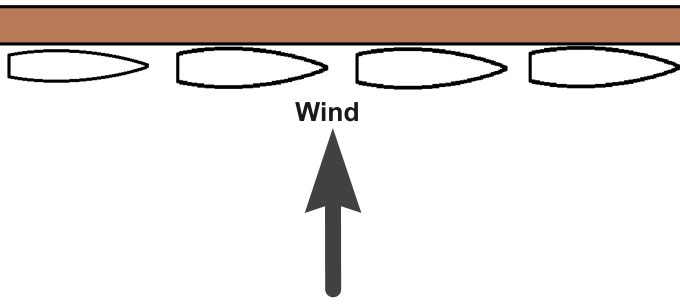
pinned against the dock


If the wind is very light, we use a stern spring line. We tie a large bowline in the end of a dock line and drop it over a dock cleat located close to midships. The other end of the line is secured to Nine of Cups at a cleat near the stern. Next, we position a fender at or slightly forward of the stern cleat. Since the stern will be swinging close to the dock, it is important to make sure there isn't a piling or other obstruction that could damage whatever is on the rail like an outboard or a solar panel. Once all the other dock-lines are released, we begin slowly backing up. As the spring line tensions, the stern will begin to pivot on the fender and the bow will start to swing out. We keep the engine in reverse, increasing the engine speed as necessary until the bow swings out enough to clear the boat in front of us. Then I put the engine in neutral which immediately takes the tension off the spring line. If there is someone on the dock, they remove the bowline from the cleat and toss it to us. If not, Marcie is quite adept at giving the dock line a flip to remove it from the dock cleat. As she pulls the line in, I motor forward and away from the dock.
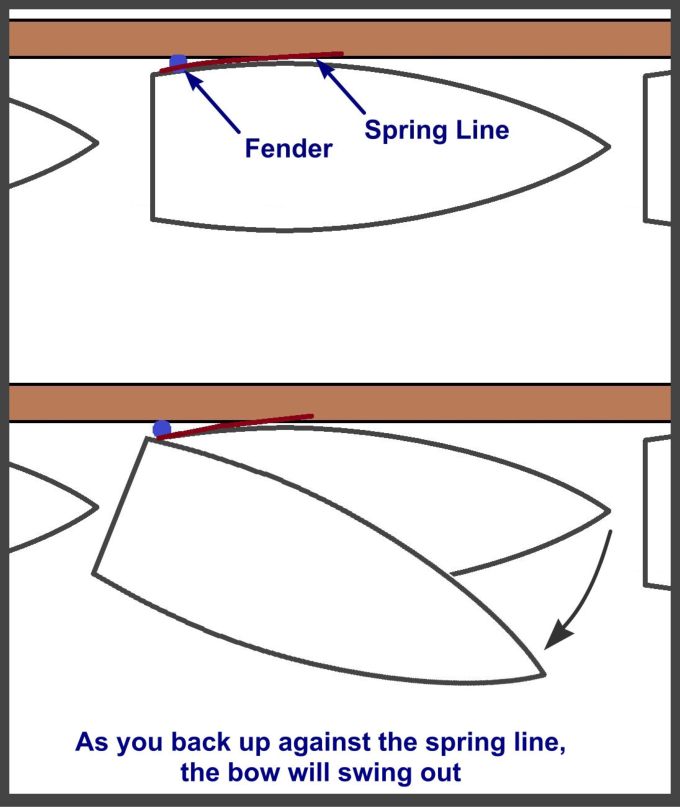
 

spring maneuver


If there is a moderate wind blowing, it is better to use a bow spring line. The spring line is attached to the bow and the fender is rigged forward. As Cups motors forward, tensioning the spring line, the stern will swing out. Once it is far enough out, I put Cups in neutral, taking the tension off the spring line, and it is removed from the dock cleat. I put the boat in reverse, and as we back away from the dock, the wind will blow the bow downwind. This is not the time to dawdle – I use a lot of throttle as we back away from the dock to make sure the wind doesn't blow Cups into our neighbor. I continue backing up until I find a spot with enough maneuvering room to turn around.


bow spring maneuver


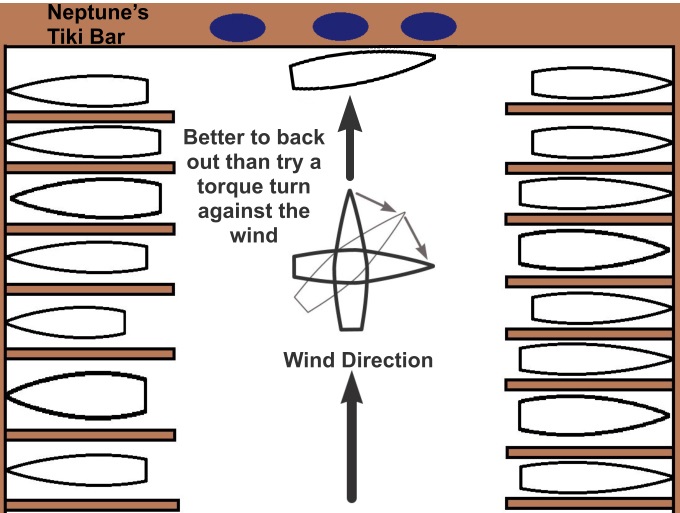
In my last Blue View, we found ourselves moored between the tables at a dockside tiki bar after botching a torque turn. We tried to extricate ourselves by springing off the dock, but that's when we learned that Nine of Cups has too much windage to manage it if the wind is stronger than 20 knots or so. An obliging sailor offered to take a bow line and secure it to a piling 100' (30m) upwind. Once he secured the line, we used the windlass to pull us off the dock. Once we were clear, he released the line, Marcie quickly pulled it aboard before it could get fouled in the prop (that would have really capped the evening), and we motored out of the marina.

I'm not sure whether the applause we received as we left was to congratulate us on finally getting off the dock or to thank us for providing the evening's entertainment. If the latter, we did not even consider going back for a curtain call.

The Blue View - Turning the Boat in its Own Length

Just to remind you that we do live on a sailboat and though we're currently in the middle of the desert, we're still thinking about sailing …. We took a course when we were first learning to sail called “Basics of Bareboat Chartering”. After successful completion of the course, we would supposedly be qualified to charter a boat on our own for a week or so in some exotic place like the British Virgin Islands. It was a fun course – we actually got to live aboard our classroom for four days - and we learned a lot about sailing. One of the things the instructor taught us was torque turns, which is a technique that allows you to turn a boat 360 degrees in an area no longer than a boat length. This is a very useful maneuver. We have used torque turns on dozens of occasions to turn Cups around in a tight marinas, or to line Cups up with a slip when there was no maneuvering room.


torque turn


When making a torque turn, we depend on the boat's propeller walk to help turn the boat. Prop walk is the tendency of the boat to rotate when it is first put in gear, and is much more pronounced in reverse than in forward. If the boat has a right-handed prop (i.e. the prop turns clockwise when viewed from the stern), the prop walk in reverse will cause the stern of the boat to swing to port. Conversely, if the boat has a left-handed prop, the stern will rotate to starboard when the boat is put in reverse.


prop view


Nine of Cups has a left-handed prop, so when we put the engine in reverse, the stern of the boat has a tendency to move to starboard. To do a torque turn with Cups, we turn the wheel hard to port, then put the engine in forward. The boat will start moving forward and to port. As soon as we start moving forward, I move the throttle to idle, put the engine in reverse, and then put the throttle at about half full speed. Cups will stop moving forward, but before there is any perceptible movement backwards, the stern will start rotating to starboard. As soon as the boat starts moving backwards, I again move the the throttle to idle, shift to forward and apply half throttle. As this process is repeated, Cups will rotate in place in a counterclockwise direction. If your boat has a right-handed prop, you would turn the wheel hard to starboard, and the torque turn will rotate the boat clockwise.

There are a couple of potential complications to keep in mind when doing a torque turn. We've learned the hard way that the wind and current have a major effect on how successful the torque turn will be. For example, it is very difficult to turn Cups' bow into even a moderate wind using a torque turn. The best we are able to do is get Cups broadside to the wind while she is being blown downwind. I learned this when we had had Cups only a few months, and I was trying to get us out of a tight marina in St. Pete. We provided the evening's entertainment for dozens of cruisers enjoying sundowners at a tiki bar there. I think we could have dropped anchor between two waterside tables and bought a round of drinks while I figured out how to extract us.


windy torque turn


Likewise, if there is a current, Cups will do a very nice torque turn while moving down-current at whatever speed the water is moving. I learned this a few months later when I was trying to line Cups up with a Travelift slipway. I did a great torque turn before realizing there was quite a strong current. By the time I got us perfectly aligned, we were about a boat length downstream of the slipway.

In most circumstances, the technique works very well. When it doesn't, I'd like to devise a clever way of quickly covering Cups' nameboards. I need to give that some thought.

The Blue View - Controller for the Daytank

The purpose of the fuel pump is to deliver diesel from the main fuel tank(s) to the injector pump. If the fuel contains air bubbles or the flow is restricted or interrupted, the engine will sputter and quit. One of the advantages of a daytank is that it can give us a little warning if the fuel pump stops delivering fuel, but only if we have a way of detecting when the fuel level in the daytank is low. As it turns out, adding a low fuel alarm to a daytank is quite easy. There are several fuel tank gauges available that incorporate a built in alarm. If the fuel level in the daytank drops below a certain level, an LED on the gauge lights up. Some have built-in audible alarms and some allow an external alarm. These gauges can be purchased with the sending unit or will work with most standard sending units.

It would also be nice to control the electric fuel pump automatically. The ideal controller would turn the fuel pump on when the fuel level in the daytank drops to a certain level, then turn the pump off when the fuel level rises above another predefined level. It should also incorporate a low fuel alarm and have an overflow alarm in the event the fuel level gets too high.

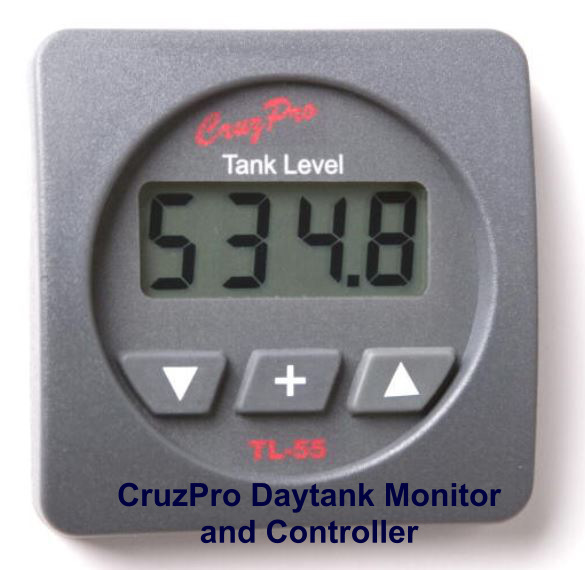
There are a few controllers available that do all of that. One in particular, the TL-55 from CruzPro in New Zealand is an inexpensive unit that appears to be well designed. The controller costs about $120USD. Add to that the cost of the sending unit, shipping, the cost of other incidentals like wire, a fuse and connectors, etc. and the entire unit will probably be just around $200USD.


cruz pro controller


Another alternative is to build your own controller. If you are handy with a soldering iron, it is not that difficult. It took about two days to build the controller for my daytank, and ended up costing about $50USD. The design is quite straightforward and has been working quite well for several years now.

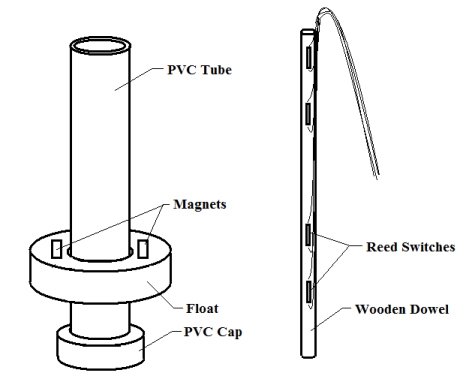
The figure below shows the level sensor portion of the controller. I used magnetic actuated reed switches that open or close when a magnet is in close proximity. The float, which has magnets epoxied to it, moves up and down with the level of the fuel. As it passes a reed switch, the switch closes.


controller sensor


The controller itself is housed in a plastic case. The three LEDs give an indication of the fuel and pump status. I attached the controller to the daytank. I also configured a remote LED and alarm in both the cockpit and the Nav station.


daytank with controller


The complete design documentation, including schematics, parts list, assembly details and photos are contained in a separate document, which you can find on our website at http://www.nineofcups.com/boatprojects.html.

To help with the process, here is our three part playlist on Soldering Basics:


Daytank Series Pt. 1

Daytank Series Pt. 2