The Blue View - Charging Two Battery Banks

Nine of Cups has the usual two battery banks – one for supplying power to the “house” and one dedicated to the starter battery. It's not easy keeping them both charged. The house batteries consist of four 210 amp-hour (ah) batteries for a total of 840 ah, while the starter circuit consists of a single 210 ah battery. Both have switches so that in an emergency, we can use either or both banks to start the engine or provide power to the house circuits.


schematic 1


When we are on shore power, we have a smart battery charger that monitors both battery banks and charges each as needed. The charger is only a 30 amp charger, so it takes several hours of charging to fully charge the house battery bank, but this isn't normally a problem.

The real challenge is when we are away from shore power – which is most of the time. When we don't have shore power, we rely on solar panels and a wind generator to produce most of our power, and when they aren't enough, we start the engine and use our 200 amp alternator to charge the batteries.

If I were designing the perfect charge controller, first, it would totally isolate each battery bank from the other, and would monitor the battery levels. If the engine was not running, it would direct the charge current from the solar panels and wind gen to whichever bank most needed the charge. In the rare event both battery banks were fully charged, the charge controller would redirect most of the incoming current to the water heater, and provide a trickle charge to both battery banks. If the engine was running, the charge controller would combine all three charge sources to maximize the charging current and provide an intelligent three-stage charge to both banks.

To my knowledge, there is no such charge controller. There are alternator regulators that can charge two battery banks, but they are quite expensive and don't deal with alternative charge sources. Some vessels have two engine-mounted alternators, one for each battery bank, each with its own regulator. This approach has a number of advantages, but it is expensive, adds complexity, and also doesn't handle alternative charge sources. There are battery isolators and battery combiners that help charge two battery banks, but none is ideal, and they're usually large and expensive.
 

BVCharge Photo1


So what do we do? We have our own method of keeping both banks charged. It doesn't come close to the 'perfect' charge controller, but it's inexpensive and works reasonably well. We use a diverter type controller for the solar and wind gen currents. As long as the house batteries need charging, the output from the wind gen and solar panels are fed into the house battery. Once it reaches full charge, the current is diverted into the water heater. This current is not enough to make the water hot, but does warm it a bit, and doesn't waste any energy. The output of the alternator is also fed into the house batteries.

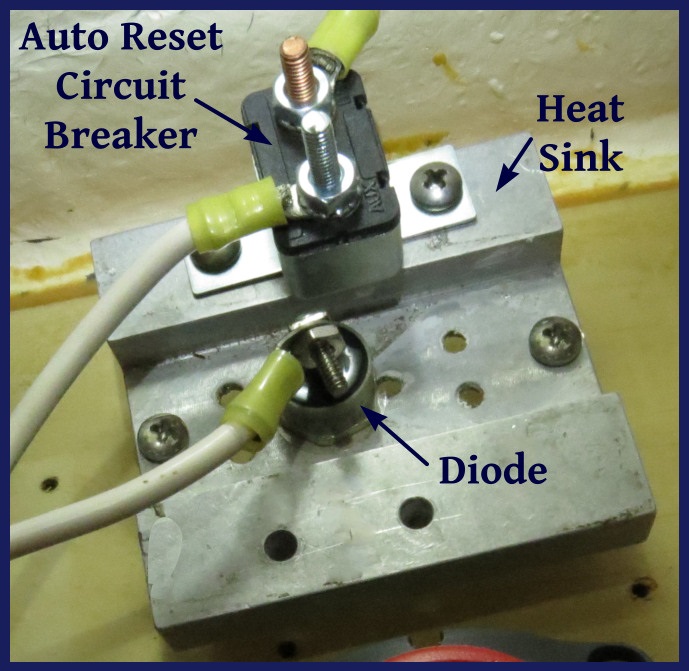
We use a diode and an automatic reset circuit breaker to connect the two battery banks. When there is solar and wind and the house battery bank begins to charge, once the voltage rises to about 0.4 volts above the starter battery voltage, the starter battery is trickle charged to keep it about 0.4 volts below the house batteries. When the sun goes down and/or the wind calms, the house battery voltage drops and the diode prevents the starter battery from discharging. Thus, it is always kept topped up.

When the starter motor begins cranking the engine, a huge load is applied to the starter battery, and its voltage drops to 10.5 volts or less. As the starter battery voltage drops, a large current flows through the diode connecting the two banks, but this quickly trips the circuit breaker, and the circuit is opened. Once the engine stops cranking, the starter battery voltage returns to near normal. After a few minutes, the circuit breaker automatically resets, and a charge current begins flowing from the house batteries to the starter batteries.

The auto reset circuit breaker is rated for 20 amps, eliminating the possibility of charging the starter battery at too high a charge rate – a problem we had with the battery isolator that we had originally. The diode I used is rated for 95 amps continuous, which is overkill for this circuit, but is one I had on hand. A 60 amp diode would be quite adequate for this circuit.


schematic 2


We have used this circuit for a few years now, and it has worked well for us. I plan to continue using it until we find (or I find time to design and build) the ideal charge controller.


The Blue View - Our New Book

anchors and anchoring

When we first moved aboard Nine of Cups in 2000, we dreamed of sailing off to as many far away places as we could, and since then, we have managed to find some pretty amazing and remote locations. One thing we quickly discovered, however, was that the learning curve for our new way of life was steep.

A case in point is the art of anchoring. We learned that what works well in Narragansett Bay isn't always the best approach when anchoring in the heavy kelp and deep anchorages of Tierra del Fuego, the coral atolls of the South Pacific, the deep grass and hard sand of the south coast of Australia, the muddy rivers of Panama or even the Florida Keys.

Over the years we've gained a lot of knowledge about ground tackle and anchoring techniques under different conditions. How do I deploy two bow anchors? When is it best to use a stern anchor? How do I rig anchors in series and why? What the heck are snubbers and kellets, and how do I use them? How do I pick an anchorage to weather an approaching storm, and how do I prepare for it?

Much of this knowledge was gained by talking with and observing the many cruisers, voyagers, yachties and fishermen we've met in our travels. As we learned a new anchoring technique, it often took a few iterations to work out the bugs and streamline the operation, and we made mistakes – lots of them.

Over the past couple of years, I've devoted a number of Blue Views to the art of anchoring. We collected these blogs, expanded on them, added a number of new topics and organized them into our new eBook, Nine of Cups Guide to Anchors and Anchoring. It covers everything from selecting the right ground tackle for your boat and your cruising plans to how you go about deploying a series anchor. If you are just starting out as we were in 2000, we think it will make the learning curve a lot less steep and help you avoid some of our mistakes. If you are an experienced cruiser, we think you will still find that it contains a great deal of useful information.


cover

Nine of Cups Guide to Anchors and Anchoring is available in a .pdf format which will work just fine on your iPad, laptop or PC:

$4.99

[buy_now_button product_id='9011']


It's also available in Kindle format from Amazon:

The Blue View - Anchorage Etiquette

party  boat  

As we approach a new anchorage, drop the hook and set up housekeeping, we try to do our best to be a good neighbor. Beyond the basic safety issues – where to drop the hook, how to set the anchor, how much scope to use, etc., there are a number of things we avoid doing that will annoy everyone else in the anchorage. Some of these are just common sense and some we learned by watching other boats.

Hopefully, I won't sound too much like a grumpy old curmudgeon as I list the “Nine of Cups Rules of Proper Anchoring Etiquette” for your consideration:

  • First boat in sets the rules. The first boat to anchor is the one that sets the rules and has the “right of way”. If you arrive in an anchorage and the other boat or boats are using two bow anchors, you should follow suit. If a boat anchored nearby thinks you are too close, you are obligated to move. If you are the first boat in, think about this as you anchor. Using a scope of 10:1 is probably overkill, and will certainly be a problem if the anchorage fills up. While technically you have the right to do this, you will most certainly have issues trying to get the next 10 boats to anchor far enough away to provide that much swinging room.
  • Anchoring near other boats. I don't know how many times we have been anchored in an idyllic spot all by ourselves, only to watch a boat approach and drop their anchor a boat length or less away, despite the fact there was miles of open beach on either side of us. Maybe they think we hunted around for hours looking for just the right spot and, therefore, this is the only place that is safe. If the anchorage is small or crowded, you may not have a choice, but if there is space, always try to anchor a reasonable distance away from the boat or boats already there.
  • Generators. A lot of larger sailboats and most power boats have generators. If you have a generator and will be running it, try to anchor near like boats who will also be running theirs. Avoid anchoring directly upwind of another boat. If possible, try to limit the hours you will be running it to mid-morning or afternoon when the noise will be least annoying to others in the anchorage. If you will be running your generator all night to power your air conditioning, try to anchor as far away as possible from those of us who prefer a quiet, peaceful anchorage.
  • Power tools. Remember the old definition that cruising is repairing your boat in exotic places? Most of us will find ourselves needing to run a power tool from time to time while anchored. As with a generator, try to be considerate when running it. If possible, anchor well away from the other boats, and limit the usage to the less annoying times. If you will be generating dust or debris, don't anchor upwind of another boat. Don't begin work at sunrise.
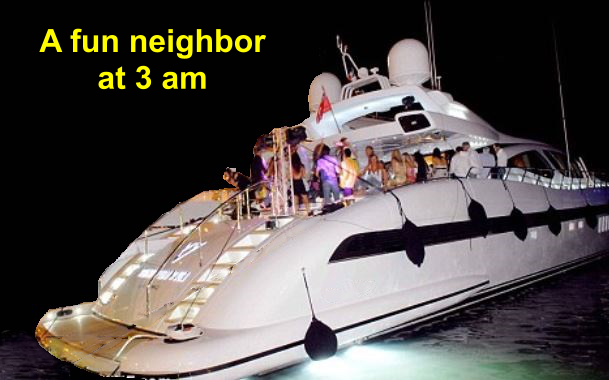
  • Partying. Most of us enjoy getting together with other cruisers. Having potluck dinners and enjoying sundowners with new and old friends are part and parcel of the cruising life. Unless you are inviting all the neighboring boats, however, be considerate, both in the amount of noise and how late you intend to “party on”. Sound carries very well over the water, and not everyone shares your taste in music or finds a joke from a loud, inebriated sailor enjoyable (though that's hard to believe).
  • Dumping. Rules vary around the world regarding the use of holding tanks and pumping wastewater overboard. Make sure you know and follow the local ordinances. Beyond the laws, however, common courtesy suggests that if people are swimming in the anchorage, you should avoid dumping raw waste into the water. Biodegradable garbage should be held until going to shore or heading offshore. Those banana skins, egg shells and potato peels will more than likely wash up on the beach.
  • Wakes. As you meander through the anchorage, whether in the mothership or the tender, keep your speed low enough to avoid making a wake. You won't make any friends if you knock over their sundowners.


jet skis


  • Toys. Many boats carry water toys aboard – kayaks, jet skis, water skis, sailing dinghies, sail boards. The wind and human-powered toys are usually quiet and unobtrusive. Others, like jet skis and the fast tenders pulling water skiers, are quite annoying, both because of the wake generated and the noise pollution. Don't think for a second that anyone else in the anchorage will enjoy watching at close hand your water skiing skills. Slowly motor your toy far away from the other boats, then have a ball.
  • Voices. Voices carry remarkably well over the water. Be assured that everyone within a half mile will be privy to the argument you are having with your spouse or the loud cell phone conversation you are having with your stock broker. Keep your voice down. Use the hand signals you learned in an earlier blog when dropping and raising the anchor. Sometimes, listening to loud conversations on other boats is entertaining and amusing, but more often it is just annoying.
  • Anchor lights. When anchored at night, you should always have an anchor light on. Most sailboats use a white light at the top of the mast. While this meets the legal requirements for an anchor light, we have found that this often isn't enough. Usually the crew of a boat making its way through an anchorage at night is peering straight ahead looking for obstacles and not 60 feet (18m) in the air where the anchor light is located. Nine of Cups, as well as the boats of several of our friends, have been run into at night, despite the fact that all were using masthead anchor lights. We now augment our anchor light with another light mounted above the cockpit. Since the lights are LEDs, there is very little extra power required, and so far we haven't been rammed since we began using it. That said, don't overdo it. If you like lighting your boat up like a cruise ship, either anchor well away from the rest of the fleet or tone it down at bedtime.
  • Spotlights. Spotlights and high intensity LED flashlights are great for finding your way through a crowded anchorage at night, but be considerate. Use them to pick out obstacles in the water – mooring balls, anchor rodes, markers, etc. Don't use them to illuminate the other boats as you approach. If you are worried about a vessel approaching your anchored boat at night, don't shine the light at the oncoming boat. Shining a light in the eyes of the approaching crew will most likely blind them for a few minutes, making matters worse. Instead, turn your spreader lights on and shine your spotlight on your own hull which will make you more visible.


barking dogs


  • Dogs. A lot of cruisers we've met have dogs. Most are well-behaved, friendly pets that provide companionship to the owners and security to the boat. Some, however, bark – a lot. Some bark whenever the crew goes ashore without them. Some bark the entire night through or whenever there is anyone in sight on the boats anchored nearby. If you have one of these dogs, do the rest of us a favor. Either get one of those collars that teach it not to bark or anchor somewhere far from the rest of us – maybe next to the guy who is running his generator, air conditioning and 20,000,000 candlepower deck lights all night.

So what do we do if we are following the “Nine of Cups Rules of Proper Anchoring Etiquette” and trying to be a good neighbor, but a boat anchored next to us isn't? Many times people just don't realize that something they are doing is unpleasant for the rest of us, like starting their generator at 6 AM or just as everyone is enjoying the sunset, and a tactful suggestion is all it takes. Sometimes, the other people could not care less about annoying everyone else in the anchorage, like the weekenders who like to have a party aboard that lasts all night, complete with blaring music and high speed tenders going to and from shore, with 15-20 of their closest, loudest friends. While we have often hoped they would drag anchor out to sea or have considered cutting their anchor rode, in the end, all we can do is either grin and bear it or move. We've done both.