The Blue View - Replacing a Halyard

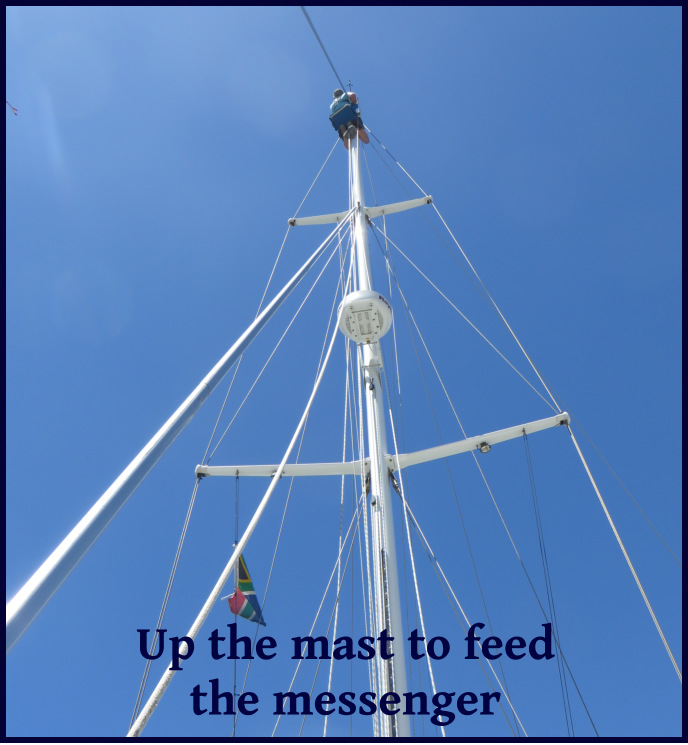
up the mast One of the problems we had while crossing the Indian Ocean last year was a head sail halyard that parted. It starts at the deck, enters the mast about six feet up (2m) on the port side, exits the top of the mast and is attached to the head sail. We had last replaced it several years ago in New Zealand, and apparently it had been chafing against the main halyard all these years. Unfortunately, the spot that chafed was inside the mast at a location that never sees the light of day except on the rare occasion the head sail is removed, so we didn't see it coming and it eventually chafed through and parted. Fortunately, we were near the end of our passage and were able to furl the head sail and complete the passage with the staysail and reefed main.

Usually when we replace a halyard, we can use the old halyard as a messenger. We attach the end of the new halyard to the end of the old one, and as the old halyard is pulled out, the new one follows (See the Blue View – Reeving a New Halyard). In this case, however, the old one had parted and pulled out of the top of the mast. We wouldn't have wanted to use the old halyard as a messenger anyway, because if we routed the new halyard along the same path as the old, it too would chafe through in a few years. Better to route a new messenger.

Both the entry and exit points for the halyard were close to the port side, so we wanted the new halyard to lie close to the mast on the port side. If we simply dropped the new messenger down into the mast, it quite likely would foul one of the other halyards inside the mast. To avoid this, we put Nine of Cups on a heel to port. We attached a long line from the spinnaker halyard to a stout cleat on the end of a slip a few boat lengths away and using a cockpit winch, we tensioned the spinnaker halyard until Cups had a definite list to port. Had we been at anchor, we would have swung the boom out to the port side and hoisted the dinghy and engine from the end of it. Together, they weigh about 200 lbs – if this wasn't enough weight, we would have partially filled it with water.
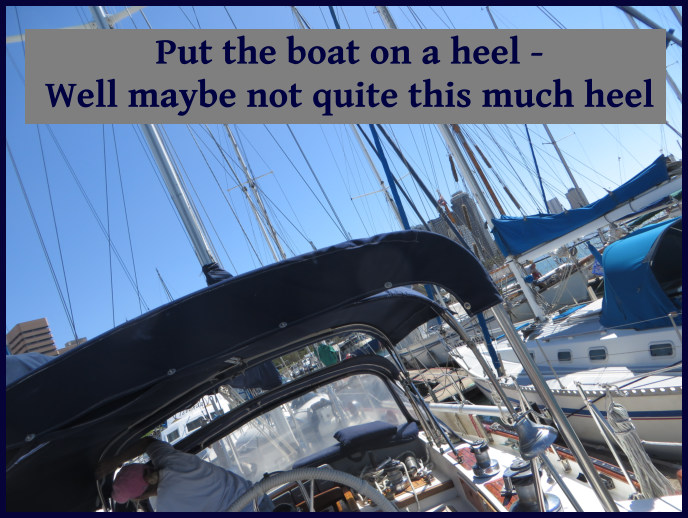
nine of cups at heel

We removed the stainless trim piece from the entry hole for the halyard in the side of the mast, then I rigged up a messenger using 1/8” (3mm) line and a few fishing weights. I attached the opposite end of the messenger to the new halyard, then went up the mast. I lowered the messenger over the masthead block and down into the mast.

reeve messenger wire hook

Marcie positioned herself at the halyard exit point and watched for the end of the messenger to appear. Using a bent wire, she fished the weights on the end of the messenger out of the mast. Then it was a simple matter to pull the remaining messenger and the attached halyard out of the bottom exit point on the mast as I fed the line from the top.
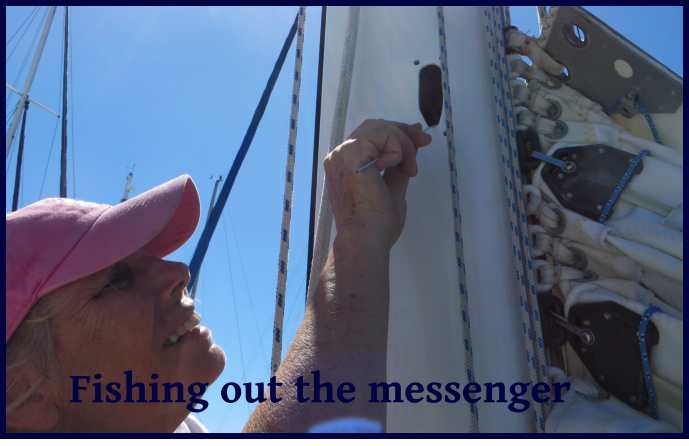
fishing

All that was left to do was reattach the trim piece and whip the halyard ends.

The Blue View - Fender Boards

fuel jetty Some of the most interesting places we've visited also had some of the roughest piers and wharves to tie up to. Hobart, Tasmania is a good example. The downtown wharf is a wonderful place to visit, with great old buildings, a plethora of pubs and chandleries, and a wonderful seafaring ambiance, all within walking distance of the waterfront. Unfortunately, we were required to tie up to a commercial wharf with pilings that probably dated back to Flinders' visit in 1798. Lying against the rough pilings, especially with the large tidal swings there, would have been a problem for our topsides and varnish had it not been for a couple of fender boards.

fenderboard with tire

Fenders are the inflatable bumpers that are hung from the sides of boats to protect the topsides from getting scratched or damaged at a dock or jetty. They work well when lying against the typical marina jetty or pleasure boat dock. They are, however, pretty much useless when used to fend the boat off from a commercial wharf or jetty. They aren't wide enough to stay between the boat and a piling, and may be chafed and ruined by a concrete wharf. Some wharves have huge tires attached to them which provide protection for ships and large fishing vessels, but which are much too large, coarse and dirty to lie against a sailboat. Attempting to use fenders when tied alongside these huge tires is not a good idea either. With harbor surge and tidal changes, the tires will likely snag the typical sailboat fender, and may break the line holding, it or even rip the stanchion out of the deck. In addition, the usual tar, muck and oil deposits on a commercial wharf will quickly coat those pretty yacht fenders with a sticky black residue, which will, in no time, get ground into the boat's topsides.

fender board illustration

Fender boards are large planks of wood that are suspended between the boat's fenders and those nasty commercial wharves. We have two dedicated fender boards that have kept Cups' topsides reasonably intact at dozens of some of the nastiest wharves and docks you can imagine. We also have three more planks that are primarily used as supports for our fuel cans, but could be drafted into action as fender boards should the need arise.

To make our fender boards, I started with two 2x10x7 (50mm x 250mm x 2.1m) planks. I drilled a couple of 3/4” (18mm) holes in the planks about four inches (~100mm) from the ends. Then I cut four 8 foot (2.4m) lengths of ½” (12mm) line and attached them to the fender boards using bowlines.

better fender boards

One of our friends has a much better method. He started with the same type planks and drilled a 1-1/2” (37mm) hole about three inches (75mm) in and three inches down from the upper corners of each plank. Then he drilled a vertical 3/4” (18mm) hole from the upper edge of the plank and down to the 1-1/2” hole. The line was fed down the vertical hole and pulled out the the 1-1/2” hole. He tied a stopper knot in the end of the line and pulled it back until the knot was taut in the hole. It was more work, but there was no possibility of the line chafing against the piling, whereas in my version, the bowline might rub against the piling.

Before deploying the fender boards, we make a reconnaissance of the wharf to determine where, how many and how high we need them. Marcie attaches the fenders, then secures the fender boards in place. We use either two or three fenders behind each fender board, depending on the wind and surge.

fenderboard in use

The next part of the plan is for me to maneuver Cups to within a foot or so of the wharf and come to a stop while Marcie lassos a cleat or two. Rarely do I manage this. More often, I come to a nice stop 8 feet off the wharf or I come in too close and snag one of the fender boards on a tire or piling while still moving forward with interesting results. We've provided entertainment in a variety of exotic places around the world, but eventually we get tied up.

The Blue View - Essential Ship's Library

top ten list of useful books blue view

When we began our cruising life, we had precious little experience. We had taken a few classes on sailing and had bare boat chartered several times in Florida and the Caribbean. We did, however, have a number of very experienced friends to rely upon as we gained experience. These good friends, the Dashews, the Pardeys, Nigel Calder, Don Casey, Brion Toss and Jimmy Cornell to mention a few, also helped us out of more than a few ticklish situations.

In reality, we have only met a few of these fine people, but we have read their books cover to cover. We started collecting their books when the cruising life was still a far off dream. Then, when it did become a reality, hardly a day went by that I didn't consult with Nigel to get his input on servicing a winch or bleeding the diesel engine, or with Don to improve my fiberglassing technique, or Jimmy to plan our next voyage.

I no longer check with my mentors quite as frequently as the early days, but they remain on-board as cherished old friends. And while I have begun to embrace e-books on my Kindle, I can't fathom ever parting with my hard copies.

I painfully reduced this list to my ten most used technical books – my essential ship's library. I'll be the first to admit that my list is very dated. I haven't been keeping track of the latest and greatest new generation of authors and books. If you have suggestions for books that should be added to the list, please let me know.

General Reference

Pocket Ref by Thomas Glover

The hands down winner of the most used book aboard Nine of Cups, this book is a compendium of a zillion useful pieces of information. Want to know the tap drill bit size for a 6mm bolt? How to convert from horsepower to kilowatts, or from hogsheads to gallons? The safe working load of wire rope? How about wire size vs amperage? It's all there.

General Cruising and Passage Planning

World Cruising Routes by Jimmy Cornell

This is a great book for planning passages – everything from a trip to the Bahamas to a circumnavigation. It provides winds and currents throughout the world, as well as the best times and routes for passages.

Maintenance and Repair

In addition to the specific repair manuals for the equipment aboard, we recommend the following:

Boatowners Mechanical and Electrical Manual and Marine Diesel Engines, both by Nigel Calder – or any other book by Nigel for that matter.

(Okay – so I cheated just a little and only counted these as one book). If you plan to leave the marina, you need to know the basics about repairing the mechanical and electrical systems aboard. After Pocket Ref above, these books are probably the two most used books aboard Nine of Cups. (You can tell by the greasy fingerprints all over them.) They not only describe how most of these systems work, but how to repair them.

This Old Boat by Don Casey

While it is basically intended as a book for restoring an older boat, it is also a great collection of tutorials on a variety of boat projects such as upgrading, repair and maintenance of fiberglass, paint, varnish, canvas, electrical, refrigeration and much more. In addition, his writing style makes it an enjoyable read.

Sail and Rig Tuning by Ivar Dedekam

A short concise book that does exactly what its title says.

Seamanship

The Annapolis Book of Seamanship by John Rousmaniere

This book, a classic, covers the basics of sailing, navigation, boat handling and seamanship.

Marlinspike Seamanship

While most of us probably won’t ever learn how to caulk the seams of a wooden boat or to tar a hemp lanyard, ropes still require knots, splices and hitches, and a sailmaker’s needle and palm are still necessary gear aboard a modern cruising sailboat. Beyond the basic essentials, however, it is quite satisfying to learn some of the traditional sailors’ arts. A fine canvas bucket or rope mat are far superior to the modern plastic or “astroturf” equivalents. We recommend and frequently refer to the following books:

The Ashley Book of Knots by Clifford Ashley

A compendium of almost 4,000 knots of every type imaginable, from occupational to decorative, along with a lot of interesting nautical lore and history. It is such a valuable book, I devoted a whole blog to it.

The Marlinspike Sailor by Hervey Garrett Smith

A great book on the traditional arts of the sailor, from basic knots to decorative ropework and canvaswork.

Riggers Apprentice by Brion Toss

A good source of information on repair and maintenance of your rigging, a good section on the basic knots and splices needed aboard and a chapter devoted to decorative knots.

Brightwork: The Art of Finishing Wood by Rebecca Wittman

Nine of Cups has a lot of teak brightwork, and I must have spent a few man-years in what often seems like a never-ending and futile attempt at trying to keep it beautiful. This book is my bible on the subject.

I've only covered technical reference books in this blog. I'll leave it up to Marcie to cover the books which she considers to be part of an Essential Ship's library on the non-technical side.