
The Blue View - Fuses and Circuit Breakers

Sooner or later, if you own your boat any length of time, you will have to deal with replacing or adding a DC electrical circuit. Perhaps you are upgrading an older piece of gear and the wiring is corroded or inadequate, maybe you are adding some new electronics, or maybe you are replacing a previous owner's amateurish handiwork that is now causing problems. Whatever the reason, it is not difficult to do the job correctly, with results that are professional looking, safe and reliable. a shipshape installationPlanning the installation

If you are upgrading an older piece of electrical gear, you may only need to replace the old wiring with new. If the amperage requirements of the new gear is no more than the old, if it was wired correctly to begin with, and the circuit it is connected to is not overloaded, it should be fine. Otherwise, you will need to find a new circuit for your power connection. So how do you go about finding the best place to connect the new wiring?

figure 1

Figure 1 shows a simplified DC electrical schematic for a typical sailboat. It has two house batteries in parallel and one starter battery. The switches allow either battery bank to be disconnected or to be re-routed. For example, if the starter battery died, it is an easy matter to start the engine using the house battery bank. The breaker panel has one sub-main breaker and several branch breakers, only a few of which are shown in the figure.
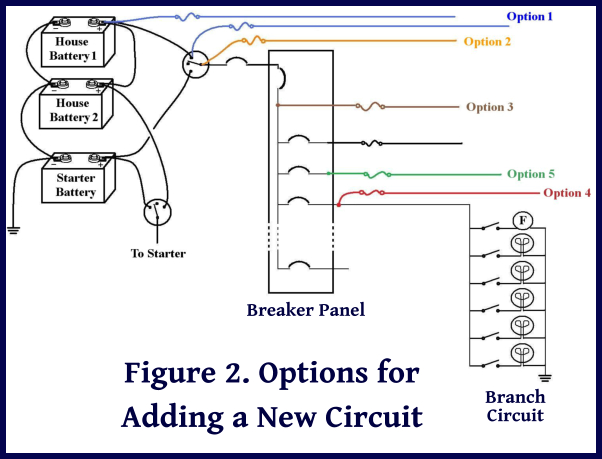
figure 2

Figure 2 shows several options for connecting your new electrical gear to the house batteries. Option 1, shown in blue, connects the new circuit directly to the battery. This is allowable for certain equipment that should be powered all the time, such as battery chargers, safety equipment (bilge pumps, alarms, etc.), and electronic equipment requiring continuous power for its memory. As long as there is a fuse or circuit breaker in the circuit and it is placed no more than 7” (178mm) from the battery or the switch, this method is acceptable. ( Note: if the conductor is enclosed in a sheath or enclosure, the fuse can be located up to 72” (182cm) from the battery terminal or within 40” (102cm) of the switch.)

The second option is to connect the new circuit to the battery switch as shown in orange in Figure 2. This is acceptable, again, as long as the fuse is within 7” (178mm) of the switch, or within 40” (101cm) of the switch if the conductor is contained in a sheath or enclosure. This option is better than the first for most equipment because the circuit can be switched off using the battery switch.

In the third option, the brown wiring in Figure 2, the new circuit is connected downstream of a circuit breaker. Depending on the type of equipment being connected and the conductor size, a fuse may or may not be required.

You can also connect the new circuit to an existing branch circuit as shown in red in Figure 2, which in some cases, may be the best option. As in the third option, a fuse may or may not be necessary depending on what you are installing. If you are adding a new reading light to the starboard settee, it makes perfect sense to connect it to the “Stb Cabin Lights” breaker. On the other hand, it would be illogical to connect the wiring for a new chart plotter to that same branch circuit. Before deciding on this fourth option, you should calculate the existing load on the branch circuit and make sure the new equipment will not overload the circuit. If the existing load plus the amperage requirements of the new circuit are less than the breaker size, it is probably safe to add the new circuit. In some cases, it might be possible to increase the breaker size, but this is unwise without carefully evaluating the conductor sizes and loads in an existing branch circuit. (The last few blogs discussed the processes for calculating loads and wire sizes).

One other option for connecting the new circuit is the green wiring shown in Figure 2. If you have a spare breaker, the circuit can be wired as a new branch circuit. This would be the best option if you are installing some new gear like an autopilot, refrigeration unit, or radar. The fuse may not be necessary if the breaker is sized correctly.

The two key things to remember are:

  1. Don't overload the circuit. If you are installing new gear, make sure the added load combined with the existing load doesn't draw more than the circuit can handle.
  2. Don't make the wire the weak link in the circuit. Be sure the wire you are adding to a circuit can carry the maximum current the breaker is rated for. If you connect a 20 AWG wire to a circuit with a 20 amp breaker and the wire shorts out, the red-hot wire with its smoking insulation will become the circuit fuse before the breaker trips. A better way is to add a small fuse between the breaker and the small wire.

Want to know how to install a fuse? Stay tuned to next week's blog.

The Blue View - Calculating Electrical Loads

It is usually quite simple to calculate the electrical load on a circuit. If there is only one electrical device connected to the circuit, the load is simply the amount of current the device consumes when it is running. If a circuit only powers an electric bilge pump, and the pump draws 8 amps, then this is the load. The wiring and fuse or breaker must be adequate to handle 8 amps. calculating electrical loads

If there are several devices connected to the circuit and all are often running simultaneously, then the total load can be calculated by adding up the current requirements of each device. For example, if we have an autopilot that requires 6 amps, a GPS that draws 2 amps, and a chartplotter that draws 3 amps, then the total load on the circuit would be 11 amps.

But what if we have a number of devices connected to a circuit, some of which may be on all the time and some of which are on only part of the time? Do we tally up the loads for every device and design the circuit to handle this worst case load? Do we take the average load? Maybe the average load plus a fudge factor? If we guess wrong in one direction, we will be popping breakers or blowing fuses on a regular basis. If we design the circuit for the worst case scenario, we will be spending a lot more on wiring and breakers than we probably need to.

Fortunately, the National Fire Protection Association (NFPA) as well as the American Boat and Yacht Council (ABYC) provide some guidance. The ABYC provides a worksheet developed for boats, and it is quite helpful in determining the likely total load on a circuit that has multiple devices. I've modified it slightly and show it below.

The two columns on the left side are for devices connected to the circuit that are on either continuously or for long periods of time. There are several blank lines provided, so if your boat has other devices on the circuit, add them in 'Column A'. Next enter the current required for each device in the 'Amps' column, and add these all up and enter the total in the cell labeled 'Total of Column A'.

The columns on the right are for devices that are only on occasionally. Again, add any additional devices in 'Column B' and then enter the current required for each device in the 'Amps' column. Add these all up and enter this total in the cell labeled 'Total of Column B'. Now multiply this by 0.1 and enter it in the following cell, '10% of Total of Column B (1)'.

Scan the 'Amps' column on the right side and find the largest single load. Enter this in the cell labeled 'Largest Single Item of Column B (2)'. (Not too difficult to follow so far, eh?). Enter the larger of the two values, either (1) or (2), in the applicable cell on the left side, and add it to the 'Total of Column A' cell. The resulting sum is the total load likely to be seen at any given time.

I find the process to be fairly straightforward, and much easier than, say, filling out a 1040 Tax Form.

Next week, I'll talk about circuit breakers and fuses. Stay tuned.

The Blue View - What Size Wire Do I Need - Pt. 2

smoking wires Last week's blog discussed one aspect of determining the correct wire size for an electrical application – how much current a wire can safely carry. Another aspect that should be considered is the amount of voltage drop that will occur.
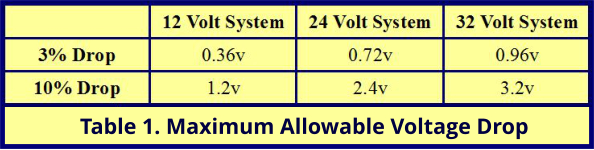
All electrical wire has resistance, and because of this resistance, as current flows through the wire, there will be a voltage drop. The amount of voltage drop that occurs depends on three factors: the length of the wire, the amount of current flowing, and the resistance of the wire. For some non-critical circuits, like cabin lighting, a 10% voltage drop is acceptable, but for most other circuits, a 3% voltage drop is the maximum allowable. Table 1 provides the maximum allowable voltage drop, in volts, for 12 volt, 24 volt and 32 volt systems.

table one

The first step in determining the voltage drop is to measure the wire length. I use my tape measure and measure each section of the wire run. I always round up and add a couple feet, or half a meter, for good measure - it is better to overestimate. I measure the return wire path to DC ground as well.

The second variable, the amount of current the wire will be carrying, may or may not be simple to calculate. If the wire is used for a single device – a bilge pump for example – all that is needed is to check the label on the device or refer to the owner's manual. If there are several devices connected to the circuit, the process is more complicated and involves a worksheet and a few calculations. I will describe the process in next week's blog. For purposes of this week's blog, let's assume we have a single device being powered by our circuit.

We now have all the information necessary to determine the necessary wire size. Follow these steps:

  1. Calculate the maximum resistance per foot using the formula:

Ohms per foot = Allowable Voltage Drop / (Current in Amps x Length of wire in feet)

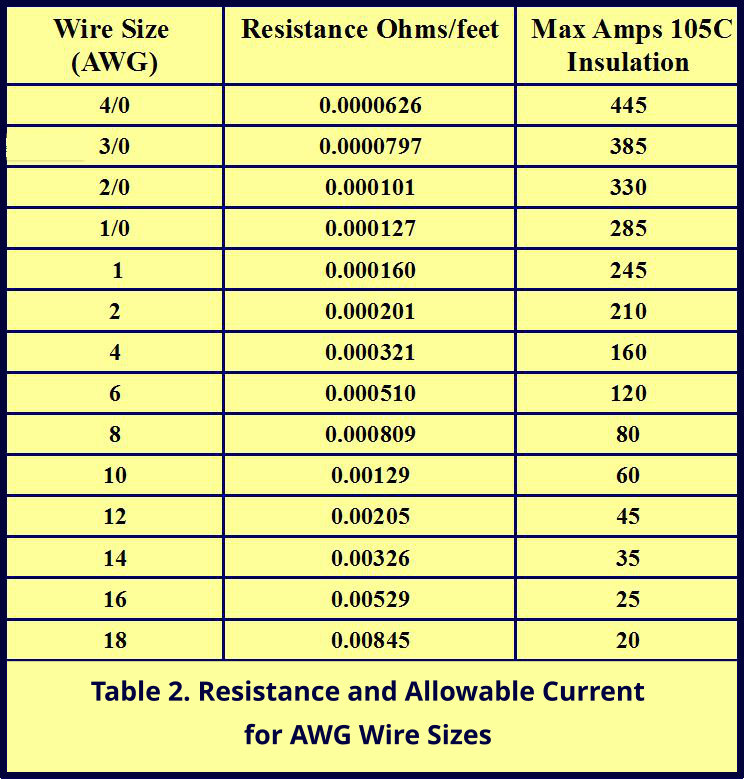
  1. Use Table 2 to find the wire size. Select a wire size that has a lower resistance per foot than the calculated resistance.

For example, let's say we have a 12 volt system and are adding a circuit for a new chart plotter that draws 3 amps. The round trip length of wire is 35 feet. We want no more than a 3% voltage drop in the circuit. For the equation above,

Allowable voltage drop = 0.36 volts (from Table 1)

Current in amps = 3

Wire length = 35 feet,

so the maximum resistance per foot would be 0.36v/(3amps * 35') = .0034 Ohms/foot.

table two

Looking at Table 2, wire size AWG 14 is the smallest wire that has a resistance less than .0034 Ohms/foot. So, AWG 14 wire is the smallest wire we can use and still have a voltage drop of less than 3% for our circuit.

The last column in Table 2 lists the maximum allowable current that the various conductor sizes can handle under ideal conditions. (This should look familiar if you read last week's blog.) This value is for quality marine wire with insulation rated for 105ºC. If more than the allowable current is passed through the wire, the wire will heat up enough to melt the insulation, creating a fire hazard. If you use wire with a lower temperature rating for the insulation, the wire cannot handle the same amount of current before the insulation begins to melt. Likewise, if the wire is run through an engine compartment with a higher ambient temperature, or if several current carrying wires are bundled together, the insulation may melt with a current less than the listed maximum current.

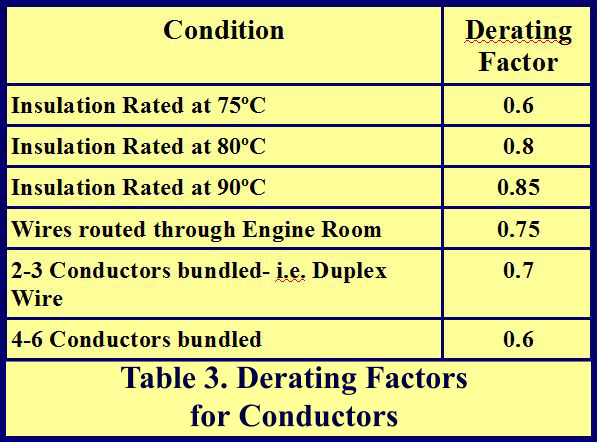
Table 3 lists some multipliers that can be used to estimate the reduction of the maximum allowable current for different situations. These are somewhat conservative values. If more than one situation applies, the multipliers should be combined.

table three

For the chart plotter example, if a two-conductor duplex cable with AWG 14 wires is run from the distribution panel, through the engine compartment, and on to the new chart plotter, the maximum allowable current would be less than the 35 amps shown for AWG 14 wire in Table 2. Since the wire has two conductors, we have to derate the current capability by 0.7, and because the cable passes through the engine room, it must be derated a further 0.75. So, the AWG 14 wire will only be able to handle 35* 0.75 * 0.7 = 18 amps. The chart plotter only draws 3 amps, however, so the AWG 14 duplex wire is more than adequate.

The important thing to remember is that the wire must be adequately sized to meet both criteria; it should have an acceptable voltage drop and be large enough so as not to overheat. Most often, if a given wire size meets the first criteria, it will also meet the second, but not always, so it is important to check both.

Next week, I plan to talk about the process of calculating the total load on a circuit when there are several devices connected. Stay tuned.