Most Americans are not familiar with the British navigator, explorer and cartographer, Matthew Flinders. He was the first to circumnavigate Australia and chart its coast and offshore islands. When I asked our good cruising friend, John Lewis of Active Transport, to write a guest post, Matthew Flinders was his topic of choice … a propos … March 16th is Flinder's birthday. Thanks, John. In deference to our Aussie friends who celebrate the 16th before our friends in the USA, we're posting this a day early.
by John Lewis, s/y Active Transport
As so often seems to happen, my discovery of Matthew Flinders and his interesting life was a total accident. I was in Australia on a business trip and had a weekend to kill. Wandering through downtown Melbourne on a Saturday afternoon, I stumbled upon a roving museum exhibit on the life of Captain Matthew Flinders. The price was right (free), so I checked it out.

When I was a teenager, someone had given me a copy of “The American Practical Navigator” (aka Bowditch) which was the fundamental text book used at the American Naval Academy. In the chapter on compass correction, there was mention of something called Flinder's bars that, I subsequently learned, during my fortuitous museum visit, were invented by Matthew Flinders to help correct for the compass deviations that are introduced when a ferrous metal (magnetic) ship heels, but its compass card stays level. The metal causing deviations in the compass was moving around the compass card, so the deviation was always changing. Devising a solution to this problem was a major contribution as ship building was transitioning from wood to iron. Until I saw the Melbourne museum exhibit, I did not even realize that Flinders was a person. I guess I thought “flinders” was a nautical term that might be used in an expression like “shiver me flinders”.

The more I learned about Matthew Flinders the more impressed I became. Captain Flinders was an extremely talented cartographer and explorer who would have probably been as famous as Captain Cook, if Flinders had only managed to avoid the fatal mistake of dying young.
Captain Matthew Flinders only lived to be 40 years old. He spent seven years of his short life in a French prison on Mauritius and yet he still managed to leave a stunning legacy. Among other things Captain Matthew Flinders was responsible for:
- The first publication on the use of a barometer in forecasting weather at sea
- The use of the previously mentioned “Flinder's bars” and other techniques for compass deviation compensation
- Demonstrating that Tasmania was an island separate from Australia
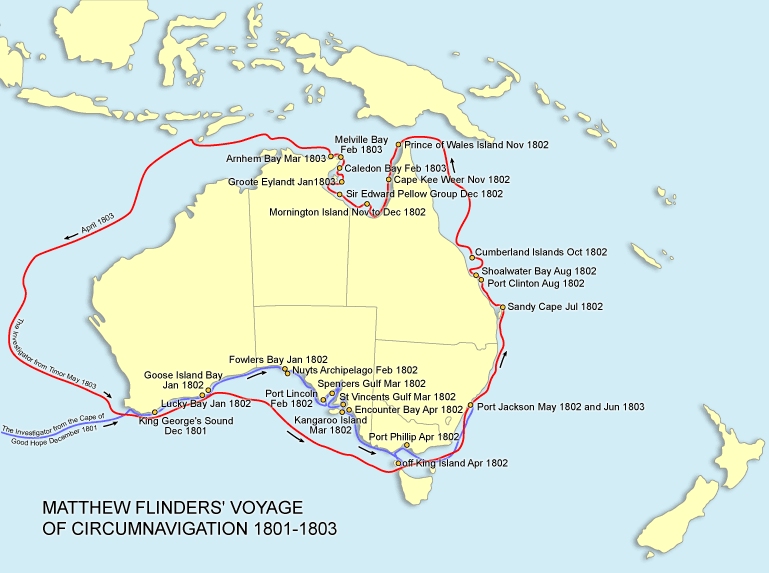
- First European navigator to circumnavigate Australia and prove it to be a continent
- Charting Australian waters, in the late 18th century, so accurately that the allies were still using his charts in WWII.
- Applying the name “Australia” to the continent
- Came up with the name “Great Barrier Reef” (and ran aground on it)
- Immortalized his cat, “Trim” in one of his three books
Matthew Flinders was born in Donnington, Lincolnshire, England on March 16, 1774 into a family of surgeons. It is thought that the family name derived from the fact that they were immigrants from Flanders.
It was his father's intent that his son would follow in his father's and grandfather's footsteps and become a surgeon, but Matthew's reading of Daniel DeFoe's “Robinson Crusoe” set his ambitions on a completely different track. Eventually his father acquiesced and Flinders' career in the Royal Navy was launched. He was 15 at the time.
As he worked his way up through the ranks, he became the protege of Sir Joseph Banks who had served as Captain's Cook's naturalist on early voyages of discovery. He saw service against the French Navy while serving on the Bellerophon and also was an officer on Captain Bligh's second bread-fruit voyage. Bligh wrote that Flinders was a talented and capable cartographer and apparently gave him responsibility for navigation and cartography on the voyage. If Flinders had started a mutiny, perhaps he would have had a more prominent place in history
Captain Flinders made three voyages to Australia which was in the process of being developed as a British penal colony ... as far away from England as anyone could come up with.
On his second voyage he was joined by his friend, George Bass, and the two of them explored the coast of Australia, south of Sydney in a small open boat named “Tom Thumb”.
Flinders named the Bass strait between Tasmania and Australia after his friend. Interestingly, he never named any of his discoveries after himself although he did apply the family name to one location, but it was in honor of his brother.
It was on his third voyage that Flinders circumnavigated Australia during which time he produced most of his excellent charts.
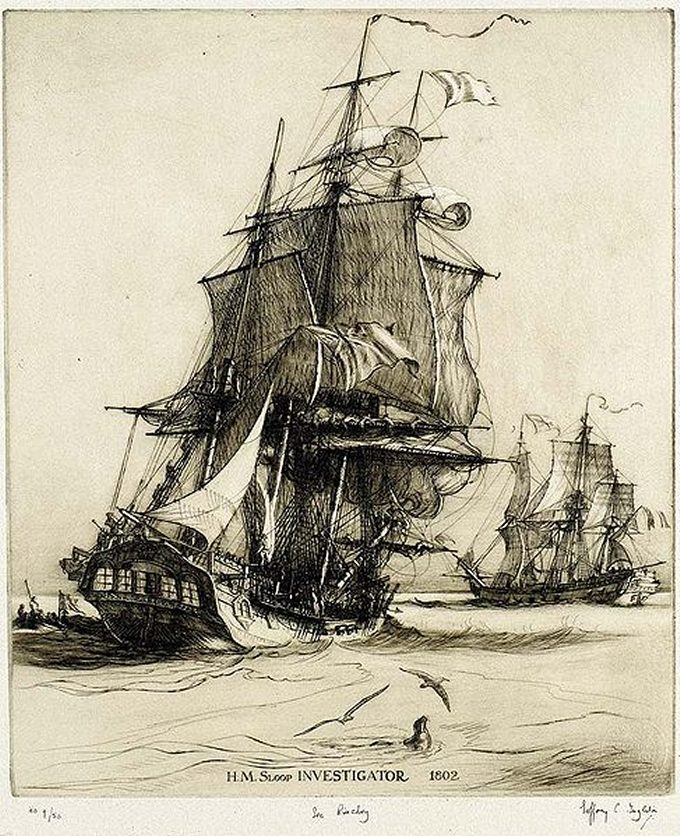
His ship at that time was in poor shape, so he talked the Governor of the colony into giving him an old ship to sail back to England in hopes of getting the Navy to give him a new ship to continue his explorations. He unfortunately lost his ship on the Great Barrier Reef and left his crew on an island while he sailed back to Sydney for another ship.
The second ship he talked the governor into giving him was in poor shape but Flinders was in no position to be too demanding, so he took it and sailed back to pick up his crew, and sailed into the Indian Ocean. About three quarters of the way across the Indian Ocean, his ship was was no longer sailable. He made port in Mauritius in hopes of making necessary repairs. Unfortunately, Mauritius was French at the time and France and England were once again at war. Flinders and his crew were taken prisoner.
This is where Flinders really screwed up. Instead of graciously accepting the French island's commandant’s wife's invitation to dinner, he blatantly refused to socialize with them until his demands for better treatment for his crew were met. He was, after all, a British officer. The French were not impressed. The commandant promptly lost all interest in being nice and, instead of making a decision himself, wrote to Paris for instructions on what to do about Flinders.
Since Flinders was an officer he was not kept in a cell. He was allowed to live with a French family on a plantation and was even given his charts and papers to work on in his captivity. His crew was released years earlier and had returned to England, but Flinders continued to pay for his pompous shenanigans until the wheels of French bureaucracy finally issued an order for his release. I find it interesting to think about Flinders spending seven years confined to life on a plantation on an island … which is exactly how Napoleon ended his days on St Helena a few years later.
Flinders returned to England and barely lived long enough to publish his two books on his Australian explorations. The powers at the Royal Navy vetoed Flinders' wish to use his name of “Australia” in the title and insisted that the name “Terra Australis” be used. He died in poverty. The Royal Navy was not very appreciative of his contributions and did not provide him a pension to live on.
Captain Flinders died at the age of 40 and spent seven years in captivity on Mauritius. He joined the navy when he was 15 which only left him with a career that spanned 18 years to accomplish such a great deal.
The Royal Navy declined to provide Flinders' widow with a pension, but the Australian states of New South Wales and Victoria got together and provided a pension which she used to raise their daughter, Anne. The Australian government understood the magnitude of Flinders' contributions. His daughter, Anne, married William Petrie and had a son they named William Matthew Flinders Petrie.
William and Anne Petrie's son went on to become one of the most famous of the British Egyptologists during the period of intense exploration that took place during the latter part of the 19th century. If you Google “Matthew Flinders” you have to look closely at the “hits” you get back or you can find yourself being led into the complex world of archeological exploration … not that the subject is such a horrible briar patch to wander into. Flinders-Petrie donated his grandfather's papers to the library in Sydney in 1926.
It is interesting that the pension that the Australian government saw fit to bestow on the wife of Captain Flinders came back to England in the form of a distinguished scholar. Who knows what would have become of Anne if Australia had not stepped up to the plate with the pension?
Alas, the story of William Matthew Flinders Petrie is not all sweetness and light. He was well known for his pro-eugenics positions on the evolution of the Egyptian civilization. He could not accept the widely held view that the Egyptian civilization had developed from African roots. He was a racist.
This brief summary of the life of Captain Matthew Flinders should only serve to whet your appetite for learning more about this amazing individual, so I will provide a few starting points for those who wish to pursue the subject.
There is a lot of excellent information available for free as e books on www.gutenberg.org. The works of Captain Flinders' grandson also show up there, so make sure you are getting the books you want when you download them.
Ernest Scott, an historian at the University of Melbourne, wrote an excellent biography of Matthew Flinders called “The Life of Matthew Flinders” This book is available for free on the Gutenberg site. It was written in the early 1900s, so its copyright has long since expired.
Flinders' own books on his Australian explorations called “A Voyage to Terra Australis with Accompanying Atlas Volumes One and Two” are also available on the Gutenberg site for free.

I entertained myself for a few evenings, while we were anchored on the Great Barrier Reef, by pulling up Flinders' books on my Kindle while comparing his charted positions against our electronic charts on the nav computer. His positions were always very close which is all the more impressive when you realize that he did not have a chronometer (timepiece). All of his celestial navigation was done by the method of lunar distances.
“My Love Must Wait” by Ernestine Hill revolves around the fact that the Royal Navy's policies forced Flinders to leave his wife behind when he sailed off on his voyages of discovery. I was never able to find this book in an electronic format, but was very fortunate that an Australian friend found a copy on line and made a gift of the book. The friend who made the generous gift of the book was surprised that I knew who Captain Matthew Flinders was. Many present-day Australians don't have a clue about who Flinders was.
One other book of interest, “Matthew Flinders' Cat”, is by Australian author Bryce Courtenay. It is not about Flinders, but rather a mystery story in which a statue of Matthew Flinders' cat, Trim, features prominently. Many years after the statue of Flinders was erected outside the library in Sydney, a bronze statue of his cat was added below the statue of Flinders. Trim, by the way, was named after the butler in the novel “Tristram Shandy”. The words on the plaque on Trim's statue were written by Flinders himself …
TO THE MEMORY OF TRIM
The best and most illustrious of his race.
The most affectionate of friends,
faithful of servants,
and best of creatures.
He made the tour of the globe, and a voyage to Australia,
which he circumnavigated, and was ever the
delight and pleasure of his fellow voyagers.

If you're interested in more about Matthew Flinders, I would suggest starting with this Wikipedia article.