Australian Customs have really gotten a bad rap. Maybe it was deserved some time, some place in the past. We've certainly heard several horror stories, but as for us, we've been blessed with professional, courteous, efficient Customs officers who have have taken their jobs seriously without being offensive or officious. Perhaps, we've just been lucky or there's been a change in attitude.
Customs officials worldwide are an interesting lot. Their job primarily involves dealing with folks who are entering or leaving their country and are bringing in goods. It could be just luggage. It could be a freighter full of goods for importation. It could be illegal drugs which tend to be frowned upon. It could be cruisers, who are bringing in lots of boat parts from the States. It could even be folks like us who want to extend their stay in a country with their sailboat and don't want to pay Customs duties to import the boat. Some Customs officials, like say in the Eastern Caribbean, for instance, can be officious and haughty. Some can request “gifts” in order to complete the boat paperwork correctly and in a timely manner. Here in Australia, it's by-the-book.
 For those who haven't traveled to Australia with a boat, their rules are rather strict. We had to give 96 hours notice to Customs before arrival or face a stiff fine. This was pretty easy actually. We sent an email from the boat about a week before our arrival. They're flexible with dates as long as it's more than 96 hours in advance and you update them as necessary. Not every port is an official Port of Entry. We arrived in Bundaberg, Queensland last November (2011) and Customs directed us to a Quarantine dock upon arrival.
First aboard was AQIS, Australian Quarantine. They clear the boat and the crew before Immigration or Customs even steps aboard. They confiscate any fresh food or specific items that cannot be imported (e.g. honey), empty out the vacuum cleaner, check that there are no pets aboard including the creepy-crawly variety like roaches and generally inspect the boat. We had to show proof that we had anti-fouled the boat within the last six months.
Next came Immigration. Australia is one of very few countries that requires everyone (other than Kiwis) to have a visa to enter. Typically when we enter a foreign country, we receive at least a 30-90 day visa on arrival, no pre-paperwork necessary. Australia makes it easy in that you can apply for and pay for your ETA (electronic transit authority) on line, but it must be done in advance of your arrival. We got our initial visa in Fiji last year and then another one in the States to return to Tasmania in September. We applied for, paid for and received a one year visa, so we're good until September 2013.
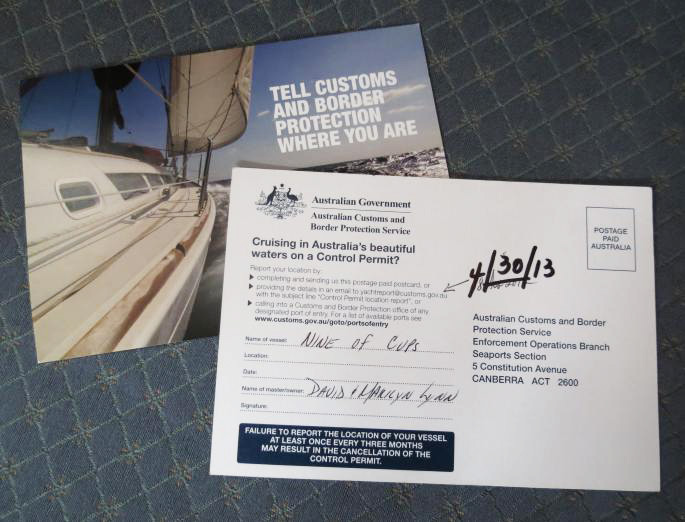
Then Customs came aboard. They have the right to go through the boat, checking in lockers, under floorboards, exploring nooks and crannies to determine exactly what you are bringing into Australia. Sometimes they even bring sniffing dogs. We were limited as to the amount of liquor, beer, wine, cigarettes, etc., we could bring with us. It pays to be honest because if you're not and they find any discrepancy, you're in hot water. Additionally, we had to place a value on the boat because if we intended to sell it in Australia, we would have to pay import duties on it. We received clearance which allowed us to keep the boat in Australia for one year without paying any duties as long as we reported in quarterly to Customs via postcard, phone or email as to our whereabouts and intentions.
One question frequently asked is how we know what to do when arriving in a new country. Easy...I do research well in advance of our departure from our previous port. Once again, Australia makes it easy. They have a separate page on their government website specific to arrival procedures for yachts.
Well, here we are one year later. It's November again. We're still in Australia with no plans to leave any time in the near future and we needed to renew our Customs paperwork. We'd been good citizens, didn't get into any trouble and had duly submitted our “Control Permit Location Reports” on time each quarter. Even so, whenever you're dealing with officials in foreign countries, you tend to be a bit uneasy. Come to think of it, whenever you're dealing with officials in your own country, you can get uneasy (think IRS, police, school principals).
 We stopped by the Customs Office in downtown Hobart a month ago. They said call back a week before renewal time and make an appointment to come in. Well, this was the week. I made the appointment and gave them information in advance over the phone. The Customs office is on the second floor of a government building. It has a small lobby and a counter with a push button for service. We rang the bell. An officer came out, asked our business and disappeared. Two minutes later another officer appeared and asked for our arrival paperwork. She took it, returned in another five minutes and we were good to go for another year. No fees, no hassle, no problems. I've already marked our postcards with the quarterly report dates and put them on the calendar.
 The boat is now legal in Australia for another year. To paraphrase Groucho Marx, we're not sure we want to be in a country that allows the likes of us to stay. ;-) .


 When I was looking up a boat term the other day, I happened to find a Wiki article about chandleries and it got me to thinking about the origin of so many nautical terms. I thought I'd share this particular one with you because I found it particularly interesting. A chandlery to us is a shop that specializes in boating equipment, gear and parts. We think as large as West Marine and Defender or as small and parts-deprived as Moe's in the Cook Islands.
So it was a big surprise to find that a chandlery in medieval times was a room where candles and wax were kept. The chandler was the person responsible for making and stocking the household with candles for its evening light. Chandelier, from Old French, was an early lighting fixture which held many candles. Soap is a by-product of candle-making (unbeknownst to me) and was added to the list of chandler responsibilities evidently when humans finally began to wash. That must have been an interesting day.
When I was looking up a boat term the other day, I happened to find a Wiki article about chandleries and it got me to thinking about the origin of so many nautical terms. I thought I'd share this particular one with you because I found it particularly interesting. A chandlery to us is a shop that specializes in boating equipment, gear and parts. We think as large as West Marine and Defender or as small and parts-deprived as Moe's in the Cook Islands.
So it was a big surprise to find that a chandlery in medieval times was a room where candles and wax were kept. The chandler was the person responsible for making and stocking the household with candles for its evening light. Chandelier, from Old French, was an early lighting fixture which held many candles. Soap is a by-product of candle-making (unbeknownst to me) and was added to the list of chandler responsibilities evidently when humans finally began to wash. That must have been an interesting day. Though we do try to make many things ourselves on the boat like beer, bread and homemade cookies, candle and soap making is not on the list in the foreseeable future.