Clewless in St. Francis Island

“So what would you do”, we asked yesterday? Here's the situation with all the info we had at the time.  

clew and jib


  1.  The clew of the jib has torn out (what?). Anyway … it's out of commission. We're not sure if we can repair the torn sail ourselves. We have an old 120 genoa aboard, but putting it up in 25 knot winds is probably not going to happen. So, no headsail at the moment other than the staysail.
  2. The holding in the anchorage at St. Francis is poor to nil, but we do seem to be holding at the moment. In fact, after three hours, we were still holding. We're protected from the SW swells here and wind from three quarters (E/S/W), but exposed to the north.
  3. The winds continue strong SE 20-25+ knots. Without a headsail, we'd have to motor against the wind in big, churned up seas to get back to Streaky Bay (54nm). Eucla to the northwest is 232 nm away. Without a jib, we'd be moving slowly and not get there in time to beat the W/SW predicted. No yacht services in Eucla.
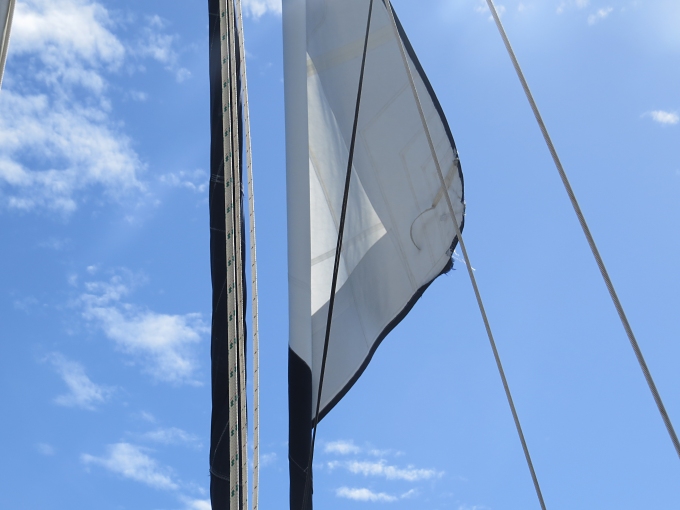
 

clewless jib


Our decision. Wait out the night in St. Francis. We set an anchor alarm (in fact two of them). David stayed up late. Marcie went to bed, but there was little sleep to be had. After a couple more hours of staying put, David felt confident enough to crawl into bed, too. We both wore all of our clothes to bed just in case we needed to leave in a hurry. A night exit would be hairy, but doable. We could follow our track out and the charts seemed spot on. We were both up and down the rest of the night, listening to the wind howl, anticipating the anchor alarm, checking our position, imagining we heard the alarm when, in fact, we didn't.

At 0130, the rain started, then stopped and all was still … too still. At 0200, the thunder and lightning began. Big claps of thunder broke the stillness and lightning streaked a pitch black sky. Then came the gusts of wind and pelting rain. We were up and ready to move out, but the anchor held. We looked at the squall cells on the radar. There were several all around us, but the rest seemed to avoid us. At 0400, the radar looked clear. Marcie returned to bed. David, too keyed up to sleep, requested more GRIBs and weather info and started analyzing options.

At 0600, David had more information and a plan. Since we seemed to be holding, he proposed staying another day at St. Francis while the stronger SE winds blew themselves out. More thunderstorms and rain were forecast for today also … a soggy trip if we left. Tomorrow was now calling for light SE before the northerlies and strong W/SW took over. We could motorsail against lighter winds back to Streaky Bay (54nm),  work on the jib there and wait for another weather window. A reasonable plan. He left out more scope, attached the snubber and finally came to bed.

A day in St. Francis with winds too high to launch the dink, even if we did trust the holding enough to leave Cups and go ashore. Wonder what we can see from the boat?

I'm sure I left out some details and I'm already warning you that if you come up with an alternative we didn't and it's a good one, we'll be kicking ourselves. And yes, we haven't missed the fact that in addition to being sleepless in St. Francis … we're also clewless!
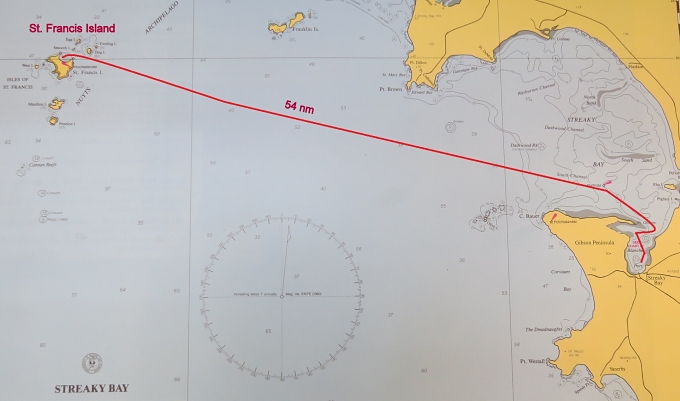
Streaky Bay to St. Francis Island

A Day of Small Catastrophes


map


We thought we were starting off this passage on the right foot. A 50nm daytrip to St. Francis Island is just the thing we needed to dip our toes into the Great Australian Bight without being totally immersed.

We prepped last night, so all was ready. We checked the weather one more time before we left. It had  changed a bit. The long term (5-day) forecast up until yesterday had been S/SE 15-20 for the foreseeable future, but now light northerlies followed by strong SW/W winds were showing up on the grid … not good. What to do?


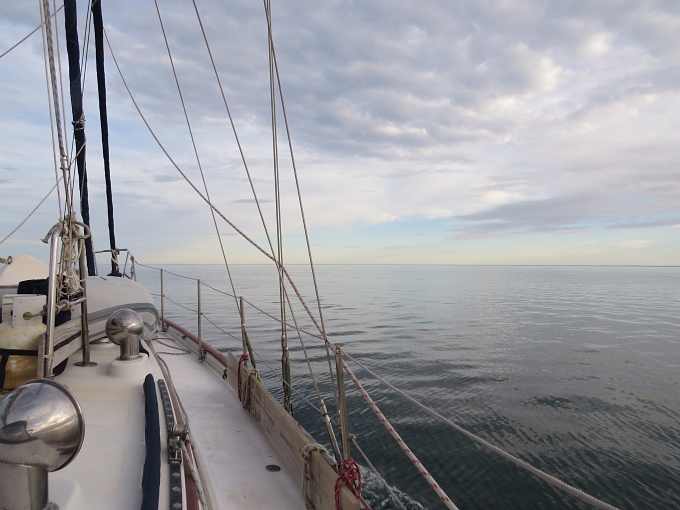
calm waters


We decided we'd go for it while the winds were good and hide out in St. Francis or Eucla to wait out the adverse winds and be that much ahead when the desired S/SE showed up again. In the process of getting ready to leave, Marcie managed to tangle with the wind generator blade. The wind gen won and sliced Marcie's finger and nail. Blood on the deck … not a good way to start the day, but all part of the tribute we pay for the privilege of living aboard.

The sunrise was gorgeous … pinks, oranges, purples. Within minutes, the clouds took over, leaving us a rather drab, grey day. Dolphins saw us out of Streaky Bay. A cape effect had us thinking we'd motor all the way, then we passed the cape and good south winds 10-18 knots took over. A pleasant day for sailing and we made good time until …


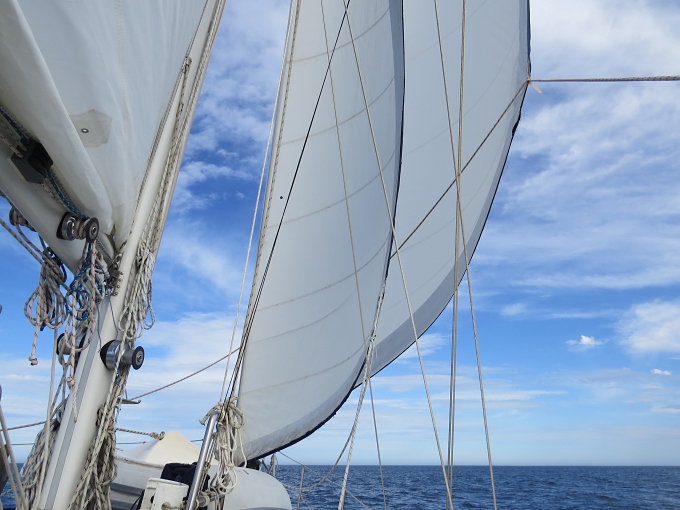
all sails up


Boom  – thunk … what was that? It took us a minute to figure out that the clew had pulled out of the foresail! There lay the limp jib sheets on the deck while the jib threatened to tatter itself to death. David furled the sail quickly, surprised it had no candy stripes, and a postage stamp size jib still fluttered in the breeze, no sheets to secure it.


clew in hand


The wind increased a bit (of course, it did) and it was no time to try to take it down. It would have to wait till we anchored. We were only 12 miles from St. Francis. The main and staysail were working hard, but we could only manage 4 knots with the seas building. It was nearing 5pm; we got the iron jenny (the engine) fired up. We wanted to get in, anchored and the jib sorted out before nightfall.


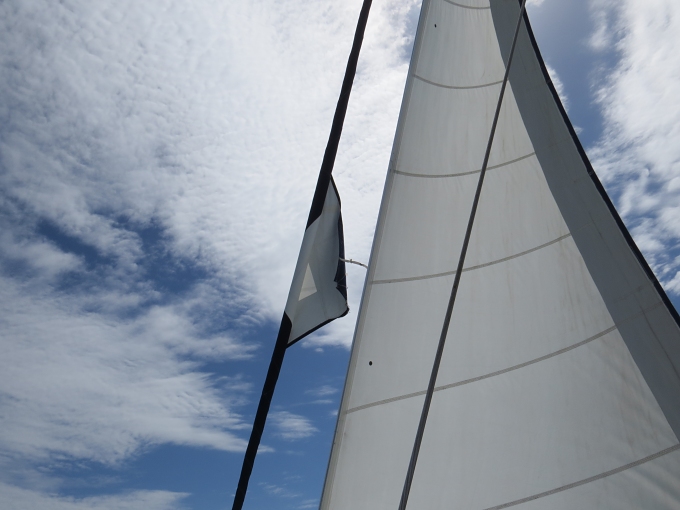
postage stamp jib


I might add, this is not an old sail. It was custom made for us three years ago in New Zealand and you'll remember we barely even sailed last year. Was it poor workmanship? W doubt it. We know the sailmaker and his work well. Was it bad UV thread? All the stitching broke around the clew, even the hand-stitching. Was it just too much strong UV in the southern hemisphere? We checked out all the sails before leaving Adelaide, they appeared in good condition. Obviously, they were not.

Right about this time, we noticed an odd phenomenon in the sky before us. A long, dense cloud resembling a tightly rolled cigar stretched out ominously. We'd never seen anything quite like it before. David growled “white squall” half in jest.  Before we knew it, we had 35 kts battering us and as quickly as it had come, it moved on … a total of maybe 5-6 minutes.


odd cloud


We saw another approaching and one beyond that and one beyond that. Bands of low-lying solid white horizontal cylinders that moved swiftly. When directly overhead, they appeared tan in color and pommeled us with huge gusts of wind. Are any of you Aussies out there familiar with this? Does it have a name? We've seen squall lines before, but none that looked like this.


line of clouds


We were approaching our entrance to the anchorage  between Dog Island and St. Francis. The jib continued to flog and complain, but the seas abated as we moved into the lea of the island. The cigar clouds had passed and we saw no more. There was a sense of relief as I walked forward to drop the anchor, but not for long. The wind increased to 20-25 knots and we dragged on our first attempt. We tried again ... no good. We moved to another part of the wide bay. We increased scope and David held the boat in position to allow the anchor to set … still we dragged. He'd written the anchor evaluation too soon and the anchor gods knew it! We looked for a sand patch, but we ended up too close to shore  … 20' to 12' and less and still we were not close enough to the sand.

We tried again in yet another place … our sixth try. Though dragging slowly, we had plenty of room and decided we had to get the jib down. No easy feat in these winds. I released the halyard  and lowered the sail while David tried to keep it on deck. In the end, we won the battle, but not without pain and suffering. Marcie's injured finger got nicked again and blood smears were all over the white sail as we wrestled it along the side deck around shrouds and fender boards and dorades into the cockpit and down below. David cleverly deployed the lee cloth and contained the jib on the port settee.


jib in lee cloth


Now back to anchoring. It was getting dark by now (though I stopped for two seconds earlier to take a pic of the sunset which was deceptively beautiful). Two more attempts at anchoring failed. We'd never had a situation where it was totally impossible to anchor. The guidebook, local knowledge and other yachties reported “good holding”. I guess all things are relative. The bottom was thick grass as evidenced by the field of grass on the anchor each time we pulled it up and the fact that the foredeck looked like it needed mowing. One last attempt … miracle of miracles ... it held tentatively. We didn't trust it, but it allowed us time to recoup, have something to eat and think about the alternatives.


sunset at st. francis


What would you do? Check back tomorrow.

Great Australian Bight - Crossing Plans

great australian bight  

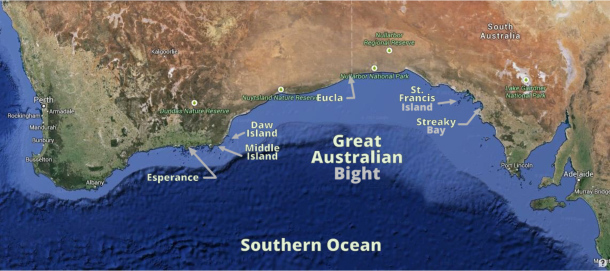
Wiki defines the Great Australian Bight as “a large bight, or open bay, off the central and western portions of the southern coastline of Australia”. The coastline of the Bight is characterised by 400' (120m) cliff faces known as the Bunda Cliffs, said to be the longest line of seacliffs in the world . The International Hydrographic Organization considers the Bight part of the southeastern Indian Ocean, but on all Australian charts and maps, it's the Southern Ocean. It's a 600 nm stretch of tough ocean passage marked by submarine “terraces” and “canyons” with depths ranging from ~16,000' (5000m) to 164' (50m) causing those southwest swells that prevail to become big rollers.

The Great Australian Bight (GAB) was first noted by European explorers in 1627, when Francois Thijssen, a Dutch navigator sailed along its western margins. Our old buddy, Matthew Flinders, British navigator and cartographer was later the first to accurately chart the area in 1802, during his circumnavigation of the continent. The GAB runs east to west in alignment with the equator and is the longest ice-free coastline running in this direction in the Southern Hemisphere.

Few cruisers transit the Bight for obvious reasons. There's a certain amount of trepidation associated with that part of the world. The charting isn't up-to-date and in many areas, “inadequately surveyed” shows up as a comment on even our electronic charts. We've known, however, several people who have crossed without incident and met fishermen who made their living in the area.

Originally we thought we'd do as most others do … wait for a weather window and just get across. After chatting with Warrick on “Olein”who fished the area for many years and recommended seeing some of the Bight, we started to think about things a little differently. Though we're keen to get across safely, we've never been known to hurry, so we looked into the possibilities.

Warrick gave us his copy of Western Australia Cruising in exchange for some Tassie guides we had. Additionally, he provided several hand charts he used as a fisherman. We also have Jack and Jude's (Banyandah) South and Western Australia anchorage guides/information. Then, of course, we talked to Geoff here in Streaky Bay who highly recommended a stop at St. Francis Island. So instead of streaking across the Bight, we're now considering a more scenic route.

  1. Streaky Bay to St. Francis Island
  2. St. Francis to Eucla
  3. Eucla to Daw Island (Eastern Group)
  4. Daw to Middle Island
  5. Middle Island to Esperance (next port of call)

Keep in mind though, we've never stuck to a plan yet.

What's to see? Well, it's a gathering place for Southern Right Whales in winter although we're a bit too early for that. Blue whales, humpbacks and sperm whales also travel through the Bight. There are Great Whites, dolphins, sea lions, southern bluefin tuna, squid, octopus and lots of seabirds. In fact, the Great Australian Bight has some of the highest levels of marine diversity and endemism (occurring nowhere else in the world) in Australia. Stopping at little deserted islands will be an interesting adventure. Most islands are known to have a healthy snake population, so we'll be wearing our boots.

During our travels, internet may be non-existent. We'll be emailing Gentry our blogs for posting, but we'll have to catch up on the photos later. Wish us luck!