Crossing the Indian Ocean - Days 4-6

Indian Ocean Crossing - Update 2

Geraldton, Western Australia to Cocos Keeling
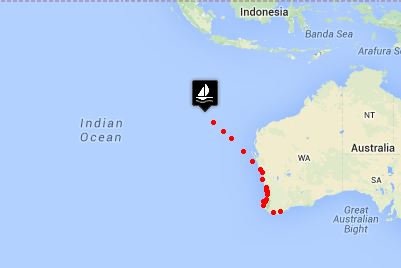
passage map

passage map

Day 4 Begin: 973 nm  -  End of Day 4:  832  nm to go

We're getting on a sched now. Up during most of the day with naps only as needed, eating regular meals and generally enjoying our time at sea. We''re not sure how long the sunny days and fine winds will continue, but we're loving them at the moment.

During our morning deck walk, we found a tiny flying fish in the scupper. He either flew in or got washed aboard, either way there he lay … stranded. He was an itty-bitty guy, no more than 2” (5cm) long, shiny gray and black with gossamer wings, bulging eyes and stiff as a board. Our all-time record for flying fish in one day found in the scuppers was 23 while crossing the Atlantic. They smell awful, so we're not trying to break any records here.

Night watches, though cold, have been beautiful. The stars, especially the Southern Cross, have been brilliant, that is until the moon rises after midnight and steals the show. The moonrise is always a shocker. The sky is totally black and then a loom appears on the eastern horizon and up she pops … dazzling.

The wind switched to SW for awhile today and is now a steady south tending to SSE. Looking at the forecast for the next few days, we're pretty sure we've found the trades … southeast, southeast, southeast.

Day 5Begin: 832 nm  -  End of Day 5: 686  nm to go

Sunrises tend to be quite dramatic the last few days. The tops of the clouds pink up a little in anticipation of the big arrival. Then an absolutely brilliant sphere of dazzling sun rises midst dark clouds and the contrast is startling. It's an artist's rendition of Christ's rising … no exaggeration. Sharp, golden shards of light pierce the clouds and shine back down to the sea in a Hollywood-esque fashion that only Mother Nature's flair for the dramatic can carry off effortlessly.

Beyond super sunrises, I lost my favorite “Good Old Boat” hat overboard. We were tooling along at 8 knots and turning back to fish it out of the drink was never a consideration.

We are officially in the tropics now … when we crossed the 23.5 latitude line known as the Tropic of Capricorn. We celebrated with an extra TimTam with our cuppas. And today, for our ongoing passage entertainment as I was checking out the sails, I noticed the silhouette of a squid caught in the first reef of the mainsail. He was stubbornly stuck to the sail and we had to sort of peel him off. Look at that … calamari, can't get it fresher!

Day 6Begin: 686 nm  -  End of Day 6:  566 nm to go

A dark, sapphire blue sea for as far as we can see under a cornflower blue sky … not a cloud in sight. Days have been glorious. We're 600 nm off the Western Australia coast now and Java is about 700 nm due north. We're more than half way to Cocos Keeling and we celebrated with Half Way Alfredo for dinner.

It's a slow sailing day today. The winds are light and a bit contrary. We only made 120 nm to the good. Quite honestly, it's so beautiful out here, who cares?

We're slowly shedding layers … scarf, gloves and foul weather jackets are stowed away and we're down to one blanket on night watch. We're edging our way to the warm, day by day.  Reading, writing, making plans, eating, napping and chores occupy most of our days and nights. I still do 95% of the cooking on passages, but David usually does clean-up and dishes which limits our individual time in the galley. Needless to say, long passages have their hidden perks for the first mate.

Another flying fish met his demise in the scupper … this one pretty large comparative to the 2-incher who glided aboard the other night. We regularly see them gliding long distances from wave to wave … must be something chasing them. David put out the fishing lines today.

Continue with us on our Indian Ocean crossing.

Planning our Indian Ocean Passage

Several people have asked what resources we use for making a long passage, in particular, our 6,100 nm across the Indian Ocean. There are several sources for good information. We usually start by looking at Jimmy Cornell's World Cruising Routes. This book summarizes traditional cruising routes and provides the best time to make the transits based on prevailing winds, currents and weather, a little info of what to expect on the passage, what paper charts are applicable and diagrams of the routes. For instance, we're looking at Fremantle/Perth, Western Australia to Africa. The advice is to sail from Fremantle northwest to the Cocos Keeling Islands to catch the easterlies and then proceed across the Indian with possible stops at Rodriguez, Mauritius and Reunion before making the east African coast.  
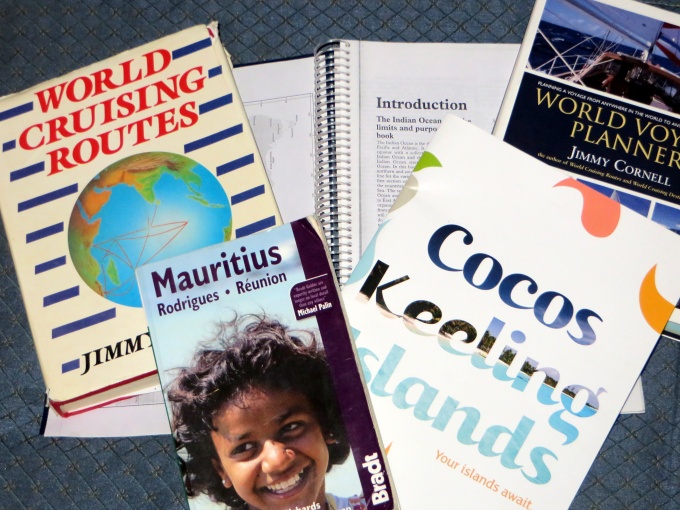
resources


Once we've determined the best time to go, we start researching what's along the route and the distances between them. The distances provide us with an idea of what we'll need for provisions, supplies, fuel, etc. Noonsite is a great on-line resource for what to expect in each country we visit. Just click on the country of interest and there's Customs/Immigration info, marina info and much more including any updated info from recent visitors. We find it invaluable.


noonsite


Having a tentative plan allows us to direct our attention to identifying possible cruising guides and other ancillary, helpful information. For this trip we had picked up a used copy of the Indian Ocean Cruising Guide way back in Ecuador and I dug it out. It might be an old edition, but it'll work for our purposes. I also consulted the SSCA archives of articles posted in the last five years and got several useful tips from fellow cruisers who'd been there. There was an on-line guide by Tony Herrick that we picked up as well. The more info, the better. We'll have lots and lots of time to sort through it.

I always try to find yacht arrival information specifically provided by each country. As an example, when I googled “Mauritius yacht arrival”, the Mauritius Revenue Authority website popped up immediately. It confirmed what I already knew about arrival requirements, but getting current information “from the horse's mouth” as it were, is important. Some countries require pre-notification of arrival (like Australia, New Zealand, Fiji) and others prefer that all paperwork is completed before arrival (like South Africa, Australia, New Zealand). I've downloaded all the forms we'll need to complete before arrival.

When we're absolutely sure of the sailing plan, we purchase the electronic charts … two sets. One for the chartplotter (Navionics Gold) and also Navionics charts for the iPad app. We also picked up the small scale paper charts of the Indian Ocean … just in case. While we still have internet, we also collect and save Google Earth satellite views of each harbor and anchorage we will be visiting to augment our digital charts. We had digital pilots aboard already that provide wind roses and currents for easy referral as necessary.


navionics gold


Having a travel guide like Lonely Planet aboard is great for once we've arrived at a port of call. I was fortunate enough to obtain a used copy of the Bradt Mauritius travel guide from another yachtie which also includes Rodrigues and Reunion and I've already begun reading it … like a novel. What's to see? What's to do? What can't be missed?

By the way, I found a great free travel app called Maps With Me for the iPad. It allows you to download any country in the world and provides great detailed maps including the location of supermarkets and ATMs and once downloaded, it can be used offline. It's a gem. I've already downloaded all the places we'll potentially be stopping. Even little Rodrigues Island and Reunion are included.

Don't forget the courtesy flags and the Q-flag! The Australian flag works for Cocos Keeling. I made a new flag for Mauritius/Rodrigues already. Our old French flag will work for Reunion and I dug out the South African courtesy flag from 2007 which will work just fine for our upcoming visit. I put the yellow Q-flag with the other flags we'll be needing all in one zip-loc ready to fly as soon as we arrive.


courtesy flags


There you have it … we're ready to go. Now … make sure the boat is shipshape, the provisioning is done, the fuel's topped up …

Crossing the Indian Ocean - Days 1-3

Indian Ocean Crossing – Update 1

Geraldton, Western Australia to Cocos Keeling

straight shot to cocos keeling

straight shot to cocos keeling

Day 1

Begin: 1423 nm - End of Day1: 1275 nm to go

We were excited and didn't sleep well last night. We had our last minute to-do lists sitting on the saloon table and we were anxious to get them done and head out. Fill the water tanks, empty the trash, take off the sail cover, make the passage soup (Lemay Special) and a batch of muffins, take our last hot showers, do last minute e-mails, pay credit cards … lots to do and actually plenty of time. We finished by 0800 and still had to wait for Customs/Immigration to come clear us out at 0900. We twiddled our thumbs and paced nervously, trying to think of what we had forgotten. We go through this exercise every time we're leaving on a big passage.

Customs arrived right on time and handled all the formalities without a hitch and within an hour we were heading up the North Channel out of Geraldton and doing a slalom around all the lobster traps. The day was brilliantly sunny; the water, an exotic blue-green; the sky, cloudless. What a day to begin a passage.

Once we passed the anchored ships in the outer harbor, we pointed Cups' bow towards Cocos Keeling … a straight shot. We sailed passed the low-lying Abrolhos Islands and sighted whales along the route. Humpbacks were breaching and spouting. I finally got a reasonable shot, but you'll have to wait till we reach internet-land again.

The wind was the predicted 15 knots and we beam-reached for hours. By mid-afternoon, the wind had freshened and the waves had steepened. We took a reef in the main and cruised along in the 7's. By 1700, the wind had worked it way to 25 knots on the beam and we took another reef … and continued in the low 8's.  By 1800, we were both seasick.  We took two hour watches on a cold, raw, boisterous night, fighting off the cold and the seasickness as best we could. The passage soup went untasted.

Even writing this blog on my watch is a trial. More tomorrow.

------------------------------------------ Day 2

Begin: 1275 nm  -  End of Day 2: 1132nm to go

Not much sleep last night, but we're making up for it today with several naps. We're both feeling better. The wind has shifted to SE and we're sailing downwind, wing-on-wing, but slowly in 8 knots of apparent wind. The seas have calmed down and the sun is shining brilliantly. David found a loose screw on the deck while taking his morning walk … always a worry … but we found the stanchion from whence it came and all is good.

A red-tailed tropic bird came a-visiting this morning. A snow white bird, the size of medium gull, these tropical beauties have dark eyes and a single, fire-red tail feather. Females lose their tail feather when nesting and I remember collecting them with Vero, the Cook Islander caretaker at Suwarrow Atoll. My mind wanders.

The sky is pale blue today with puffy, grey-white cumulus clouds floating lazily by. The sea is dark. We saw dolphins earlier, but they were all business and didn't stop by to play.

Despite the lessening of the waves, the swell persists making for a lot of rocking. We've been sleeping like starfish in the aft cabin in our bunk (in shifts, of course). “Starfish sleeping” … laying on our backs, arms and legs spread out to keep from rolling. By evening, the wind returned to 20-25 knots and lasted throughout the night. We gained some good mileage

Sad news from Lin today. Jelly, our ship's cat,  has died. She'd been losing ground and energy for awhile now, and I guess this was her time. I must admit to tears when I read the news. She was, without a doubt, the best pet we've ever had, a good sailor and a good companion.

Magellan Louise Lemay Lynn aka Jelly March 24, 2000 – September 13, 2014

RIP, Jelly! You were loved.

---------------------------------------------------- Day 3

Begin: 1132 nm  -  End of Day 3:  973  nm to go

We had a good run today … 163 miles total and 159 miles to the good (we don't always go directly in a sailboat). I happened to notice the depths on the chartplotter today … 13,123 feet (4,038 m) … yikes, that's deep. Made me wonder what lives down there? Massive, hideous, eyeless creatures? Giant squids with long tentacles that wrap around ships and drag them down? Enough of that …

The days continue to be fair, the night's cold and clear with a waning moon and increased winds. As we move north the temps are becoming warmer during the day … low 70s F (20s C), in the 50sF (low teens C) at night and with 25-30 knot winds, the wind chill keeps us layered up … a t-neck, sweatshirt, fleece and heavy offshore jacket for me, plus sweatpants, socks, scarf, gloves, hat, socks, shoes and two blankets, just about does it for me. It's wonderful to slide into the sea berth at the end of my watch, already pre-warmed by David.

We had to switch the whisker pole from starboard to port side to accommodate a change in wind. This should have taken 15-20 minutes max, but instead it occupied nearly two hours. The pole jammed in the track on the mast and David noticed that the swivel is bent. It took brute force on the part of the captain (read that a hammer), to jury rig it into place, but it'll need attention in Cocos. The list of the to-do's is, of course, beginning to grow daily: a minor issue with the voltage regulator on the alternator, lines to whip, replacing the preventer on the boom. Some we'll do at sea, others will wait. David took a chafed dockline and recycled it into two new snubbers today.

Saw several sooty shearwaters checking out the waters for fish this morning. Perhaps what I read was wrong and we'll have some good fishing in the Indian after all.

Continue of our Indian Ocean Crossing here.