Beware the Notch - Pringle Bay

Mosselbaai to Simon's Town

Yes, I know we're supposed to be heading to CAPE Town and we are, but SIMON'S Town is on the way … kind of … and we've heard such good things about this little seaside town and … you know how we are about making plans and sticking to them. We're easily distracted.

simons town 210 nm

We stayed an extra night in Mosselbaai because the promised easterlies were really southeasterlies and very light which would have meant motoring for most of the day. Plus, (this is the real reason) it was rainy and drizzly and raw, and let's face it … we're wimps. Sun was promised for a few days and the weatherman was good on his word. It's always easier leaving port on a sunny day after a good night's sleep. We rigged the whisker pole to port, hauled anchor, hoisted the mainsail and set off mid-morning under a glorious blue sky with a cold easterly wind.
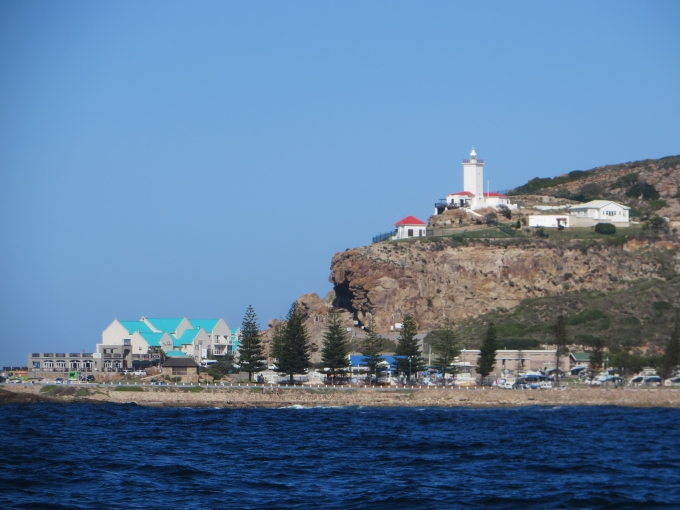
leaving mossel bay

Dolphins jumped. A seal poked his head out of the water. White-breasted cormorants dove for their breakfasts. We were a bit miffed at the local fishermen who had laid out fishing floats in our path, requiring us to slalom through the maze. Then, one of the floats flew off and we realized it was pairs of gannets strategically resting along our route. Oops … never mind, fishermen.

cormorants not floats

The day was mostly uneventful. We were anxious about rounding Cape Agulhas and, as you already know, other than the tot of rum to Neptune at 0400, it, too was quite uneventful. That is in no way a complaint! We hailed the rising of the sun, portending another sunny day ahead. The sun never seemed so big.

big african sunrise

We knew we couldn't make Simon's Town before dark, though we were making 7 knots. Rather than spending another night at sea and wait until light to enter the marina, we opted to tuck into Pringle Bay about 25 nm away. David had noticed it on the charts, a little indentation on the coast on the west side of Cape Hangklip  and it  looked as if it would protect us from the building southeasterlies. The forecast was calling for 15-20 knots, but by late afternoon, we were seeing sustained 30-35 knot winds and gusts near 50. We have two cruising guides aboard and both agreed that in case of strong southeasterlies, little Pringle was the choice of local fishermen.

Rounding Cape Hangklip proved to be more difficult than Cape Agulhas. With a double-reefed main, we were motor-sailing with only a few miles to go. Though we anticipated some cape effect as we rounded Hangklip, we weren't expecting quite as much as we got … near 50 knots. We could see little Pringle Bay, but getting there was another story. We clawed our way at 1.5-2 knots up the coast, eased our way in and doused the main. As we headed into the bay, the waves subsided and we noticed the notch in the mountains, just above the quaint little town of Pringle. Not a good sign.
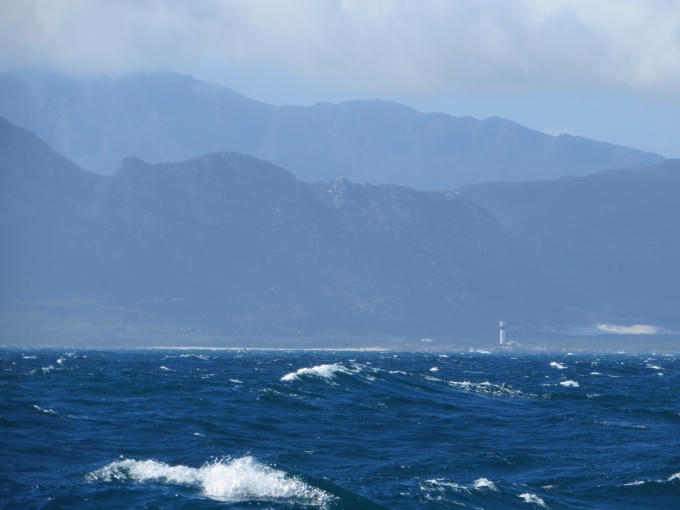
cape hangklip

We'd seen notches like this before at Erith Island in the Bass Strait and many times in the Patagonian canals. Our experience was that a notch like this tends to funnel the wind through like a locomotive. Yet both guides seemed to indicate the fishermen found it a safe heaven in southeasterlies. Maybe something about this particular anchorage and notch was different. NOT! We noted there were NO fishermen in this bay at the moment.

erith island notch

Our alternatives were to set an anchor alarm and tough it out for the night, or heave-to in the middle of False Bay and wait overnight for light to enter the marina. The weather forecast, by the way, was still calling for strong southeasterlies throughout the area, just not quite as strong as we were seeing. We opted to drop the hook in Pringle. That in itself proved to be a challenge. With all the bouncing around, the anchor chain had fallen on top of itself in the anchor locker and fouled, so that when David gave me the sign to drop anchor, the chain jammed. We worked for five minutes or so unjamming it, the gale force winds pommeling us as we worked. Finally, it was free. David re-positioned us for anchoring and thankfully the hook caught and held almost immediately. There was no need to back down on it with a 40-knot wind blowing. The chain was out straight and taut in seconds and Cups was swinging around and pitching gently at its end.

Yes, we did tidy up the decks and stow the whisker pole, but nearly blew off deck in the process. No, we did not launch the dinghy and go ashore. We went below and had a cuppa. Whew! The wind howled the whole night long, “shivered our timbers”, shrieked through the rigging like a banshee. No anchor alarm went off, but we checked regularly, just to make sure we were still in the same spot … and we were.

pringle notch

We waited till dawn to up-anchor. We checked the local AcuWeather and found that Simon's Town was experiencing 9-12 knots of wind, while the notch was till providing us with 30 knots and all the noise we could we handle. Moral of the story: Beware the notch.

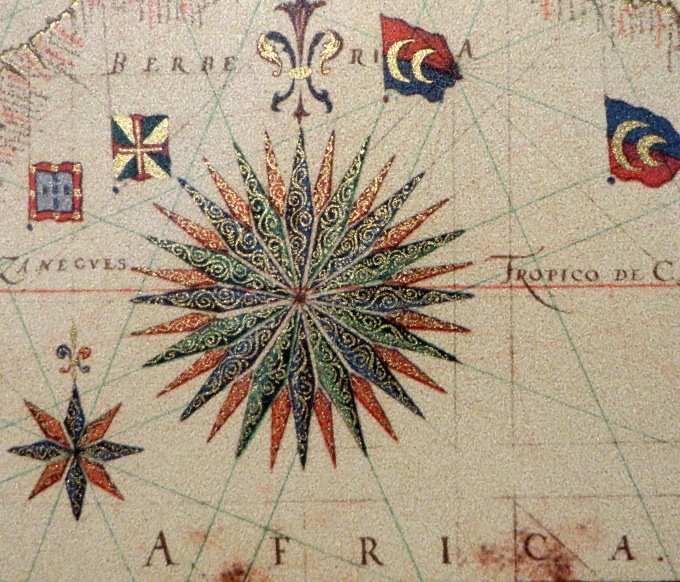
Goodbye, Indian Ocean! Hello, Atlantic!

Rounding Cape Agulhas

We've left Mosselbaai en route to Cape Town and we've rounded Cape Agulhas! Cape Agulhas is the southern-most geographic point of land at the tip of the African continent  and according to the International Hydrographic Organization, it is the official dividing line between the Indian and the Atlantic Oceans. We're back into the Atlantic.

sign in agulhas

Named Cabo das Agulhas (Cape of the Needles) by Portuguese navigators c. 1500, the name does not reflect the ragged headland of the cape, but rather the fact that they noticed that magnetic north and true north on the compass needle were the same. There was no magnetic deviation at the southern tip of Africa.

wind rose

Last time we were here, we were land-touring the Western Cape, taking pictures of the rugged cape shore and the Cape Agulhas Light, the third lighthouse to be built in South Africa, and the second-oldest still in operation. Built in 1848, its light first shone in March 1849. The original building now serves as a restaurant and museum and a new automated aluminum structure has taken its place as sentry.

cape agulhas lighthouse

The nearby little fishing village of Arniston, with its whitewashed sandstone houses, was quaint and picturesque.

arniston harbor

The sea off Cape Agulhas, like most major capes, is notorious for storms, big winds and big waves. There have been lots of shipwrecks off this coast and we paid attention to the cruising guide which recommended hugging the coast as we rounded the Cape. We stayed about 3-5 miles off and had no problems.

cups rounds cape algulhas

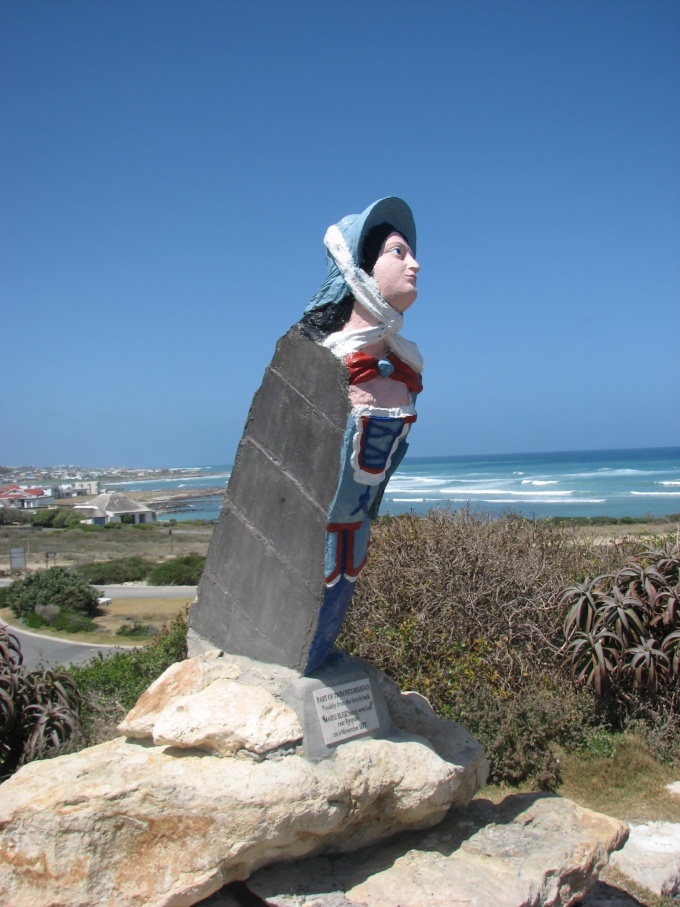
The figurehead of the French ship, Marie Elise, was on display at Agulhas National Park when we visited … salvaged parts from a shipwreck in 1877.

marie elise figure head

Unfortunately, the rounding of the cape was at 0400 in the morning and there wasn't much to see. We toasted Neptune with his tot of rum and asked for his continued guidance and protection as we left the Indian Ocean and sailed back into the Atlantic.

david toasts neptune

Though Cape Agulhas is the southern most point in Africa, it's not considered one of the Five Great Southern Capes and we're not sure why. Instead, the Cape of Good Hope, the most southwestern point of the continent at the tip of Cape Point claims the title, and so, we still have that cape to round before claiming our Five Great Capes badge. Always something to look forward to.

Midnight Arrival in Mosselbaai

(Mossel Bay) As usual, things seem to happen during the night. The wind finally backed to the east around 2200 … late, but better than never. We had rigged the whisker pole to starboard while it was still light in anticipation of the wind change and, for once, we called it right and put the pole to use as soon as the east winds began to blow.

The ship traffic was horrendous and all going in our direction. At one point, there were 10 ships closing in from behind and beside us. Keeping track of them all with AIS was sometimes nerve-wracking, but much better to know they're there and bearing down on you, than to be literally in the dark. We contacted several ships whose CPA appeared too close and they all accommodated us by altering their course. No close calls.

Around 0200 just before the turn of the watch, I heard a loud scraping sound and a dull thud. The whisker pole extension had retracted. I woke David and he manhandled the whisker pole to extend the pole once again only to have it retract almost immediately. He scrambled on deck once more and we finally settled with using a partial jib and a retracted whisker pole till he could figure out the problem once we were in port. The whole process lasted 45 minutes and was exhausting.

Dawn broke, not as colorful as yesterday, but sunny nonetheless. The birds were not as plentiful in this area. The gannets were still active, but now they mingled with sooty shear waters and white-chinned petrels instead of gulls.

white chinned petrel

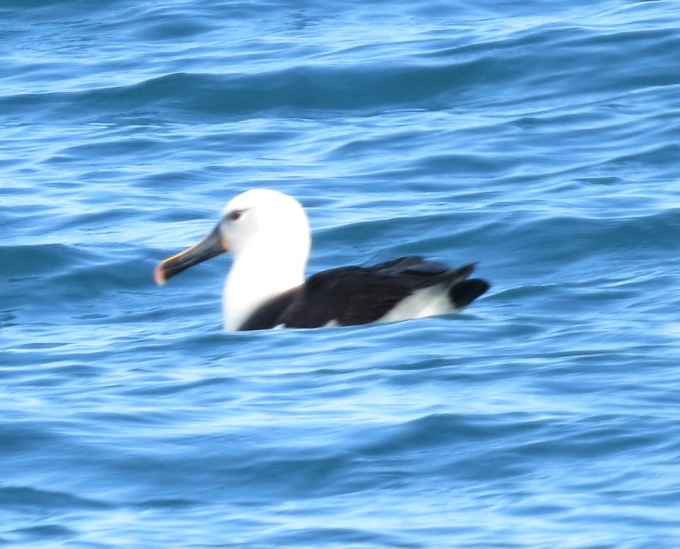
By chance, we spotted a yellow-nosed albatross relaxing on the water and totally unperturbed by Cups.  We saw another whale, but as before, he didn't venture near enough for pix.

yellow nosed albatross

The day was long with constant wind changes in both direction and velocity. Out of nowhere fishing floats appeared and we had to pay close attention, so we didn't snag one. By afternoon, the sky was a cement-sidewalk gray and rain began just before dinnertime. It was cold and raw. We'd hoped to arrive in Mosselbaai before dark, but our fruitless excursion out to find the elusive current plus tacking and jibing exercises to accommodate the wind changes had us arriving very tired and closer to midnight than sunset.

fishing float

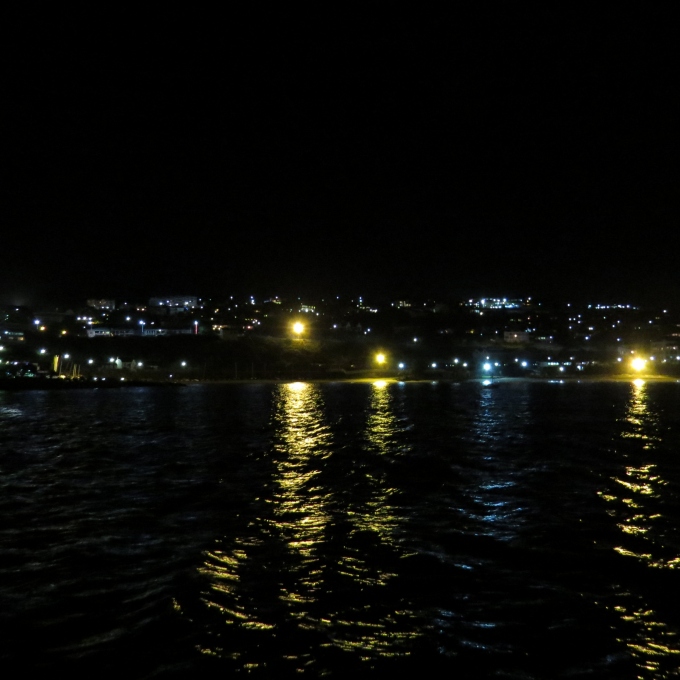
The yacht club anchorage is outside the harbor breakwater, but tucked in and quite protected. The rain had stopped and visibility has improved as we neared the shore. We could see the small city of Mosselbaai spreading up the hillside, lights twinkling in the darkness. With the mainsail down, the boat rocked violently from gunwale to gunwale with the southwest swell. The dish locker below flung open and the dishes all come out with a crash. We'd handle the aftermath later. We were hoping the anchorage in the lee of the breakwater would be calmer.

We expected a bunch of little moored boats, but there were none.  Instead, we found a wide open bay. It was, however, much calmer. We selected a reasonable place to drop the hook outside the breakwater. All systems shut down quickly, including ours. As David tidied up the topsides and set the anchor alarm, I cleaned up the mess below. Nothing major … a couple of dinner plates that had thoroughly smashed in a million bits. The rest of the plates had scattered, but were intact. It was easily swept up and by 0130, we were happy to crawl into our bunk for a good night's sleep.

twinkling ligths of mosselbaai