Communications Aboard

Tony follows our blog regularly and comments often, asking relevant questions as he prepares himself and his boat to head off sailing into the sunset one day. Recently, after reading our post on Social Media for Cruisers, he asked about communications aboard. We thought we'd offer this article we wrote awhile back for Ocean Navigator as an overview of the types of communications we have aboard Nine of Cups. In the 15 years since we have been cruising, we have seen some vastly significant improvements in communications … both at sea and in port. Truth be told, we're usually way behind the times. We still do not use a SAT phone, primarily because  the technology is still slow and monthly costs incurred are too painful for our budget. While costs are coming down and the technology continues to advance, cruising friends have reported that it still costs them between $500-$1000 per year for limited e-mail and weather forecasts.

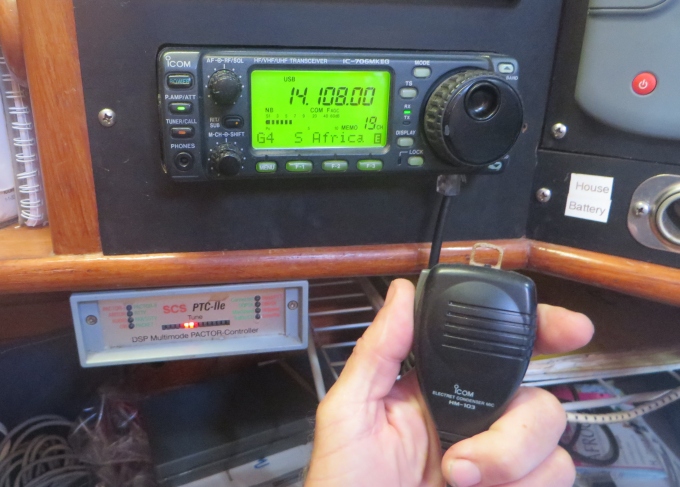
We still rely on our trusty ICOM single-side band (SSB) radio in conjunction with SailMail ($250/yr) for e-mails at sea and downloading GRIB and other weather files. The SailMail “shadow mail” function allows us to monitor our incoming Yahoo land e-mails and selectively download them. It's slow, but affordable and mostly reliable. We also use our SSB for participating in cruiser nets during passages, something we would not be able to do with a SAT phone. That said, however, and despite budget constraints, if we were to start all over again, we might consider the Iridium Go! or some comparable SAT phone system rather than invest in SSB.
ssb

Though it's necessary to have aboard, we seem to use our VHF less and less. Interestingly, outside of the USA, we've found that many marinas do not use VHF communication at all. They expect an e-mail or a call prior to arrival which is a challenge when we're just arriving in a new country and have no mobile phone available. VHF at sea is used exclusively for emergency and ship-to-ship contact. Once in port, VHF use is totally dependent on the area. In Opua, New Zealand, for instance, there was a local, daily net on VHF and cruisers contacted each other on VHF constantly, making the radio traffic quite bothersome at times. In other ports, VHF is used for contacting authorities (Port Authority or Coast Guard) for arriving or reporting boat movement, but we rarely hear a cruiser hail. Instead, mobile (cell) phone communication is the norm between cruisers nowadays. Our Standard Horizons VHF also provides us with passive AIS and DSC communications … a whole other blog topic.

david on vhf

We originally had two-way radios to communicate with each other when we went ashore. We gave those up years ago and instead invested in a couple of unlocked, generic mobile phones. The purchase of inexpensive SIM cards on arrival in a new country is usually one of our first orders of business after clearing in. The process of setting up service in the new country, however, is sometimes convoluted and time-consuming and the documentation requirements vary. We usually choose a pay-as-you-go plan which allows us to buy more time via the internet or at local shops. We tend to text each other, rather than calling because it is more economical.

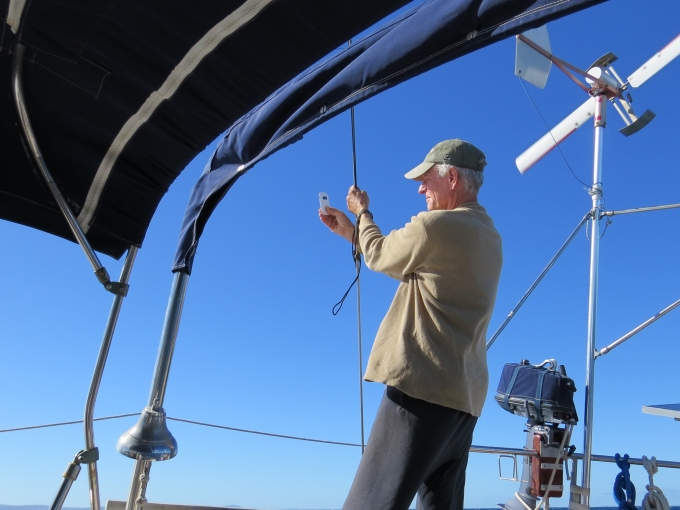
We've also purchased internet dongles when available which affords us the luxury of having internet aboard. Frequently, there are introductory offers which include the dongle purchase as well as a certain amount of data bytes at a bargain price. This worked especially well in many parts of the South Pacific and Australia when we had internet on-board all the time while in port or at anchor, and up to 10 miles offshore for most of our coastal passages. Sometimes it took some acrobatics to obtain a good signal, reminiscent of adjusting the rabbit ears on old TV sets. We usually have to pay for data by the kilobyte, thus we rarely do video streaming, large downloads or random internet surfing because of the cost.
david with the dongle

In our early days of cruising, we found internet kiosks ashore and used their house-computers for e-mails, but we were always justifiably paranoid when we wanted to do any banking transactions or parts purchasing which required us to input our credit card numbers. We rarely need to use internet kiosks any longer.

Many marinas worldwide now offer free internet, but the signals never seem to be all that strong.  We graduated to an antenna aboard in 2007 which was reliable within ½ mile. It had its limitations, but it was a step-up from using the kiosks, for sure. When internet was not available in an area, we lugged the laptop to a free hotspot ashore each day (or several times a day) to connect to the internet. We recently upgraded to a high-powered wifi antenna and receiver along with a mini-router which we now rely upon heavily for the convenience of internet on the boat. Its maximum range is reportedly seven miles and we reliably pick up signals at least a couple of miles away. If we're not in a marina with free wifi or we don't have a  prepaid internet subscription, it is rare that we find an unsecured, free wifi hotspot from the boat. We don't mind paying for access if it's available. Otherwise, we carry our tablets to shore and find a local coffee shop or McDonald's for our internet hit of the day.

wifi antenna

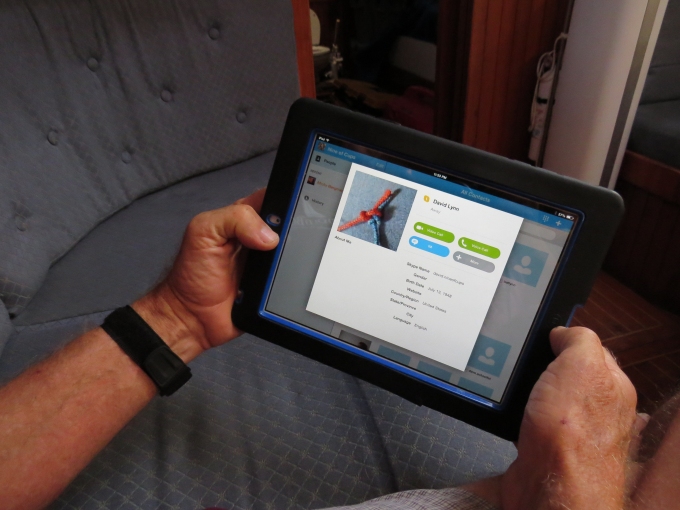
Calling home has changed dramatically over the years as well. We no longer have to find a phone booth (what's that?) or purchase phone cards for long distance calling. We have Skype apps for both the laptops and the tablets and have encouraged friends and family around the world to use Skype as well. Calls home are frequent and free.
skype on tablet

One of the slowest forms of cruiser communication is the traditional “coconut telegraph” which is still alive and well. Word of mouth between cruisers seems to pass from one boat to another, one port to another, and one country to another with adaptations as bizarre and diverse as the cruisers who pass along the messages and stories. If accuracy and speed are not criteria, this is probably the cheapest way to go.

Making Plans...Changing Plans

now what In the words of John Lennon “Life is what happens to you while you're busy making other plans.” We make plans and change them all the time. Do you?

One thing about living on a sailboat and cruising full time, there are too many decisions to make. Too many plans to make and change and make and change again. Sometimes because life happens; sometimes on a whim. This time, it's because we need to take care of some necessary repairs to Nine of Cups. We'll be spending a good part of the winter months in southern Africa.

Ever since David determined that the chainplates were suspect and needed replacing, we've been making plans. In fact, every evening we make plans with the daily information we receive and quickly change them the following morning when new information comes to light. Will we do the work here in Cape Town or move someplace else? Will David do the work or will we have some of the work done? What's the cost? No, that's not right, you're missing something … now what's the cost? Does that include hardware and supplies? No? now what's the cost? The frustration grows as does the number of decisions to be made and the cost, but we're sorting it all out.

One question, of course, is where do we go after the work is done? It's nearly winter here in South Africa, but our visas are expiring once again, as is the Customs permit for Nine of Cups. We can't stay in South Africa and by the time we arrive in the States, hurricane season will be upon us. So … what are the options?

where to

Well, we can spend some time along the Namibian coast (the next country up from South Africa on the west coast), then dawdle at St. Helena and Ascension and head to some place in the southern Carib, like Trinidad, for instance, which is out of the hurricane belt. We considered Brazil, but Americans visiting Brazil pay hefty fees for visas (reciprocity, I'm sure) and friends currently in Brazil are not enjoying the high costs nor the security issues nor the bureaucracy. Europe's always an option, especially with the Euro nearly at par with the US$. So … no decisions on that front yet.

There's no sense in making firm plans at the moment. There are too many what-ifs and not enough  information to make informed decisions. And quite honestly, even if all the answers were in place … we'd probably change our minds anyway. Stay tuned. We'll keep you updated on the boat repair progress and let you know when it's time to head out. You know you're always welcome to come along for the ride … wherever we go … or stay.

A Round versus Around

After arriving in Cape Town, we had to review our track and actually convince ourselves that we had indeed completed a bona fide circumnavigation … and we had. Rounding of the Capes, however, required more review than we'd previously given it. It might be a question of semantics, but we're embarrassed to say that we may not have rounded all of the five great capes after all. We have rounded four of them, but we sailed “around” Cape Horn like most yachties do. We were unaware of the “rules” regarding a rounding of the world's southernmost cape. cape horn

Upon researching "rounding the Horn", I found some conflicting  information. Wikipedia, for instance indicates that a rounding of the Horn “is traditionally understood to involve sailing from 50 degrees south on one coast of South America to 50 degrees south on the other coast, the two benchmark latitudes of a Horn run...”. Though it's not perfectly clear, we think this means crossing the latitudes at 50 degrees in both the Atlantic and Pacific. Well, we'd been at 50 south on the west coast (Gulfo de Trinidad, Chile in the Patagonian Archipelagos) and 50 south on the east coast (heading north up the Argentine coast from Ushuaia to Mar del Plata), perhaps we had rounded the Horn.

Around Cape 50DegreeMap

Then I stumbled upon the  IACH website (International Association of Cape Horners) and their eligibility criteria. “The Horn rounding shall be part of a non-stop passage of at least 3000nm and shall pass through fifty degrees south in both Pacific (or Indian) and Atlantic Oceans … under sail.”  They also added that that Cape Horners must “have rounded Cape Horn in a commercial sailing ship in trade.” Well, we definitely didn't qualify in this regard. Obviously, these rules are not for yachties and we don't qualify to be Cape Horners.

Looking at the websites of several commercial passenger boats that ply the Cape Horn waters, many mention “rounding the Horn”, but can you trust an advertisement for adventure seekers? Are they really “rounding the Horn”? Certainly, our trip around Cape Horn was a bit more dramatic than being on a cruise ship or a crewed passenger vessel, but the question remained … was it a round or around?

We think the true criteria for rounding Cape Horn is probably sailing from 50 degrees south from the Atlantic to 50 south in the  Pacific (or vice versa) … non-stop and outside the protection of the Patagonia and Tierra del Fuego archipelagos. With this criteria in mind, Joshua Slocum never rounded the Horn aboard “Spray” (though he did manage it twice sailing on a commercial vessel). Nor did Magellan in 1520 make it nor did Sir Francis Drake round the Horn in 1578, for that matter. They both took the shortcut through the Straits of Magellan  … and still they named the Drake Passage after Sir Francis. Go figure. It wasn't until 1616, when Dutch explorer and navigator Willem Schouten rounded and named Kaap Hoorn that the Cape was rounded for the first time. Our hero, Captain James Cook, managed it from both directions. What a guy! Nine of Cups and crew, however, did not.

Around Cape Horn

So, readers and fellow sailors, we didn't mean to lead you astray or boast about accomplishing something that we'd really not done. Nostra culpa … but sailing “around” Cape Horn will have to suffice.

A few notes about what we're NOT entitled to...

A sailor that rounds the Horn can wear a gold loop earring. Tradition has it that the earring should be worn in the ear that faced the Horn as it was rounded. I actually bought a gold earring for David at the time which he never wore. Good thing, huh?

Another amenity offered to sailors who've rounded the Horn is being allowed to put one foot on the table. If they'd rounded the Cape of Good Hope, too, they were allowed to put both feet on the table. I don't see this as a big privilege, but that's just me.

We're also missing out in the tattoo department because true Cape Horners can have a fully rigged ship tattooed somewhere on their body parts. Just as well we didn't do this because at our ages, our tattoos would  probably look like sinking ships.