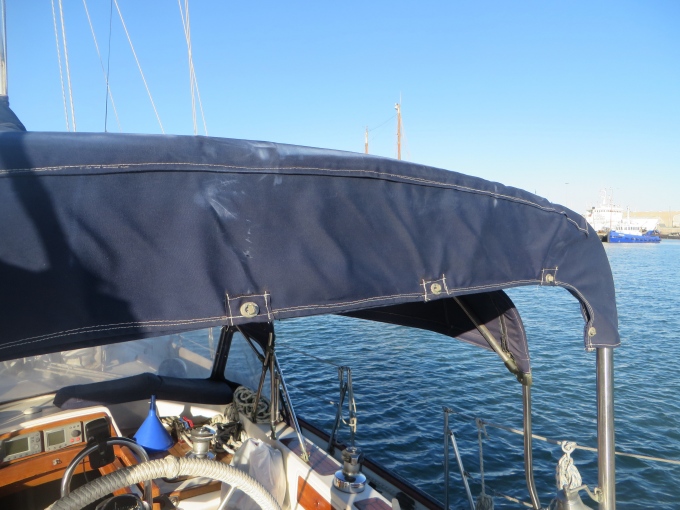
Moving Wind Wanderer

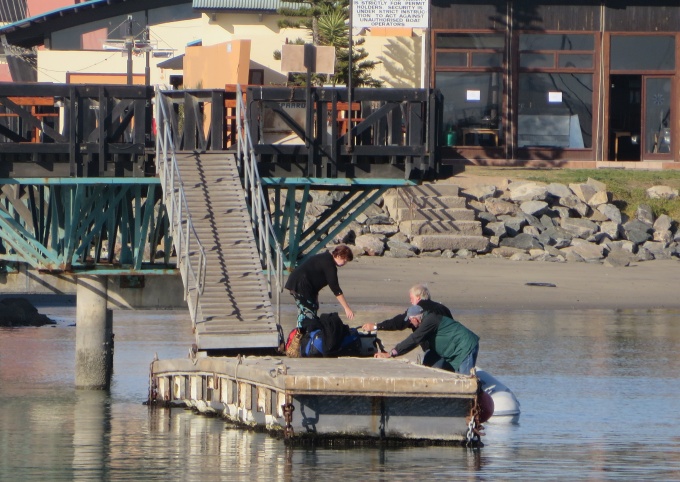
Our friends, Sandy & Vic on Wind Wanderer, were in a hurry. After a miserable trip from Cape Town to Luderitz during which lots of things broke (does this sound familiar?), they arrived late one night with only two days to spare before their flight back to Australia was due to leave. Talk about angst! They're good friends and it wasn't hard for us to offer some help. The biggest issue? Wind Wanderer (WW) was not on a permanent mooring and she'd need to be moved to one. Vic had everything sorted with Port Control before they left (or so he thought) and we just needed to move the boat to a new mooring as soon as possible. unloading at the dinghy dock
Assured that all was handled, Sandy and Vic left for Windhoek and their flight back to Oz.

leaving for windhoek

Hmmm … but TIA (This Is Africa) and rarely does anything go according to plan … or on time. Before WW's crew left, Port Control had identified a mooring not too far away, but prudence dictated it should be checked by a diver before moving WW and so a diver was scheduled … but not before they left. The mooring owner, however, changed his mind about WW using the mooring for an extended period. Port Control found another mooring and rescheduled the diver. When we checked with Port Control two days later, we found that the diver was actually checking the newly assigned mooring at that very moment. We dinghied out to the mooring in a hurry. There were three big problems with it: 1) It was located a long dink ride away from shore; 2) it was exposed to winds and fetch from all directions; and most importantly, 3) it was located much too close to a recently sunken boat. Yikes! This was not a good mooring.  The Port Control person with whom we had been dealing was out for a few days and  the current mooring owner needed WW to be moved soon to make room for his own boat. What to do?

sunken boat by mooring

We stopped to see our neighbor, Andy, on his trimaran and told him the tale of woe. He had a solution for us almost immediately. “Why don't you use Paul's mooring? It's designated for a yacht and it's not being used. It's only a year or so old and it's very sturdy.” We had just met Paul when we had dinner at Liz's house two nights before. We dinghied out to check the mooring first and it looked ideal. It was a short distance from WW's temporary mooring. We gave Paul a call. “No problem,” he said, “but you should have a diver check it out.” We contacted the divers again and got the new mooring scheduled for a check. They managed to get it done the same day and  David went out to the mooring to monitor the survey. All was good! Now to move the boat.
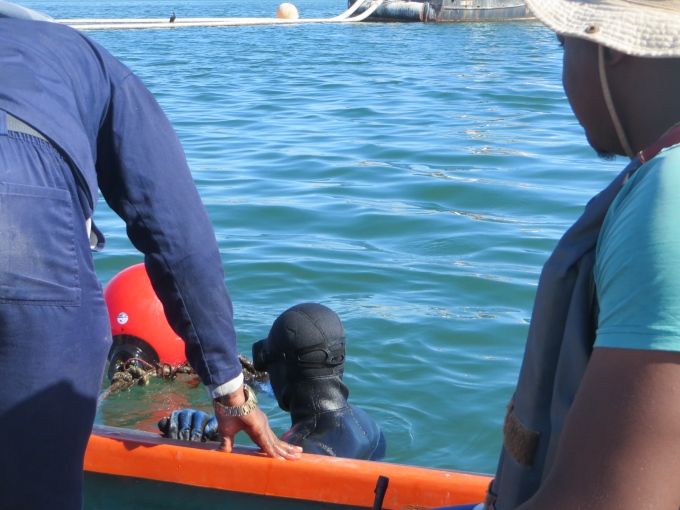
diver checks the mooring

We enlisted Andy to help us … a third hand is always welcome. Since the new mooring was so close, about 70m (225') away, we attached one end of a long line (one of our Patagonia shorelines) to the new mooring and Andy and I handlined WW to the new mooring while David provided assistance with the dinghy. This 30-ton boat was easily maneuvered by two hands from one mooring to the other. Piece of cake!
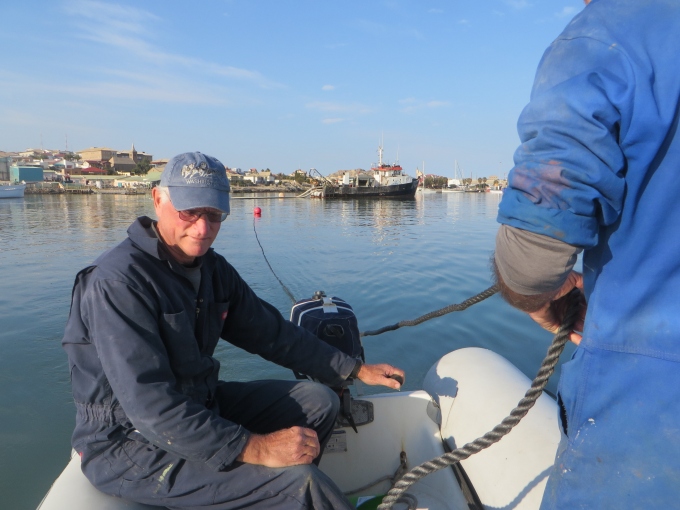
stretching a tow line

We got her all double-tied to the new mooring which will be her home for the next couple of months. Her new neighbors, Nautilus II and Fukula, seem to be comfortable with her being there. All's well that ends well.
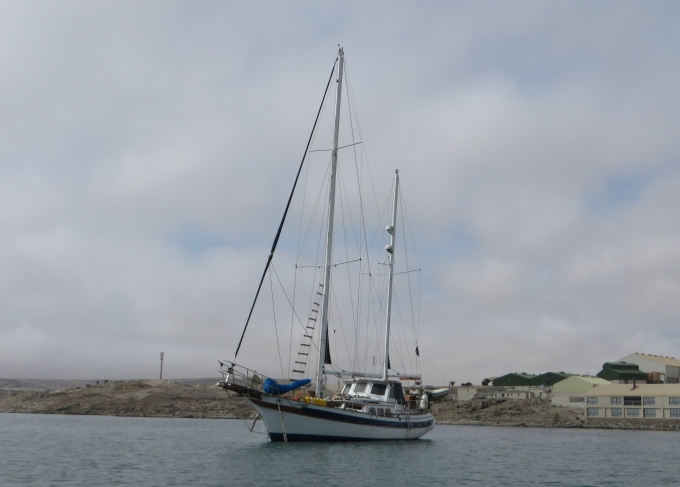
wind wanderer on her new mooring

That Pesky Chore List

Under Control

That chore list I described when we first arrived here in Lüderitz is actually getting a bit shorter. I know you think we've only been gallivanting over the Namibian countryside and cavorting over deserts chasing wild horses, but in actuality, we're also getting a few things accomplished … and they were actually on the to-do list.

We've had a couple of extremely windy (30-35+ knot) days when there was a chop on the bay and we could see whitecaps all around us. Those were good days for concentrating on inside chores. With so much power, I was able to sew without worrying about power consumption. I fabricated a new dinghy engine cover which I'd been putting off (rather successfully, I might add) for over a month.

new dinghy engine cover

I re-stitched the boom crutch cover, but as usual, it wasn't as easy as anticipated. The twist-locks  which hold the cover in place were pulling out, so they had to be removed. I stitched on reinforcement patches (12 of them)  and then David re-installed the twist-locks. Typical small project that should have taken 30 minutes ended up taking a whole morning. Sewing a new zipper in my foul weather bibs was easy compared to the other two projects. And the chafe guard between the dinghy storage location on the foredeck and the hatch cover was just straight stitching … a piece of cake … for me. David had some problems securing it, but managed after giving it some thought (and choice invectives).

repaired boom crutch cover

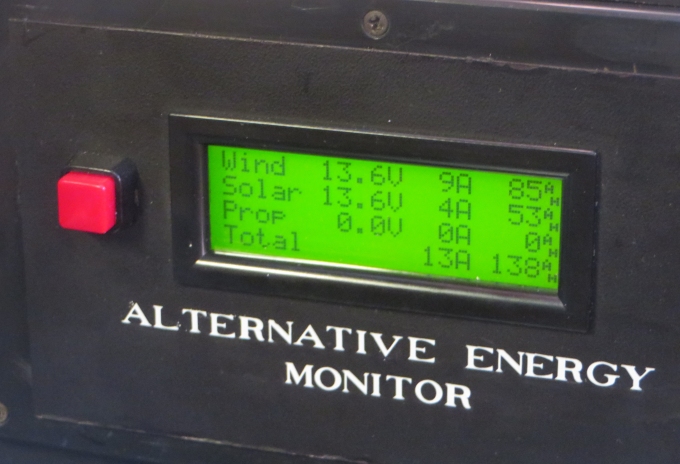
David has been working on a rather clever electronics project: a gizmo that measures and displays the amps and amp hours produced by our alternative energy sources, i.e. wind, solar and prop generator. I'll let him tell you about it himself, but the finished product all mounted and labeled and backlit is pretty impressive. Of course, I'm from the “dark side” (marketing), so what do I know?

alternative energy monitor

David's tackled the calcification in the head hoses … nasty job, but done. The fairleads for the traveler are now in place. He's tinkered with the reef lines and is happy with them now and the shaft brake has been adjusted.

Still, a few more things to do … additions actually. It's time for preventive maintenance on the dinghy engine and before we leave for the Atlantic transit, I need to do the annual ditch bag check. We've eaten up some stores, of course, so we'll need to do a mini-provisioning before we leave Namibia.

With all those chores accomplished, I think it's time for more play. Just need to convince the captain!

Off-Season Passagemaking

We got an e-mail the other day from Catherine in Australia. We've never met her, but it feels like we know each other. We've been in contact off and on over the last couple of years via e-mail. She and her husband have just recently “cast off the lines” and are cruising. She asked about our change in plans and wondered about passagemaking in the off-season. It's surely not the time when most folks set off to cross the Atlantic. She thought it might be a good blog topic and we agree. First of all, as we've said many times, making plans on a sailboat is always done in the sand at low tide. Things change … the boat needs work, unexpected repairs, weather delays, emergencies at home, health issues with the crew or maybe friends need help. We've delayed departures and changed plans many times in the past for these reasons and others. Once we moved a sick friend's boat from Ushuaia, Argentina to Uruguay, leaving Cups on the hard in Panama. When we returned to Panama, only a tiny bit late in the season, there was a slow-down (read that “strike”) of Panama Canal workers and we didn't get through till two months later … too late to cross the Pacific. What to do? We visited old friends in Ecuador, then headed to Puerto Montt, Chile to visit more friends there. We dawdled in the Patagonian canals and Chiloe (not a bad place to dawdle, by the way) and waited till it was reasonable to cross the Pacific and headed across from there.

plans at low tide

We were late leaving New Zealand when David's Mom was ill. We opted to stick around another season to explore the South Island till cyclone season was over in the Pacific. In Australia, Cups stayed in Adelaide for months while Marcie's mom recovered from an illness. The next year, we were late leaving Mandurah, Australia  to cross the Indian Ocean when Marcie's mom died.  These are unavoidable circumstances and going with the flow is the best philosophy. We still made it across the Indian, but at a less relaxed pace than we would have liked. We missed some places we would have liked to see.

That said, wind, weather and currents many times dictate our passage-making plans. We consult Jimmy Cornell's World Cruising Routes and wind pilots, as well as available cruising guides and notes from friends. Most Atlantic crossing guides talk about crossing from the US to Europe and back. Fewer guides talk about the South Atlantic crossing. We've done it twice before from both directions, but at different times of the year. One crossing was rough (Uruguay to Cape Town) and one crossing was the stuff dreams are made of (Cape Town – Charleston,SC).
plan a plan b

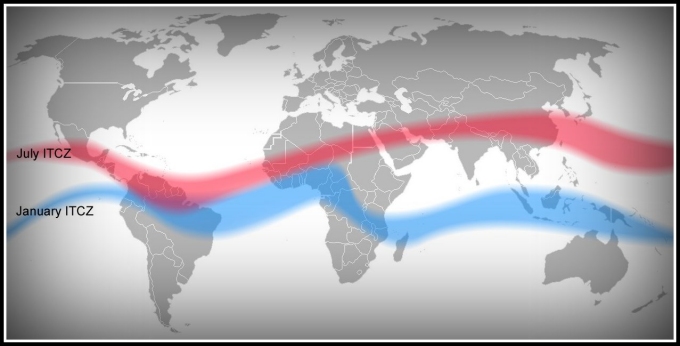
Once again, we're late …  leaving Africa is best done January-March if you're heading back to the States. Repairs and weather mostly account for our late start. The hurricane season is now in full swing in the northern hemisphere. So how does that change our plans? Well, crossing the South Atlantic this time of year is not the problem since tropical and subtropical hurricanes are rare south of the Equator and  when they do occur, it's in the austral summer. Additionally, the problem of crossing the ITCZ (the InterTropical Convergence Zone) this time of year is less of a challenge, since it sits further north above the Equator in the austral winter.  The problem is once we cross the Equator, where do we go?

itcz january to july

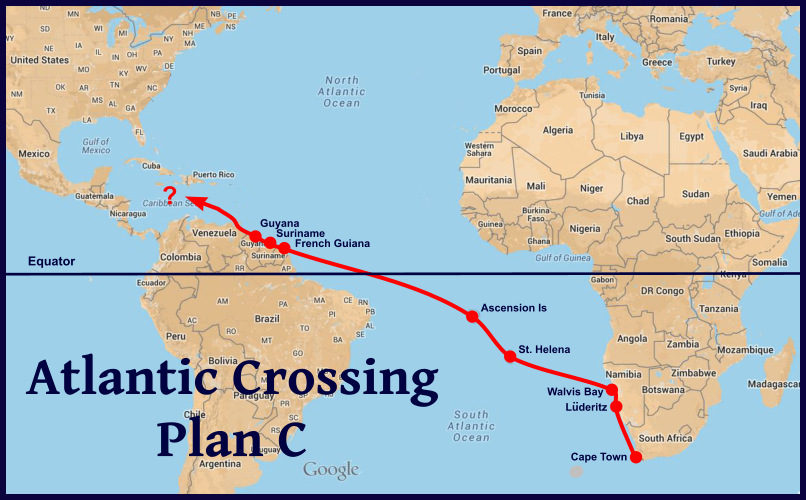
We had originally planned to head out across the Atlantic in the February/March time frame with a destination of the US east coast, probably the Chesapeake, via Bermuda. That was Plan A. Then, there was Plan B. We'd head out in the April/May timeframe and perhaps head to the southern Carib … Trinidad, maybe. We're now working on Plan C. We'll hang in Namibia … Lüderitz and then Walvis Bay further up the coast … till the August time frame and then head across the Atlantic via St. Helena and Ascension as originally planned. Instead of heading into the Caribbean, we'll head to the Guianas … three small South American countries we've yet to visit. None of these countries suffer from hurricanes … only heat and humidity. They're a good point of sail and on the way, and will provide a good entrance into the Caribbean once the hurricane season has passed. The Chesapeake will have to wait till next Spring.

plan c

Being flexible is key when you're cruising … especially on a sailboat. There are times when it's prudent to wait and other times when it makes sense to alter your plans a bit to fit with Mother Nature's plans.

stay flexible

The world is huge when you're sailing and 70+% of it is water. There's always somewhere to go. By the way, we've begun to think of it as being extremely early for next season as opposed to being particularly late for this one. It's all in how you look at it!

Thanks for this blog post idea, Catherine! Anyone else have any ideas for blog post topics? We're wide open to suggestions. Leave a comment or send a quick note via our contact page.