Intracoastal Waterway - Day 4

Day 4 – 490 nm to go A hot and humid night with nary a breeze and little sleep to be had. We've been checking the weather daily but still no reasonable weather window to get us all the way to the Chesapeake. The winds are either 5-7 knots variable or strong winds from the north … right on the nose. We plan to continue along the ICW, at least to Charleston, SC.

It was easier to get up this morning than to lay awake in our sweaty bunk. We were anchor up by 0620 before the fiery red sun had even cleared the horizon. Another gorgeous sunrise greeted us with birds singing in the tall grass and waders plying the sandy shore. Pelicans circled, poised to plunge as soon as they sighted a possible snack. Dolphins were already making their rounds through the feeding grounds.

sun on the horizon

We've had our share of minor repair issues along the way. The tachometer has been flaky. The speed transducer hasn't been working and the wind vane direction is stuck permanently reading “N”. David wiggled wires for the tach, but it didn't do any good, so that will wait till we're in port. He has no plans to go up the mast at the moment, so we'll just check the flag to see which way the wind is blowing. He'll pull the speed transducer tonight to free it up.

The landscape is slowly changing. Instead of miles and miles of flat, grassy lowlands, we're beginning to see a background of more trees, a nice break in the scenery. We crossed Calibogue Sound and then across the Hilton Head Inlet. By 10am, we crossed into South Carolina.

now there's trees

One thing about the ICW that is a pain is the number of bridges we must negotiate along the way. There are some 144 bridges along the entire 1,243.8 SM (1080.8 NM) route, almost half of which were south of us in Florida. We figure we still have to negotiate 74 bridges and one set of locks. Depending on wind, current, weather and the type of bridge, this can be easy or challenging.

The fixed span bridges on the ICW are at least 65' MHHW. In other words, at the highest tide, there's still 65' from the center span of the bridge to the water. Our mast with antenna is 63', so we have 24” to spare. It never looks as if the bridge is tall enough. Tide gauge boards are usually posted on the fenders on the north and south sides of the span entrance showing the current allowable mast height.

tide gauge boards

The more challenging bridges are the opening varieties. They have varying opening times and requests for openings must be made to the local bridgemaster on a designated VHF channel (usually 09 or 13). Some bridges open on demand; others only open on the hour or half hour and sometimes not at all during heavy traffic times (0700-0900 and 1600-1800). We had downloaded a 2016 bridge list and referred to it frequently throughout our ICW passage. The timing of the bridge openings isn't the issue other than it can be inconvenient to hang out for another half hour if you've just missed a bridge opening by 3 minutes or so.

The biggest problem is that there are several different types of opening bridges and they all pose their own particular set of problems. For instance, the Causton Bluff Bridge/ aka Sam Vernadoe Bridge is a twin, double-leaf bascule bridge and the left section of the second set of leaves was not in operation, making the opening single leaf and quite a bit narrower.

sam varnedoe bridge

The Ladies' Island Bridge is a swing bridge and when it opens, it reveals two transit lanes through the bridge. We were all lined up to go through, but mistimed how long it took the bridge to open. Another boat was just off our stern and we were too close to the bridge which hadn't fully opened. We had no room to reverse without hitting our tailgating friend. Instead, David made a last minute hard turn to port and had to turn around and get to the back of the transit line quickly in order to make it through the bridge without delay. No big deal, but it was a bit trying to the nerves.

ladies island bridge

The Sister's Creek Bridge is a bascule bridge, but a new fixed bridge was under construction directly behind it. We waited till the bascule bridge opened, then immediately went under the under-construction span. Sometimes there are cables and wires strung across as well. It's always a bit nerve-wracking; nothing major, just a bit of angst. But then what kind of an adventure would it be without a little excitement and a few complaints?

sisters creek bridge

We found a pleasant anchorage near Church Creek, dropped the hook and enjoyed a calm evening.

We continue on tomorrow to one of our favorite east coast cities, Charleston, South Carolina for a welcome couple of days relaxation and Southern hospitality.

Intracoastal Waterway - Day 3

Day 3 – 575 nm to go We were up with the sun for an early start. All was calm on the Crescent River and the sunrise was spectacular. What a way to start the day.

sunrise on the crescent river

We are working towards at least 60nm per day and early starts, when the day is cool, are advantageous to the plan. Tides are an issues here. The tidal swing is 6-7 feet. If we enter a river on a rising tide, we have a push, but by time we're half way up the river, of course, the tide is pushing against us from the other side. On occasion, we've timed it right (through no fault of our own) and we get a push and a pull to help us along. Usually, however we don't have it both ways, so we've been averaging 5-6 knots and 60 nm miles requires 10-12 hour days.

It's not as unpleasant as we imagined, however. It requires us to be alert and someone, usually David, is at the helm all the time. Active Captain, especially a contributor known as Bob423, has provided invaluable local knowledge for negotiating the trouble spots and we've avoided most problems. I monitor the Active Captain site and provide input as to upcoming shoals and hazards. That said, we did have our first soft grounding today at Johnson Creek. Cups glided to a slow, but definite stop in the mud though we thought we were where we were supposed to be. David was able to back up, torque turn in the mud and we were off and on our way in a matter of minutes … no kedging, cursing or towing involved.

We see dolphins daily and frequently in the rivers. We identified them as common Atlantic bottlenose dolphins, but thought they were particularly small. I learned that the dolphins here plying these protected inland waters are indeed smaller than their offshore counterparts. They're seldom very playful. They surface and dive in an effortless, undulating fashion. They're curious, but their visits are brief and then they're back to the work of feeding.

dolphin fin

As the day heats up, the sound of cicadas is so loud, we can hear their droning buzz over the engine noise. Ospreys are a common sight. Their huge, unwieldy nests are easily spotted and most that we've seen are occupied.

osprey nest

We're still in Georgia. The marshland grass here is thick and very uniform in height as if a barber services the area regularly and gives it a flattop cut.

flat even grass


Sometimes the waterway is quite wide. Other times, it seems as if we could touch the shore.

marshland grass

We noted that there are lots of saints in the area. We left Saint Augustine and passed St. John's Inlet and St. Mary's and Saint Simon's and probably more. I'm sure Matthew and Luke and probably more are around somewhere, we just haven't found them.

Today's adrenaline rush was passing through Hell Gate and then Fields Cut. Both are actually “cuts”, man-made, dredged channels connecting the waterways. We've been through Hell Gate, the narrow tidal strait on New York City's East River. We've passed through Hell's Gate on Tasmania's west coast heading into Macquarie Harbour. Comparatively speaking, this Hell Gate was neither as exciting nor as as treacherous as the other two. We did have the benefit of the right tides and a little local knowledge, and found the anticipation much worse than the actual passage. Thank goodness!

We anchored the night between Jones Island and Turtle Island. Neither Joneses nor turtles made an appearance and we spent a comfortable night conveniently located just off the ICW ready to resume our trip at tomorrow's first light.

Along the Intracoastal Waterway

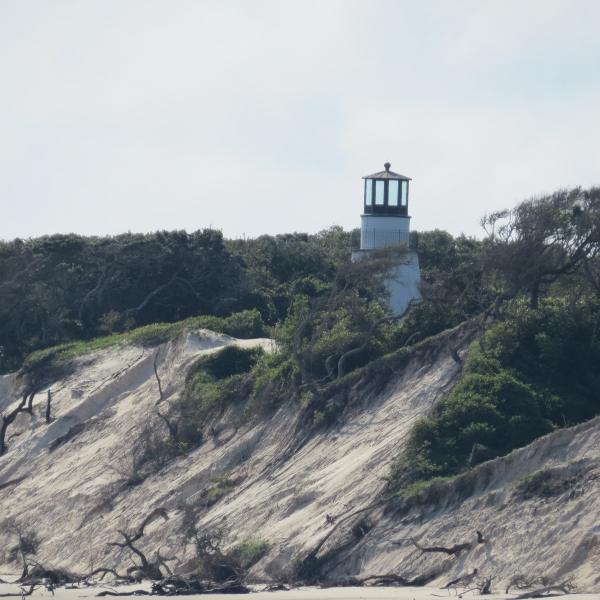
Day 2 – 637 nm to go We woke to a glorious, clear-skied morning on the ICW. We could really get into this. We were anchored just off the National Parks dock and Cumberland Island begged exploration, but we said no this time. We were anchor up by 0630 and on our way heading up the Cumberland River. David had plotted the day's course the night before while I prepared dinner, so we were ready to go. The water was flat calm, nary a ripple to be seen. The Little Cumberland Island Lighthouse poked its head into view as passed the north end of the island.

little cumberland island lighthouse

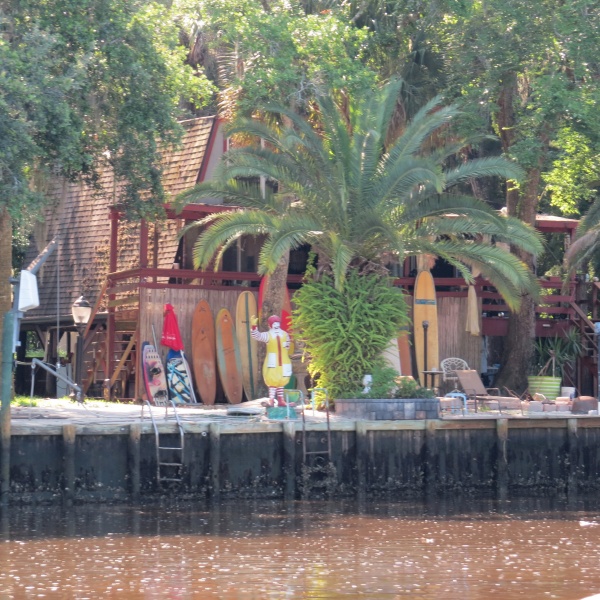
We pass by clusters of home from time to time along the canals. Some are palatial and others just river shacks. Some of the owners have a sense of humor.

ronald mcdonald waves at us

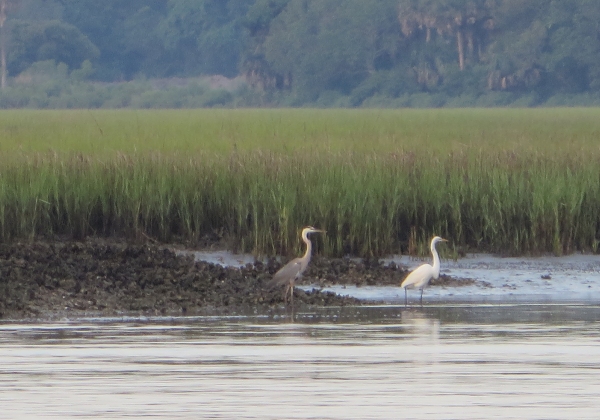
Mostly though, the scenery has been pastoral and pleasantly ever-changing. Bright green grassy banks line the rivers of these Georgia marshlands. The day turned hot and sultry by 10am and we were thankful for light cloud cover and a slight breeze. Herons and egrets, just a couple boat lengths away wading along the muddy shores, ignored us as we passed, more interested in their morning's breakfast.

wading birds on a grassy shore

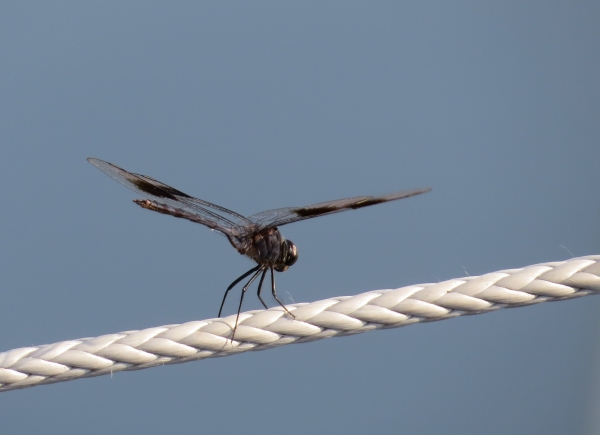
Dragonflies, butterflies, bees and huge horseflies hitched rides with us throughout the day. One dragonfly, the size of a hummingbird, lighted on the lifelines. I snatched my camera for a picture, but the “change battery” light came on. Figures. I scampered down below, got a new battery, changed it and came back up. Believe it or not, that vain dragonfly was still there, just waiting for his photo to be taken.

dragonfly

Each day presents a minor adrenaline rush with its shallows and narrow canals. These are not life-threatening nor boat-wrecking events. The worst that would happen is we would be probably be grounded in mud and sand. Still, we're used to traveling on the ocean where the depth meter seldom registers. Watching the depth meter plunge below 10, then 9, then 8 feet is unsettling with our 7.2' draft. Day 1 the major bugaboo was the Fernandina Shallows where we saw (and felt) a 7' spot under the keel. We plowed through the few feet of mud and felt as if we had done a bit of dredging for sailors in our wake.

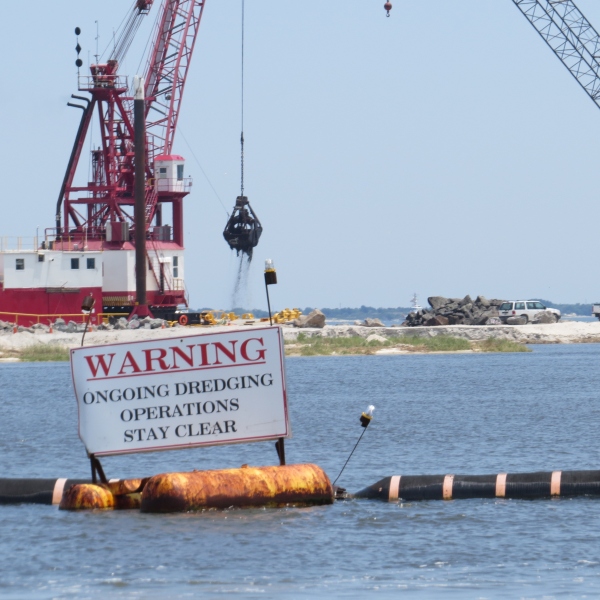
Today's tough spot was the Jekyll Creek along the west coast of Jekyll Island. Once again, the depth meter plunged and we were close enough to the dock at the Jekyll Island Marina to nod hello and say a few words to the folks moored there without raising our voices. Because of the ongoing movement of the river waters, silting and shoaling are constant issues and though we see dredging operations regularly, it never seems to be quite enough.

dredging in progress

Around 3 pm, the VHF wailed a violent storm warning for the local inland waters. Though there was some cloud build-up, we never saw a drop of rain nor an increase in winds. We counted ourselves lucky for dodging yet another weather bullet.

We're fascinated by the names of some of bodies of water we're passing through like the Little Mud River (hmm!), Buttermilk Sound, Old Teakettle Creek and DoBoy Sound. We wind and wend our way through this maze of waterways. Thank goodness for GPS.

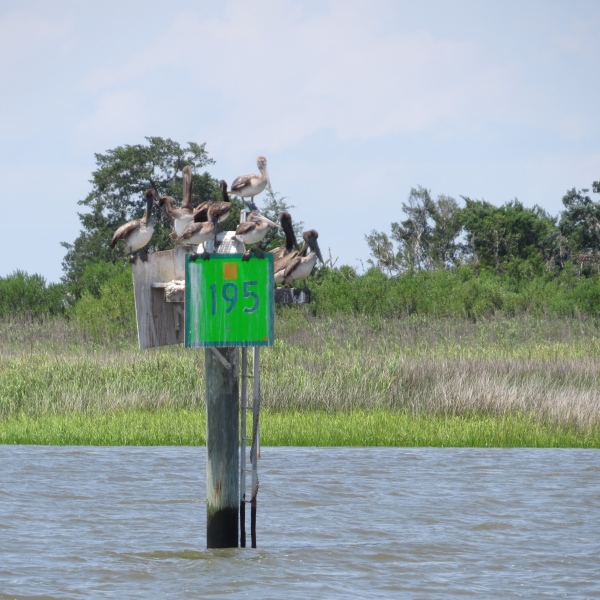
Pelicans were out in force today. They'd careen past us at top speed, dive into the water, swallow their catch (or perhaps just a lot of river water) and then fly off again. When they weren't fishing, they congregated wherever they could for some socializing. We wondered just how many more pelicans could have fit on the top of this marker.

how many pelicans can fit on a marker

It was nearly 5:30 pm when we quit for the day. We found ourselves a pleasant little anchorage out of the current in the Crescent River just off the main channel. With the engine off, the quiet was nearly palpable. It was hot and humid below, but sitting in the cockpit after a long day, enjoying a cold beer (yes, there's still some ice left) was heaven.