In the news...something besides politics

Despite our crazy daily schedule of packing, moving, installing, painting, cleaning, assembling and generally keeping ourselves occupied with a new house, I've been trying to keep up with the news by reading the newspaper that's delivered to our sidewalk each and every morning. I'd say it's delivered rain or shine, but usually there's only shine. Las Vegas paperboys have an easy job of it. The primaries and caucuses have taken the spotlight in the news and, quite honestly, it's getting old. There have also been all the regular, uplifting stories that capture the front page headlines in Las Vegas: Pedestrians killed by drunk driver, crazy woman kills her lover, graft and corruption in the gambling industry. But beyond all that, I find wonderful little nuggets of information and/or good news that seems to be hidden in the back of Sections B, C and D.

For instance, first grade students celebrated Dr. Seuss' birthday by reading to animals at the SPCA. The animals seems to enjoy it as much as the kids did. And there was an article on teddy bears. The first was created in 1902 and named after President Teddy Roosevelt. There was a wonderful article on keeping chickens as pets … maybe not on a boat. It discussed the rules concerning keeping chickens and the best breeds for family pets, egg laying and meat (did I say pet?).

best chickens for pets

One full-page ad asked if I was “looking for a medical marijuana dispensary?” I'm not, but Nevada has legalized medicinal pot and Euphoria/Wellness (yes, that's the name) offers “the biggest variety of flowers, concentrates, pre-rolls and edibles.” How about that? They also offer free express delivery valley-wide.

marijuana?

There was also another article, on a more serious note, which explained “Why We Need Immigrants” in the USA. In light of the political controversy, it was very informational.

why we need immigrants

And most exciting? The World Championship of Sign Spinning competitions was held in Downtown Las Vegas. I would never have believed that those energetic corner buskers gathered together to spin their stuff.

sign spinners

I guess what I'm saying is that if you look for it, you find all sorts of good pieces of information that are newsworthy. I'm not an Alice in Wonderland kind of girl, but it's certainly pleasant to read an article that's uplifting and positive once in awhile.
The Blue View - Using the Series Drogue

series drogue Deploying the series drogue...

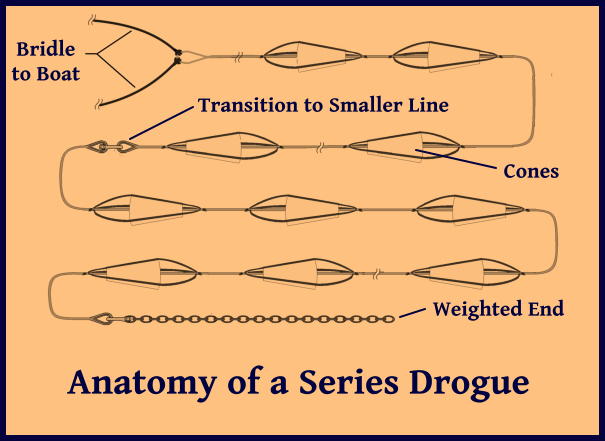
Let's assume we are way offshore and the GRIBs and Buoy Weather are predicting some nasty weather coming our way. We have our trusty, handcrafted Jordan series drogue safely aboard. How are we going to deploy it?

Don Jordan recommends having the drogue bridle attached to the dedicated chainplates and the drogue flaked in a bag or container, ready for instant deployment, during any bluewater passage. It's probably good advice, but we don't normally do this. We do have it ready and accessible on a passage, however, and if the weather forecasts are indicating anything near a gale or worse, we get it prepped and ready well in advance.

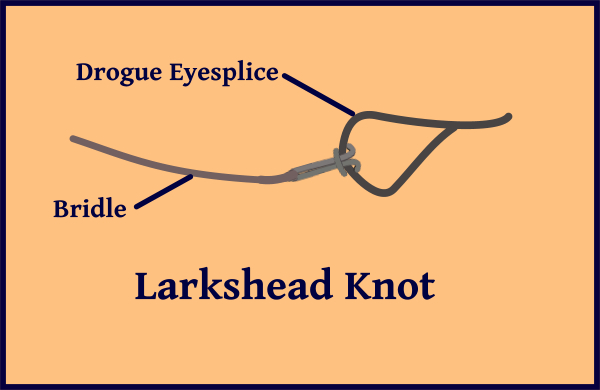
To prep it, I begin by attaching the two bridle lines to the end of the drogue. Each of our bridle lines has an eyesplice in one end. Each is run through the drogue eyesplice then through its own eyesplice to form a larkshead knot around the drogue line. The drogue is positioned on the aft deck, and the other end of each bridle line is routed over the stern rail and back to the strong point on either side of our transom.

larkshead knot

Next, I connect all the drogue segments together and attach the chain we use as a weight. The drogue is then flaked out on the aft deck, starting with the bridle on the bottom and working up to the weighted end. The flaked pile is secured in place, ready to deploy.

When the weather starts getting bad, we drop and secure our sails, remove the lines securing the drogue, then drop the weight over the stern rail and let the drogue run out. Once it is properly deployed, we check that the wheel is centered, then close the hatches and go below. We make sure the AIS and radar alarms are on, then try, as best we can, to rest while we wait out the storm.

Retrieving the series drogue...

Whew – that was quite a blow! It's now two days later and we're pretty much over our seasickness. The seas are calming down, the wind has dropped to around 30 knots, and it's safe to retrieve the drogue. I use a variation of Don Jordan's method for bringing it back aboard.

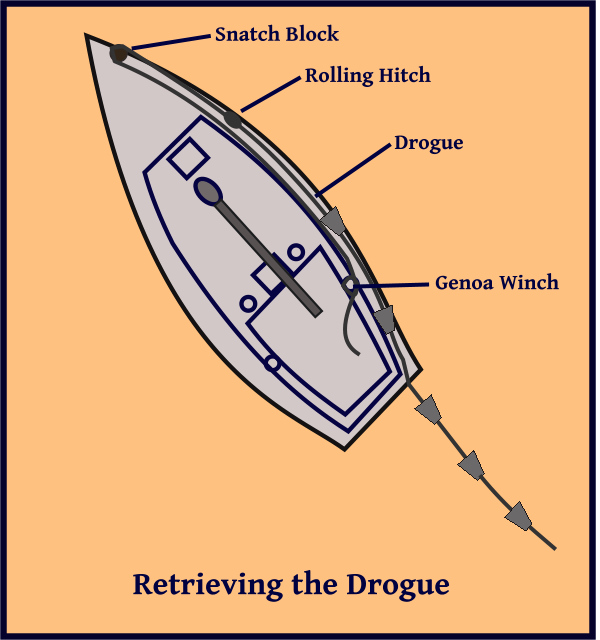
I use two lines that are about twice the length of Nine of Cups – about 90 feet. I have two retired jib sheets that work well for the purpose. I rig snatch blocks to either side of the bow pulpit, then run the lines from each of the genoa winches forward to the snatch blocks and back to the stern rail. I run the port line over the rail, attach it to the starboard bridle with a rolling hitch and take the slack out of the line. Before I can start winching the drogue in, however, I have to release the bridle from the strong points on the transom. What works for me is to run the starboard line through the starboard aft hawsehole,and attach it to the bridle with a rolling hitch. Then I crank on the starboard genoa winch until the starboard bridle can be removed from its strong point on the transom. Once the bridle end is free, I slack off on the starboard line until the port line is tensioned. Next, I winch the port line in until the end of the bridle is on the aft deck. Then, I release the port bridle from its strong point, untie the starboard line from the starboard bridle, and pull it back aboard through the hawsehole.

The next steps are as follows:

  1. I winch the port line until the rolling hitch reaches the snatch block. As the drogue is winched forward, I keep an eye on it to make sure none of the cones catch on anything.
  2. Then I tie the end of the starboard line to the drogue with a rolling hitch and winch it tight enough to take the tension off the port line.
  3. Next, I release the port line from the genoa winch, walk forward, untie the rolling hitch, and bring the end of the line back to the stern rail. I also pull the portion of the drogue that lies on the port deck back to the aft deck.
  4. Finally, I winch the starboard line in until the rolling hitch reaches the snatch block.

retrieving the drogue

I repeat the process until the drogue has been retrieved. Since our bridle is about 375 feet long, I have to winch each side about four times.

I don't want to stow a wet drogue, so I flake it on the aft deck and secure it. At the next opportunity, I will separate the drogue sections, hose them off with fresh water and set them out to dry. Then I will flake and secure each section and stow them below.

The process isn't as complicated as it sounds, but it isn't something I do everyday. We might go a year or more without even thinking about the drogue, which is about 11 months longer than I need to forget most of the details. I keep sketches and notes stashed in a ziplock, which is taped to the drogue so I can refresh my memory when it comes time to deploy it.

#TBT - Turks and Caicos 2002

We're in the process of moving into a new house in Las Vegas at the moment. Whenever it gets too crazy, we take a deep breath and think back about where we were in March in years past. The Turks and Caicos come to mind when we think about March 2002. We had finally broken loose from the hold of the Bahamas and we were heading to the Dominican Republic. The Turks and Caicos were on the way and well worth the stop. turks and caicos map

We didn't have a website then. I kept a handwritten journal and I was just getting into photography. We were also really just getting into the cruising life. Everything was new and exciting. We were venturing just a little further off the beaten path. We stopped first in Provo (Providenciales), the largest island in the Caicos, and did a bit of exploring on foot. Provo is known for its luxurious resorts, its diving and its upscale tourism. Though we appreciated its beauty, it was far too touristy for us.

cheshire plantation turks caicos

We moved on to the Turks and anchored off Grand Turk Island. Here we found what we were looking for … few tourists (except us, of course), an interesting history, and lots of exploring to do. We visited the tiny, but informative Turks & Caicos National Museum where we learned lots about the island from its curator.

turks and caicos museum

While in the museum garden, I spotted two male lizards apparently having an altercation over a female or territory, I suppose … perhaps both. Their dewlaps were extended, and had they not been tiny critters, they might have looked ferocious. We were told that these anoles were endemic to the Turks & Caicos and that we would see endemic anoles in most of the Caribbean islands. To this day, it's one of my favorite photos.

anoles fighting in turks and caicos

We wandered down Front Street along the shore, admiring the houses, but one notable observation was that all of the houses had walls, gates and fences. According to poet, Robert Frost, “Good fences make good neighbors!”, but come on now on such a tiny island, is this really necessary?

house on front street in turks and caicos

It appears that if locals want to have a garden it is necessary, otherwise donkeys eat your yard. Donkeys? Lots of them! As very tangible reminders of the salt-raking industry of Grand Turk’s past, donkeys still roam freely on the island and can be seen most everywhere. The island’s official donkey keeper rounds up the equine vagrants about every six months and corrals them on a “ranch” in the northern part of the island. If adopting a donkey appeals to you, this would be a great place to find one. Providing a good home is the only criteria for ownership!

donkey of turks and caicos

We wandered from one end of the island to the other. The Grand Turk Lighthouse, which was cast in iron in England and transported and reassembled in 1852 overlooking Northeast Reef was a good spot for a picnic.

grand turk lighthouse

The Bermudian Saltrakers were the first to commercially produce salt in the Turks and Caicos by evaporating sea water in a series of salinas or salt ponds. Salt played an important part of the islands' economy until the 1960's. The salinas still occupy a huge area in Grand Turk and Salt Cay, and are reminders of this history. The old, now decrepit windmills once used to pump water between the salt ponds, were particularly scenic.

turks and caicos windmill

There are more than 40 islands in the Turks & Caicos, only 8 of which are inhabited. Had we been a bit more seasoned cruisers, we would have explored more, but we didn't. We were anxious to move on. We've learned through experience to slow down and appreciate each place more. Guess we'll just have to go back some day and do a better job of exploring.

Want to learn more about the Turks & Caicos? Check out this website.