Marco Polo Speaks

marco polo meme

I speak and speak ... but the listener retains only the words he is expecting.

It is not the voice that commands the story; it is the ear. - Marco Polo

Marco Polo states “I did not write half of what I saw, for I knew I would not be believed”. It's amazing how often we try to tell stories of our adventures and watch as people's eyes glaze over, and we realize they are not interested; they've stopped listening. We've learned to curtail our stories unless prompted, lest people lose interest in our company altogether. We've talked to other cruisers and they experience much the same reaction. It's reassuring that it's not just us.

We've discussed this phenomenon at length with fellow sailors. We think we're reasonably good storytellers; we think some of our adventures are worth sharing; so what's the problem? As Marco Polo states, “the listener retains only the words he is expecting”. If the words we speak are not expected, the listener turns off. Most people have no frame of reference for our life aboard a sailboat, for the constant travel, for foreign customs and lands, for big storms or endless seas. It's alien to them and since they cannot share the experience, they prefer not to listen. The chat turns to grandkids, or work, or recipes, or whatever seems to be common ground. Talk of sea adventures diminish in the chatter and we, then, are left to listen.

Sometimes our enthusiasm for travel and the liveaboard life is so unbelievable, our listeners think we're exaggerating and bragging rather than just sharing our stories. If they have visited the Caribbean Islands or ventured to the South Seas, it's a given that their experiences are vastly different from ours … and they'd rather recount their tales than listen to ours. Few members of our family follow our blog with any regularity. We can usually tell that they're not into our sailing life when we call and they ask where we are and what we're doing.

We've learned not to take it personally. It's not as much a lack of interest as it is a lack of familiarity with our non-traditional lifestyle. It's hard for non-sailors to comprehend the life we lead living on a sailboat. There's little common ground to share. School kids and the elderly seem to do best with the subject matter we present. They're either very eager to receive new information or patient and captive enough to listen to what we have to say. So … if you ask, we can talk your ears off, but we promise to stop when your eyes glaze over.

In the news...something besides politics

Despite our crazy daily schedule of packing, moving, installing, painting, cleaning, assembling and generally keeping ourselves occupied with a new house, I've been trying to keep up with the news by reading the newspaper that's delivered to our sidewalk each and every morning. I'd say it's delivered rain or shine, but usually there's only shine. Las Vegas paperboys have an easy job of it. The primaries and caucuses have taken the spotlight in the news and, quite honestly, it's getting old. There have also been all the regular, uplifting stories that capture the front page headlines in Las Vegas: Pedestrians killed by drunk driver, crazy woman kills her lover, graft and corruption in the gambling industry. But beyond all that, I find wonderful little nuggets of information and/or good news that seems to be hidden in the back of Sections B, C and D.

For instance, first grade students celebrated Dr. Seuss' birthday by reading to animals at the SPCA. The animals seems to enjoy it as much as the kids did. And there was an article on teddy bears. The first was created in 1902 and named after President Teddy Roosevelt. There was a wonderful article on keeping chickens as pets … maybe not on a boat. It discussed the rules concerning keeping chickens and the best breeds for family pets, egg laying and meat (did I say pet?).

best chickens for pets

One full-page ad asked if I was “looking for a medical marijuana dispensary?” I'm not, but Nevada has legalized medicinal pot and Euphoria/Wellness (yes, that's the name) offers “the biggest variety of flowers, concentrates, pre-rolls and edibles.” How about that? They also offer free express delivery valley-wide.

marijuana?

There was also another article, on a more serious note, which explained “Why We Need Immigrants” in the USA. In light of the political controversy, it was very informational.

why we need immigrants

And most exciting? The World Championship of Sign Spinning competitions was held in Downtown Las Vegas. I would never have believed that those energetic corner buskers gathered together to spin their stuff.

sign spinners

I guess what I'm saying is that if you look for it, you find all sorts of good pieces of information that are newsworthy. I'm not an Alice in Wonderland kind of girl, but it's certainly pleasant to read an article that's uplifting and positive once in awhile.

The Blue View - Using the Series Drogue

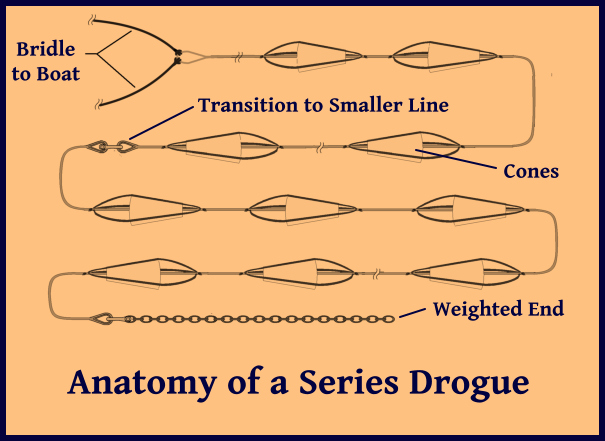
series drogue Deploying the series drogue...

Let's assume we are way offshore and the GRIBs and Buoy Weather are predicting some nasty weather coming our way. We have our trusty, handcrafted Jordan series drogue safely aboard. How are we going to deploy it?

Don Jordan recommends having the drogue bridle attached to the dedicated chainplates and the drogue flaked in a bag or container, ready for instant deployment, during any bluewater passage. It's probably good advice, but we don't normally do this. We do have it ready and accessible on a passage, however, and if the weather forecasts are indicating anything near a gale or worse, we get it prepped and ready well in advance.

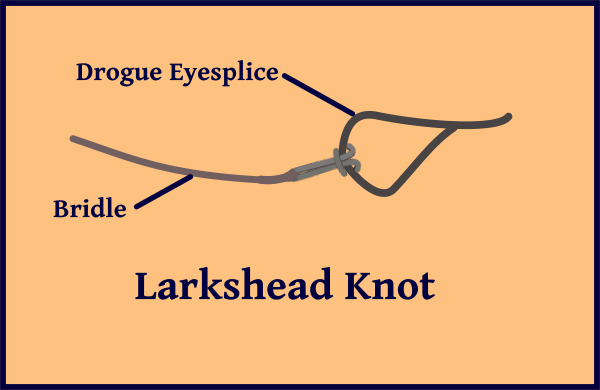
To prep it, I begin by attaching the two bridle lines to the end of the drogue. Each of our bridle lines has an eyesplice in one end. Each is run through the drogue eyesplice then through its own eyesplice to form a larkshead knot around the drogue line. The drogue is positioned on the aft deck, and the other end of each bridle line is routed over the stern rail and back to the strong point on either side of our transom.

larkshead knot

Next, I connect all the drogue segments together and attach the chain we use as a weight. The drogue is then flaked out on the aft deck, starting with the bridle on the bottom and working up to the weighted end. The flaked pile is secured in place, ready to deploy.

When the weather starts getting bad, we drop and secure our sails, remove the lines securing the drogue, then drop the weight over the stern rail and let the drogue run out. Once it is properly deployed, we check that the wheel is centered, then close the hatches and go below. We make sure the AIS and radar alarms are on, then try, as best we can, to rest while we wait out the storm.

Retrieving the series drogue...

Whew – that was quite a blow! It's now two days later and we're pretty much over our seasickness. The seas are calming down, the wind has dropped to around 30 knots, and it's safe to retrieve the drogue. I use a variation of Don Jordan's method for bringing it back aboard.

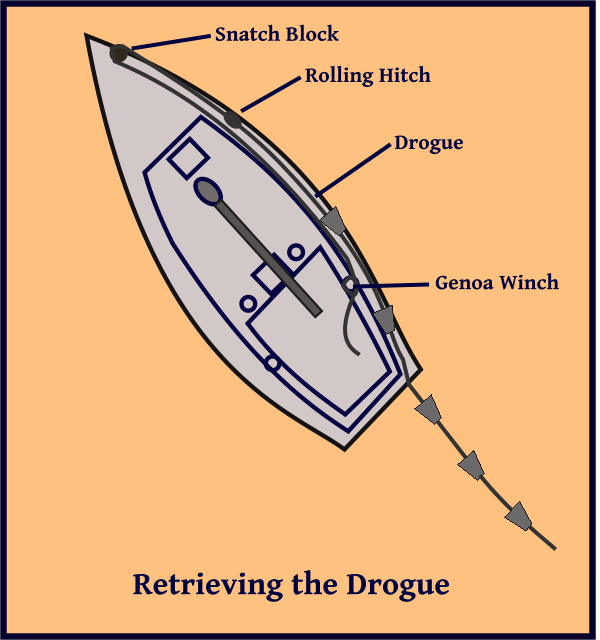
I use two lines that are about twice the length of Nine of Cups – about 90 feet. I have two retired jib sheets that work well for the purpose. I rig snatch blocks to either side of the bow pulpit, then run the lines from each of the genoa winches forward to the snatch blocks and back to the stern rail. I run the port line over the rail, attach it to the starboard bridle with a rolling hitch and take the slack out of the line. Before I can start winching the drogue in, however, I have to release the bridle from the strong points on the transom. What works for me is to run the starboard line through the starboard aft hawsehole,and attach it to the bridle with a rolling hitch. Then I crank on the starboard genoa winch until the starboard bridle can be removed from its strong point on the transom. Once the bridle end is free, I slack off on the starboard line until the port line is tensioned. Next, I winch the port line in until the end of the bridle is on the aft deck. Then, I release the port bridle from its strong point, untie the starboard line from the starboard bridle, and pull it back aboard through the hawsehole.

The next steps are as follows:

  1. I winch the port line until the rolling hitch reaches the snatch block. As the drogue is winched forward, I keep an eye on it to make sure none of the cones catch on anything.
  2. Then I tie the end of the starboard line to the drogue with a rolling hitch and winch it tight enough to take the tension off the port line.
  3. Next, I release the port line from the genoa winch, walk forward, untie the rolling hitch, and bring the end of the line back to the stern rail. I also pull the portion of the drogue that lies on the port deck back to the aft deck.
  4. Finally, I winch the starboard line in until the rolling hitch reaches the snatch block.

retrieving the drogue

I repeat the process until the drogue has been retrieved. Since our bridle is about 375 feet long, I have to winch each side about four times.

I don't want to stow a wet drogue, so I flake it on the aft deck and secure it. At the next opportunity, I will separate the drogue sections, hose them off with fresh water and set them out to dry. Then I will flake and secure each section and stow them below.

The process isn't as complicated as it sounds, but it isn't something I do everyday. We might go a year or more without even thinking about the drogue, which is about 11 months longer than I need to forget most of the details. I keep sketches and notes stashed in a ziplock, which is taped to the drogue so I can refresh my memory when it comes time to deploy it.