The Blue View - A DIY HF Antenna

Probably 95% of the offshore sailboats we see that have either a marine or HAM radio use a long-line type antenna. This is simply a wire that runs from just above the deck to the top of the mast, with insulators at each end to electrically isolate the wire from the other metal parts of the boat. While there are a few subtleties to be considered, the antenna itself is quite simple. In this blog, I'll describe how we built a simple, inexpensive antenna. The wire is actually only half of the antenna. The other half consists of a ground plane or counterpoise. On a land based antenna, the earth is sometimes used as the ground plane, but often a network of wires is run radially out from the base of the antenna, and this type of ground system is called a counterpoise. On a boat, the seawater acts as a great ground plane as long as there is a good connection between the antenna ground and the water. In next week's blog, I'll talk about options for the ground plane/counterpoise design, and what we used.

Finally, in the third part of this series of blogs, I'll talk about other antenna options. I know – it doesn't get much more exciting than this, but please try to control your enthusiasm.

First, a caveat. While I am an electrical engineer, my expertise is not in radio electronics. (Actually, I'm not sure where my expertise lies, but I know it's not antenna design). I understand the basics, but there are a lot of other websites and blogs that were written by people far more knowledgeable on the subject than me, and I've provided links to a few of these at the end of this blog. What I plan to accomplish here is to describe an inexpensive design that works for us on Nine of Cups.
overview

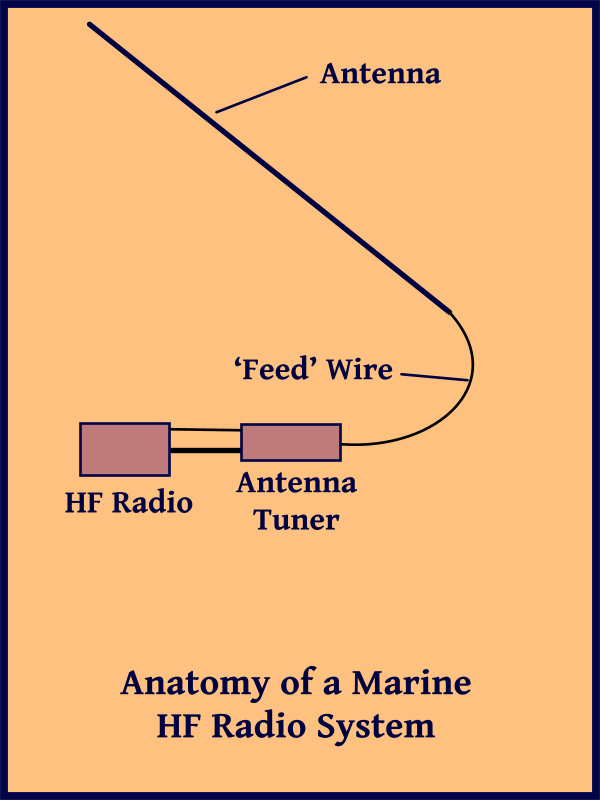
The sketch shows an overview of the radio system. The signal from the radio first passes through an antenna tuner. If we were only planning to transmit at a single frequency, we could adjust the length of the antenna to optimize it for that frequency. When we change frequencies, however, a mismatch between the radio and the antenna occurs, resulting in power being reflected back into the radio instead being transmitted. If the mismatch is big enough, the radio will actually be damaged. The tuner uses variable inductors and capacitors that are switched into and out of the circuit to match the radio output impedance to the antenna's input impedance, thus protecting the radio from the reflected radio waves. A common misconception is that the tuner 'tunes' the antenna to improve its performance at different frequencies. In actuality, the same mismatch and power losses still exist, only now it is between the tuner and the antenna. A good tuner will be able to withstand a large reflected wave and still protect the radio.

The radio connects to the automatic antenna tuner via two cables. One is a coaxial cable that carries the radio waves. The other cable provides power and control signals for the tuner. With our Icom radio, whenever the transmit frequency is changed, the radio sends a command to the automatic antenna tuner, and it matches the radio and tuner to the new frequency.

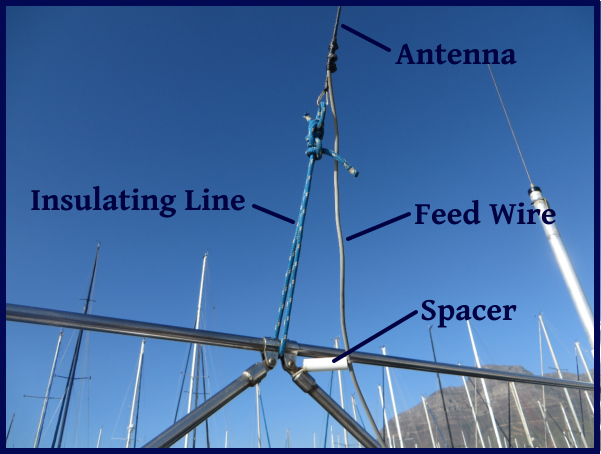
The output of the tuner is connected to the antenna via an insulated, single conductor wire. (I'll call it a feed line for simplicity, but it is actually part of the antenna system rather than a feed line.) It should be kept as short as possible. I mounted our tuner in a locker in the aft cabin to put it as close as possible to the actual antenna. The 'feed line' should be separated from any grounded metal like stanchions. I used small, 3” PVC tubing as separators.
spacer

The antenna itself is a single, dedicated wire that runs from above the stern to the top of the mast. Over the years I've used uninsulated galvanized wire, electrical wire and even lifeline wire for our various antennas. Anything larger than about AWG8 wire is probably large enough as long as it is strong enough to be strung to the mast head and tensioned, and is able to withstand the occasional errant halyard. I spliced a loop into both ends of the wire using small hose clamps.
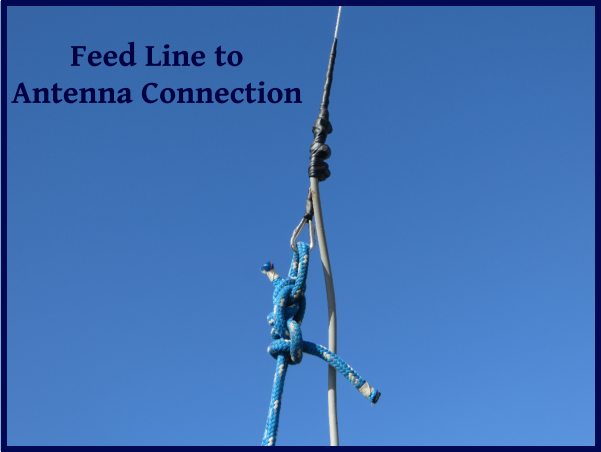
connection

To connect the feed line to the antenna, I stripped several inches of insulation from the end of the feed wire and if the antenna I was using had an insulating cover, I removed several inches of insulation from it as well, just above the loop in the end. I wrapped the feed line around the antenna wire, secured it in place using cable ties, then weatherproofed the connection with amalgamating tape. Riggers' tape also works well.

I insulated the ends of the antenna from the connections at either end using short lengths of line. Nine of Cups has a double backstay, so I attached the antenna to both backstays near the top. The bottom was attached with line to the pole supporting our windgen. If we had a single backstay, I would have attached the top to a tang on the mast, and the bottom of the antenna to the stern on either the port or starboard side, ensuring that it would always clear the mainsail.


connection at top


connection at top

Stay tuned for Part 2 in next week's Blue View.

Links:
Antenna Tuner

Antennas


#TBT - Feck Off Snakes - Wellington, NZ

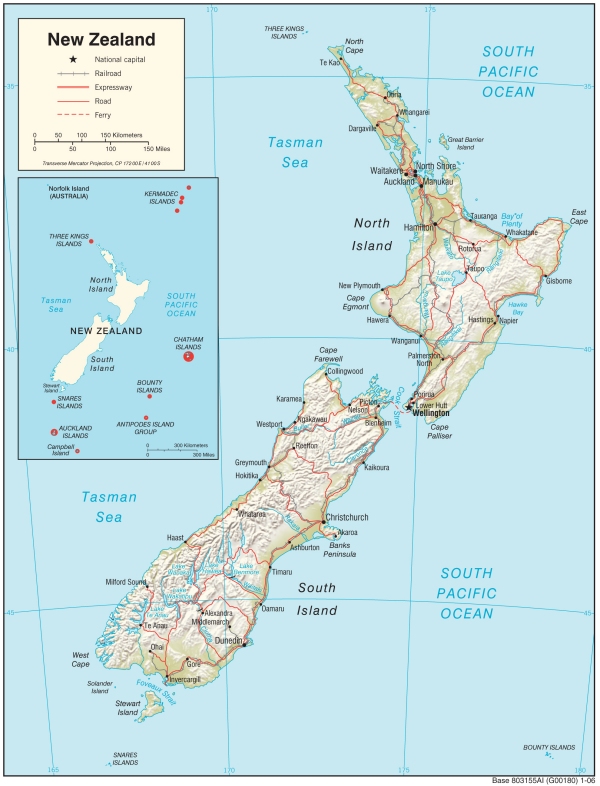
We spent St. Patrick's Day 2010 in New Zealand's capital city of Wellington. If ever there was a windier city, we haven't found it. Being in the higher latitudes and just off the Cook Strait which separates New Zealand's North and South Islands, the wind blew constantly at 40 knots in windy Wellington and no one seemed to notice. new zealand map

We drank a pint or two to celebrate the Irish at the Green Man Pub because on St. Patrick's Day ... everyone is Irish.

feck off snakes

There are some striking similarities between New Zealand and the Emerald Isle. About 20% of New Zealanders claim Irish ancestry. The drinking age is 18 in both countries. Both countries are lush and green. The populations are about equal. And like Ireland, there are no snakes in New Zealand (they're all in Australia!).


kiwi shamrocks

We spent a week in the city, walking, exploring and enjoying Wellington city. There's lots of wide open spaces and parks, loads of interesting street art, a world-class museum and a fine collection of pubs. Take a quick tour with us.

new zealand street art


civic square wellington new zealand


te papa museum in wellington new zealand


The museum was right next door to the marina and entrance was free (by donation), so we visited three times and still didn't get enough.


buzzy bee in new zealand


the beehive in wellington new zealand


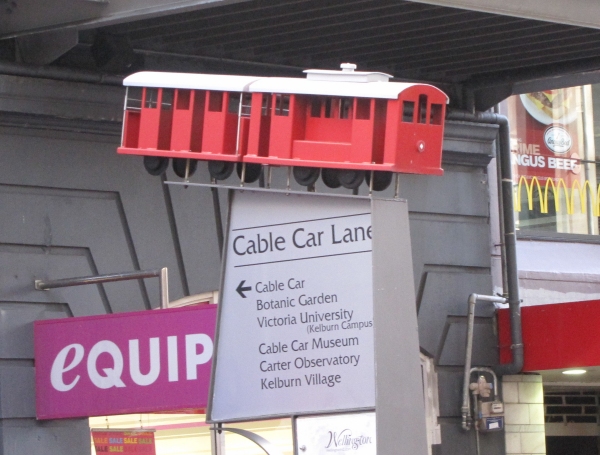
cable car in wellington new zealand


wellington new zealand botanic garden


bolton memorial park wellington new zealand

Interested in more New Zealand? We really got around. Take a look at our website.

P.S. “Feck off” is a quasi-polite, socially acceptable Irish profanity and, after all, it is St. Patrick's Day!

FAQ - Do you ever take crew aboard?

We know lots of cruisers who like having extra crew aboard, especially when they're facing a long trip ahead. For sure, having an extra mate to stand watches and help with chores during an ocean passage can be a great benefit. We know of several boats that have had excellent experiences taking on crew in local ports. We also know several that have had nightmare crews and regretted taking crew aboard. FAQ-No crew

We have only taken on crew once. It was a long passage from Ecuador to Chile via the Galapagos and Easter Island. John is a good friend and we couldn't have asked for an easier crew mate to get along with nor a more knowledgeable or helpful sailor. It was a long passage, however, with lots of days at sea and after a particularly big storm, he was ready to call it quits when we arrived in Easter Island. He was very honest about it. “This is your life and for me, it's just a one-time adventure and I'm ready to go home.” He'd had enough.

Talking with other cruisers and from our limited experience, here's some basics we'd suggest if you are considering taking on crew…

  1. Finding crew.Consider asking friends whom you know are good sailors and whom you trust to accompany you on the passage. Check out bulletin boards in local marinas … there are always ads for crew seeking passages or experience. If you're “interviewing” on line, be sure to speak to the person in advance, get a feel for them. Obviously, in person interviews are best. Get references from other captains. Are they capable and trustworthy? Remember if you're sharing your “home” and watches, you've got to be able to trust the crew, so you can sleep. There are lots of on-line crew/passage finding websites. Here's a few …crewseekers.net, www.cruisersforum.com/forum/f30, floatplan.com
  2. Personalities in sync.The best qualified person may not mesh with you and the personalities of the resident crew. A very experienced crew person may want to take over and feel it beneath him/her to do menial chores, while a more inexperienced crew member may be excited to pitch in and learn as much as possible. Weighing the pros and cons of how the new crew member will fit in with life aboard is crucial to harmony at sea.
  3. Set house rules in advance.No smoking aboard. No drinking alcohol during passages. No friends with benefits aboard, etc. Whatever your rules, state them in advance and make sure they're understood.
  4. Outline crew financial obligations.Crew usually pay for some boat expenses like their share of food, sometimes part of the fuel, etc. plus their own personal expenses as well as immigration entry fees at new ports. Who pays to get them to the next port or back home? Make sure they understand the costs involved and, more importantly, have enough money to pay.
  5. Delineate your expectations regarding duties.Do you expect them to stand night watches? What are their responsibilities regarding maintenance, repairs, cooking, sharing cleaning chores, etc. Be specific.
  6. Be aware of the immigration/maritime laws of countries you plan to visit. Taking on and letting off crew can be tricky in some countries. Some require that a bond be posted in case a crew member jumps ship. The captain is required to pay their airfare back to their country of citizenship. We know a captain who paid a hefty fare to repatriate a Russian crew member from French Polynesia to Moscow. The French weren't interested in having an indigent Russian hanging out in their paradise.


That said, the biggest problem with crew for us is that we lose our privacy. We don't usually bother to close the head doors when we go to the bathroom. We don't necessarily get dressed when we head into the galley for morning coffee. We aren't beyond skinny-dipping in tiny, secluded anchorages. I reckon we enjoy our intimacy, personal freedoms, and “us” too much to share with others for any length of time.

Have you ever taken on crew? What were your criteria and how did it turn out?