Lobstahs and Chowdah in Glos'tah

To celebrate the captain's birthday, he wanted lobster for lunch, so we decided to take a day trip to Gloucester (Yankees pronounce that Glos-tah). This entailed taking Lin to work so we could borrow her car and heading to Cape Ann on the North Shore of Boston just around rush hour. Rush hour in Boston is any time of day ... further complicated by summer tourist season. We left Lin about 8:30 am. We stopped en route only for a Dunkin Donuts coffee (America runs on Dunkin' … free coffee on your birthday) and a quick breakfast nosh. This 60 mile trek from East Walpole should have taken just over an hour. At 11am, we finally crossed the causeway leading into Gloucester. The captain drove and remained calm, patient and amiable as usual. Luckily, he is selectively hard of hearing in his right ear because the first mate groused about traffic all the way. Gloucester, by dint of its prime location on the coast, has always revolved around the maritime trades. Made famous by The Perfect Storm among other things, it's now gentrified somewhat for tourists, but still a working, commercial fishing port. We've visited many times, by land and sea, and thoroughly enjoy the whole Cape Ann area. But Gloucester, in particular, has a certain working man's allure and appeal to these sailors.

We'd done a little homework as to where we might find a good spot for lunch that we hadn't tried before and had narrowed it down to two or three places. We settled on a lobster shack kind of place on the water appropriately called the Blue Collar right in the downtown. We each ordered a bowl of New England clam chowder and split an order of twin boiled chicks (two “chicken” lobsters, i.e. lobsters weighing about 1 pound each). Blue Collar is a no-nonsense restaurant that offers only the basics: lobster, lobster rolls, chowder, peel and eat shrimp, raw oysters and corn on the cob. Everything a good Yankee needs for lunch. You can get your beer next door and walk it over. The atmosphere of the place is in its surroundings.

blue collar

The day was perfect … warm and sunny with a light breeze as we sat under colorful umbrellas at rough wooden picnic tables. The salt in the air was heaven to our senses. We miss Nine of Cups at the moment and this was a palpable reminder of her. We watched as lobster boats worked their way to the wharf below, unloading their catch. The crew of Dog & I especially caught my attention. My, my, my … toting those lobster traps and crates definitely keeps some lobstermen in fine trim.

dog and i crew

The schooner, Thomas E. Lannon, filled with tourists for a harbor cruise, slid out of her berth and past the historic Cape Pond Ice House.

thomas e lannon schooner

Sea gulls soared overhead and cried as they passed. Some followed the lobster and fishing boats in and out of the harbor; others were content with tourist leftovers and discards ashore. When we finished, there was very little remaining for the hungry gulls.

lobster is all gone

We drove a bit further along the coast for awhile then headed inland towards Ipswich and Rowley. We figured we'd end the day in fine form by stopping at the 1940s Agawam Diner for pie. Just listening to the waitress recite the list of freshly baked pies had us mesmerized … apple, cherry, pecan, blueberry, coconut cream, lemon meringue, peach, chocolate cream, pumpkin, custard, blackberry. We'd died and gone to pie heaven.

pies and coffee

Sated to capacity, we waddled back to the car, battled 2/-1/2 hours of North Shore traffic and arrived just a few minutes late to pick up Lin at work. (Oops!) It was David's birthday and the tardiness was forgiven. No, we didn't need to eat dinner … just in case you wondered … but we did slosh down a bit more wine before playing a rousing game of partners Pitch with Lin and Matt.

All in all … a fine way to celebrate another birth year past and another year beginning.

Our Top 12 Favorite Sailing Movies

Since we haven't owned a television for the past 20 years, we tend to watch lots of movies on board. We have some favorite sailing movies that we've watched over and over. They're not strictly “sailing” movies per se, but they are all sea-related. Here's a list of a dozen sailing movies we recommend … not in any particular order. We've given a short synopsis of each and why we specifically liked them. White Squall (1996)

Jeff Bridges is captain of a traditional sailing schooner used as a training vessel for teen-aged boys.

It deals with coming of age for young men in need of discipline as well as the vagaries and sometimes horrors of life at sea.

The Bounty (1984)

There are several versions of Mutiny on the Bounty, but we like this one the best with a very young Mel Gibson as Christian Fletcher and equally young Anthony Hopkins as Captain Bligh. In addition to the historical significance of this movie, having visited Pitcairn Island and met some of Fletcher's progeny, this movie held lots of interest for us.

Longitude (2000)

We thoroughly enjoyed the book by Dava Sobel (1995) so when the made-for-TV movie was released we wanted to see it. It's the story of John Harrison's obsession with creating a reliable marine chronometer in the 18th century, thereby allowing navigators to calculate longitude.

Captain Ron (1992)

Kurt Russell plays an eccentric captain who is hired to teach a family how to sail a “yacht” bequeathed to them by a long-lost uncle. It requires a large dose of “suspension of disbelief”, but is a great laugh.

Master And Commander: The Far Side Of The World (2003)

It was the novels of Patrick O'Brian and the stories of Horatio Hornblower that first inspired David to want to go to sea. This Napoleonic-era epic about a determined British naval captain in pursuit of an elusive French war ship provides lots of history, an interesting view of the tough life at sea for sailors and some thrilling sea battles.

Around Cape Horn (1980)

We first saw this documentary at the Penobscot Marine Museum in Searsport, Maine and later purchased it at the Mystic Seaport Museum in Connecticut. It's fearless Captain Irving Johnson's black and white film account of rounding Cape Horn on a square rigger in 1929. It's wonderfully entertaining and the footage is nothing short of spectacular.

All Is Lost (2013)

This movie was panned by many sailors we know, but we enjoyed it nonetheless. A solo sailor (Robert Redford) crossing the Indian Ocean in a sailboat, collides with a shipping container and uses his ingenuity to try to save the boat and himself. As we have realized time and time again, when one thing goes wrong, it all goes wrong. Yes, he made some bad decisions, but we found ourselves wondering how we would have handled all the problems he encountered.

In the Heart of the Sea (2015)

David's brother, Paul, just turned us on to this movie-version of Nathaniel Philbrick's non-fiction account of an early 19th century New England whaling ship holed by a giant whale. This account was the inspiration for Herman Melville's 1851 novel, Moby Dick. Great cinematography and a riveting story told from a different angle. Critics panned it, we liked it.

The Perfect Storm (2000)

This disaster drama/thriller movie was released just as we began our life aboard Nine of Cups. It scared the crap out of us because it proved that you just can't predict nor control Mother Nature nor Neptune. A New Bedford fishing vessel off Canadian waters and a yacht heading to the Caribbean are both caught in the collision of Hurricane Grace and an unnamed nor'easter. The weather conditions were “perfect” for the storm of the century. The Andrea Gail and all hands aboard were lost at sea. I still shudder when I see the size of the waves that capsized her.

Titanic (1997)

I know, I know … another disaster film and it's not about “sailing” on a sailboat, but we really like it. Beyond being a classic disaster/love story, the takeaway from this movie for sailors is the issue of hubris, being too sure of yourself and getting cocky. Whenever we think we've mastered some thing, we find ourselves time and time again, humbled by Neptune. The Titanic was considered “unsinkable” … Neptune didn't think so.

Cast Away (2000)

Tom Hanks is a FedX exec whose plane goes down in the Pacific and washes up on a deserted island. It's a story of perseverance, self-reliance and ingenuity. We wonder sometimes how we'd survive if Nine of Cups went down and we were forced to fend for ourselves in some desolate place. Of course, it might be harder without an ice skate, a soccer ball and a plastic porta-potty enclosure to rely upon, but then that's the challenge.

Life of Pi (2012)

Once again, we had read Yann Martel's novel first and were anxious to see how well, or even if. the movie adaptation adhered to the original story line. It was great. The story tells of Pi, a young Indian boy, who is shipwrecked and survives 227 days at sea in a life boat with his only companion, a Bengal tiger named Richard Parker. The story is captivating.

I know there are lots more that we've forgotten or omitted like all the Horatio Hornblower flicks for more sea adventure and Captain Phillips for a realistic look at piracy on today's oceans. Then there's Dead Calm and the thriller genre, and we haven't seen the latest Kon Tiki movie, but we had to whittle down the list.

So … what's tops on your list of favorite sailing/sea-related movies? Can you give us some recommendations?

Click the title or the picture and you'll be taken to the Amazon information page. All of these links are affiliate links provided for you convenience. If you purchase a movie, we get a small commission and you pay nothing extra. Win ... win!

Following are links to some of these movies if you prefer to rent or buy them through Amazon Instant Video.

White Squall

The Bounty

Captain Ron

Master And Commander

All Is Lost

In the Heart of the Sea

The Perfect Storm

Titanic

Cast Away

Life of Pi

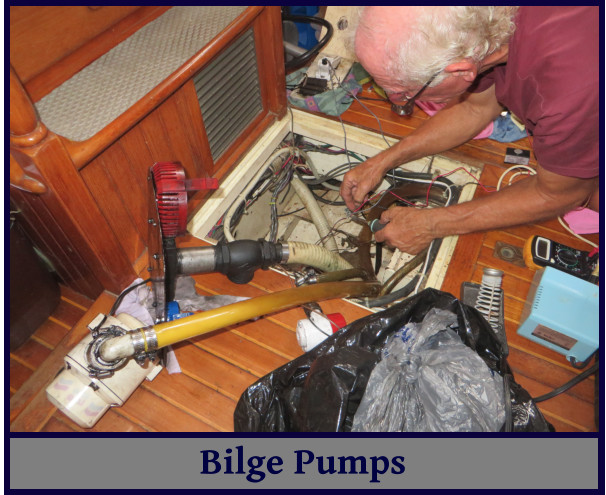
The Blue View - Bilge Pumps

bilge pump Nine of Cups has four bilge pumps in place – one electric pump with a 3700 GPH (gallon per hour) capacity, one electric with a 500 GPH capacity and two hand operated 3600 GPH pumps. And if all else fails, we have several buckets aboard. Discounting the buckets, if both electric pumps were running and Marcie and I were giving it our all at the pumps, we should, in theory, be able to pump more than 11,000 GPH, or almost 200 gallons per minute! That should handle just about anything, right?

If you've followed our blogs over the years, you may remember a few that talked about bailing water from Nine of Cups. I can recall three occasions when we were at sea and taking on water – a most distressing situation. The leaks turned out to be relatively small and easily repaired, but what was more distressing was that the combined output from three of the four bilge pumps would barely keep up with even those small leaks (Marcie was hand pumping while I tracked down the source of the leak). Had we suffered some serious hull damage, all four of the pumps would not have even come close to handling the water ingress. The best we could have hoped for was that our pumps would buy us enough time to fix the problem, get help, run Cups aground on a beach somewhere – or, sigh, get the life raft deployed and loaded.

On the other hand, our bilge pumps are adequate for routine water ingress, minor emergencies and pumping out all the collected water once the emergency has been handled. Here are my thoughts on a reasonable bilge pump system.

bilge pumps

  • Small Automatic Pump. We have a small pump (500 GPH) with an automatic switch located in the lowest part of the bilge. This pump takes care of routine water ingress. We almost always take on some water during rainstorms or from waves over the bow or into the cockpit during rough weather. A small capacity pump is desirable for this application. When a bilge pump runs, it has to pump water out of the bottom of the bilge to a height above the waterline of the boat. When the pump shuts off, all the water in the hose will eventually run back down through the pump and back into the bilge; the bigger the pump, the bigger the hose, and the more water that will make its way back into the bilge. Thus, a smaller pump with 3/4” diameter hose is preferable. It is controlled via a switch on the breaker panel and an automatic switch – see below for a discussion on automated switches.
  • Large Capacity Electric Pump. We have a large capacity (3700 GPH) electric pump located next to the small pump. It is not automatic, and is turned on via a switch on our breaker panel. This pump is used in emergencies or when more than the usual amount of water has made its way into the bilge. For example, when it's time to clean the bilge, we first use oil absorbent pads to collect any fuel or oil, then turn off both pumps and pour several gallons of fresh water mixed with an acceptable bilge cleaner into the bilge and let it set a day or so, allowing it to slosh around. Next we turn on both pumps, quickly pumping the cleaner out and cleaning the hoses at the same time.
  • Hand Operated Pump #1. This hand operated pump is permanently mounted below the cabin sole and while primarily intended for emergencies, is used more frequently than you might think. On passages, we usually turn off the automatic pump and use the hand operated pump once or twice a day to determine whether we are taking on more than the usual amount of water. By counting and tracking the number of pumps required each morning to empty the bilge, the early signs of a pending problem, like a leaking fitting, can be identified before it becomes an emergency.
  • Hand Operated Pump #2. This pump is attached to the underside of one of the cabin sole hatches, along with 15' (4.5m) of hose. In an emergency, the hose can be fed down into the bilge and the pump taken up into to cockpit and operated there.
  • Automatic Switch. I have tried a multitude of automatic bilge switches, most of which didn't work reliably. The mechanical float switches would sometimes stick, or would run the pump dry while on a heel. The automatic bilge pumps have a tendency to cycle on and off frequently as the water is pumped out of the bilge, then drains back down into the bilge from the hose. (See the further discussion below regarding non-return check valves in the discharge hose).I do like a few of the electronic sensors that detect water level by measuring the capacitance between two sensor pads. The capacitance will be different depending on whether there is air, water or fuel between the sensors, and since it can detect the difference between oil/fuel and water, the switch has been programmed to turn the pump on only when water is present. Since oil and fuel float on water, the switch will then turn the pump on only until all or most of the water is pumped out, and turn the pump off before any oil or fuel gets pumped overboard. The switch I use is the Water Witch Model 101*. One of its features is that it keeps the pump switched on for several seconds after the level of the water drops below the sensor. If the switch is mounted above the bilge pump, the pump will continue running until the water level drops well below the sensor height, so when the water left in the hose drains back into the bilge, the water level will still be well below the sensor, preventing it from cycling on and off.

water witch

  • Check Valves. A non-return check valve will prevent the water in the hose from draining back into the bilge. The ABYC allows the use of a check valve in the discharge hose of an automated bilge pump for just this purpose - to prevent the pump from cycling on and off. I'm not a big fan of check valves in bilge discharge lines. Since the bilge water often has debris in it, the check valve often becomes fouled, causing it to leak and rendering it useless.
  • Operational Feedback. Having some sort of feedback to let me know the automatic bilge pump is running is important. We have an indicator light on the alarm panel that illuminates when the pump is running. On my wish list is the addition of a cycle counter – a device that keeps track of how many times and for how long the bilge pump has turned on. An increase in the amount of time the automatic bilge pump has come on may well be an indicator of a problem that is simple to fix now, but which could be catastrophic if allowed to get worse.

alarm panel

  • High Water Alarm. We have a water activated switch located well above the normal level of water in the bilge. If the water ever rises to the level of the switch, it sets off audible and visual alarms both below deck and in the cockpit. I use a different model Water Witch switch for this application – the Model 10, which is identical to the Model 101 but without the shut-off delay. We installed it after our passage from Easter Island to Ecuador when we began taking on water and were blissfully unaware of the problem until the floorboards were almost awash with water.

So that, in a nutshell, is our bilge pump system.

BTW, I want to thank our JALF blog reader, Tony in California, for suggesting this blog. I thought I had covered the topic long ago, but neither Tony nor I could find an older Blue View on the subject. So, thanks Tony.

This is a link to the Water Witch bilge switch on Amazon. If you buy anything from Amazon using this link, it costs you no more, but we make a tiny percentage on your purchases.