
The Blue View - What Size Wire Do I Need - Pt. 2

smoking wires Last week's blog discussed one aspect of determining the correct wire size for an electrical application – how much current a wire can safely carry. Another aspect that should be considered is the amount of voltage drop that will occur.

All electrical wire has resistance, and because of this resistance, as current flows through the wire, there will be a voltage drop. The amount of voltage drop that occurs depends on three factors: the length of the wire, the amount of current flowing, and the resistance of the wire. For some non-critical circuits, like cabin lighting, a 10% voltage drop is acceptable, but for most other circuits, a 3% voltage drop is the maximum allowable. Table 1 provides the maximum allowable voltage drop, in volts, for 12 volt, 24 volt and 32 volt systems.
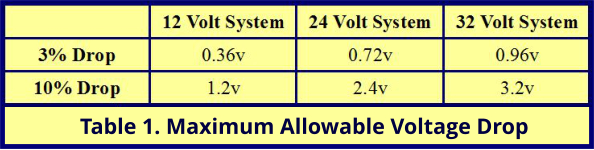
table one

The first step in determining the voltage drop is to measure the wire length. I use my tape measure and measure each section of the wire run. I always round up and add a couple feet, or half a meter, for good measure - it is better to overestimate. I measure the return wire path to DC ground as well.

The second variable, the amount of current the wire will be carrying, may or may not be simple to calculate. If the wire is used for a single device – a bilge pump for example – all that is needed is to check the label on the device or refer to the owner's manual. If there are several devices connected to the circuit, the process is more complicated and involves a worksheet and a few calculations. I will describe the process in next week's blog. For purposes of this week's blog, let's assume we have a single device being powered by our circuit.

We now have all the information necessary to determine the necessary wire size. Follow these steps:

  1. Calculate the maximum resistance per foot using the formula:

Ohms per foot = Allowable Voltage Drop / (Current in Amps x Length of wire in feet)

  1. Use Table 2 to find the wire size. Select a wire size that has a lower resistance per foot than the calculated resistance.

For example, let's say we have a 12 volt system and are adding a circuit for a new chart plotter that draws 3 amps. The round trip length of wire is 35 feet. We want no more than a 3% voltage drop in the circuit. For the equation above,

Allowable voltage drop = 0.36 volts (from Table 1)

Current in amps = 3

Wire length = 35 feet,

so the maximum resistance per foot would be 0.36v/(3amps * 35') = .0034 Ohms/foot.
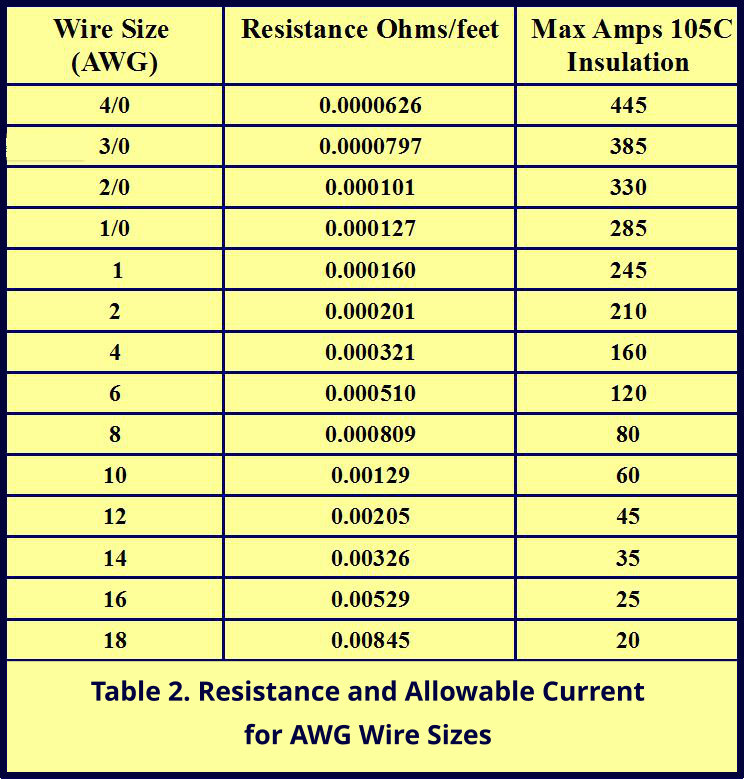
table two

Looking at Table 2, wire size AWG 14 is the smallest wire that has a resistance less than .0034 Ohms/foot. So, AWG 14 wire is the smallest wire we can use and still have a voltage drop of less than 3% for our circuit.

The last column in Table 2 lists the maximum allowable current that the various conductor sizes can handle under ideal conditions. (This should look familiar if you read last week's blog.) This value is for quality marine wire with insulation rated for 105ºC. If more than the allowable current is passed through the wire, the wire will heat up enough to melt the insulation, creating a fire hazard. If you use wire with a lower temperature rating for the insulation, the wire cannot handle the same amount of current before the insulation begins to melt. Likewise, if the wire is run through an engine compartment with a higher ambient temperature, or if several current carrying wires are bundled together, the insulation may melt with a current less than the listed maximum current.

Table 3 lists some multipliers that can be used to estimate the reduction of the maximum allowable current for different situations. These are somewhat conservative values. If more than one situation applies, the multipliers should be combined.
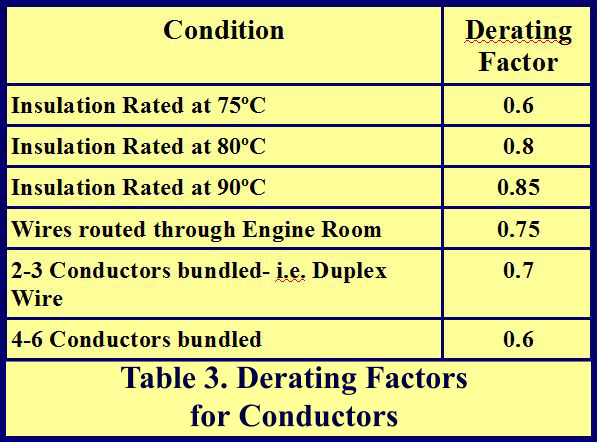
table three

For the chart plotter example, if a two-conductor duplex cable with AWG 14 wires is run from the distribution panel, through the engine compartment, and on to the new chart plotter, the maximum allowable current would be less than the 35 amps shown for AWG 14 wire in Table 2. Since the wire has two conductors, we have to derate the current capability by 0.7, and because the cable passes through the engine room, it must be derated a further 0.75. So, the AWG 14 wire will only be able to handle 35* 0.75 * 0.7 = 18 amps. The chart plotter only draws 3 amps, however, so the AWG 14 duplex wire is more than adequate.

The important thing to remember is that the wire must be adequately sized to meet both criteria; it should have an acceptable voltage drop and be large enough so as not to overheat. Most often, if a given wire size meets the first criteria, it will also meet the second, but not always, so it is important to check both.

Next week, I plan to talk about the process of calculating the total load on a circuit when there are several devices connected. Stay tuned.

Land Life in the Desert

It doesn't take long to settle back into life on land. We don't miss the long morning treks to the toilets and showers, and doing the laundry is pretty easy. Jumping in the car to head to the grocery or hardware store is a snap. Instead of boat chores, there are house chores to attend to, but they're not all that time-consuming, so we're spending our time on other things. David is studying for his Nevada Master Electrician's Exam and I'm working on our 2016 IRS returns. I've also just volunteered to be on the planning committee for an upcoming high school class reunion. On a friend's recommendation, we're looking into some free on-line courses that might be fun. All take up a considerable amount of time and we're enjoying the change of pace.

studying for master electrician course

We do appreciate the long morning walks around the Stallion Mountain Golf Course. We've got a pleasant routine of waking in the morning around 5:30, having a cuppa, checking the morning temps in Vegas and Chesapeake, reading the news (always alarming lately) and then heading out for our walk. The paved walk around the golf course is about 3.5 miles long and if we head out before sunrise, we miss the early morning golfers. I particularly enjoy seeing the local animals ... desert cottontails, herons, coots and ducks … they all seem to be waking up then, too. There's a falcon that sits in the same spot everyday, patiently waiting for an opportunity to swoop down on an unsuspecting bunny. Sometimes, we see the resident coyotes trotting along on the hillside, heading for their daytime retreat.

coyote in las vegas nevada

The views of the Strip when the early morning sun reflects off the buildings are quite beautiful. It's hard to imagine while we're enjoying the quiet and peace of our walk, that we're so close to the hustle-bustle of the Strip. It's walkable if we chose to make the trek. Heck, we can see the Linq's High Roller, currently the world's tallest Ferris wheel, from our front yard.

las vegas nevada strip view

David has planned several outdoor tasks including staining the new raised planters that he and Paul built on our last visit. Mary and Karen are looking forward to planting veggies soon. The backyard irrigation system is complete and with our newly acquired knowledge about native plants, trips to the local nursery have been on the agenda. It's like a scavenger hunt finding just the right plants to achieve our goals of beauty and color combined with low maintenance, xeriscaping and reasonable cost.

raised planter beds

We've been up making the rounds of local doctors and dentists for past-due check-ups and physicals, having lab work done and generally catching up on healthcare that we've delayed. The verdict? We're healthy … must be our crazy lifestyle.

We've taken the time to visit a few local places that we've not seen before. This year's Chinese New Year display at the Bellagio was a pleasant hour spent. Our day at the Springs Preserve was outstanding and we plan to return soon and probably buy a membership. We've revisited places we especially enjoy like the Clark County Wetlands Park, one of my favorite places in Las Vegas. We saw a roadrunner there the other day. We plan to head to the Henderson Bird Preserve one morning soon, too.

roadrunner at clark county wetlands park las vegas nevada

Added to the agenda, we've recently learned about the China Ranch Date Farm, which is only about 1-1/2 hours away. It sounds interesting, so I've put it on our local “to-see & do” list. I mean, what do we know about dates? Could be a fun, learning experience.

Yes, we're keeping busy. Land life is certainly a different kind of life than we're used to, but we're easily adaptable and, for the most part, we find it enjoyable. It's a relief not worrying about whether the anchor will drag or what the wind is going to do tonight or tomorrow. On the other hand … we've scheduled our return trip to Nine of Cups at the end of February. Can't get too used to this land life nor being anchored in the same spot for too long!

Visiting the Springs Preserve

Ever since we started coming to Las Vegas, the Springs Preserve has been on my “to-see & do” list, but we never seem to make it. The tickets are $17/pp for Seniors and about half price for resident Seniors (that's us). We, however, are Bank of America customers and the first full weekend of every month BOA sponsors “Museums on Us”, free admission to about 150 museums across the country, including the Springs Preserve. We figured it was time to visit. You can tell when you're getting close to the highway exit for the Preserve. The resident critters catch your attention and invite you in.

springs preserve sign las vegas nevada

Built around Las Vegas' original water source, the Las Vegas Springs, the Springs Preserve encompasses about 180 acres of land within sight of the Las Vegas Strip. Owned and operated by the Las Vegas Valley Water district, the Preserve is dedicated to celebrating the history and culture of the Las Vegas Valley and encouraging environmental stewardship. The sprawling facilities offer two museums, galleries, outstanding botanical gardens, interpretive walking trails and so much more … definitely more than we could absorb in a single visit.

spring preserves las vegas nevada

We began our visit at the Nevada State Museum. Christopher the Columbian Mammoth greeted us on arrival. We learned about dinosaurs and other prehistoric animals that roamed the Las Vegas Valley tens of millennia ago and we found it fascinating

springs preserve las vegas nevada

dinosaurs of las vegas nevada

We wandered through exhibit after exhibit, taking in not only sights, but sounds. From the desert animal cries of coyotes, owls hooting and rattlesnakes hissing to the sounds of miners working their claims and steam trains chugging and slot machines spilling out coins. The history of the Las Vegas Valley was recounted before our eyes … and ears.

We headed to the botanical gardens for a guided tour by the Preserve's volunteer Master Gardeners. We had a mission here. We're in the process of planning the landscaping for our backyard and are, of course, especially interested in native plants and certainly desert tolerant plants. We currently have a rather uninteresting collection of cacti, yucca and aloe in the front yard, and we are searching for a bit more variety in the back. The three tour guides were excellent. I wish we'd brought notebook and pencil, but we did the best we could with our poor memories and photos of plants that would fit well in the yard. Brochures were offered and accepted and ongoing classes and gardening events might well be in our future.

gardens at springs preserve las vegas nevada

We walked along some of the interpretive trails, listening to mockingbirds sing and watching butterflies and hummingbirds flit about. We ended up in Boomtown 1905, a new exhibit that has just opened featuring a streetscape of Las Vegas at the turn of the 20th century. We took a peek inside the bank and the Wells Fargo stagecoach then progressed down the street to the mercantile, movie theater (showing silent movies), the Arizona Club, the hotel and the train station.

boomtown springs preserve las vegas nevada

An old operating player piano was being demonstrated at the Arizona Club and the kids were thrilled to take their turns “pumping” out out WWI tunes. Several small houses lined the opposite side of the street and it was interesting to view the period furniture and furnishings.

player piano springs preserve las vegas nevada

We never made it to the Origen Museum nor did we tour the galleries nor suss out all the garden art that's placed throughout the grounds. Many trails were left unwalked. Too much to see, too little time, but there's always another day. We'd rate the Springs Preserve an “A” place to visit.