Want a date? China Ranch Date Farm

No, it's not a social media dating site. The China Ranch Date Farm actually grows, harvests and sells dates. We learned about the farm during our recent visit to the Springs Preserve and decided it would make a good day trip from Las Vegas. Located in Tecopa, California, it's a 90-mile drive along the Old Spanish Trail Highway, the old trade route between Santa Fe, NM and Los Angeles, CA. Once out of Las Vegas, we traveled through the aptly named Red Rock Canyon and over the Mountain Springs Summit (alt. 5502') and felt our ears pop. The mountaintops were snow-covered and picturesque. Snow is always more picturesque at a distance and when it doesn't require shoveling.

snow covered mountains nevada california


As we ventured further into the Mojave Desert, the landscape changed significantly. Joshua trees, sage, scrub and cacti took over the land. Houses and towns are few and far between in this area. We watched the temperature plummet from near 70F in the city to the mid-40s in the high desert. We crossed the state line into California quite unceremoniously.

We arrived at the road to China Ranch Date Farm and it seemed an unlikely place for a date palm orchard. The last two miles was a winding, steep, gravel road through surreal sandstone cliffs. Erosion has created windows on the cliff tops.

sandstone windows in california

Old gypsum mine shaft entrances were plentiful and fenced off to keep curious visitors at bay.

mine shaft in california

The date palms came into sight quite unexpectedly … a huge orchard of them. Dates hung invitingly as we wandered around and between the luxuriant palms. Bird song was everywhere. We observed two coyotes on the prowl, but they disappeared once they spied us.

So … a little date trivia. The date palm, native to northern Africa and the Middle East, first came to the US in the 1890s. They thrived in the deserts of Nevada, California and Arizona and currently, “the USA date industry produces more than 60 million pounds of fruit annually. Iraq is the world's largest producer of dates.”

date palms

Now, what about the name: China Ranch Date Farm? Well, it appears that a Chinese borax mine worker (Ah Foo ??) came to the area some time in the mid-late 1800s. He developed the water source, planted fruits and veggies and raised cattle to supply the local miners. The locals predictably called it Chinaman's Ranch. Along came a guy named Morrison c. 1900 who ran off the Chinese fellow at gunpoint and claimed the developed land as his own. The land has had many owners since and has been used for several different purposes. In 1970, the Brown-Sorrells family purchased the land and it remains in the families today.

After a stroll through the orchard, we visited the gift shop from which enticing smells were emanating.

china date ranch california

Freshly baked date bread, date muffins and cookies were on offer and several varieties of dates were available for sampling. Karen tried several and reported them all delicious. It was, however, the rather unusual date milkshake that finally lured all three of us in. Different and delicious, but filling and very, very sweet.

china ranch date farm date samples

We sat outside the gift shop at a picnic table on a small outdoor patio. Anna's hummingbirds hovered above us as we sipped our milkshakes and appreciated the warm sunshine.

anna's hummingbird china ranch date farm

The surrounding area was definitely photo-worthy.

old truck on china ranch date farm

view from china ranch date farm

There are several hiking paths and trails along the Amargosa River, but we were not prepared for a long hike, so instead we visited the ranch's “Modest Museum”. Actually, “modest” was probably too complimentary of the tiny 2-room ramshackle cabin which contained more cobwebs and spiders than photos or memorabilia. The “tour” didn't take long, but did provide a laugh or two.

modest museum at china ranch date farm

All in all, we found the day trip to China Ranch Date Farm to be a pleasant diversion. Next time, we'll be prepared for a little hiking ... to walk off the date milkshakes.

Valentine's Day 2017

happy valentines day It's Valentine's Day tomorrow and, of course, we plan to celebrate in style. Ethel M's, a local upscale chocolatier, has a botanical cactus garden that is pretty spectacular to tour during the day. Around Valentine's Day each year, they dress it up with a half million sparkling colored lights and open it to the public for night time viewing. We visited last year and decided it was worth another visit this year.

ethel m's cactus garden las vegas nevada

The night was mild and mellow. The full “Snow Moon” was obscured by the clouds. There was a sizable crowd at the gardens, but the number was not overwhelming. We strolled hand in hand along a maze of cactus-lined paths that twinkled and glowed in the darkness. Reds, pinks and purples dominated the “Lights of Love” (corny, huh?) display.

ethel m's cactus garden las vegas nevada

The use of backlighting and shadow made for interesting viewing. A new technology (at least to us) known as meteor shower lighting accounted for a fireworks effect. Dazzling brightly colored reflections danced on the walkways … candy for the senses.

ethel m's cactus garden las vegas nevada

We've made plans for an intimate, romantic dinner at Casa di Amore, a noted Italian restaurant in town that touts “Vegas the way it used to be”. Since we don't know what “Vegas used to be”, it'll all be new to us … but the reviews we read are great. We don't dine out all that often, so we're looking forward to this special occasion. How could we go wrong on Valentine's Day eating at Casa di Amore (House of Love)?

To look back at how we celebrated in years past, take a look at Valentine's Day in Australia in 2014 and Lesotho in 2015.


Hoping you're loved on Valentine's Day!

The Blue View - What Size Wire Do I Need - Pt. 2

smoking wires Last week's blog discussed one aspect of determining the correct wire size for an electrical application – how much current a wire can safely carry. Another aspect that should be considered is the amount of voltage drop that will occur.
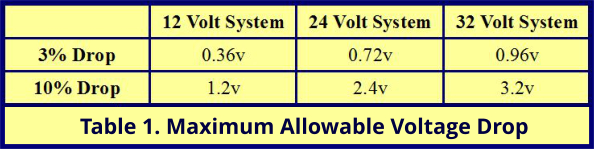
All electrical wire has resistance, and because of this resistance, as current flows through the wire, there will be a voltage drop. The amount of voltage drop that occurs depends on three factors: the length of the wire, the amount of current flowing, and the resistance of the wire. For some non-critical circuits, like cabin lighting, a 10% voltage drop is acceptable, but for most other circuits, a 3% voltage drop is the maximum allowable. Table 1 provides the maximum allowable voltage drop, in volts, for 12 volt, 24 volt and 32 volt systems.

table one

The first step in determining the voltage drop is to measure the wire length. I use my tape measure and measure each section of the wire run. I always round up and add a couple feet, or half a meter, for good measure - it is better to overestimate. I measure the return wire path to DC ground as well.

The second variable, the amount of current the wire will be carrying, may or may not be simple to calculate. If the wire is used for a single device – a bilge pump for example – all that is needed is to check the label on the device or refer to the owner's manual. If there are several devices connected to the circuit, the process is more complicated and involves a worksheet and a few calculations. I will describe the process in next week's blog. For purposes of this week's blog, let's assume we have a single device being powered by our circuit.

We now have all the information necessary to determine the necessary wire size. Follow these steps:

  1. Calculate the maximum resistance per foot using the formula:

Ohms per foot = Allowable Voltage Drop / (Current in Amps x Length of wire in feet)

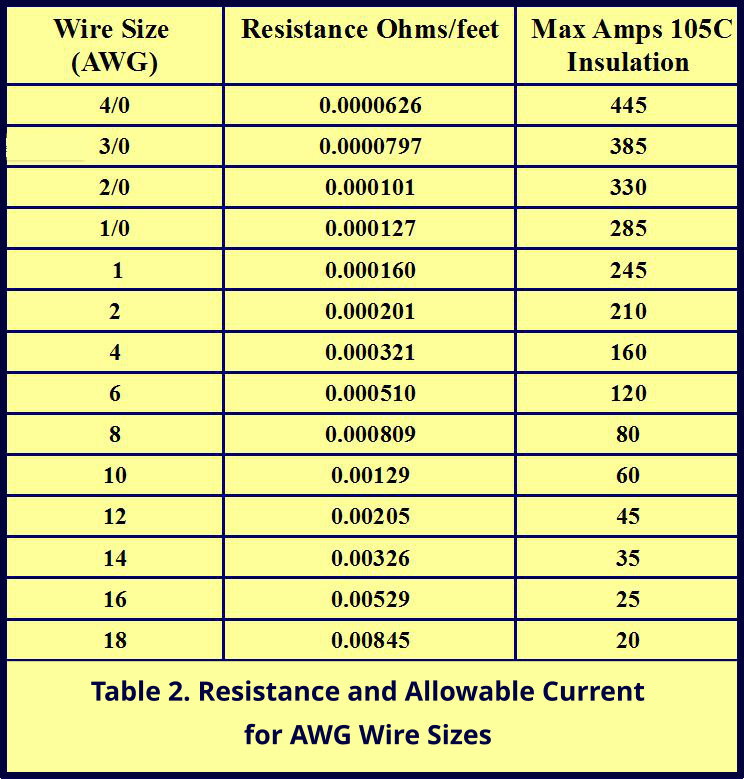
  1. Use Table 2 to find the wire size. Select a wire size that has a lower resistance per foot than the calculated resistance.

For example, let's say we have a 12 volt system and are adding a circuit for a new chart plotter that draws 3 amps. The round trip length of wire is 35 feet. We want no more than a 3% voltage drop in the circuit. For the equation above,

Allowable voltage drop = 0.36 volts (from Table 1)

Current in amps = 3

Wire length = 35 feet,

so the maximum resistance per foot would be 0.36v/(3amps * 35') = .0034 Ohms/foot.

table two

Looking at Table 2, wire size AWG 14 is the smallest wire that has a resistance less than .0034 Ohms/foot. So, AWG 14 wire is the smallest wire we can use and still have a voltage drop of less than 3% for our circuit.

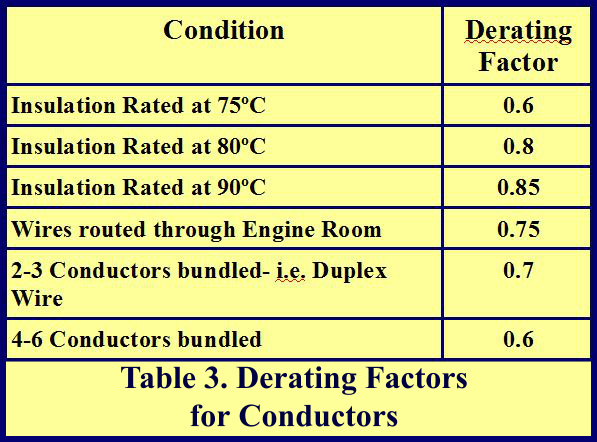
The last column in Table 2 lists the maximum allowable current that the various conductor sizes can handle under ideal conditions. (This should look familiar if you read last week's blog.) This value is for quality marine wire with insulation rated for 105ºC. If more than the allowable current is passed through the wire, the wire will heat up enough to melt the insulation, creating a fire hazard. If you use wire with a lower temperature rating for the insulation, the wire cannot handle the same amount of current before the insulation begins to melt. Likewise, if the wire is run through an engine compartment with a higher ambient temperature, or if several current carrying wires are bundled together, the insulation may melt with a current less than the listed maximum current.

Table 3 lists some multipliers that can be used to estimate the reduction of the maximum allowable current for different situations. These are somewhat conservative values. If more than one situation applies, the multipliers should be combined.

table three

For the chart plotter example, if a two-conductor duplex cable with AWG 14 wires is run from the distribution panel, through the engine compartment, and on to the new chart plotter, the maximum allowable current would be less than the 35 amps shown for AWG 14 wire in Table 2. Since the wire has two conductors, we have to derate the current capability by 0.7, and because the cable passes through the engine room, it must be derated a further 0.75. So, the AWG 14 wire will only be able to handle 35* 0.75 * 0.7 = 18 amps. The chart plotter only draws 3 amps, however, so the AWG 14 duplex wire is more than adequate.

The important thing to remember is that the wire must be adequately sized to meet both criteria; it should have an acceptable voltage drop and be large enough so as not to overheat. Most often, if a given wire size meets the first criteria, it will also meet the second, but not always, so it is important to check both.

Next week, I plan to talk about the process of calculating the total load on a circuit when there are several devices connected. Stay tuned.