Spring Planting

Spring comes early to Las Vegas … at least we're hoping it does. We've noticed the trees budding and leafing out as we take our morning walks. The temps are a bit warmer and each day is minutes longer. We're getting itchy for a change and what better way to exploit our itch than to plant a garden. We surveyed all the local places for plant availability and price. We were opting for seedlings versus seeds. Walmart had all the regular flowers and veggies. Lowes and Home Depot were a bit more expansive in their offerings and the prices were good. The local Star Nursery has slightly higher prices, but the variety, quality and knowledgeable clerks sometimes make up for the price difference. We spread the wealth and bought stuff at each place.

We started with a large ceramic planter for the front entryway. It gets direct sun and lots of it. David ran a soaker from the sprinkler system to the big new pot. We bought bright purple and yellow violas, pansies and dianthus, all of which like full sun, and filled the planter.
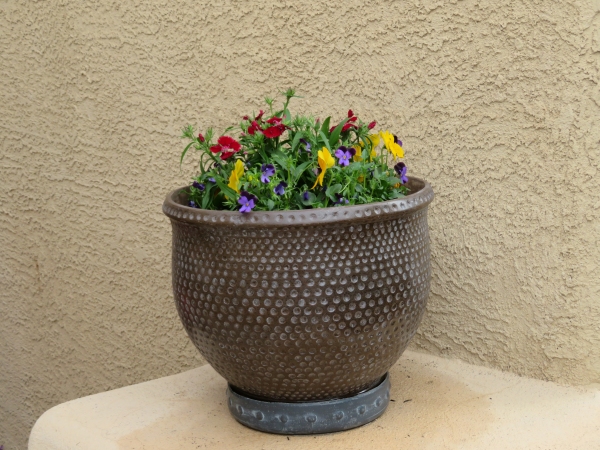
big pot of flowers in las vegas nevada

Next, we chose three lavender plants for the side entry which we've just discovered has sprinkler heads. David fixed the ones that were broken and exposed those that were buried. After rock removal and a bit of soil work, the lavenders are in and looking fine.

lavender on the side of the house

Mary is working on the new backyard raised planters. She's keen on different varieties of peppers and tomatoes and likes to experiment with new things like kale and artichoke. Herbs are key on her grow list and she chose lemon balm, lemon thyme, basil, cilantro, mint … the list goes on. We'll be a well-herbed family and she plans to use them in her summer menus.

I took to the internet to figure out how to prune cacti and succulents. The universal answer … carefully! Armed with pruning sheers and long tongs, I trimmed back our prickly pear, removing several decayed and errant pads. I doubt it had ever been pruned. The aloe and yucca were also trimmed back and the front yard is looking much improved.
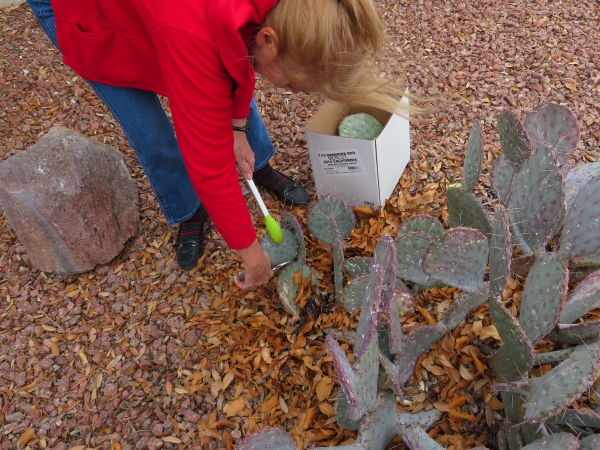
pruning prickly pears

There's still much to be done in the landscaping department. David wants to build a deck with more planters. We'd like to add a couple of trees and some shrubs and perhaps some border plants along the back wall. There's no rush. Las Vegas has four planting seasons and we'll do a little bit each time we visit. In the meantime, it was great being outdoors and initiating the rites of Spring.

Let's hope Mother Nature doesn't decide to do winter again!

Henderson Bird Viewing Preserve

henderson bird preserve nevada

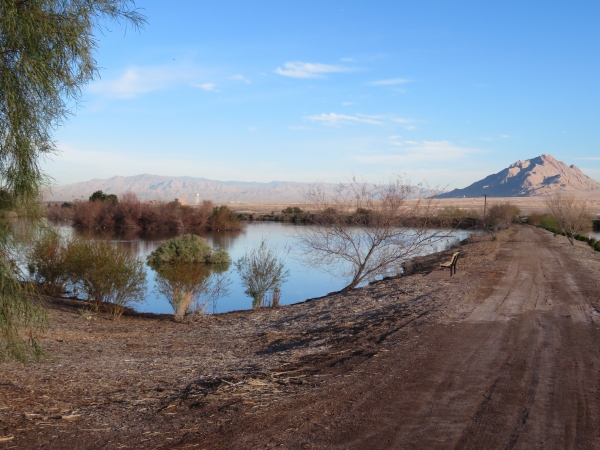
Instead of our usual morning walk around the golf course, we drove four miles to the Henderson Bird Viewing Preserve to enjoy some early morning peace, quiet and bird-watching. As I've said before, we're not “twitchers”, i.e. avid bird watchers, but we do enjoy watching and identifying birds in beautiful settings.

Located at its Water Reclamation facility, the City of Henderson has done a great job with the bird viewing preserve for nearly 20 years. Over 140 acres of land including nine ponds provide lots of safe area and nesting for residents as well as welcome rest stops for migrants and visitors. It's one of our favorite places to visit when we're in the area.

henderson preserve nevada

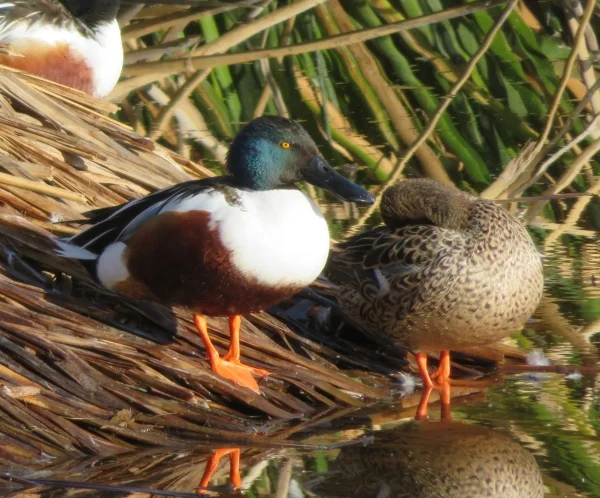
We've never spent much time at the preserve during the winter months, so we weren't sure what to expect. We were waiting at the gate when it opened at 7 am and spent over two hours walking the maze of paths around the ponds. We certainly got our 10,000 steps in without any difficulty. Of the nearly 300 species identified on the preserve's checklist, we saw only a few and most of them were waterfowl. That said, the species we saw were relatively new to us (or our memories have failed us once again). The northern shovelers were in great abundance.

northern shoveler henderson preserve nevada

...and I don't remember seeing (or ever hearing about) buffleheads before. It's a great name though.

bufflehead henderson preserve nevada

While ducks, coots, Canada geese and grebes swam peacefully on the ponds, falcons and hawks soared overhead looking for breakfast. The wary desert cottontails hid inconspicuously in the bramble and the smaller birds took refuge in the reeds and grasses along the shore. We saw one coyote prowling just outside the preserve's fence … watch out bunnies.

henderson preserve nevada

I got a kick out of the Quail Crossing sign with all the Gambel's quail milling around … obviously not jaywalkers.

quail crossing henderson preserve nevada

The place was nearly empty during our entire visit other than a few photographers trying to catch the morning's “magic light”. Hopefully, serene, beautiful places like this will continue being supported and funded by local governments and organizations, providing a great place for walks and birders and a safe haven for our avian friends. We look forward to returning on our next visit to Las Vegas.

henderson preserve nevada

The Blue View - Calculating Electrical Loads

It is usually quite simple to calculate the electrical load on a circuit. If there is only one electrical device connected to the circuit, the load is simply the amount of current the device consumes when it is running. If a circuit only powers an electric bilge pump, and the pump draws 8 amps, then this is the load. The wiring and fuse or breaker must be adequate to handle 8 amps. calculating electrical loads

If there are several devices connected to the circuit and all are often running simultaneously, then the total load can be calculated by adding up the current requirements of each device. For example, if we have an autopilot that requires 6 amps, a GPS that draws 2 amps, and a chartplotter that draws 3 amps, then the total load on the circuit would be 11 amps.

But what if we have a number of devices connected to a circuit, some of which may be on all the time and some of which are on only part of the time? Do we tally up the loads for every device and design the circuit to handle this worst case load? Do we take the average load? Maybe the average load plus a fudge factor? If we guess wrong in one direction, we will be popping breakers or blowing fuses on a regular basis. If we design the circuit for the worst case scenario, we will be spending a lot more on wiring and breakers than we probably need to.

Fortunately, the National Fire Protection Association (NFPA) as well as the American Boat and Yacht Council (ABYC) provide some guidance. The ABYC provides a worksheet developed for boats, and it is quite helpful in determining the likely total load on a circuit that has multiple devices. I've modified it slightly and show it below.

The two columns on the left side are for devices connected to the circuit that are on either continuously or for long periods of time. There are several blank lines provided, so if your boat has other devices on the circuit, add them in 'Column A'. Next enter the current required for each device in the 'Amps' column, and add these all up and enter the total in the cell labeled 'Total of Column A'.

The columns on the right are for devices that are only on occasionally. Again, add any additional devices in 'Column B' and then enter the current required for each device in the 'Amps' column. Add these all up and enter this total in the cell labeled 'Total of Column B'. Now multiply this by 0.1 and enter it in the following cell, '10% of Total of Column B (1)'.

Scan the 'Amps' column on the right side and find the largest single load. Enter this in the cell labeled 'Largest Single Item of Column B (2)'. (Not too difficult to follow so far, eh?). Enter the larger of the two values, either (1) or (2), in the applicable cell on the left side, and add it to the 'Total of Column A' cell. The resulting sum is the total load likely to be seen at any given time.

I find the process to be fairly straightforward, and much easier than, say, filling out a 1040 Tax Form.

Next week, I'll talk about circuit breakers and fuses. Stay tuned.