

Kidney Relocation - Second Anniversary
/
Burger and David, recovering from the transplant
October 15 marks the second anniversary of my spare kidney’s relocation to its new home. Burger, retired surgeon, avid pickleballer, violinist, luthier, and sailing friend, is doing great with his new kidney. And so far, the kidney seems happy with its new neighborhood.

The transplant center has been thorough about follow-up testing. For me, that meant lab work at one week, three months, six months, one year, and finally, two years after surgery. Burger, as the recipient, had a considerably more demanding schedule: weekly or biweekly nephrology or clinic visits for the first three months, tapering to every four to eight weeks, and then quarterly visits forever after. He’ll also be getting labs done monthly - key for early detection of organ rejection.
He’ll also need lifelong immunosuppressants to prevent rejection, along with medications to guard against certain infections and control post transplant diabetes, a common side effect of the immunosuppressants. Not exactly a walk in the park, but considerably better than tri-weekly trips to the dialysis center.
My second annual round of follow-up tests wasn’t without drama, however. The lab results showed elevated potassium and a creeping increase in creatinine, both of which can be warning signs of kidney trouble. My nephrologist promptly contacted me and suggested that I watch my potassium intake for a week, then repeat the tests.
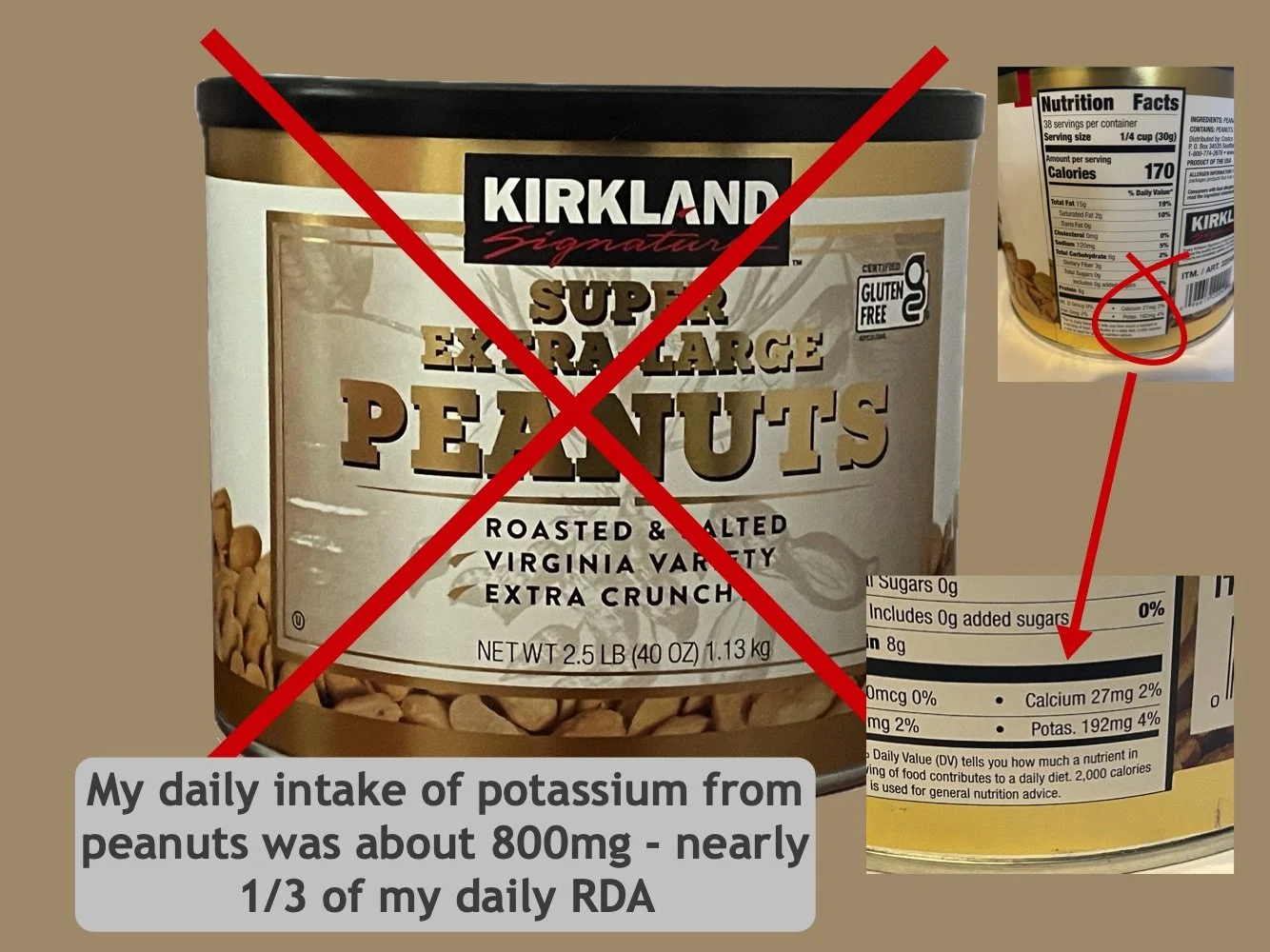
When I researched foods high in potassium, I discovered a bit of a dilemma. Many of the foods we consider healthy—including beans, fish, leafy greens, and yogurt—are also rich in potassium. Even peanuts, my go-to evening snack, made the list. And by snack, I mean a quarter-pound or so that I’d happily scarf down while reading. I cut out the peanuts for a week, and the retest showed my potassium back in the normal range.
An interesting aside: When I went in for the second blood draw, I mentioned to the phlebotomist that my previous test had shown elevated potassium. She promptly released the tourniquet and waited a few seconds before jabbing me. She explained that prolonged tourniquet use and the collection process can sometimes affect potassium measurements, particularly if blood cells rupture and release their potassium into the sample. That can produce a falsely elevated result, a phenomenon known as pseudohyperkalemia.
Then there was the creatinine. Nancy, Burger’s wife, pointed out that strenuous exercise can temporarily raise creatinine levels. Creatinine is a waste product associated with normal muscle metabolism, but after heavy exercise, as muscle tissue breaks down and rebuilds, more than the usual amount of creatine is released into the bloodstream.
Just before my original blood work, I’d been exercising hard in preparation for the climbing trip I was planning with our oldest son. I eased off the exercise before the repeat tests, and voilà, my creatinine level was back down to its lowest point since the transplant.
With that little adventure behind me, I thought you might be interested in a brief history of kidney transplantation. It’s a remarkable story of medical persistence, experimentation, and the gradual overcoming of what initially seemed like an insurmountable obstacle: the human immune system.
A Brief History of Kidney Transplants
The Early Experiments: 1900–1954
In 1902, Austrian surgeon Emerich Ullmann performed an experimental kidney transplant in a dog. It was an early demonstration that a kidney could be surgically transplanted, although the technology and medical knowledge needed to make such procedures successful in humans were still a long way off.
In 1936, Ukrainian surgeon Yurii Voronoy performed an early human kidney transplant using a kidney from a deceased donor. The organ failed, largely because the body rejected it. The operation nevertheless marked an important step in the development of transplantation.
In 1953, French surgeon Jean Hamburger and his colleagues performed a living-donor kidney transplant from a mother to her son. The kidney functioned for 22 days before being rejected.
Then came the breakthrough.
In 1954, surgeon Joseph Murray and his team at Peter Bent Brigham Hospital in Boston successfully transplanted a kidney between identical twins Ronald and Richard Herrick. Because identical twins have essentially the same genetic makeup, the recipient’s immune system was far less likely to recognize the donated kidney as foreign. The transplanted kidney functioned for eight years.
Murray later received the 1990 Nobel Prize in Physiology or Medicine for his pioneering work in organ and cell transplantation.
The Battle Against Rejection: Late 1950s–1980s
Successful transplantation between identical twins was one thing. Making it work between unrelated people was another. The immune system is designed to identify and attack foreign material. Unfortunately, a transplanted kidney looks foreign to the recipient’s immune system, which can attack and destroy it just as it would an invading organism.
Early efforts to suppress this response included total-body irradiation and the use of corticosteroids. During the late 1950s and early 1960s, these approaches helped make transplants between non-identical siblings and other donors possible, although rejection remained a major problem.
In 1962, the introduction of azathioprine, an immunosuppressive drug, in combination with corticosteroids helped make successful kidney transplants from deceased, unrelated donors a practical reality.
A further breakthrough came with cyclosporine, a drug that selectively suppresses important immune responses. Developed through research in the 1970s and introduced into clinical practice in the early 1980s, cyclosporine dramatically improved transplant success rates.
With better surgical techniques, improved tissue matching, more effective medications, and closer monitoring, kidney transplantation became an increasingly reliable treatment for patients with kidney failure.
One Million Transplants and Counting
In 2022, the United States reached a remarkable milestone: one million cumulative organ transplants. Kidneys account for the largest share of those procedures.
That’s amazing - in 1954, doctors were celebrating a kidney transplant between identical twins. Today, transplantation offers thousands of people each year a chance at a longer, healthier life.
On our two-year anniversary, Burger is doing well; my remaining kidney is holding its own, and the transplant team seems satisfied with the results. I’d say the kidney relocation was a success. The only casualty so far has been my evening peanut habit.