

How Route 66 Got Its Name
/
Had events unfolded just a bit differently, America's most famous highway might have followed another route entirely—or carried a number like U.S. 60 or U.S. 62. Somehow, I doubt Bobby Troup's song would have been quite as catchy if it had been called (Get Your Kicks on) Route 62.
How U.S. 66 got its name is actually one of the more interesting—and surprisingly little-known—chapters in Route 66 history. Here's how it happened.
A New Way to Number Highways
Before the 1920s, most long-distance roads had names rather than numbers. Organizations promoted routes such as the Lincoln Highway, National Old Trails Road, and Dixie Highway, but these named trails didn’t always connect from state to state, followed inconsistent alignments, and could leave travelers scratching their heads.
In 1925, the federal government and the states agreed to create a standardized U.S. Highway System using numbered routes. The basic rules were simple:
Even-numbered highways generally ran east-west.
Odd-numbered highways generally ran north-south.
The most important routes would end in 0 or 1.
Lower numbers would be assigned to highways in the north and east, while higher numbers would be used farther south and west.
For example, U.S. 2 became the northernmost transcontinental route, while U.S. 1 hugged the East Coast.
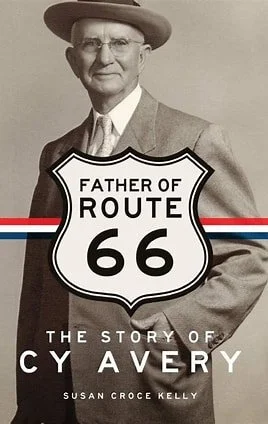
Meet Cy Avery
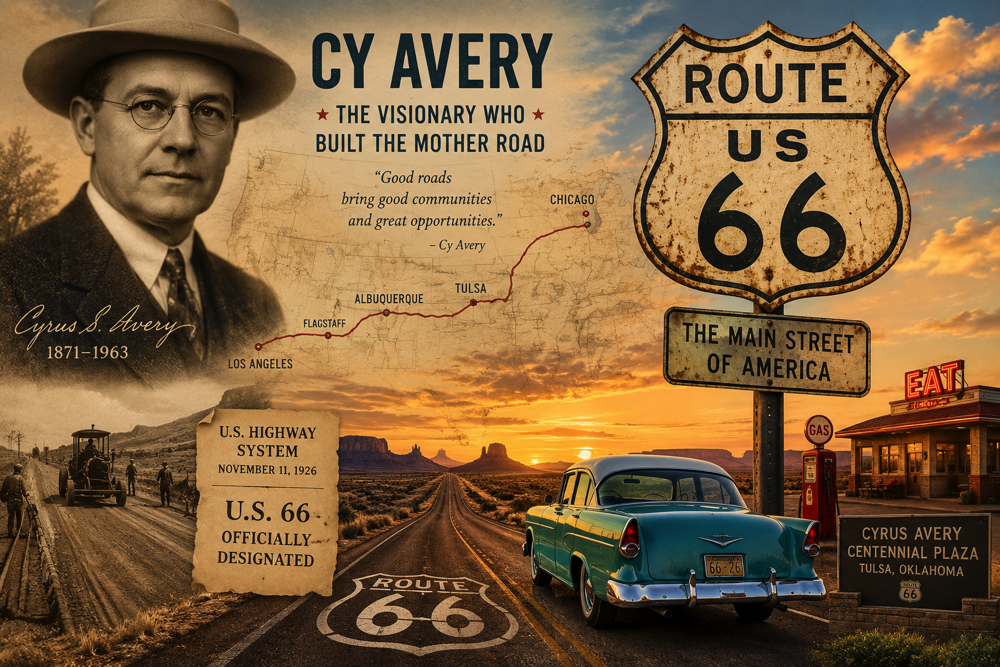
Cyrus Stevens Avery was born in Pennsylvania in 1871, but his family headed west by covered wagon while he was still a boy. By the time automobiles began replacing horses, Avery had settled in Tulsa, Oklahoma, where he became a successful businessman involved in real estate, banking, ranching, and the oil industry.
As automobiles became more common, Avery realized that roads weren't simply a convenience for motorists—they were economic engines. Paved highways allowed farmers to reach markets, businesses to ship goods more efficiently, and travelers to explore places they'd never seen before. Communities that had once been isolated suddenly found themselves connected to the rest of the country.
That insight led Avery onto highway commissions and national planning committees, where he became one of America's strongest advocates for a modern highway system. It also made him the driving force behind the highway that eventually became Route 66.
Avery envisioned a major diagonal highway linking Chicago and Los Angeles while passing through the rapidly growing communities of Missouri, Kansas, Oklahoma, Texas, New Mexico, Arizona, and California.
Ironically, he never intended to call it U.S. 66.
Believing it would become one of the nation's premier highways, Avery proposed naming it U.S. 60. The Executive Committee responsible for assigning highway numbers agreed, and submitted it to the Federal Bureau of Public Roads for approval.
Avery was so confident the designation would become official that Oklahoma began producing hundreds of U.S. 60 road signs and promotional brochures. Missouri went even further, printing approximately 600,000 official highway maps showing the Chicago-to-Los Angeles route as U.S. 60.
Unfortunately, someone else wanted that number.
Kentucky Upsets the Apple Cart
Kentucky objected because every neighboring Mississippi Valley state had been assigned a prestigious "0" highway—except Kentucky. And as luck would have it, 60 was the only available "0" number left.
Governor William Fields personally lobbied federal officials, arguing that Kentucky deserved a major highway ending in zero. Federal highway chief Thomas MacDonald eventually agreed. Without consulting the Executive Committee, he proposed taking 60 away from Avery's highway and renumbering it 62 instead.
Avery was furious.
He immediately fired off a sharply worded telegram protesting the decision. He argued that changing the number without notifying the Executive Committee was making "a joke of the interstate highway." He concluded with the blunt declaration: "We shall insist on Route Sixty from Chicago to Los Angeles."
The language was surprisingly blunt for government correspondence in 1926, and didn’t endear him to the highway chief. MacDonald replied that Kentucky would receive U.S. 60 despite Avery's objections.
An Unexpected Solution
On April 30, 1926, Avery met with highway engineers from Missouri and Oklahoma to discuss their options.
During the meeting, Oklahoma Chief Highway Engineer John M. Page noticed that 66 had not yet been assigned to any highway. Avery immediately recognized it was a much better alternative than 62.
The three men wired Washington with one of the shortest—and most consequential—telegrams in highway history: "We prefer sixty six to sixty two."
That single sentence essentially gave birth to the name Route 66. On November 11, 1926, the highway was officially designated U.S. Highway 66 as part of the original U.S. Highway System.
Some historians believe Avery immediately recognized that 66 was memorable, easy to pronounce, visually appealing on road signs, and/or ideal for promotion. Given his remarkable talent as a marketer, that's certainly believable.
Others think he simply considered it the least objectionable alternative to Route 62. Either way, history worked out rather well.
A Final Thought
For years I assumed Bobby Troup wrote (Get Your Kicks on) Route 66 around the same time the television series aired. I was surprised to discover the song was actually written in 1946 and first recorded that year by Nat King Cole.
Since then it has been recorded by hundreds of artists, including The Rolling Stones, Chuck Berry, Ray Charles, Ella Fitzgerald, Bing Crosby, Bob Dylan, Tom Petty, The Manhattan Transfer, and many more.
And One Final, Final Thought
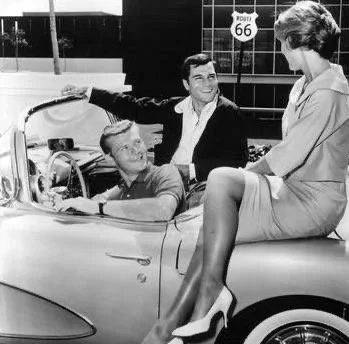
I'm old enough to remember the television series Route 66, which aired from 1960 to 1964 and starred Martin Milner and George Maharis. They played two young men having grand adventures as they traveled the Mother Road in a Chevrolet Corvette.
The show did require just a little suspension of disbelief, however.
I always wondered where they got the money to buy a brand-new Corvette every year, how they managed to travel continuously for four years without ever holding a real job, and—most puzzling of all—how they fit everything they needed for years on the road into the tiny trunk of a Corvette.
Marcie and I require more luggage than that for a one-week roadtrip.