Visiting Boys’ Town Nebraska

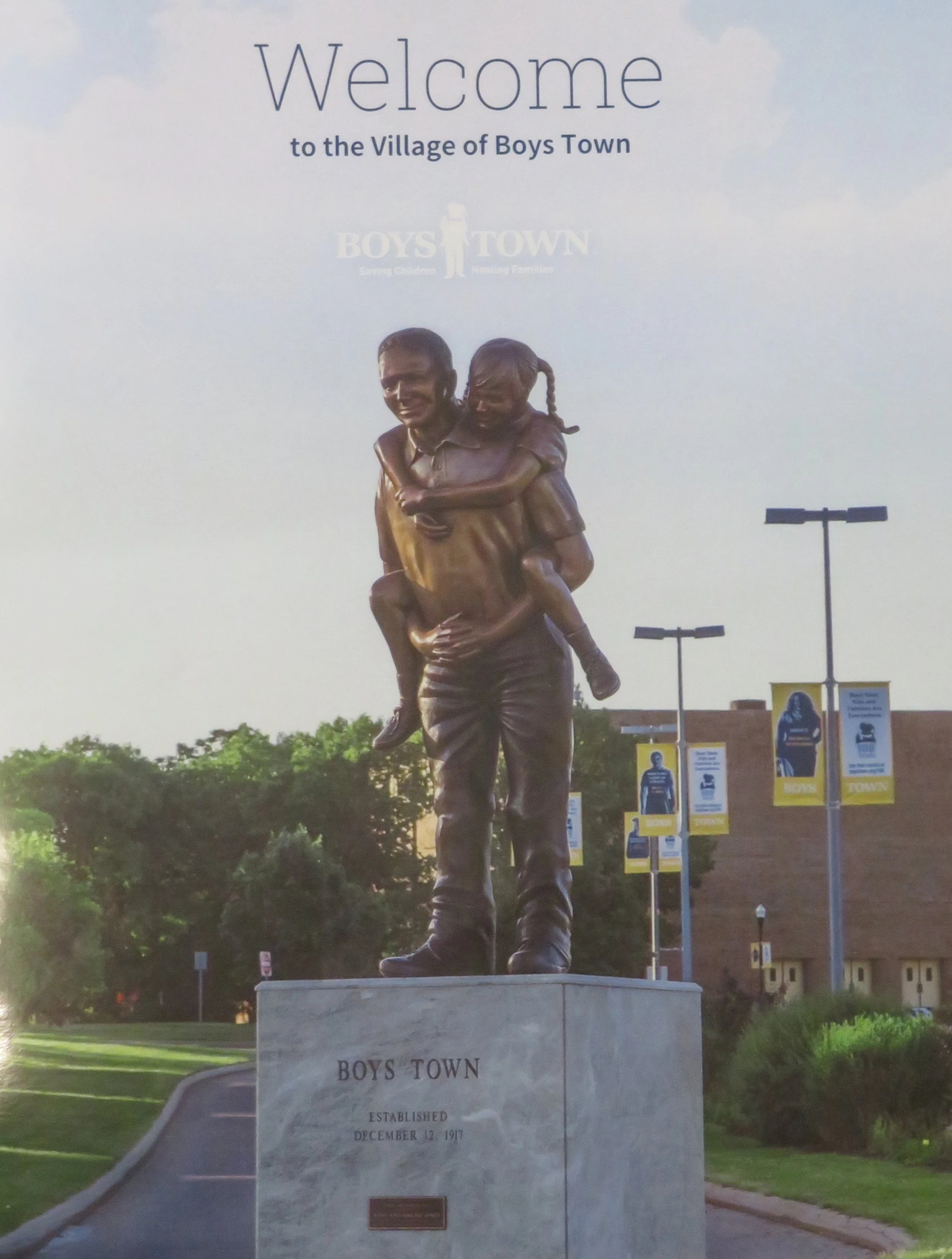
The entrance to Boys’ Town. The statue is a recurring theme throughout the village: ‘He ain’t heavy…he’s my brother.’ (or since 1979, my sister)

As we headed east on our US-6 adventure a month ago, we passed Boys' Town, just west of Omaha, Nebraska. The sign flashed by, and I immediately googled Boys' Town to learn more about it. I’d watched the 1938 Academy Award-winning movie ‘Boys' Town’ with Spencer Tracy and Mickey Rooney many years ago, but I guess I never really thought about the ‘real’ place. Once we finished US-6 in Des Moines, it was only a few more miles to Omaha, and we decided to visit Boys' Town this time. I have to admit the initial driving force for the visit was ‘the World’s Largest Ball of Stamps’ on the premises.

It was cold, raw, gray, and windy as we entered the Visitor Center, aka Leon Myers Stamp Center. Based on its name, I thought this was a philatelic shop, i.e., a stamp store for postage stamp collectors. Nope, it wasn’t that at all. Crissa greeted us warmly and provided in-depth information about Boys' Town, its history, maps, and a great overview of sites to visit while we were there. She explained the reason for the World’s Largest Ball of Stamps. First things first, however, before I rattle on (and on), a little history of Boys' Town taken directly from one of their brochures.

Leon Myers Visitors’ Center at Boys’ Town

“In 1917, a young Irish priest named Father Edward J. Flanagan had grown discouraged in his work with homeless men in Omaha, Nebraska. He decided he could do so much more to prevent the damage he saw in these men if he started helping the boys he saw living in the streets of the city. On December 12, 1917, with $90 he borrowed from a friend, Father Flanagan rented a boardinghouse in downtown Omaha and opened his first home for boys.”

Father Flanagan’s first Boys’ Home - a boarding house in downtown Omaha

When a public outcry complained vigorously that Father Flanagan’s Boys’ Home accepted boys of different races and religions, all of whom lived together, he opted to move his boys. In 1921, with the help of benefactors and raised funds, he purchased the 160-acre Overlook Farm on the outskirts of Omaha for $100,000 with the hope of developing it into a self-sustaining community for his boys. It is here that Boys’ Town flourishes today. The Village of Boys’ Town became an incorporated town in 1936 with its own government, police, fire department, schools, and post office. A note: The Catholic Church gave no money, no assistance to Father Flanigan. All money received was from donation and proceeds from activities generated by Boys’ Town.

From a boardinghouse to Overlook Farm

In 1985, Boys’ Town became a National Historic Landmark and as such has its own page on the US National Parks website. It is recognized as “a historic site that honors Father Flanagan's pioneering efforts in child care, making it a significant destination for history and social justice enthusiasts.”

Now… back to that giant ball of stamps. Father Flanagan liked to keep his boys busy. You know that old proverb... "Idleness is the devil's workshop". Beyond chores, school, and sports, he encouraged hobbies, one of which was stamp collecting. “In 1953, it was D.O. Barrett, the first curator of the Boys Town Stamp Center, along with the Boys’ Town Stamp Collecting Club, who used a golf ball as a core and covered it with donated stamps and seals. It began as a fun project for a stamp show and grew over time into the massive, record-holding attraction it is today.”

In addition to the stamps, Boys’ Town has an outstanding collection of baseball cards on display, including some of the greats… Babe Ruth, Mickey Mantle, Willy Mays, Whitey Ford, and so many more.

Collecting baseball cards was another Boys’ Town hobby and they’ve got quite the collection.

With directions from Crissa and a map in hand, we took the self-guided driving tour of the campus past a sports center, beautiful homes that house parents, and several boys or girls. Girls were included in the mix beginning in 1979. At any given time, there are ~400 kids in residence. Kids who come here range in age from 5-17 and come because they have been abused, abandoned, neglected, traumatized, have difficult family situations, or have behavioral issues, or any combination of the above. The success stories are impressive and heartwarming.

We stopped at the Hall of History, a museum of the history of Boys’ Town and its evolution from its humble beginnings as a boarding house into what it has become today. The museum is incredibly good, with well-curated exhibits explaining how the town was developed and all aspects of life in Boys’ Town. Take a look at some of the exhibits we enjoyed.

Last on our self-guided tour was a visit to Dowd Chapel and Father Flanagan’s tomb. “Dowd Chapel was dedicated in 1941, built with funds from Marie Dowd of New York City to honor her family, serving as a spiritual center for the boys and a place where Father Flanagan connected with them, and it also houses his final resting place, emphasizing the importance of faith in the organization's mission.” It’s a beautiful chapel with luminous stained glass windows providing that mystical quality one feels in churches.

Dowd Chapel is much more than a simple chapel.

Dowd Chapel adorned for the nativity season

The Reuter organ in Dowd Chapel at Boys Town is quite the instrument. It’s awesomely impressive with its four keyboards (manuals) and 5,000 pipes. I wish we could have heard it playing while we were there, but then being alone in the chapel and enjoying the peace and beauty of the place had its own rewards.

Dowd Chapel’s 5,000 pipe Reuter organ with a background of glorious stained glass windows

A carillon system, originally installed during the chapel's construction in 1941, had been out of commission since the 1980s and was recently repaired. The bells toll every hour and ring the Angelus (a call to prayer) at 6 a.m., noon, and 6 p.m. The new digital system also allows the carillon to play Christmas music and other special pieces throughout the year.

We left feeling uplifted. So much more than a glimpse at a giant ball of stamps! With all the problems in the world pervading the news, it was inspiring and encouraging to see how compassion, understanding, and hard work can make such a difference in so many people’s lives.

There are no admission fees at all in Boys' Town for any of the several places we stopped. We drove around freely on our little self-guided tour. Leaving a donation is optional, but geez, why wouldn’t you?

Next time, we’re off to Concordia, Kansas, to view a very different kind of train museum. You’ll be surprised!