The Blue View - International Electrical Connections

I was planning to give an update on the chainplate progress, but there hasn't been much progress to write about. The chainplates themselves have been cut, drilled and polished, and are sitting in Dave's office waiting for the carpenter to make the cuts on the cap and rub rails. He was supposed to come last week, but was delayed because of another project. He did arrive around 10am on  Monday of this week (he doesn't like to start too early), got all unpacked and set up, made several measurements, and discussed the plan with me. We figured out the optimal angles, measured the sections to be cut – twice – then he plugged in his saw and turned it on and … nothing. typical marina connection

As is typical in most marinas the world over, an electrical connection is never made by plugging an extension cord directly into an outlet. It almost always requires an adapter or two at the shore power end. Here in South Africa, since there are two different plug sizes commonly used for appliances and tools, it gets more complicated. Our carpenter had two adapters between the extension cord and the shore power outlet, then two more adapters between the extension cord and the power strip that his saw was plugged into. Apparently, there was a short somewhere in the system, because we discovered that as soon as everything was plugged into the shore power outlet, the GFCI breaker would open.

It took about 45 minutes to find and correct the problem (saltwater inside one connector of the extension cord) before he was able to start cutting. He will spend most of today and tomorrow making the cuts and fabricating backing pads, and I'll write about that in the next blog.

bag of connectors

Meanwhile, I thought I'd talk about the various adapters we've collected for connecting to shore power around the world.  Just for starters, the USA uses three connector types for shore power: 15A/125v, 30A/125v and 50A/125v. We have no need for the 50 amp version, but we do carry a couple of cords and adapters with connectors for the 15 amp and 30 amp circuits. These also work in most countries other than the USA that use 110-125 volts.

us connectors

Once we started cruising in the countries that use 220v/50 hz power, our adapter collection started growing. We must have encountered 10 or 12 different connector types. Initially, we would try to find an adapter that we could use to connect our American shore cable to the local shore power circuit, but these were often hard to locate and expensive. We now use a 10A/220 volt, 30m (100')  outdoor extension cord. I removed one end and replaced it with a connector that mates with our American shore power cable. The other end is removed as needed and replaced with the local connector. My inventory of connectors is pretty extensive now, and I often have one that will work in each new country, but if not, I make a quick trip to the local hardware or electrical supplier to get what I need.

internationl connectors

Converting the 220 volt/50hz shore power to our 120v/60hz world is a whole other topic for another blog.

The Blue View - Chainplate Update

We are making some progress on the new chainplates. Now that the metal has been cut, the machinist  came down to look at Nine of Cups and take some measurements. Sort of like “Ready, Fire, Aim...” in my mind. There was some initial angst when we thought the chainplates had been cut too short, but after talking it through with the shipwright and with Dave, we all agreed the newly cut metal would work. will the metal work

The marine architect made an appearance as well. He did the original design based on photos, assuring us that he knew the boat quite well and that a trip to the yacht club to actually look at Cups was unnecessary. This was borne out, as you may remember, when his first iteration of the design was totally incorrect, having the chainplates bolted to the bulwark and into the core of the deck. We had a discussion, now moot since the metal was already cut, about how the chainplates might have been designed to look less industrial and more aesthetically pleasing. He gave us several less than compelling reasons why this wasn't done, such as “it would have added extra weight to the boat” (two pounds in extra metal would make a difference on our 21 ton boat?), “designs that bolted the chainplates into the bulwark wouldn't be as strong” (not something I was suggesting, and anyway, wasn't that exactly the way he first designed it???), blah, blah, blah … We weren't really impressed.

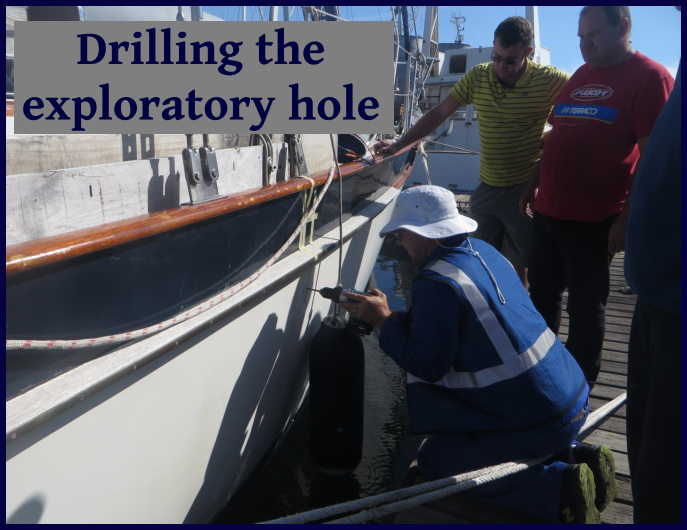
exploratory hole

The shipwright came shortly after, and following much measuring and discussion, he drilled a small exploratory hole through the hull to determine how thick it was and where the bolts would protrude into the interior. When the bit came into contact with the old chainplate, water started running out of the hole – maybe  a teaspoon or two. If water had made it that far into the hull, approximately two feet down from the cap rail, it was almost certain that the old chainplates would be suffering from crevice corrosion – more confirmation that we were doing the right thing. Another small hole was drilled alongside the chainplate, and no water came out, some assurance, at least, that the water ingress was confined to the column alongside the chainplate.

water in the hull

We are now waiting for the machinist to drill the holes in the chainplates and polish the stainless steel to a mirror finish, after which the hull drilling and cutting will begin in earnest. I sound quite negative, but in actuality, I am still optimistic that the project will turn out fine.

Stay tuned...

The Blue View - Chainplate Issues

The typical lifetime of the standing rigging on a sailboat is 10-15 years, while the typical lifetime for the chainplates is 20 years. We replaced the rigging in Colombia about 13 years ago, so it is now due to be redone. The chainplates, however, were never replaced, and are now well past their “use by” date. They are totally fiberglassed into the hull, making a thorough inspection impossible without removing a lot of interior  cabinetry and grinding out large sections of the hull. I routinely inspect the exposed portions, and while they never showed the least sign of internal corrosion or water ingress, I knew we were sailing on borrowed time. crevice corrosion

A few days ago, when I was doing our pre-passage rigging check, I noticed a salty, vinegar-smelling substance coming from the chainplate cover on one of the starboard shrouds – not a good sign. There was no doubt in my mind that it was now time to replace the old chainplates, and since the rigging was nearing the end of its life, I decided to replace it as well. In addition, if we were going to get everything done before our South African visas and the customs permit on the boat expired, we would have to hire the work out instead of doing it ourselves. This was going to be an expensive few weeks.

refit chainplate

Because it was not feasible to remove and replace the old chainplates, my plan was to attach stainless straps to the outside of the hull. Holes would be drilled all the way through the hull and the old chainplates, and the straps attached to the hull using bolts secured on the inside with nuts and washers. I've seen this done on another Liberty 458, as well as several similarly designed boats. If the straps are polished, the bolt heads countersunk flush, and the carpentry done right, the end result is, hopefully, not only be strong, but attractive as well.

Cape Town is a great place to get boat work done. They have an active boat building business, and there are hundreds, if not thousands, of local boats, as well as many more boats passing through, all of which support a number of skilled marine tradesmen. Once the decision was made to replace the chainplates, I wanted the advice of experts to make sure I did it right. I talked with the local marine services expert, who quickly contacted a marine architect (to evaluate and design the chainplates), a rigger (to  replace the standing rig), a stainless steel fabricator (to make the chainplates), a marine carpenter (to modify the cap rail, rub rail and interior cabinetry with minimal damage), and a shipwright (who will be drilling the holes). With all these experts, what could possibly go wrong?

Photos were taken and sent to the marine architect, and the various experts conferred with each other. A few days later, Dave, who owns the marine services company called to say the plans were done and the quote prepared. If I came by and signed off on it, we could get started. I checked the quote and the drawings, and thought the price was quite reasonable. But then I noticed there weren't enough chainplates in the quote – we need eight and there were only six in the quote. Dave thought about it, made a trip down to Nine of Cups, and agreed that the quote was wrong. He said he would get it redone and get back to me.

The next day Dave called again and said the quote was revised. I stopped into his office and looked everything over. The price, as expected, had gone up because of the added chainplates. In South Africa, as well as most of the world outside the U.S., everything is done in metric. I'm used to seeing things in millimeters and centimeters, but I still have to convert a dimension to feet and inches to get a feel for the size. While I was checking the drawings, I saw that they were 350mm long, and mentally estimated that that would be equivalent to about 13-14 inches. This just didn't seem long enough to me, so I asked for a copy of the drawing to take to the boat and make some rough measurements, just to convince myself everything was right. Sure enough, the chainplates were too short. Some of the bolts would have passed through the bulwarks instead of the hull, and two holes in each chainplate would have been drilled right into the deck.

Dave apologized again, and conferred with the marine architect who lengthened the chainplates and reworked the drawings. The new quote was considerably higher, and had yet another problem. The fourth quote appeared correct, but was just about double the first quote - not so reasonable anymore. I signed off on it and the stainless fabricator was given the go-ahead.

carpenter delivers the news

That was Thursday. Friday was a holiday, and on Saturday the carpenter stopped by. I told him about the lengthened straps, and he pointed out yet another problem. The hull has a small step just under the rub rail. It isn't obvious because the rub rail hides it. If the chainplates are lengthened, we will need a spacer behind each chainplate, which may or may not be a problem. Dave will need to check with the marine architect on Monday, and hopefully, the machinist hasn't started on the chainplates in case there is another change needed.

Other than that, everything is going just fine.