The Blue View - Rigging Replacement

We last replaced our standing rigging – all those wires that hold up the mast – in Colombia and Panama in 2002 and 2003. That time, I bought two big coils of wire and a box full of Sta-lok connectors and replaced each shroud and stay over a period of a couple of months. I remember doing the backstays and cap shrouds while at anchor in Cartagena. The intermediates and lowers were replaced in the San Blas Islands, with Kuna Indians watching from their dugout canoes. The forestay, with our Harken furler, was too long and difficult to manage on-deck, so we found an old dilapidated jetty up the Chagres River in the midst of a thick, dense jungle in Panama. We dropped a stern anchor and nosed up to the jetty, which was just long enough to stretch out the forestay. Instead of Indians, it was howler monkeys who watched and offered advice as I worked on it. stalok

Now, that the rigging is reaching the end of its life and since all the rigging has to be moved from the old chainplates to the new ones, it seemed like a good time to replace it. I had planned to do it myself once again, which would have required a week or so, but with our visas running out, it would have been very tight time-wise. (Of course, there is also the fact that not only is the wire thirteen years older, so am I, and the thought of going up and down the mast 10-20 times doesn't seem that attractive anymore). We decided to splurge a bit and hire out the hard parts. The riggers would do the backstays, cap shrouds and furlers, and I would do the lower and intermediate shrouds. We should be able to complete everything in a day or two.

rigging graphic


furler

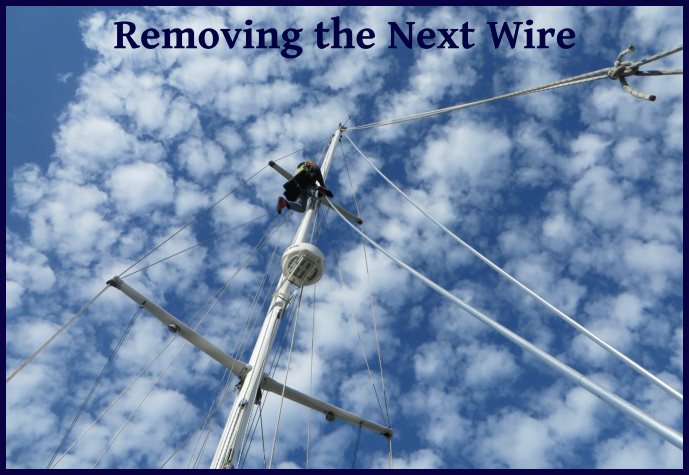
That was the plan, anyway. The rigger and two apprentices showed up a couple days ago, and other than two lower shrouds, they did pretty much everything. I kept busy polishing toggles and moving them from the old chainplates to the new ones. Four guys working on the rigging is a lot like the road construction sites we often drive by – three of us spend most of our time standing around watching the fourth guy do some work up the mast. Once a wire is removed, there is a short flurry of activity while the other three cut the new wire and move the connectors, then we all stand around watching the fourth guy reattach it and remove the next wire.
waiting

forestay

It took the four of us two and a half days to complete the job. Not the most efficient use of manpower, but labor in South Africa is inexpensive, and as they say, “everyone needs a job”. It was a lot faster than me doing it myself, plus I like to think the savings in the ibuprofen I would have needed every night went a long ways towards the cost difference.
The Blue View - Finished at Last

finished chainplates  

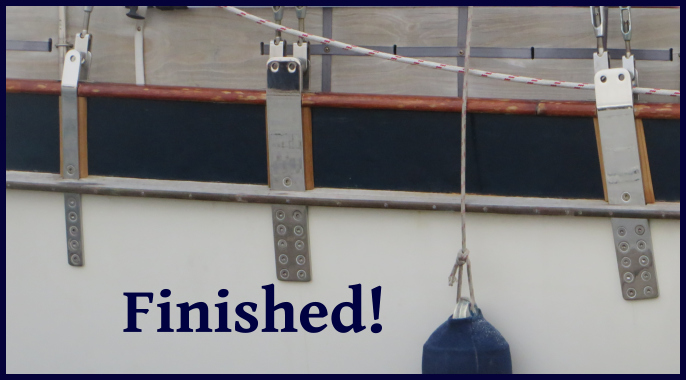
We were getting quite used to being able to check out our surroundings with a glance through any of the 68 new holes in the hull, and were beginning to appreciate the added ventilation they provided, but alas, all good things must come to an end,. The chainplates are now firmly bolted in place and each hole has its own 1/2” bolt, nut, washer and enough Sika to keep the ocean on the outside. The chainplate project is now complete.

The last few days have been busy. Each chainplate required two bends, one to conform to the hull shape and one to match the angle of the shrouds. This necessitated that each chainplate be bolted on so that the first angle could be measured, then removed and taken to the machinist to make the first bend. Then the process was repeated with all eight chainplates for the second bend. All in all, a time consuming process.

bent chainplate

The next step was to bolt them back in place and shape the teak pads that act as spacers between the chainplates and the bulwarks. This took me the better part of two days – a lot of sanding was required.

teak spacers

Then the chainplates were removed once more. Every time they were handled new scratches appeared on the surface of the stainless, and the bending process introduced tool and stress marks, so they were sent out for a final polishing.

There was another slight complication with the bolts. They had to be ordered in, and the choice was either too short or too long. Not a tough decision, but it meant all the bolts had to be cut off and dressed. Since the hull thickness varied from about 1” to more than 2”, the length of each bolt  varied as well. It took another half day to figure out how long each bolt needed to be and cut them to length.

The last step was to apply Sika bedding compound around the holes, put the chainplates in place and bolt each one down. The objective was to make sure the chainplates were stronger than the wire shrouds and stays they were holding, and I am quite convinced this goal was met. And it looks about as good as having eight steel straps bolted to the outside of the hull can look.

interior

The interior finish work will have to wait until another port, but other than that, the interior of Nine of Cups is back together and everything is stowed. Tomorrow, we start replacing the rigging. More to come...

The Blue View - Chainplate Update

We are finally making some progress on the chainplates, although it has been one step backwards for each two slow steps forward. The most recent setback was when I discovered, after the stainless for the chainplates was all cut, drilled and polished, that the metal for the backstays was the wrong thickness – 3/8” (10mm) instead of 1/2” (12mm). We will lose another week while they are redone. wrong size backstays

There are two bends that need to be made in each chainplate, but determining the location of each bend has to wait until the part is attached to the hull. Once attached, the precise location and angle of the first bend can be measured and marked, then the chainplate must be removed and taken back to the machinist to be bent. Next the parts will be reattached to the hull, the second bend measured and marked, and again sent to the shop to be bent. All this has to wait until the holes have been drilled in the hull.

chainplate attachment

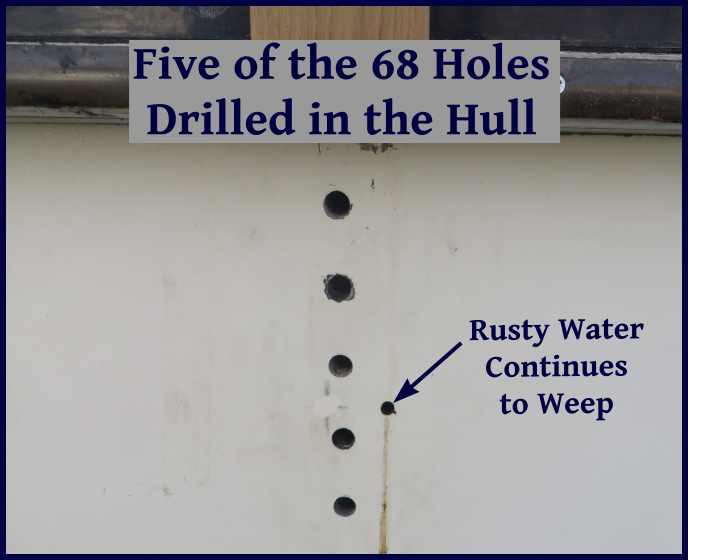
Most of the holes in the hull have now been drilled, which was a major undertaking. A total of 68 holes needed to be drilled, most of which pass not only through the hull, but the old stainless chainplates as well. All but eight of these have been drilled, and these remaining holes will wait until the first bend is made and the chainplates reattached. One thing we noticed as the holes were drilled was that rust colored water continues to seep out from the old chainplates – continued confirmation that we are doing the right thing here and didn't wait any longer.

holes in the hull

The exterior carpentry is done. The last phase was fabricating and attaching the teak spacers to the hull, and this has now been completed.

attaching the teak spacers

The interior cutouts have all been made, luckily, except for one in the forward berth, they are all inside bookshelves or lockers. I used my Ryobi version of the Fein tool to make the cuts. I will make teak pieces to cover the holes – a few in the next few days with the teak I have on hand and some later when I can get  less expensive teak elsewhere. I want to be able to easily remove the hole covers later so that the new chainplates and bolts can be inspected periodically.

interior cuts

Progress is being made, although painfully slow. Maybe another week until the project is complete – assuming no more major setbacks. Using Marcie's project formula, it'll be another two weeks.