
The Blue View - Replacing the Fuel Tanks

BVFuelTanks Intro

When we bought Nine of Cups in 2000, we hired a marine surveyor to do a complete survey on our new home. He noted that our fuel tanks were constructed of black iron, and while there were no leaks at the time, this type of tank had a usual lifetime of about 20 years. Since Cups was then 14 years old, we probably had a few more years left in them before we started to see any leaks, but we knew it was something we should be expecting. Sure enough, in 2006 our starboard tank started leaking.

We were in Ecuador at the time, and the local boat repair expert assured us it could be successfully patched. We gave it a try, but the patch only lasted long enough to get us well offshore before the tank started leaking again.

A few months later when we returned to Ecuador, I decided to replace it with an epoxy tank. I cut access panels in the cabin sole, cut the top off the old tank and removed the baffles, then constructed a new epoxy tank. It fit well and has been doing its job with nary a leak ever since, but it was a lot of work and took about 4 times longer to build than I expected – not all that atypical of most of my projects actually.

Then in 2007, the port tanks started leaking. We put the project off until we were in Ecuador again, this time in Puerto Amistad near Manta. There was a steel fabricator not too far away who made tanks for the fishing fleet out of Manta and who came highly recommended. We decided to have them made by him rather than building it out of epoxy.

cutting the sole

I started by removing the saloon table and cutting out sections of the teak and holly sole. I borrowed a Fein tool, making it possible for even me to make reasonably straight, accurate cuts.
dressed

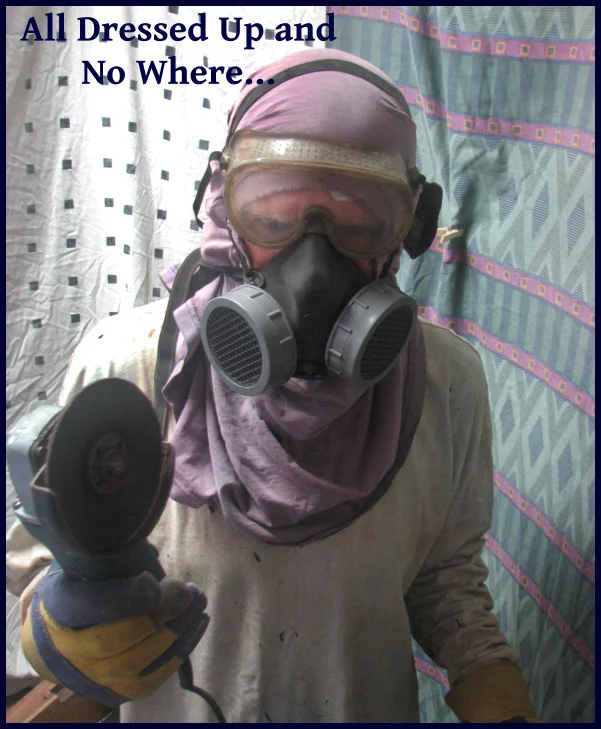
Next, I used a grinder with a cutting blade to cut the top off the old tank. This was a messy job, with sparks flying everywhere. I draped the entire area with old sheets and tarps, wore a respirator, eye protection, and enough clothing to avoid most of the burns. Once the top was cut off, I climbed inside the tank and cut the old baffles out – another messy, unpleasant job. Once I crawled back out of the tank and confirmed that I still had my nose and all ten fingers, I cleaned up the mess and hauled all the debris ashore.

The next task was to measure for the new tanks. It would have been nice to make one big tank that would fit into the old tank, but the size of the tank was limited by what would fit down through the hatch. Apparently, the original tanks were constructed and fitted before the decks were put in place.

In order to maximize fuel capacity, I decided to build three tanks, each of which would fit through the saloon hatch. The plan was to slide the new tanks into the old tank, bolt them in place, then plumb them all together. I spent several hours wiggling around inside the old tank making measurements. Then I sat at the Nav desk and sketched the three tanks.

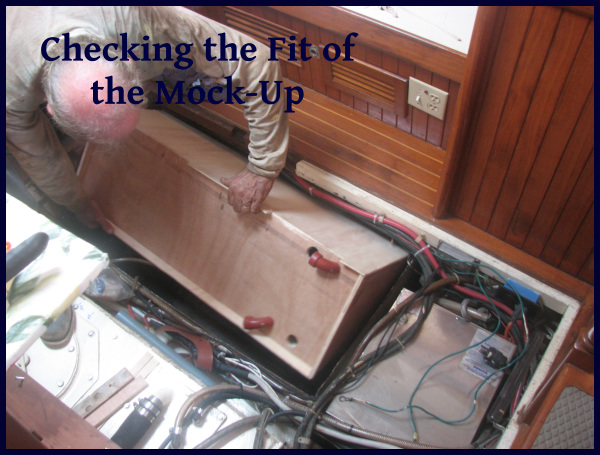
Once the sketches were done and checked, I had a dilemma. Could I trust my measurements and sketches enough to hand them over to the fabricator or should I build models of the tanks to be sure they actually fit and to check for any mistakes? Given my propensity for mistakes and the possibility that the fabricator would misinterpret some aspect of the sketches, this was a no-brainer – I decided to build plywood mock-ups of the tanks.

making the mock ups

The local lumberyard (almacén de maderas) was happy to deliver a few sheets of 1/4” plywood, I had plenty of epoxy, glue-gun sticks and screws on hand, and Puerto Amistad, the yacht club we were renting a mooring from, was kind enough to let me use some space in a fenced area to work in. I found plastic plumbing fittings at the local hardware store (ferreteria). I transported all my supplies and tools ashore, and began building the mock-ups.
checking the fit

Under different circumstances, I'm sure this phase would have gone quicker, but given the equatorial heat, the ongoing discussions with the other sailors who wondered what the hell I was doing, and who were full of suggestions on how I might do it better, and the close proximity of the cool, air-conditioned bar, it took longer than I planned to build the mock-ups. In total, I spent three days building and checking the fit of the tanks, then another day tweaking them all to correct a few errors and miscalculations. In retrospect, however, making the mock-ups was worth doing since I would have had to send the tanks back for reworking had I not made the models.

As we've said so many times before “Nothing's ever easy on a boat.” I'll talk about testing and installing the new tanks in Part 2 of this blog. Stay tuned.

Go to Part 2 of Replacing Fuel Tanks

The Blue View - A County Fair, Tasmania Style

The Huon Show Marcie and I were reviewing some old photos for a project we were working on and came across a folder of photos and video clips we took at the Huon Show in Tasmania a few years ago. A 'show' in Tasmania is much like a county fair in the U.S. There are livestock exhibitions, baking contests, food booths, a carnival and a whole lot more. We enjoyed it all, but our favorite part was the axemen competitions – contests between lumberjacks.

It was a delightful day, and we put together this video. Hope you enjoy!

The Blue View - Keeping Bugs Out of the Fuel

clogged filter Fifteen years ago, when Marcie and I first started cruising, we met Doug and his wife Fay, aboard his sailboat, Nip and Tuck. Doug is probably the most laid back guy I know, and possesses an immense amount of knowledge about fuels, engines and boats in general. We immediately became fast friends, and we've connected in half a dozen exotic places around the world.

He lives in Florida now, and spent some time with us aboard Nine of Cups while were in St. Augustine. We had an opportunity to get caught up and talk about a host of subjects. One of our topics was the new low sulfur diesel fuels and its effect on marine engines. I asked whether he would be interested in doing a guest blog for us on the subject, and he graciously agreed. Here it is:

Just over a decade ago, the soot produced by the combustion of diesel fuel was one of the largest contributors to air pollution in the U.S. In 2006, in an effort to improve air quality, the government mandated reduction of sulfur in diesel fuel and petroleum refiners geared up to produce ULSD (Ultra Low Sulphur Diesel). ULSD fuel has less than 15 ppm (parts per million) sulfur as compared to 500 ppm sulfur of the previous diesel. ULSD was introduced slowly and by 2014, it was the only diesel fuel available to us in the USA. ULSD, in a nutshell, is a cleaner diesel fuel. There is little argument that the fuel available today reduces exhaust emissions and dramatically improves air quality. (As a side note, marine and off-road diesel fuel, as well as heating oil are all ULSD, and is dyed red.)

The new fuel has a few negatives associated with it, however. To produce ULSD, a new process called hydrocracking was added to the refining of the fuel. During the hydrocracking process the demulsibility, i.e. the diesel fuel's ability to allow water to fall to the bottom of the tank, has been reduced, so there exists a situation where some water is encapsulated or entrained into the fuel. Also the natural lubricant quality of the sulfur has been greatly reduced which causes additional wear on injector pumps and injectors.

clogged filter

In addition, sulfur was also a natural biocide which helped reduce bacterial and fungal growth in diesel fuel. Many mariners do not realize that hydrocarbon-eating bacteria exist and flourish in a wet environment and can clog filters, shutting down your engine - usually at the most inopportune time. The bacteria thrive in tank bottom water, as well as condensate and feed on the fuel, leaving behind a very black, slippery effluent.

Marine diesel tanks are particularly susceptible to water and moisture contamination. Boats are often used seasonally, so diesel fuel sits in the tanks gathering moisture and condensation in what is already a very moist environment. Fuel tank vents, which are usually vented outside the hull, easily gather moisture as the diesel fuel expands and contracts with temperature changes. Air is forced out of the tank as the air gets warmer during the day and the fuel expands, then is drawn back in at night as the fuel cools and contracts. In addition, as the engine is running and fuel is being used, moist air is constantly being drawn into the tanks.

One other issue associated with ULSD is that hydrocracking refineries can now convert residual grades of crude, e.g. asphalt and #4 and #6 bunker fuels, into #2 diesel fuel used in boats, trucks and locomotives. This technology became necessary as the demand for #2 diesel fuel became higher than the available supply. The petroleum companies needed a way to produce more #2 diesel fuel and found it through hydrocracking. Unfortunately, there is asphalt fallout in the #2 diesel fuel that is called asphaltene. Asphaltene shows up in #2 diesel fuel at times and looks very similar to the black slippery effluent created by bio-contamination. The only way to differentiate between the two types of contamination is by testing.

Here are some suggestions for long term care and maintenance of diesel fuel and tanks.

  1. Keep your diesel tanks full if possible. This reduces the air space in the tank where moisture can form.
  2. Check deck fill pipes to insure the rubber “O” ring or gasket is in good condition. It does not hurt to apply Vasoline to the “O” ring or gasket to keep it pliable. Replace if cracked or hard.

fuel cleaning system

  1. Clean your tanks regularly to insure there is no water or sludge on the bottom for your pump to pick up and carry to filters. You can hire a service to do this or make your own fuel polishing system.
  2. Check to see if you have a water separating system on your vessel. RACOR makes a great water separator/filter. Check the micron size of your filter. Finding a filter with a 5 to 10 micron absolute rating is best. Always keep extra filters on your vessel. Service your fuel system regularly. Some of the microscopic encapsulated or entrained water in ULSD will pass through a fuel filter, which is why tighter filtration is always better.
  3. The primary issue today with ULSD is water. Using an additive to help reduce water in your fuel is very important. Power Service “Fuel Power” is a very good product that I have experience with and is readily available at most auto parts stores. There are a lot of products available that tout they are excellent. Read reviews and check them out before purchasing.
  4. Test your diesel fuel annually to see if you have any microbial contamination. This is a simple process that anyone can do. I use “Liqui-Cult” test kits. They are inexpensive and will tell you if you have any “bugs” in your fuel. Liqui-Cult test kits are available from several sources on the internet.

biobar stabil

  1. If your fuel tests positive for microbial contamination, make sure any water in your tanks is removed. Treat your fuel with a biocide. Sta-Bil and BioBor are both good biocides. They are dual phase, meaning they work in water, as well as the fuel.

foreign fuel

  1. Some of the fuel purchased out of the USA is not filtered and can create an issue to a sailor in a foreign port. It is easy to pick up a small 12 volt pump and a filter housing so you can filter fuel carried in deck tanks or, with the right fittings, connect to the supplier's fuel hose and filter the fuel going into your tanks. It might slow down the fuel delivery process but I would rather do that than be sitting on the water somewhere with clogged fuel filters.

Prevention through active maintenance is always better than sitting with a dead engine waiting on a tow boat.

W. Douglas Grimm STLE CLS OMA-1 was formally an ASE mechanic and Hazmat Supervisor. He has spent more than four decades in the petroleum industry testing fuel and lubricants as well as managing a large tank cleaning crew – generally ensuring that the fuel tanks of his hundreds of corporate customers were tested and cleaned and any sediment was properly disposed of according to EPA regulations. He's also been a boat owner for 30 years doing all his own maintenance.

Doug can be contacted at Capt.grimsley@yahoo.com

Below are Amazon links provided for your convenience. These are affiliate links, so if you buy these products or anything else from Amazon through these links we get a little cash back at no extra cost to you. Thank You!