The Wonders of Travel

Ibn battuta

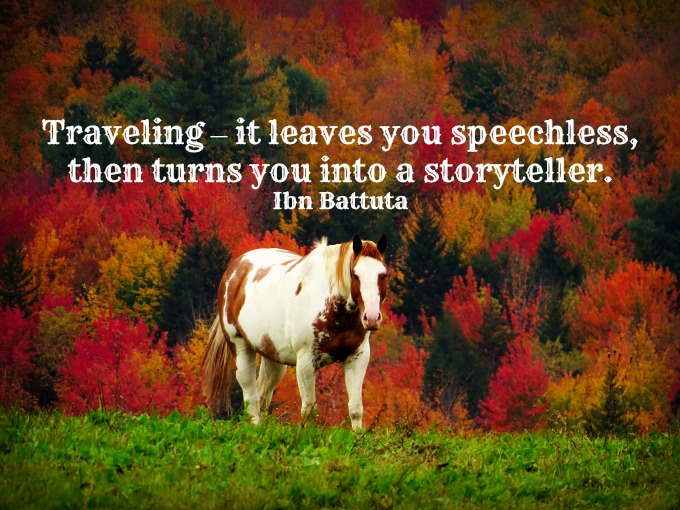
"Traveling - It leaves you speechless, then turns you into a storyteller" - Ibn Battuta

Okay, first of all you're asking, “who the heck is Ibn Battuta, did I spell his name wrong (Ibn?), what does he have to do with traveling, and why do I care?” Ibn Battuta, was a medieval Muslim/Berber traveler and scholar, who is widely recognized as one of the greatest travelers of all time.” He traveled more extensively and for longer than Marco Polo, a contemporary. Considering the challenges of the time, he certainly got around. He was one of the earliest travelers with a documented case of a travel bug bite.

Some things don't change over time. It's the same for us traveling in the 21st century as it was for Battuta back in the 14th century, except we have a GPS and a Lonely Planet. We are many times left speechless by what we see and experience. The view of the morning mist clearing to reveal Machu Picchu below us while we perched above at Huayna Picchu is forever etched in our memories.
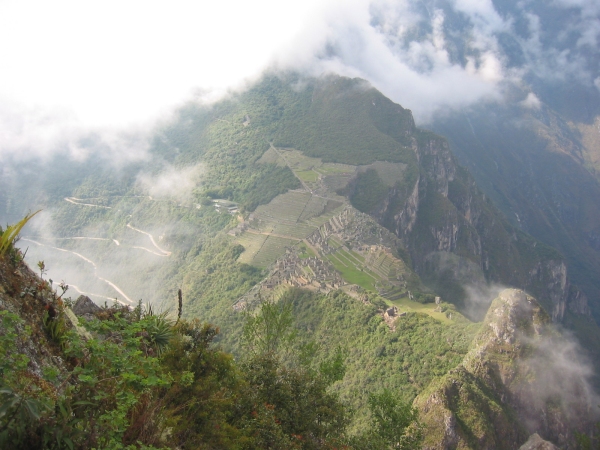
view of macchu picchu

Standing on the edge of the active Mount Yasur Volcano in Tanna, Vanuatu, feeling the ground tremble beneath our feet and the fiery heat on our faces as it erupted, smelling the strong sulphur fumes, watching boulders being spewed into the sky … that took our breaths away.
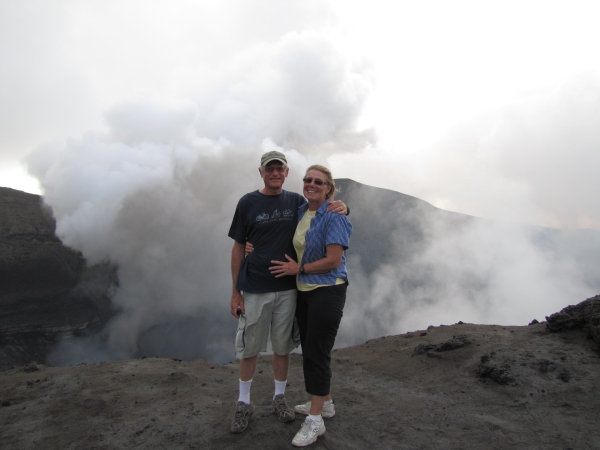
volcano at vanuatu

We're just as likely, however, to be speechless when we see a pod of dolphins or a gorgeous sunrise or sunset at sea or the leaves changing color in my native New England. No matter how many times we see everyday occurrences, we're enthralled all over again.

sunrise at waldegrave

And then comes the storytelling … to anyone who will listen. How can you experience such wondrous, astonishing, incredible things in the world and not want to talk about them and share them? On his deathbed, Marco Polo reputedly said “I did not write half of what I saw, for I knew I would not be believed”. Our storytelling is done through our website and daily blog. We've also done lots of seminars and presentations … from yacht clubs to schools to assisted living facilities. If folks are interested, we'll talk their ears off. We travel, we experience, we share and relive each experience all over again.

I wrote once, “Part of the pleasure I derive from living on a boat and traveling around the world comes from documenting and sharing the adventure. Granted, I’m just as apt to write about bugs, Vegemite and vinegar as I am to extol the splendors of Tahiti or Machu Picchu, but still, irrespective of the subject, I seem to be driven to get it down on “paper” and share it.

Thanks for traveling with us and listening to our stories.

#TBT - Stewart Island, New Zealand

Way at the bottom of New Zealand's South Island lies Stewart Island, about 18nm across the Foveaux Strait from the mainland. We had just spent over a month in rugged, isolated Fjordland National Park and rounded Southeast Cape, #2 of our great southern cape adventures. We were looking forward to all we'd heard about the magic of Stewart Island and we weren't disappointed. This blog was written before JALF was ever conceived, so I'm sharing an old SailBlog with you. stewart island map

Feb 2011 – Chased by lion!

Waterlily Bay, Port Pegasus, Stewart Island

We spent the morning chatting with the folks on "Dingo" while David & Jim fixed their outboard motor. It was an absolutely beautiful day with bright sunshine and a clear blue sky. In the afternoon, we decided we'd move Cups to the North Arm of Pegasus Bay and chose Waterlily Bay as our destination...an all-weather anchorage with a cool name. This little anchorage is absolutely stunning. Once again, we lucked out and a sturdy hawser was strung across the head of the bay to be used as a stern tie-up. A lot of kelp here, but no waterlilies in Waterlily Bay that we could find.

Exploring by dinghy, we scooted across the bay to Smuggler's Cove. A fissure in granite slightly wider than the dinghy led back about 50 feet to a tiny sand-beach grotto. The entrance is so narrow that the waves built up coming in and we had to fend ourselves off the rocky sides with our oars and then got a big push up onto the beach. Not much inside...dark and very cool out of the sunshine and most unusual...quite eerie in fact. The thick rain forest had formed a canopy overhead so it seemed more like a cave. Getting back out was a bit of challenge to overcome the incoming waves, but we managed and headed out around a small point up into Basin Creek. Since it was low tide, we made it about half way before it became too shallow. We tied up the dinghy to an exposed rock and immediately began digging for clams. It was thick with them buried in the low-tide sand and we had a bucket in no time.

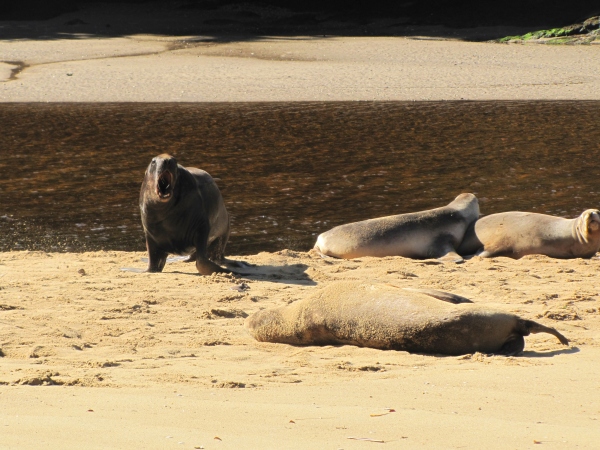
TBT-Stewart Island bull

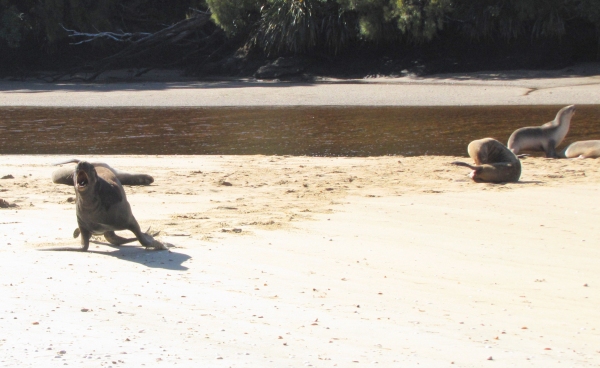
As we dug, we could hear roaring. Really, it sounded like a pride of lions at the head of the creek, but we could see nothing. Clam digging complete, we walked further up the creek, the rocky sides now exposed by the low tide. Lolling on the beach before us were about eight large fur seals. Some were sleeping; some rolling in the sand; others apparently at play. A huge bull spotted us and took his responsibility to protect the harem very seriously. With an ear-shattering roar, he charged in our direction, moving amazingly fast for such a large creature. David raised his arms and began clapping, a trick we learned in Antarctica to keep the sea lions at bay. This worked for about a minute. Actually the bull looked somewhat confused (maybe a-mused), then he resumed his charge. David repeated the clapping and the bull stopped once again. We weren't that close actually and didn't feel all that threatened since we thought we could probably outrun a half-ton seal on land...even at our age. As we slowly backed away, the bull would charge, David would clap and finally we evidently passed an invisible territorial border. The bull gave another roar and a snort and pretty much swaggered, as best as fur seals can, back to his women, shouting his own praises all the way. He's probably still regaling them with his brave acts of courage this morning over breakfast.

TBT_Stewart Island bull1

Read more about Stewart Island and New Zealand on our website.

Gentry is encouraging me to complete my e-book about our New Zealand sailing adventures. Look for it late this year or early 2017. Really!

Februaries Past - Looking Back

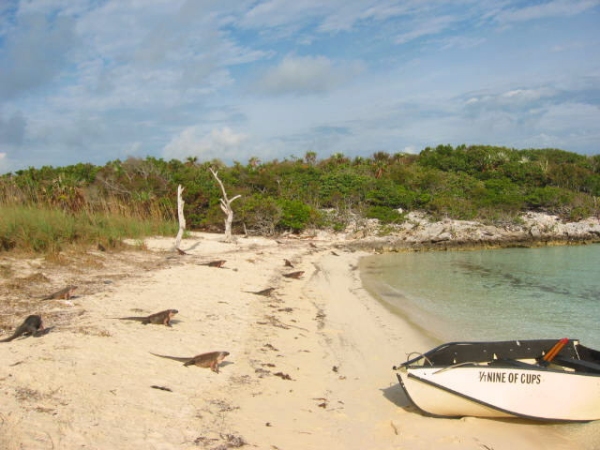
We enjoy looking back at where we were at this time of year in years past. At our age, we're sometimes surprised that we actually visited some of the places pictured. Really? We went there and did that? Hmm. Must be; we've got photos to prove it. Despite our slow travel philosophy, we're also amazed at how much distance we cover. Here's a look back at our February travels over the years. In February 2000, we had just “met” Nine of Cups (not her name then), for the first time and made an offer to buy her. We sailed across the Gulf of Mexico and up the US East Coast and completed our first “foreign” check-in in the Berry Islands, Bahamas in February 2001. There was lots of dragon-slaying along the way. When we returned to the Bahamas in February 2002, we were headed for the Caribbean.

baham exuma islands bahamas

February 2003 found us anchored in the Islas Las Aves, en route from Puerto la Cruz, Venezuela to Bonaire.

islas las aves

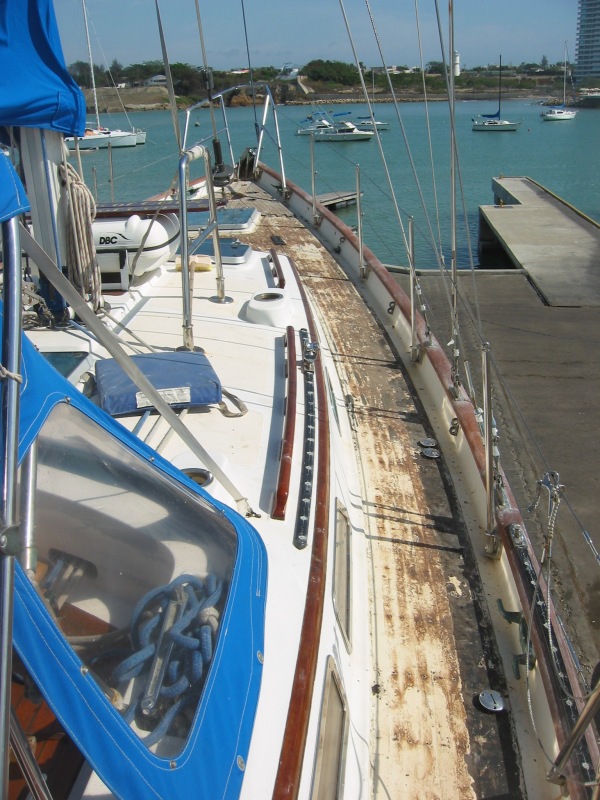
We were ''on the hard” in La Libertad, Ecuador in February 2004, removing our teak decks. We made a passage to the Galapagos and Easter Island after we splashed, but managed to break enough stuff en route to warrant another haul-out and major rework in LaLibertad. In February 2005 … we were once again on the hard.

puerto lucia yc lalibertad

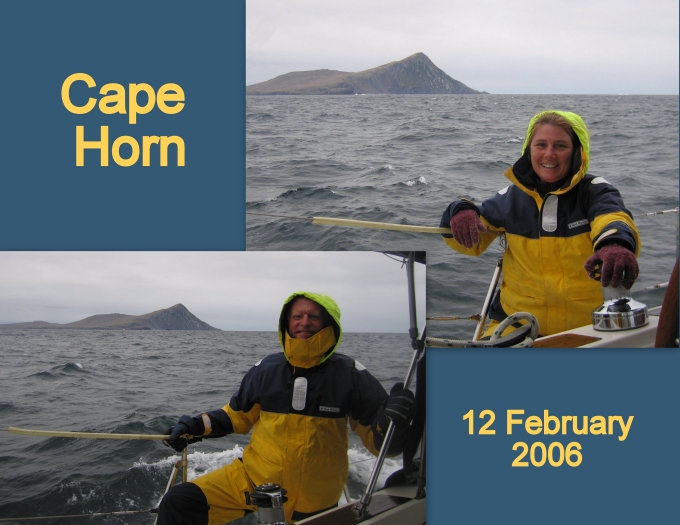
We finally broke Ecuador's magnetic hold on us and headed south to Patagonia. It was just a little further! By February 2006, we were rounding Cape Horn, the first of the five great southern capes.

rounding cape horn

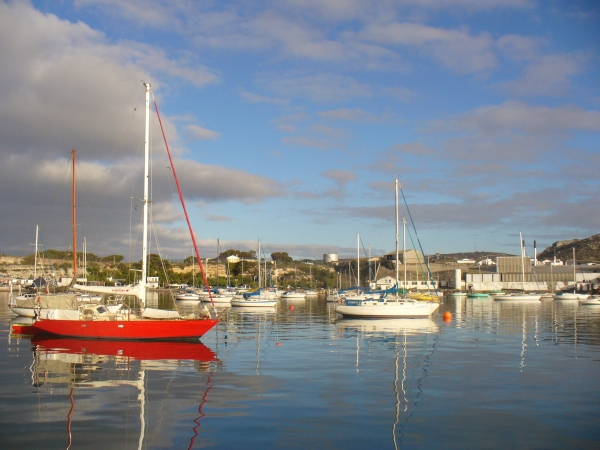
2006 was a busy year and we put lots of miles under the keel, including an Atlantic crossing to South Africa. In February 2007, we were just departing Cape Town for our second Atlantic crossing. Jib furler problems had us moored up the coast in lovely Saldanha Bay, South Africa for a few days making repairs.

saldanha bay south africa

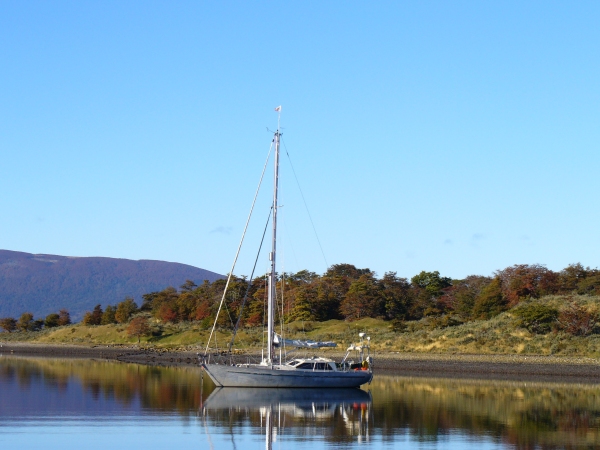
Plans always change and instead of crossing the Pacific, we found ourselves back in Ushuaia, Argentina in February 2008. A good friend had fallen ill and asked us to move his boat from Ushuaia to Uruguay and decommission her. We were happy to oblige.

bahia relegada tierra del fuego

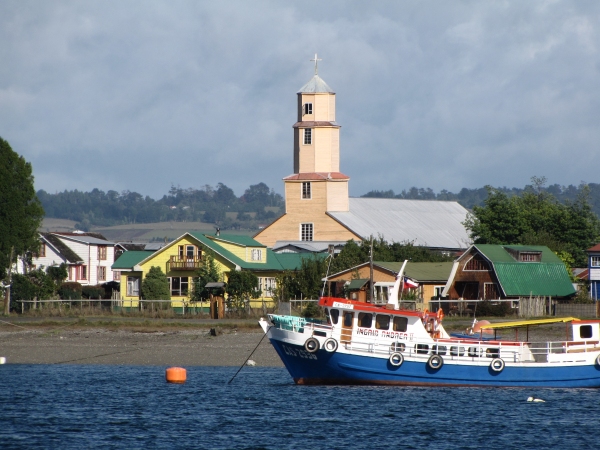
Nine of Cups was back in the Pacific by mid-2008, but it was too late for a Pacific crossing. We headed south back to Chile and spent February 2009 exploring Chile's largest island, Chiloé, and all its nearby islands.

estero pindo chile

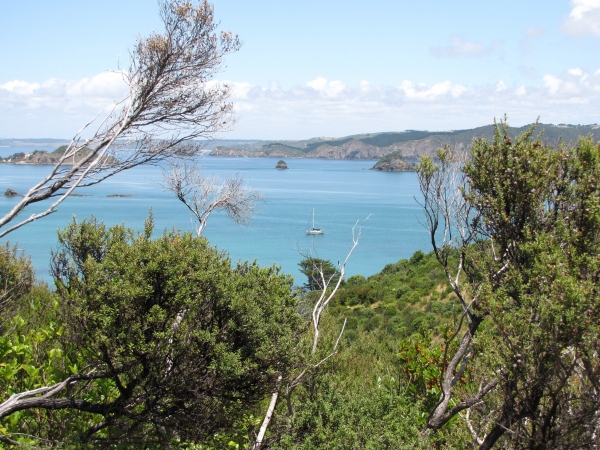
Finally, we completed the long awaited Pacific crossing and by February 2010, we were enjoying New Zealand's Northland coast and the Cavalli Islands.

cavalli islands in new zealand

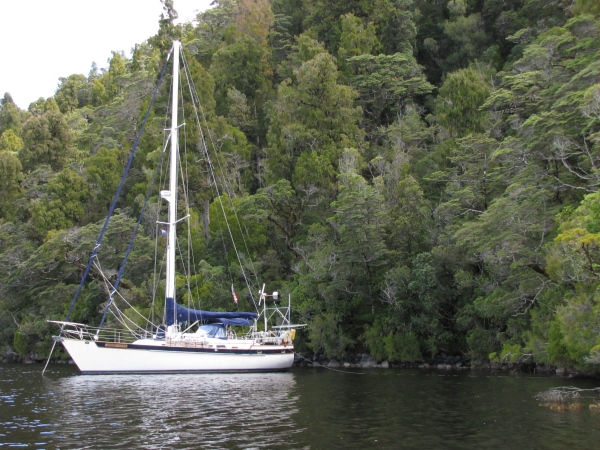
New Zealand has amazing cruising grounds. We decided a circumnavigation was the only way to see as much of the country as possible. In February 2011, we were anchored in the southern most fjord of Fiordland National Park on the South Island, preparing for a blow.

preservation inlet in new zealand

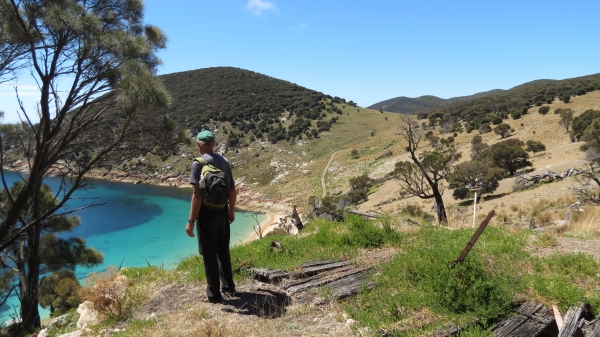
On to Australia and the magic of Deal Island in the middle of Bass Strait separating mainland Australia from Tasmania. This was our first visit to Deal, but not our last.

deal island tasmania australia

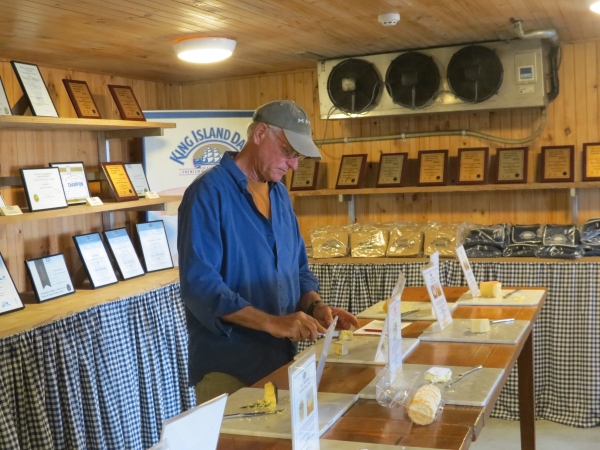
We circumnavigated Tasmania during 2012 and returned to Deal Island once again in early 2013. This time, we continued west to King Island in the Bass Strait, en route once again to the Australia mainland.

king island australia

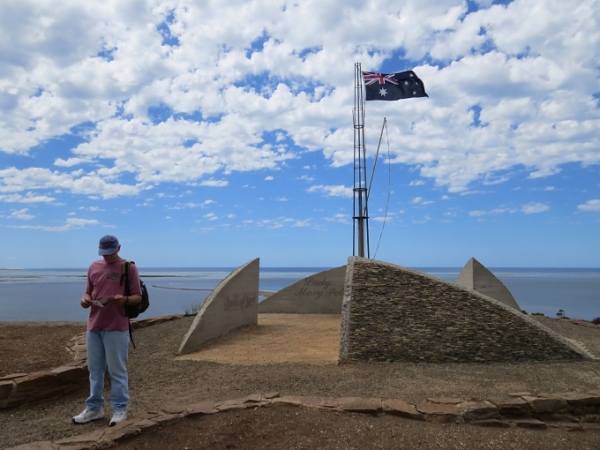
From Adelaide, Australia, we visited Kangaroo Island in February 2014, continuing west along Australia's southern coast.

flagstaff hill on kangaroo island australia

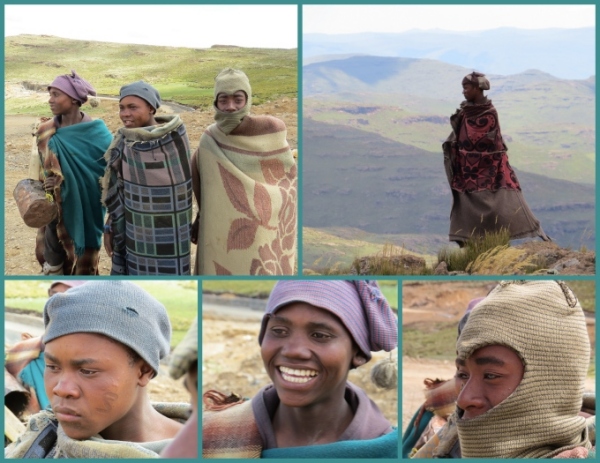
Long passages in 2014 across the Great Australian Bight and the Indian Ocean and by February 2015, we were in Durban, South Africa and inland traveling with our family.

sani pass in lesotho

Wow, we wonder how we managed 86,000nm, but when we look at the itinerary over the years, it's not that surprising at all. We're thinking we should do it all over again.