

Life in the Mojave Desert
/
Life in the Mojave Desert: The Art of Living with Less Water
The Mojave Desert isn’t just dry—it’s the driest desert in the United States, receiving an average of only 4.2 inches of rainfall in a typical year. What falls on our yard in a year is about what we consume in two months, and if we were careful, we might have enough left over to wash Blanche (which, in Southern Nevada, we’re not supposed to be doing anyway). And it’s getting drier: the desert southwest has been experiencing a drought since 2000, which is the most severe, long-term drought since 800 CE. The longest period without measurable rainfall in Las Vegas was 240 days, set just a few years ago in 2020. A very close second occurred last year, with a 214-day dry streak ending on February 13, 2025.
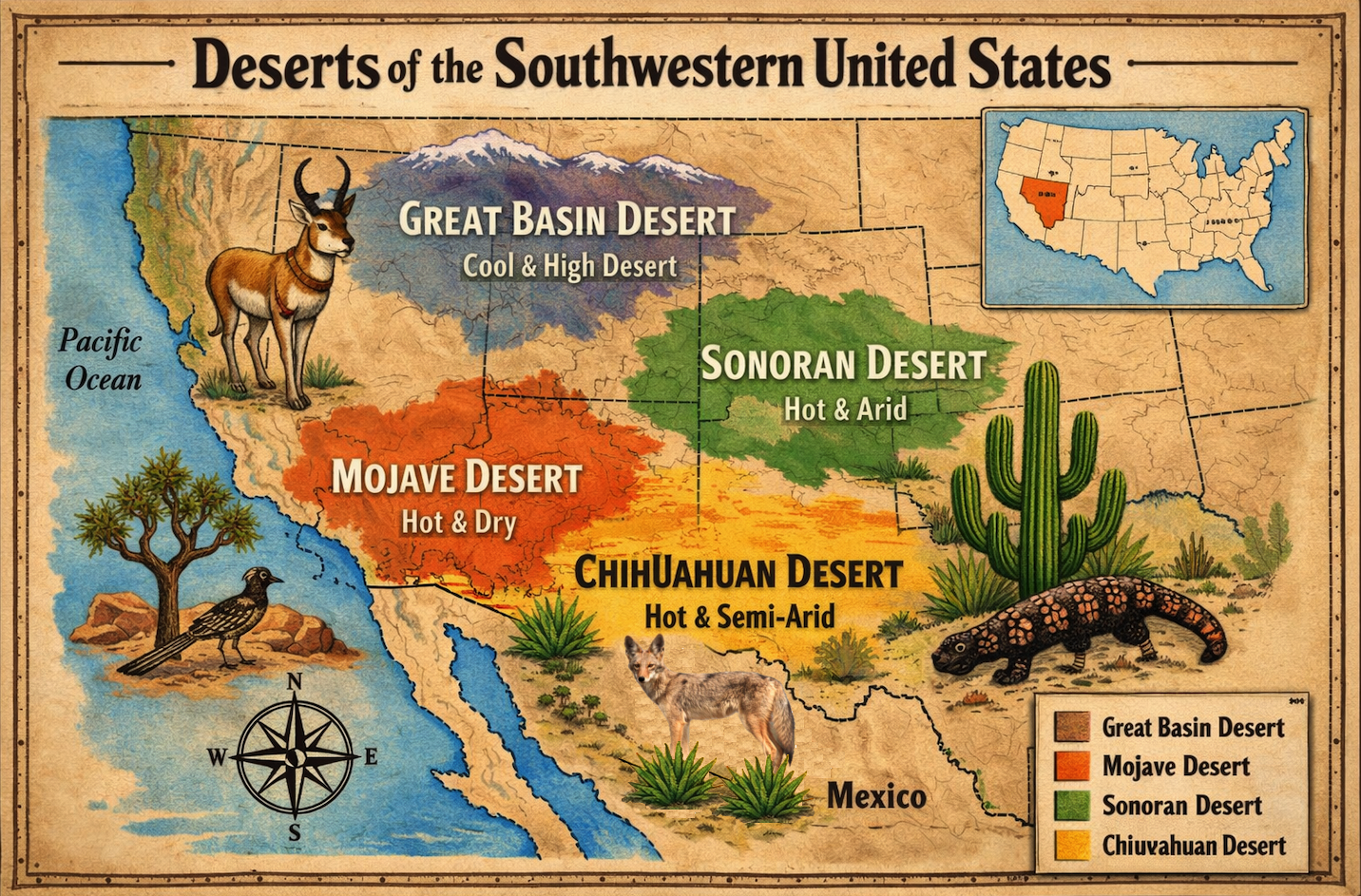
Map of the Deserts of the Southwest
A Desert Defined by Absence
What makes the Mojave especially dry isn’t just bad luck—it’s geography. Mountain ranges like the Sierra Nevada block moisture from the Pacific, creating a “rain shadow” that leaves Nevada parched. Rivers are scarce, lakes are often dry, and even the few waterways that exist tend to disappear underground. It’s a landscape where water shows up briefly… and then vanishes like a magician’s assistant.
And yet, right in the middle of all this dryness sits a city of more than two million people: Las Vegas.
Las Vegas: A City That Learned to Drink Responsibly
At first glance, Las Vegas seems like an unlikely success story. A neon oasis in one of the driest places in North America? Bold move. But here’s the twist: Southern Nevada has quietly become one of the most aggressive water conservation success stories in the country.
About 90% of the region’s water comes from the overworked Colorado River, primarily via Lake Mead, which has dropped roughly 160 feet since 2000. That kind of statistic tends to get a city’s attention.
And it did.
Since the early 2000s, the region has:
Reduced per-person water use by about 58%, even as the population grew by nearly 900,000 people.
Banned or limited non-essential water uses, like decorative grass and certain fountains.
Imposed strict watering schedules and penalties for waste.
Homeowners have even been nudged—sometimes enthusiastically—into ditching their thirsty green lawns in favor of desert-friendly landscaping, and these days, it’s practically a point of pride. The Southern Nevada Water Authority sweetens the deal by offering about $7.00 per square foot to swap out grass for xeriscaping, turning conservation into a surprisingly economical, if not profitable, home improvement project. As a result, lawns have given way to rock and native plants, drip irrigation has quietly replaced sprinklers, and people know exactly which day (and minute) they’re allowed to water without getting a polite-but-firm notice. And perhaps most tellingly, the idea of a lush green lawn starts to feel not just impractical, but a little absurd—like wearing a wool coat to the beach.
The Heat Is Turning Up—Literally
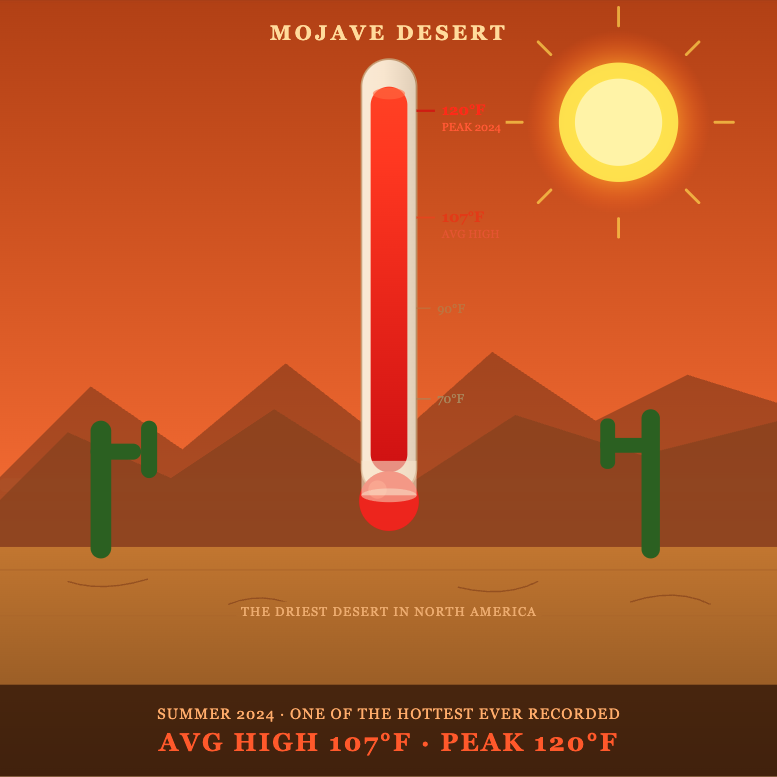
As if being the driest desert weren’t enough, the Mojave has recently decided to double down with some truly aggressive heat. Southern Nevada has been experiencing record-breaking temperatures, including:
One of the hottest summers ever recorded in 2024, with average highs over 107°F and a peak of 120°F.
This year is starting off even hotter with an unusually intense early-season heat wave, with temperatures 20–30°F above normal.
March temperatures pushed into the high 90s—numbers that normally don’t show up until summer, and making it the hottest March on record.
In other words, spring showed up, looked around, and said, “Nah, let’s just skip to July.”
These heat waves aren’t just uncomfortable—they’re dangerous. Thousands of heat-related emergency room visits are recorded during extreme summers, and hundreds die each year in southern Nevada from the heat. In fact, in 2024, there were 527 confirmed heat-related deaths here, underscoring how closely water, temperature, and human health are tied together in the desert.
Living in the Driest Place—On Purpose
What’s remarkable isn’t that the Mojave Desert is dry and hot—it’s that people have figured out how to live here anyway, and not just barely, but with a surprising level of comfort and ingenuity. Cities like Las Vegas are proving that growth doesn’t have to mean waste, and that even in the harshest environments, adaptation isn’t just possible—it can be downright impressive.
Water conservation is key, of course, but just as important is air conditioning - the hero of desert civilization. In most places, A/C is a convenience; in Southern Nevada, it’s more like critical infrastructure. Life shifts around it. In the mid-day summer heat, we don’t dawdle walking across the parking lot from the car to the grocery, and a windshield sun screen is as essential as an ice scraper is in Minnesota in the winter. We know that a broken air conditioner in July is less an inconvenience and more a full-blown emergency. Entire buildings are designed to keep the heat out—reflective materials, tinted windows, better insulation—all working together to give that A/C system a fighting chance.
Over time, people adapt in smaller ways, too. Mornings start earlier to beat the heat. Outdoor activities migrate to dawn or dusk. “It’s only 100 degrees” becomes a perfectly reasonable sentence.
What’s perhaps even more remarkable, however, is that we actually like living here. As brutal as the summer heat can be, the late fall, winter, and early spring are dry and sunny, with warm days and cool evenings. Rarely does the temperature drop below freezing anymore - perfect for all those outdoor activities we love - walking, biking, and camping. We cook more dinners outside on the grill than inside on the stove. And enduring a Mojave summer is not unlike coping with a New England winter - there’s a combination of resignation, frisson, and camaraderie as we commiserate with fellow desert rats about surviving another 117°day.
In the end, desert living is a kind of quiet partnership with the environment. You don’t conquer the Mojave—you negotiate with it. And if you’re willing to adjust your habits, respect the limits, and embrace a slightly different definition of comfort, it turns out you can build a pretty thriving life in a place that, at first glance, seems determined to keep you out.
Still, the margin for error is thin. The combination of long-term drought, shrinking water supplies, and rising temperatures means the Mojave isn’t getting any more forgiving.
It’s a place that demands respect—and maybe shorter showers.